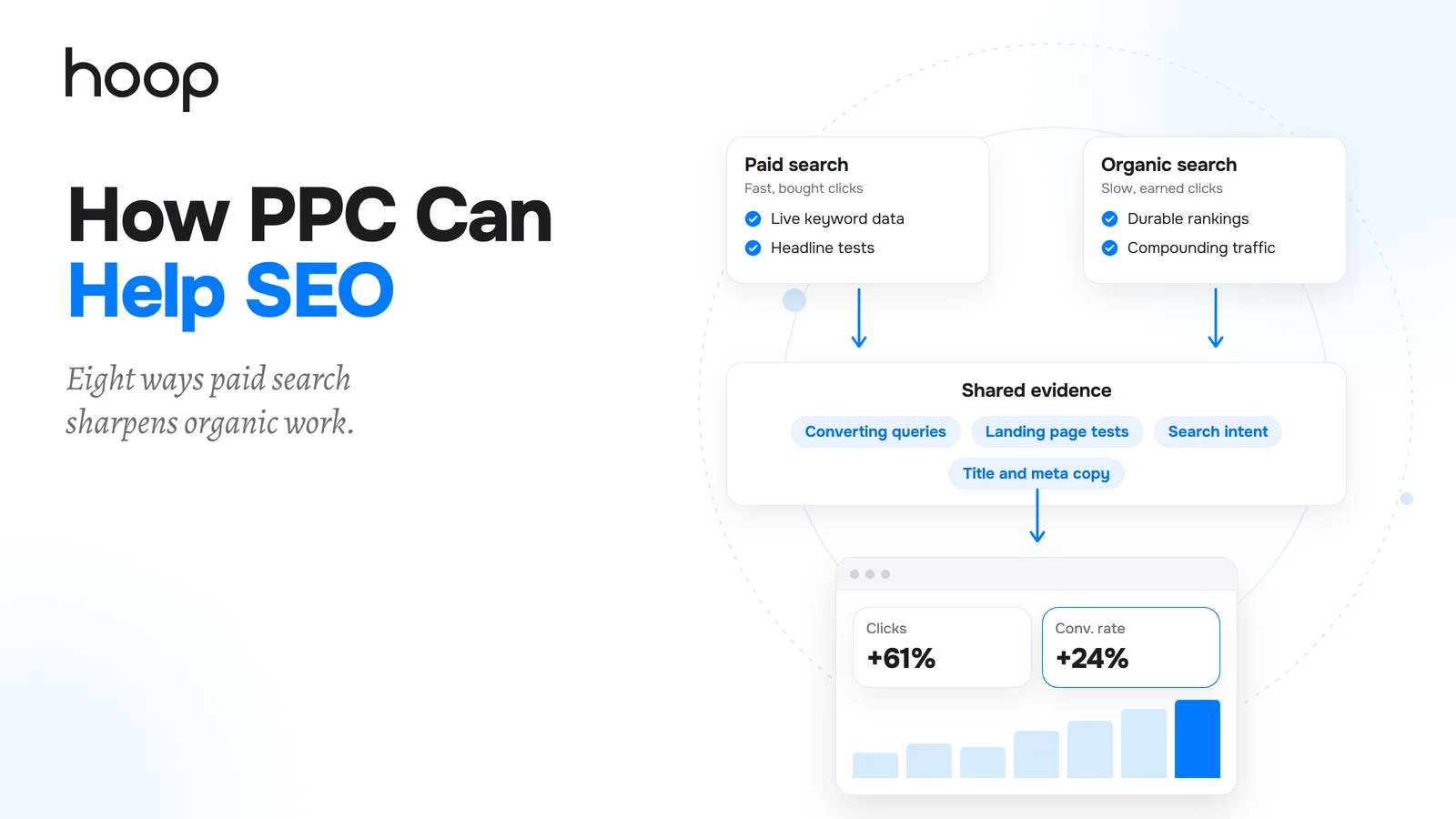
How PPC Can Help SEO: 8 Ways Paid Search Improves Organic Strategy
Ads buy placement, never rank. What PPC really gives SEO is evidence: the queries people actually type, the promises that earn qualified clicks, and the pages where buyers drop out.
Ibrahim
Content Writer
PPC can help SEO by revealing real search queries, testing messages, and showing which landing pages attract valuable customers. Paid advertising does not directly improve Google organic rankings, but campaign evidence can guide smarter SEO decisions.
The strongest benefit is reduced guesswork. You can observe what people search, which promises attract qualified clicks, and which offers produce meaningful actions. Then you can use those findings to prioritize useful organic pages. A paid campaign does not guarantee that an SEO page will rank or convert in the same way.
Need this done right?
Want a team to handle it? Our SEO services take this from plan to results.
Explore our SEO servicesDoes PPC Directly Improve SEO Rankings?
No. Google keeps advertising systems separate from organic Search ranking. Buying more ads, raising bids, or generating more paid clicks does not purchase higher organic positions. Google states that advertising does not affect inclusion or ranking in its organic results.
Search engine optimization (SEO) improves a site’s eligibility, relevance, usability, and visibility in unpaid results. Pay-per-click (PPC) advertising purchases opportunities (see PPC) to show sponsored placements. The channels can share research and website improvements, but their placement systems remain independent.
What can PPC actually change?
PPC can bring visitors to a page quickly and supply useful observations about search intent, offers, and user behavior. Your SEO team can then update page structure, answer neglected questions, and clarify conversion paths. Organic improvements require their own evaluation through Search Console and business outcomes.
Why do some businesses think ads improve rankings?
A company might launch ads while publishing new content, fixing technical issues, and earning links. Organic visibility can rise during the same period. That overlap does not prove the ads caused the ranking change. Compare dates, page changes, search demand, and organic performance before making a causal claim.
How Can PPC Help SEO Through Keyword Research?
To use PPC for SEO keyword research, review actual paid search queries and group relevant terms by the problems buyers want solved. Google Ads Search Terms reporting shows queries that triggered ads, subject to reporting thresholds and privacy protections.
Find real queries instead of guessing
Start with the Search terms report in Google Ads. Export available queries, clicks, conversions, costs, and relevant conversion values. Distinguish the exact search term from the target keyword in your campaign. One broad keyword can match multiple requests with very different intent.
For example, a CRM agency could see “CRM setup for small law firms,” “free CRM template,” and “CRM migration consultant.” The 3 queries indicate different needs. The first suggests an industry-specific service page, the second an informational template, and the third a migration service page.
Separate buyer intent from research intent
Classify queries as informational, commercial investigation, or transactional. A product explanation needs a different page from a quote request. Review both the search wording and what the customer actually did. A click without a meaningful action does not establish purchase intent.
Respect search-term reporting limits
Google does not reveal every individual query in its reports. Lower-volume queries can appear only as aggregated themes or remain unavailable. Search Terms Insights groups related searches, but grouped categories are not a complete transcript of buyer behavior. Use Google Search Console and customer research alongside paid reports.
How Can PPC Validate SEO Content Before You Publish?
To validate SEO topics with PPC, run a tightly scoped campaign for a relevant buyer problem and review qualified actions. A paid test can reveal whether the message interests a selected audience before you commit substantial content resources.
Test a narrow service topic
Suppose a B2B software company is deciding between 2 guides: “inventory dashboard setup” and “custom stock management software.” The team can test targeted campaigns with appropriate landing pages and compare qualified inquiries. More clicks alone should not decide the SEO roadmap.
A page with 15 clicks and 2 qualified consultations can deserve attention over a page with 150 visits and no useful action. Both samples remain small, so review confidence and sales quality before making a large investment.
Turn winning queries into page clusters
Group queries by shared intent rather than publishing one page per wording variation. A topic cluster might include a core “CRM implementation” service page, a migration checklist, and an industry-specific requirements guide. Connect related articles through relevant internal links to help visitors navigate the subject.
Do not assume that a paid landing page should become an exact organic copy. Organic visitors may expect deeper explanations, pricing context, author information, or useful examples before contacting sales.
How Can Ad Tests Improve Organic Page Messaging?
To improve organic messaging with PPC, test distinct ad headlines, descriptions, and offers, then carry supported lessons into title tags and page introductions. Advertising tests provide directional language insights, not guaranteed organic click-through improvements.
Identify the promise that earns qualified interest
Compare messages about cost, speed, service specialization, and process clarity. For an accounting firm, “fixed-price monthly bookkeeping” attracts a different motivation from “bookkeeping for growing ecommerce shops.” Assess each message against qualified leads, not just click-through rate (CTR).
Translate ad copy into helpful SEO titles
Use successful messages to sharpen a page title and opening paragraph. Keep title tags descriptive and faithful to the page. Avoid promising instant results, guaranteed rankings, or services your business does not provide. Google can rewrite displayed title links, so monitor actual organic search performance.
A headline winner in a paid auction is not automatically an organic winner. Ad placement, audience, visible competitors, and surrounding snippets differ. Treat creative results as ideas to test on organic pages, not ranking rules.
How Can PPC Landing Page Data Support SEO?
To use landing-page evidence for SEO, review where paid visitors complete tasks, abandon forms, or struggle to understand an offer. Fix shared usability issues that affect both paid and organic visitors.
Improve relevance before increasing traffic
Map each important query to a relevant page. A visitor searching “Shopify migration support” should see service details, typical deliverables, and a clear next step. A general homepage often leaves the visitor with unanswered questions. Review clarity, mobile layout, and form completion first.
Test forms and calls to action
Measure completed consultations, qualified submissions, purchases, and phone inquiries. Test whether a long form discourages suitable buyers. Compare a short “Request an Audit” form with a detailed intake form using similar traffic and a clearly defined conversion event.
Paid visitors and organic visitors can behave differently. Check channel-level results in Google Analytics 4 (GA4) before assuming that a conversion change applies equally to both groups. Keep consent choices, accessibility, and site speed in scope.
How Should You Combine PPC and SEO Reporting?
To combine PPC and SEO reporting, keep the channels separate in raw data and compare them using shared business outcomes. Use Google Ads for paid performance, Google Search Console for organic search visibility, and GA4 or CRM records for downstream conversions.
Track the metrics that answer different questions
Paid reports show impressions, cost per click, cost per acquisition, conversions, and return on advertising spend. Organic reports show search impressions, clicks, queries, and average position. CRM records show qualified leads, opportunities, and revenue. No single dashboard can replace the distinctions.
Use a paid-and-organic decision table
The following example is a planning worksheet, not a performance benchmark. It translates channel observations into possible next steps.
| Observation | Review | Action | Difficulty |
|---|---|---|---|
| Converting paid query; weak organic page | High | Improve or create focused SEO page | Medium |
| Strong organic page; expensive paid clicks | Weekly | Test budget allocation cautiously | Medium |
| High PPC clicks; no qualified leads | Weekly | Recheck intent and landing offer | Low |
| Both channels convert for one topic | Monthly | Keep both, monitor incremental value | Medium |
| Paid keyword has little usable data | Monthly | Collect more evidence before scaling | Low |
Avoid double-counting shared customers
A customer might click a paid ad, return through an organic result, and later request a proposal. Different attribution models can give different credit. Keep source definitions consistent and report both channel contributions and total business outcomes. Do not add separately attributed revenue figures as if each represents unique sales.
How Can Small Businesses Use PPC Research on a Limited Budget?
To use paid-search evidence on a limited budget, focus on one service, one market, and one measurable conversion. Test only where you can afford useful learning without harming normal business operations.
Start with existing campaign data
You do not need new spending if an account already contains usable search term and conversion history. Review 30 to 90 days of available data, then validate terms against current services and organic rankings. Look for neglected pages where real buyers already show interest.
Choose a focused test before expanding
For a local cleaning company, test a narrow group of service-related queries within its actual operating area. Measure quote requests and booked jobs, not raw traffic. Budget requirements vary with local click prices and competition, so avoid treating one daily spend figure as universally sufficient. Our guide to Google Ads costs works through those numbers.
When paid testing is too expensive, use existing Search Console data, sales call questions (see an SEO audit), customer interviews, and keyword research. Paid testing helps only when the resulting evidence is worth its cost.
Use both teams without duplicating work
Give one person responsibility for collecting search terms and another for deciding content priorities. Share keyword intent labels, landing-page changes, and conversion definitions. A short monthly review is more useful than separate reports that never inform actual decisions. Our Scrap Cars 4 Cash case study runs paid search and SEO against one set of goals.
Our Google Ads management services connect campaign search terms, tracking, and qualified outcomes to ongoing optimization.
What Mistakes Should You Avoid When Combining PPC and SEO?
The main mistakes are treating paid impressions as ranking signals, optimizing for clicks without buyer quality, and publishing duplicate pages for every paid query. Keep channel differences visible in every decision.
Do not confuse correlation with a ranking benefit
Higher paid traffic and improved organic positions can happen together because both campaigns respond to stronger demand. Look for independent SEO changes, competitor shifts, seasonality, and indexing updates. Do not claim that paid clicks caused a ranking lift without defensible evidence.
Do not build SEO pages around every ad keyword
Ad accounts contain broad matches, irrelevant searches, and terms with low conversion evidence. Group meaningful queries into clear topics. Publish pages that genuinely help visitors, avoid thin keyword variations, and match search intent before placing a page on the content calendar.
Do not stop a profitable campaign just because SEO ranks
A strong organic position does not prove that removing ads will preserve total customers. Ads and organic listings can reach different buyers. Test budget changes carefully and measure combined qualified leads and revenue, rather than relying only on rank or last-click attribution.
For a long-term organic foundation, our SEO services address technical health, relevant content, and organic measurement separately from paid bidding.
How Can You Build a Repeatable PPC-to-SEO Workflow?
To build a repeatable PPC-to-SEO workflow, move one small set of verified insights from advertising reports into an SEO action log every month. Assign an owner, a decision, and a review date to each insight. This prevents useful research from disappearing after a campaign meeting.
Create one shared keyword evaluation sheet
Record the search query, paid clicks, qualified conversions, cost, associated landing page, organic impressions, and existing organic URL. Add a final column naming the proposed action: create a page, improve a page, consolidate content, or take no action. Your team should also record why the action makes sense.
For example, consider an illustrative query with 80 paid clicks, 4 quote requests, and 2 qualified opportunities. The landing page already addresses part of the question, but organic search traffic is minimal. A targeted update to that service page is a reasonable test. The numbers alone cannot guarantee ranking growth.
Prioritize by customer value and content gaps
Use 3 checks before approving a new SEO page. First, confirm that the query matches a service you actually deliver. Second, inspect the existing search results to identify the format searchers expect. Third, check whether an existing page already answers the same need. A new article should add useful information instead of competing with your established pages.
Review results on a consistent schedule
Check implementation progress after publication and monitor organic trends across comparable periods. Review Search Console query impressions, qualified website actions, and pages receiving new organic visits. Note search seasonality and other website changes. Ranking improvements can take time, and early fluctuations do not establish the final value of a page.
A useful review meeting ends with one concrete decision, such as updating a pricing FAQ or improving an existing industry service page. Avoid changing 10 unrelated variables before understanding which improvement helped customers.
Use PPC Evidence to Make Better SEO Decisions
PPC can help SEO by showing which searches attract interested people, which messages connect with buyers, and where landing pages lose valuable inquiries. The paid campaign itself does not improve organic rankings. The benefit comes from turning reliable findings into useful pages, clearer offers, and stronger measurement.
Start with one shared search-term report and one content decision. Review the outcome before expanding. If your business needs a focused organic roadmap alongside paid acquisition, our small business SEO support can help prioritize improvements around your budget and customer goals.
“A page with 15 clicks and 2 qualified consultations can deserve attention over a page with 150 visits and no useful action.”
Key takeaways
- 01Google states advertising does not affect organic inclusion or ranking.
- 02Search terms reports are partial — low-volume queries are withheld or grouped.
- 03Validate a content topic with a narrow campaign before committing writing budget.
- 04Keep paid and organic data separate, then compare them on qualified leads and revenue.
Written by
Ibrahim
Content Writer
Frequently Asked
Questions
Everything you need to know before booking a strategy call. Can't find your answer? Contact us directly.

Ask hoop
Usually replies in minutes
Does paying for Google Ads help SEO rankings?
No. Google states that advertising does not directly change organic ranking or inclusion. PPC data can still inform keyword and content decisions.
PEOPLE ALSO ASK
Swipe for 4 more questions →
Can't find your answer? Contact us directly.
Keep reading
All articles
How to Analyze PPC Competitor Ads and Find Better Opportunities
Nov 23, 2026 · 10 min read
Are Google Ads Worth It? How to Know Before You Spend
Sep 28, 2026 · 10 min read