How Much Are Google Ads? Costs, Budgets, and Real Examples
There is no fixed price. You set a budget, Google charges per click, and a 2026 US benchmark put the average search click at $5.42. What matters is whether a click can pay for itself.
Maimoona
Content Writer
How much are Google Ads? You choose your advertising budget, and Google charges based on actions such as clicks or conversions. For US search campaigns, a 2026 industry study reported $5.42 average cost per click. Your actual bill depends on keywords, location, competition, and campaign setup.
A small business can test with a modest budget, but a low daily amount does not guarantee enough traffic to judge sales. Separate Google advertising spend from agency fees, landing page work, and tracking costs before deciding what you can afford.
Need this done right?
Want a team to handle it? Our Google Ads management services take this from plan to results.
Explore our Google Ads management servicesHow Much Are Google Ads Per Month?
Google Ads has no required universal monthly subscription price for standard self-managed advertising. You set a campaign budget and pay for delivery within its applicable billing rules. A $10 average daily budget corresponds to a typical $304 monthly spending limit for one unchanged campaign.
Published US small-business planning estimates often begin near $1,000 to $2,500 per month for advertising, but businesses spend below and above that range. The right amount depends on likely click prices, expected conversions, and what a customer is worth.
What does a $5, $20, or $50 daily budget buy?
At an illustrative $5 CPC, $5 per day buys roughly 1 click, $20 buys 4, and $50 buys 10. Real prices change auction by auction. These examples estimate traffic, not leads or sales. A $5 daily test can reveal which searches trigger clicks without proving customer demand.
| Average daily budget | Approx. 30.4-day cap | Clicks at $5 CPC |
|---|---|---|
| $5 | $152 | 30 |
| $10 | $304 | 61 |
| $20 | $608 | 122 |
| $50 | $1,520 | 304 |
| $100 | $3,040 | 608 |
Do you pay Google for every impression?
Google Search campaigns commonly use cost-per-click pricing, where clicks create charges. Other campaign goals can use conversion-focused bidding or impression-based models. Check the bidding strategy and billing basis inside each campaign rather than assuming every Google ad works the same way.
How Much Does One Google Ads Click Cost?
Google Ads click prices depend on demand for a query, competing advertisers, ad relevance, landing page experience, and auction conditions. WordStream and LocaliQ reported an overall US search CPC of $5.42 in their 2026 benchmark dataset. That sample average is not a quoted Google price.
The same study reported an 8.18% conversion rate and $66.69 cost per lead across its measured US campaigns. Those measures are cross-industry reference points. Individual advertisers can perform much better or worse, and a reported conversion may not equal a paying customer.
Why are legal and home-service clicks expensive?
An attorney can earn substantial revenue from one new client, so competing firms may bid aggressively. Emergency repairs also attract people with urgent buying needs. Pricing reflects expected commercial value and advertiser competition, not simply the popularity of a topic.
Why are some cheap clicks a poor deal?
A $1 click from an unrelated search wastes money if the visitor cannot buy your service. A $12 click from someone requesting a detailed quotation can be worth more. Calculate acquisition cost and margin before treating cheaper clicks as better performance. Our guide to a good CPC for Google Ads works through the break-even maths.
What Determines the Total Cost of Google Advertising?
Keyword competition and buyer intent
Specific searches such as “book commercial roof inspection” often signal a clearer purchase need than “roof information.” Research queries may support education, but direct-response campaigns need terms connected to your offer. Use search-term reports to spot mismatches.
Location, schedule, and audience
A nationwide campaign reaches a larger market than a campaign targeting one service area. Search demand and competition differ by city, hour, and device. Restrict locations to markets your business actually serves, then evaluate performance by segment.
Ad quality and landing page relevance
Google considers ad quality and expected usefulness alongside bids. Your ad should match the search and point to a useful page. Poor mobile forms, vague offers, and slow pages can increase the effective cost of acquiring customers even when CPC stays stable.
Tracking and campaign management
Conversion tracking helps you distinguish a real lead from a casual visit. Set up measurement for submitted forms, qualified calls, bookings, and purchases. An agency or consultant may charge setup or monthly fees separately from the amount Google bills for media.
How Much Should a Small Business Spend on Google Ads?
To choose a starting budget, estimate your average CPC, the number of clicks required for a useful test, and the maximum acquisition cost your business can support. Start with one service and one location before spreading the same funds across many campaigns.
Step 1: Estimate search traffic costs
Check Google Keyword Planner forecasts for your target market. Use a plausible CPC range, not a single optimistic estimate. For example, 100 clicks at $4 cost $400, while 100 clicks at $10 cost $1,000.
Step 2: Calculate your allowable cost per customer
Start with contribution margin, not top-line revenue. Suppose one customer produces $600 of contribution margin before advertising. A business might set an initial allowable acquisition cost of $150 to preserve room for operating costs and profit. Your target depends on retention and sales economics.
Step 3: Set a test period and decision rules
Define a test budget you can afford to lose while learning. Decide which signals matter: relevant search terms, qualified leads, booked meetings, and purchases. Do not judge a campaign after 8 clicks or call it successful because impressions increased.
Is $5 a Day Enough for Google Ads?
A $5 daily budget is enough to run a narrow experiment, but not always enough to evaluate conversions. At $5 per click, the campaign may attract about 30 clicks over a typical billing month. A small sample cannot reliably settle whether your product will sell.
For an early-stage SaaS company, first confirm that people understand the product and complete activation. Paid clicks can test search intent, while customer interviews explain objections. Keep paid experimentation small until signup and retention data support further spending.
When does a tiny budget make sense?
Use a small budget for a tightly targeted local service or a narrow SaaS query set with affordable CPC. Measure search relevance and landing page engagement. Avoid interpreting a few visitors without purchases as proof that Google Ads never works.
When should you delay advertising?
Delay expansion if your website lacks a clear offer, mobile forms fail, or conversion events are not recorded. Fix the buying journey first. Buying more traffic cannot repair a broken booking form or a product that visitors do not understand.
Is a Five-Day Google Ads Test Worth Running?
A five-day campaign can check delivery, query relevance, tracking, and obvious landing page problems. A five-day sample rarely proves long-term profitability for businesses with small budgets or extended sales cycles. Consider weekly variation and low conversion counts before making decisions.
At $10 per day, a five-day test has a nominal $50 budget allocation. If CPC averages $5, that represents approximately 10 clicks. Even a well-designed campaign cannot establish a reliable sales conversion rate from only 10 visits.
What should you check during the first week?
- Check that tracking records real conversions without duplicate events.
- Check search terms for unrelated queries and add relevant negative keywords.
- Check whether your ad matches the landing page and stated offer.
- Check mobile form completion and calls from eligible locations.
How Much Do Google Ads Management Services Cost?
Google media spend and professional management charges are separate. Providers may charge a flat monthly fee, a percentage of ad spend, a hybrid model, or a one-time audit. Ask which work each fee includes and whether the advertiser owns the Google Ads account.
Professional work can include keyword research, campaign structure, conversion tracking, ad testing, negative-keyword reviews, landing page recommendations, and reporting. Complex ecommerce feeds or multi-location accounts require additional work. Do not assume an agency fee includes the advertising budget. Our Scrap Cars 4 Cash case study shows search ads, paid social and SEO managed together.
What should you ask before hiring an agency?
Request a written scope, management fee, platform budget, billing permissions, reporting cadence, and cancellation terms. Ask which outcomes determine success. A promise of guaranteed ranking, clicks, or revenue deserves skepticism because auction conditions and customer behavior vary.
Our Google Ads management services cover flat-fee, hybrid, audit-only, and full-funnel engagements. Review the exact deliverables and ask for a scoped proposal before assuming a fixed price.
How Do You Calculate Google Ads Costs and Returns?
Use simple calculations to connect spending with the sales process. Cost per click equals ad spend divided by clicks. Cost per lead equals ad spend divided by tracked leads. Customer acquisition cost equals all relevant acquisition expenses divided by newly acquired customers.
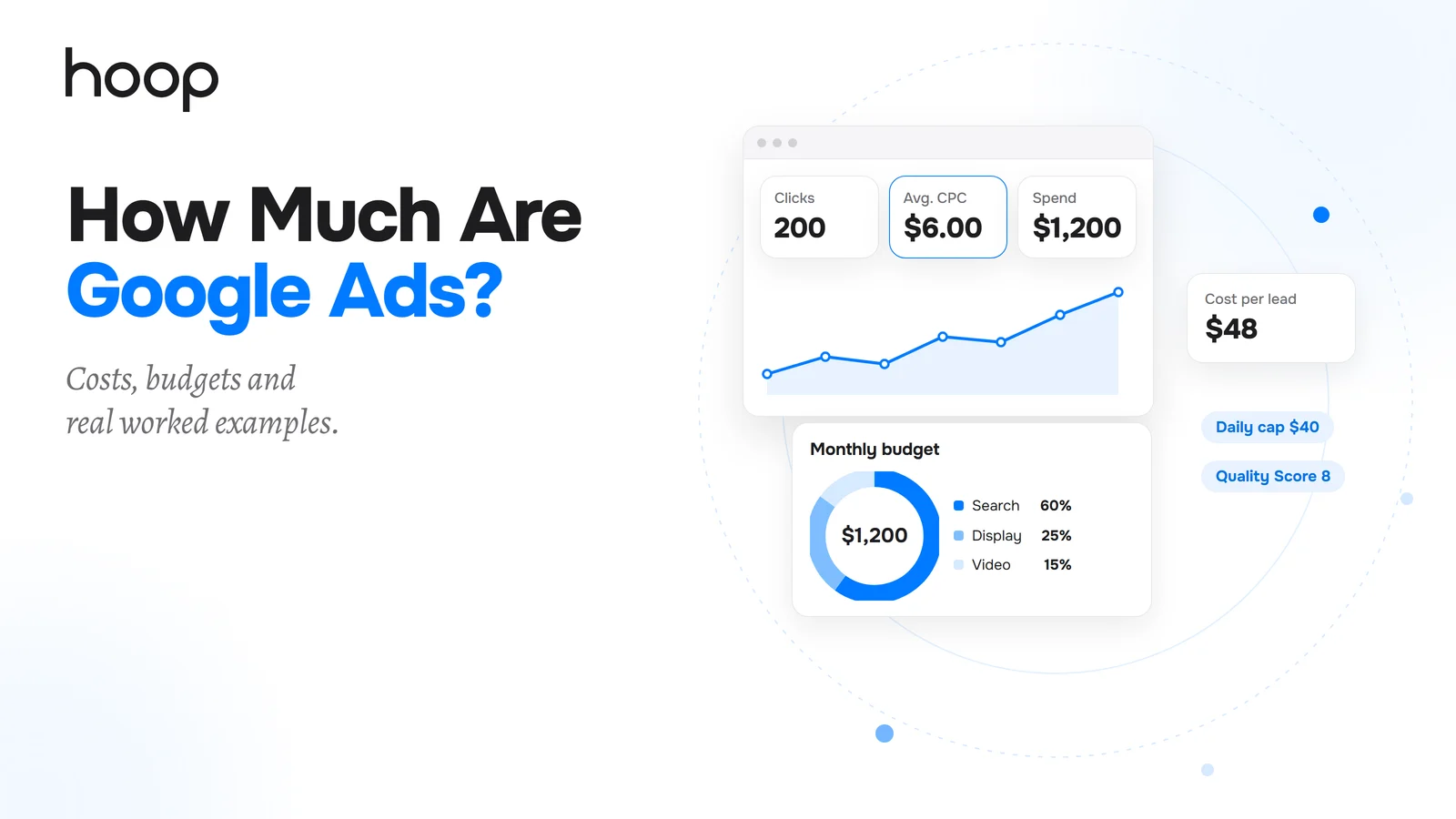
For example, spend $1,200 and receive 200 clicks. CPC equals $6. If 12 visitors submit legitimate inquiries, ad-only cost per lead is $100. If 3 become customers, ad-only acquisition cost is $400. Add agency fees and sales costs for a fuller figure.
Why does lead quality change the answer?
Ten form submissions do not automatically equal ten useful opportunities. Filter spam, students, out-of-area requests, and contacts seeking services you do not provide. Track qualified consultations and signed revenue to decide whether higher CPC is justified.
How should SaaS companies judge paid acquisition?
A SaaS company should connect paid signups with activation, subscription conversion, gross margin, and retention. A cheap free-trial signup can be expensive if almost nobody becomes a paying customer. Estimate payback using actual customer behavior rather than optimistic lifetime value.
How Can You Reduce Wasted Google Ads Spending?
Use negative keywords and narrow ad groups
Review search terms and exclude irrelevant interpretations of your offer. A CRM implementation provider may exclude searches for free classroom assignments or unrelated CRM definitions. Group terms by service and send visitors to the page that addresses their intent.
Improve forms, speed, and trust signals
A clear landing page should explain the service, show credible proof, and present one relevant call to action. Request only essential fields. Check mobile loading and whether every submission reaches your team. These improvements raise the value of existing clicks, which is the job of landing page optimization.
Review conversions instead of traffic alone
Monitor cost per qualified lead, meeting attendance, sales close rate, and profit. Pause irrelevant traffic before increasing budgets. Compare similar periods and account for seasonal differences. Better measurement helps you improve results without assuming spending more always helps.
Should You Use Google Ads or Organic Marketing?
Google Ads can put your offer in front of active searchers while a campaign runs. Search engine optimization builds unpaid search visibility over time (see pay-per-click advertising), but rankings are not guaranteed. A business can combine both channels when its budget and customer journey support them.
Prioritize paid search if urgent demand exists and you can measure leads. Prioritize website improvements and organic content if your offer needs explanation or acquisition economics remain uncertain. Your broader digital marketing strategy should account for both immediate conversion opportunities and long-term customer acquisition.
What Should Your First Google Ads Budget Plan Include?
A useful budget plan lists your media allowance, expected clicks, measurement setup, website readiness, and management responsibilities. The plan also states when you will review search terms and who can change budgets. This avoids a situation where an account spends money but nobody knows which results matter.
Create a monthly cost sheet
Write down four distinct figures: planned advertising spend, one-time setup charges, recurring management fees, and landing page or tracking costs. For example, a business might plan $900 for clicks, $300 for management, and $200 for a one-time tracking update. That first month totals $1,400, while a later month without the setup charge totals $1,200. These are examples, not service quotes.
Set rules for budget changes
Decide who approves increases and how much evidence the team needs. One week of high clicks does not automatically justify doubling spend. Inspect qualified lead volume, the price of each lead, and whether prospects become customers. If the landing page fails, improve the page before purchasing more visitors.
Keep your advertising account under your control
Create advertising accounts under your business identity and give contractors suitable access. Keep ownership of conversion data, audiences, billing records, and campaign history. Ask for a handover plan before starting an agency contract. Access to historical data helps you compare providers and makes future audits more accurate.
Choose a Google Ads Budget Based on Buyers, Not Guesswork
How much are Google Ads for your business? Start with relevant search demand, expected CPC, conversion quality, and allowable acquisition cost. Small campaigns can uncover useful signals, while larger budgets only make sense after measurement supports them.
For help with campaign planning, tracking, and cost control, talk to our Google Ads management team.
Sources: Google Ads Help (budget and spending limits); WordStream and LocaliQ 2026 PPC benchmarks; WordStream’s Google Ads cost guide. Reported averages describe US search advertiser samples, not universal Google prices.
“Buying more traffic cannot repair a broken booking form or a product that visitors do not understand.”
Key takeaways
- 01A $10 daily budget maps to roughly a $304 monthly cap, or about 61 clicks at $5 CPC.
- 02Ad spend and management fees are separate costs — confirm both in writing.
- 03A five-day, ten-click test checks plumbing, not profitability.
- 04Work back from contribution margin to an allowable cost per customer before setting a budget.
Written by
Maimoona
Content Writer
Frequently Asked
Questions
Everything you need to know before booking a strategy call. Can't find your answer? Contact us directly.

Ask hoop
Usually replies in minutes
Does Google Ads have a minimum monthly spend?
No universal minimum monthly budget applies to standard self-managed Google Ads campaigns. Your chosen budget must still support enough traffic to produce useful results.
PEOPLE ALSO ASK
Swipe for 4 more questions →
Can't find your answer? Contact us directly.
Keep reading
All articles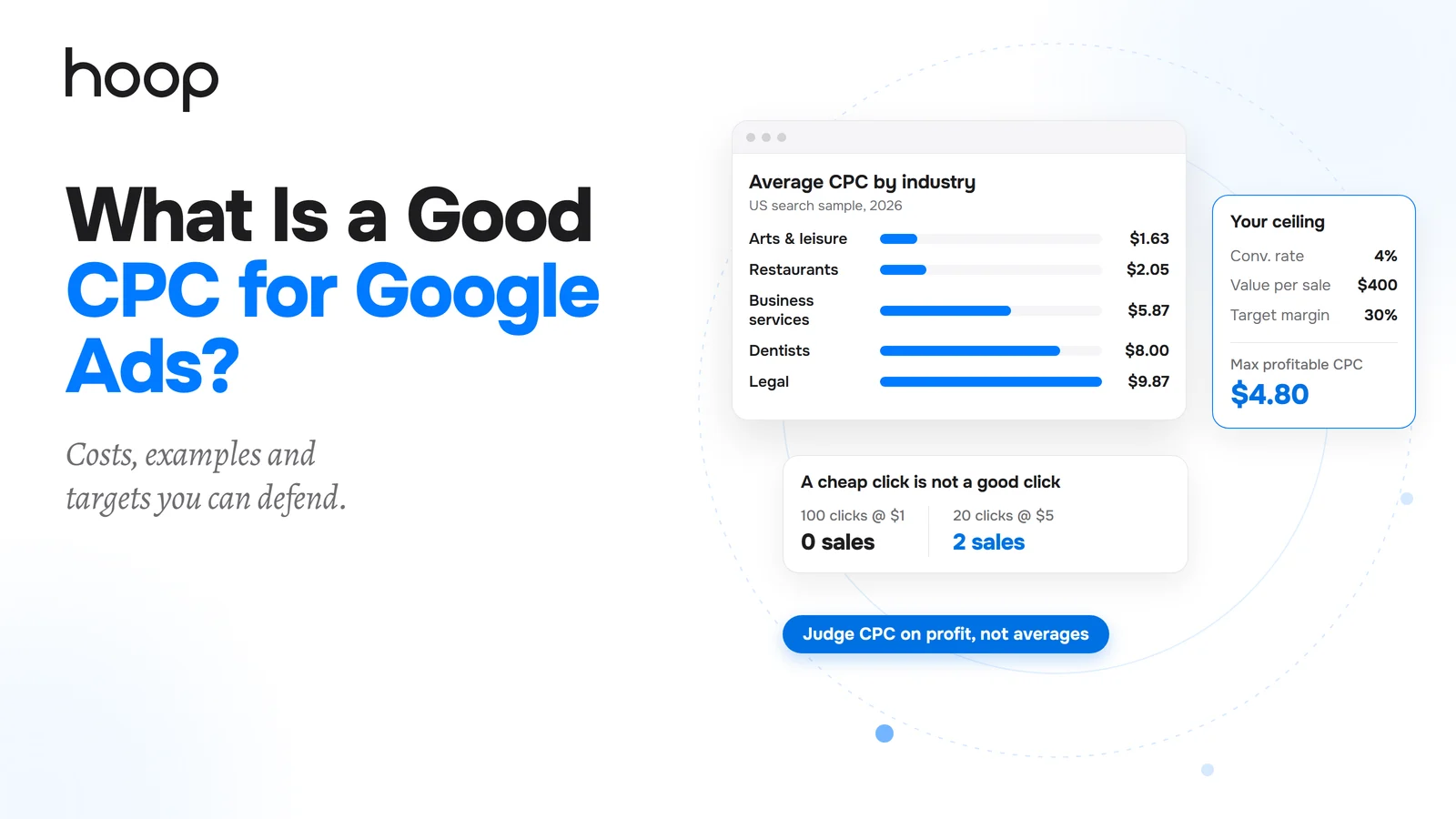
What Is a Good CPC for Google Ads? Costs, Examples, and Targets
Nov 23, 2026 · 9 min read
How PPC Can Help SEO: 8 Ways Paid Search Improves Organic Strategy
Nov 23, 2026 · 10 min read