
A full system rebuild that survived market launch.
BeesApp's retail-tech platform was a fragile patchwork of PHP, Django and Vue with no docs, tests, or DevOps. We tore it down and rebuilt one coherent system that took the business into Saudi Arabia.

- Client
- BeesApp
- Industry
- Retail Technology
- Location
- Saudi Arabia
- Timeline
- 6 Months
In short
Three half-finished stacks were stitched together with workarounds and shipping known security holes. Rather than patch a liability, we rebuilt the whole platform from scratch on Next.js, Flutter and FastAPI with real DevOps underneath — reaching 99.9% uptime and enabling a successful Saudi Arabia launch.
- Replaced a fragmented PHP / Django / Vue codebase with one architecture
- Web, mobile and API rebuilt on Next.js, Flutter and FastAPI
- CI/CD, containers and monitoring delivering 99.9% post-launch uptime
- Corporate setup and strategy enabling entry into the Saudi market
A platform that was a liability, not an asset
BeesApp arrived with one of the hardest briefs we have taken on: turn a barely-functional retail-tech product into something production-grade enough to enter the Saudi market. The existing system was three incomplete stacks bolted together — PHP backend fragments, a half-built Django layer, and a Vue frontend held up by workarounds — with no documentation anywhere.
Data integrity simply did not exist. Schemas were inconsistent, the same resource returned different shapes depending on which codebase answered, and authentication shipped with known vulnerabilities. There was no version control, no deployment pipeline, no backups, and no monitoring. After auditing it, our conclusion was unambiguous: patching would cost more and deliver less than a clean rebuild.
Fragmented stack
PHP, Django and Vue bolted together with no architectural plan and components barely communicating.
No documentation
Zero specs, comments, or API contracts — extending or debugging existing behaviour was guesswork.
Security vulnerabilities
Insecure auth, missing input validation, and exposed endpoints created real data-breach risk.
No DevOps
No version control, CI/CD, monitoring, or backups — a single bad deploy could end everything.
From three stacks fighting each other to one platform pulling together.
Old patchwork
Unified platform
- Fragmented PHP / Django / Vue codebase
- Frequent crashes and data inconsistencies
- No documentation or API specifications
- Insecure authentication with known vulnerabilities
- No version control or deployment pipeline
- No backups or disaster recovery
- Unified Next.js + Flutter + FastAPI architecture
- 99.9% uptime on auto-scaling infrastructure
- Auto-generated OpenAPI documentation
- JWT auth with role-based access and encryption
- Full CI/CD with automated testing gates
- Automated backups with tested recovery runbooks
Rebuild the system, then build the foundation under it
3
Legacy stacks audited
47
Critical issues mapped
120+
Endpoints documented
We started by reverse-engineering the old system — extracting requirements from broken code, interviewing stakeholders, and documenting every feature, data model, and integration. That audit, covering 3 legacy stacks, 47 critical issues, and 120+ mapped endpoints, became the blueprint for the rebuild.
On the application side, FastAPI gave us async performance, Pydantic validation on every request, and auto-generated OpenAPI docs over a properly normalised PostgreSQL schema. Next.js delivered an SEO-friendly, server-rendered web platform, while a single Flutter codebase shipped consistent iOS and Android apps. JWT auth with role-based access replaced the insecure legacy login.
The DevOps layer mattered as much as the code. Every service was containerised with Docker and orchestrated on Kubernetes for zero-downtime, auto-scaling deploys. CI/CD pipelines with automated test gates kept broken code out of production, and real-time monitoring plus automated backups turned operations from a liability into a strength.
FastAPI backend
Async Python API with Pydantic validation, consistent REST responses, and auto-generated docs.
Next.js + Flutter clients
Server-rendered web plus one Flutter codebase compiling to native iOS and Android.
Hardened security
JWT auth, role-based access, per-endpoint validation, rate limiting, and encryption at rest and in transit.
Containerised DevOps
Docker + Kubernetes, CI/CD gates, monitoring dashboards, and automated backup and recovery.
The stack we built on
Next.js
Server-rendered web platform with strong Core Web Vitals.
Flutter
Single mobile codebase for native iOS and Android apps.
FastAPI
Async Python API with Pydantic validation and OpenAPI docs.
PostgreSQL
Normalised schema with constraints, indexes, and migrations.
Docker
Containerised services for consistent, isolated environments.
Kubernetes
Orchestration with auto-scaling and zero-downtime deploys.
The results
Platform Uptime
99.9%
API Endpoints
120+
Faster Performance
74%
Lower Running Cost
40%
How the rebuild unfolded
- 01Weeks 1–3
Audit & architecture
Legacy reverse-engineering, stakeholder interviews, requirements extraction, new architecture design, and stack selection.
- 02Weeks 4–10
Backend & database rebuild
FastAPI services, normalised PostgreSQL schema, endpoint implementation, JWT auth, data migration, and automated tests.
- 03Weeks 11–18
Frontend & mobile
Next.js web app, Flutter mobile apps, a shared UI component library, API integration, and end-to-end testing.
- 04Weeks 19–22
DevOps & infrastructure
Docker containerisation, Kubernetes deployment, CI/CD pipelines, monitoring dashboards, and backup and recovery.
- 05Weeks 23–24
Launch & market entry
Production deployment, load testing, security audit, corporate setup, and Saudi Arabia market-entry execution.
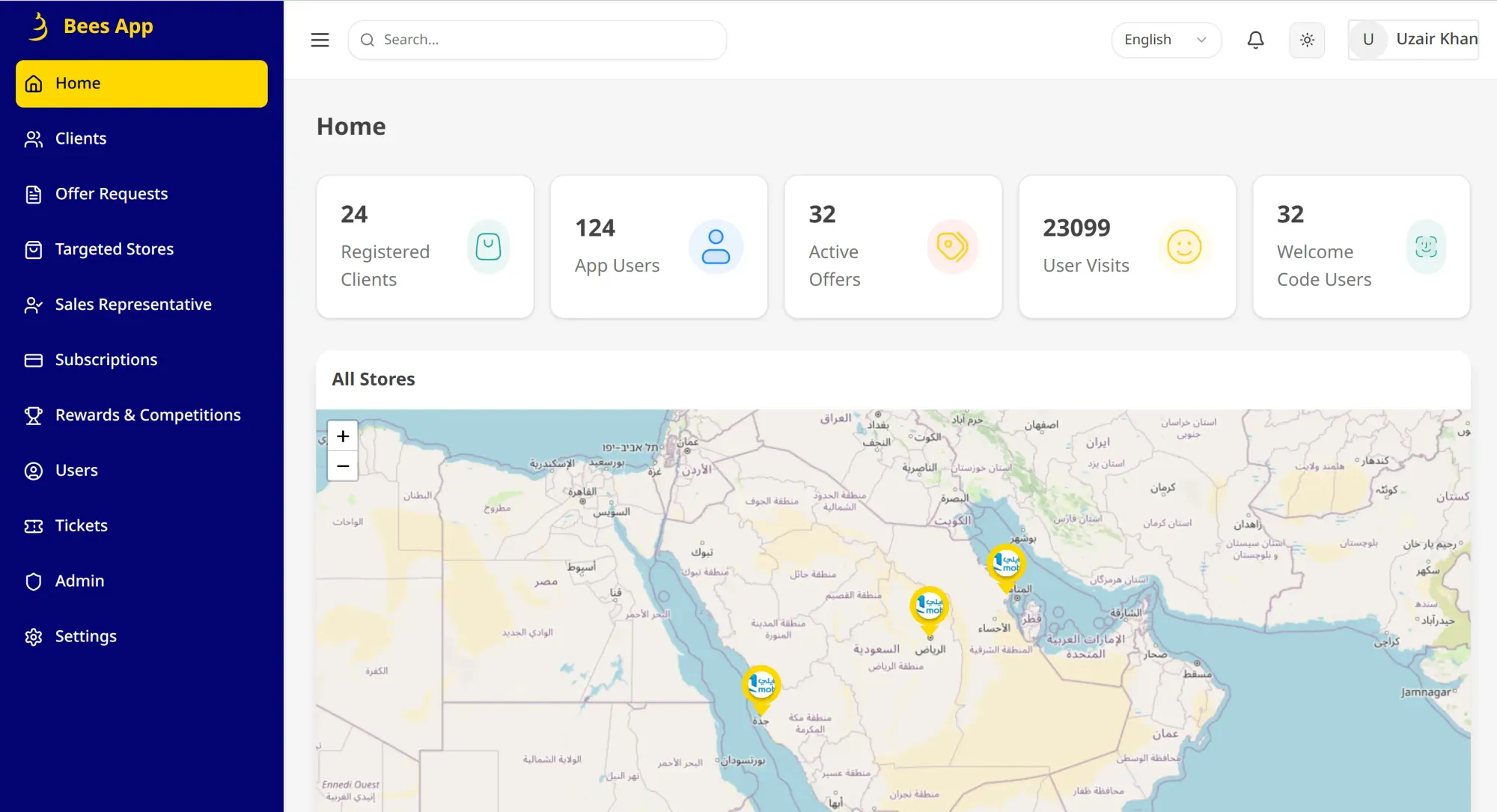
Inside the platform
We came to Hoop with a completely broken system and an impossible timeline. They rebuilt everything from the ground up and delivered a platform that hasn't gone down since launch. We couldn't have entered the Saudi market without them.
Fahad Mutesh — Owner, BeesApp
Want results like these?
Tell us where you want to go. We'll show you how to get there — and then build it with you.