Are Google Ads Worth It? How to Know Before You Spend
Google Ads are worth it when customer value clears the realistic acquisition cost and the funnel converts. Five numbers decide it — search demand, CPC, conversion rate, CAC, and customer value — and none of them is the click price on its own.
Sahar
Content Writer
Yes, Google Ads can be worth it when your customer economics support the click cost and your funnel converts traffic profitably. The platform buys access to active demand, but the business still has to turn that demand into revenue.
Google Ads become expensive when advertisers judge success by clicks instead of customers. A low cost per click means little if the traffic never becomes qualified revenue. The right question is not whether Google Ads work. The right question is whether Google Ads work for your margins, market, offer, and sales process.
Are Google Ads Worth It for Most Businesses?
Google Ads are worth testing for businesses with measurable search demand and enough customer value to absorb acquisition costs. Businesses with weak demand, thin margins, or poor tracking face a harder path to profitability.
Google Search Ads place offers in front of people who already express intent through a search query. That intent makes paid search different from channels that interrupt users before demand exists. A search for “emergency plumber near me” shows strong buying intent.
The auction still does not guarantee profit. Google decides ad visibility through Ad Rank, which considers bids, ad quality, search context, and expected asset impact. Better relevance can improve visibility without requiring the highest bid.
Your business model decides whether the resulting click price makes sense. A legal practice can tolerate a higher click cost than a low-margin retail product. One signed client can justify far more ad spend than one low-value order.
What Actually Makes Google Ads Worth the Cost?
Five numbers decide whether Google Ads create profitable growth: search demand, cost per click, conversion rate, customer acquisition cost, and customer value. You should understand all 5 before increasing spend.
Search Demand
Search demand tells you whether enough people actively look for the solution you sell. Commercial searches matter more than broad informational searches. “CRM software pricing” usually carries stronger buying intent than “what is CRM software.”
Cost Per Click
Cost per click (CPC) tells you what each visit costs. Competition, location, keyword intent, ad quality, and auction conditions influence CPC. A click only becomes expensive when the click costs more than its realistic revenue contribution.
If you need deeper budget benchmarks, Hoop’s Google Ads costs guide explains how competition, keywords, campaign type, and quality affect spend.
Conversion Rate
Conversion rate tells you how efficiently paid traffic becomes leads or sales. Two advertisers can pay the same CPC and receive completely different results. The advertiser with the stronger page and offer usually reaches a lower acquisition cost.
Customer Acquisition Cost
Customer acquisition cost (CAC) measures how much advertising and sales effort you spend to win one customer. Cost per lead cannot replace CAC because not every lead becomes revenue. Strong reporting follows the lead until the sale closes.
Customer Value
Customer value sets the ceiling for affordable acquisition. Ecommerce teams often use contribution margin and repeat purchase value. SaaS teams usually consider customer lifetime value, retention, and payback period. Service businesses often compare acquisition cost with gross profit per job.
How to Calculate Whether Google Ads Can Be Profitable
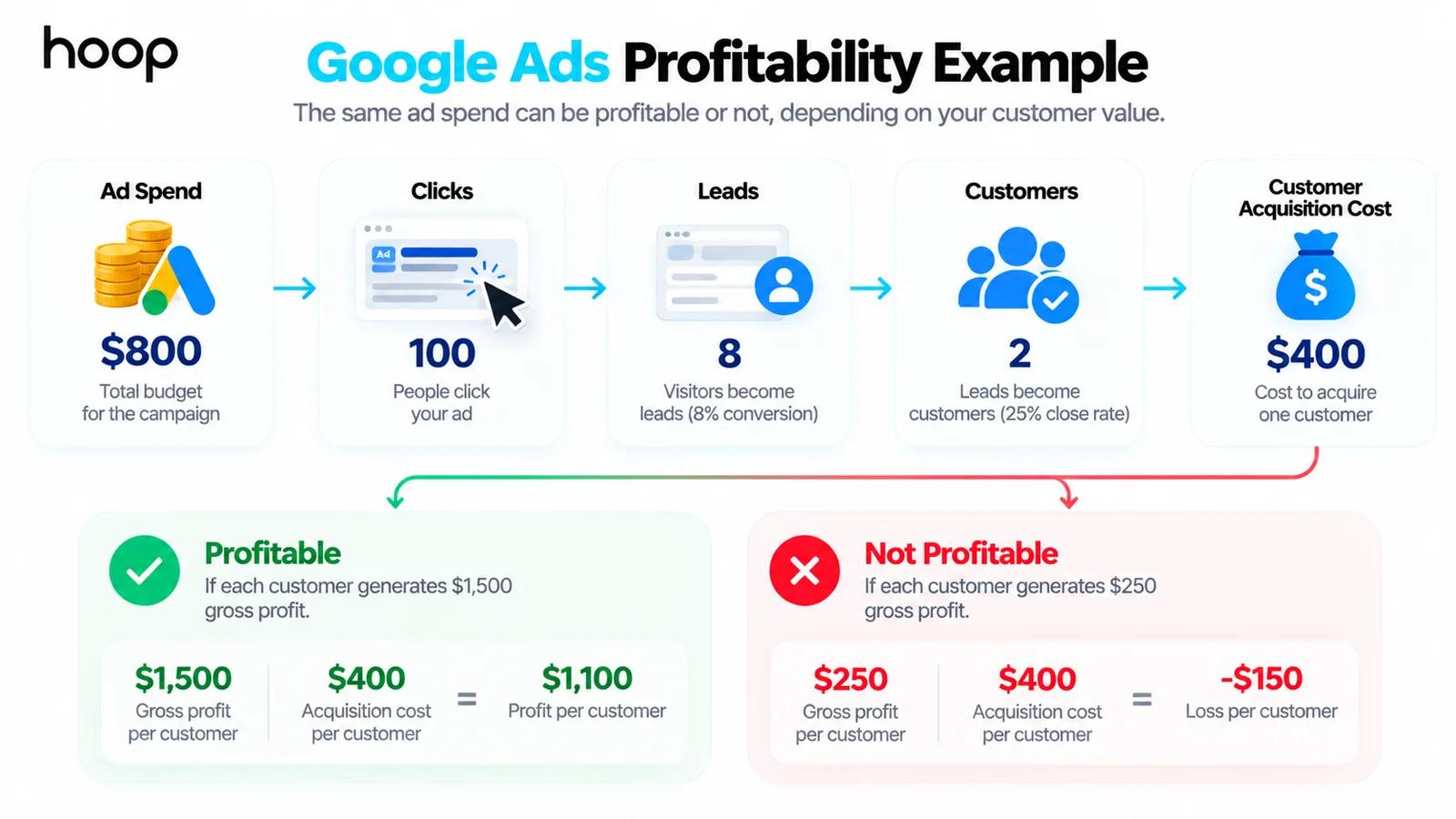
To calculate potential profitability, work backward from customer value instead of starting with a daily budget. The calculation becomes clearer when you separate clicks, leads, customers, and gross profit.
Assume your average CPC is $8. A $800 test budget buys about 100 clicks. If 8% of visitors become leads, you receive 8 leads. Your cost per lead equals $100.
If 25% of those leads become customers, you gain 2 customers. Your advertising CAC equals $400. The campaign makes economic sense when each customer produces enough gross profit to cover that $400 acquisition cost and the other operating costs.
Suppose each customer produces $1,500 in gross profit. Two customers create $3,000 in gross profit from $800 in ad spend. The numbers support continued testing. Suppose each customer produces only $250. The same campaign loses money before management fees and overhead.
You should also account for delayed revenue. A SaaS company can accept a longer payback period when retention remains strong. A cash-constrained business often needs faster recovery. Profitability depends on both return and timing.
When Are Google Ads Worth It?
Google Ads usually deserve a test when buyers already search for your offer and one customer carries enough value to support paid acquisition. Strong fit also depends on tracking and conversion quality.
- Use Google Ads when high-intent searches clearly describe the product, service, problem, or location you sell.
- Use Google Ads when customer value gives you room to pay for clicks, leads, and sales follow-up.
- Use Google Ads when your landing page matches the search intent and gives users one clear next action.
- Use Google Ads when you can track calls, forms, purchases, trials, or booked meetings back to campaigns.
- Use Google Ads when your team can review search terms, lead quality, conversion data, and wasted spend regularly.
The strongest campaigns connect keyword intent with a specific offer. Paid search works best when the visitor immediately sees the same promise that motivated the search.
When Are Google Ads Not Worth It?
Google Ads become a poor investment when the business cannot turn paid demand into profitable customers. More budget only increases the speed of the loss when the economics fail.
- Avoid aggressive spend when almost nobody searches for the category or problem you sell.
- Avoid scaling when gross margins cannot support realistic click and acquisition costs.
- Avoid relying on ads when the website loads slowly, confuses visitors, or lacks a focused offer.
- Avoid automated bidding when conversion tracking rewards page visits instead of real business outcomes.
- Avoid increasing spend when sales teams ignore leads, respond slowly, or reject most campaign enquiries.
An unproven offer creates another warning sign. Advertising can validate demand, but large budgets should not compensate for unclear positioning. Fix the offer before forcing more traffic into the funnel.
Are Google Ads Worth It for Small Businesses?
Google Ads can work for small businesses when the budget can buy enough qualified clicks to produce useful data. The required budget depends on CPC, conversion rate, and customer value rather than business size alone.
A $20 daily budget can test a market where clicks cost $2. The same budget struggles when important clicks cost $20. Small businesses should estimate realistic click volume before deciding whether a monthly budget can produce enough conversions to learn from.
Small businesses also need disciplined targeting. Tight locations, relevant search terms, clear negatives, and focused landing pages protect limited budgets. Broad campaigns can consume small budgets before enough high-intent searches appear.
Are Google Ads Worth It for Local Businesses?
Google Ads often work well for local businesses when customers search with urgency and geographic intent. Search queries such as “roof repair near me” or “dentist open now” show immediate need.
Local businesses should compare paid search with existing organic visibility. A company already dominating local results can use ads for high-value services, competitive areas, or urgent searches instead of buying every available click.
Lead handling matters as much as traffic. A phone-based business can waste strong paid leads when nobody answers quickly. Call tracking and response-time monitoring belong inside the campaign measurement system.
Are Google Ads Worth It for Ecommerce?
Google Ads can be valuable for ecommerce when product margins, feed quality, conversion rate, and repeat purchases support the acquisition cost. Strong revenue alone does not prove profitability.
Shopping campaigns and Performance Max can capture shoppers who already compare products. The product feed must communicate accurate titles, prices, availability, and product data. Weak feed quality limits relevance before the visitor reaches the store.
Ecommerce teams should measure contribution margin by product rather than treating all revenue equally. A campaign can show attractive return on ad spend while pushing low-margin products that create little real profit.
Are Google Ads Worth It for SaaS?
Google Ads can work for SaaS when valuable commercial searches exist and customer lifetime value supports the sales cycle. Early-stage SaaS companies often struggle when they buy traffic before proving the offer.
A SaaS campaign should track more than form submissions. Teams need to connect keywords with demos, qualified opportunities, trials, activated accounts, closed revenue, and retention. Cheap demo requests create little value when the sales team cannot convert them.
Long sales cycles also require patience. A campaign can look weak in the first week while qualified opportunities remain open. SaaS teams should judge the channel using realistic conversion windows and payback periods.
Why Do Google Ads Feel So Expensive?
Google Ads feel expensive because advertisers compete for the same high-intent moments. Commercial intent often raises bids because the search can produce immediate revenue.
The auction changes for every search. Google considers bid size, ad relevance, landing-page experience, competition, search context, and expected asset impact. Competitors can therefore pay different prices for similar visibility.
Expensive clicks are not automatically bad. A $30 click can be profitable when a new customer produces $5,000 in gross profit. A $2 click can be expensive when the product produces only $20 in gross profit and rarely converts.
Why Do Google Ads Campaigns Lose Money?
Most losing campaigns combine weak targeting with weak post-click execution. The platform usually exposes problems that already exist in the offer, page, tracking, or sales process.
Irrelevant search terms waste budget when targeting becomes too broad or negative keywords remain incomplete. Campaign managers should review search terms and remove traffic that cannot realistically become a customer.
Poor landing pages create another major leak. Generic homepages often contain multiple navigation paths, mixed messages, and several calls to action. Paid visitors need a page that matches the keyword and makes the next step obvious.
Hoop’s landing page optimization service focuses on improving conversion performance from existing campaign traffic instead of simply buying more visits.
Weak tracking can make bad campaigns look successful. A 45-second visit should not carry the same value as a purchase or qualified enquiry. Primary conversion goals should represent actions the business can connect to revenue.
Slow sales follow-up can destroy strong lead generation. A campaign can create qualified demand while the sales process loses the opportunity. Advertising performance therefore depends on both marketing and operations.
Has Google Ads Automation Made Campaigns Better?
Automation improves bidding speed and reach, but automation still depends on the quality of your inputs. Smart Bidding and Performance Max cannot repair inaccurate conversion data or weak economics.
Automated systems learn from conversion signals. If your account treats low-value actions as primary conversions, bidding can chase those actions aggressively. Better automation starts with better measurement.
Businesses should also avoid judging automated campaigns from isolated days. Auction conditions and conversion timing create normal fluctuations. Use enough data to evaluate a pattern before making major changes.
How Long Should You Test Google Ads Before Deciding?
Judge a Google Ads test after the campaign collects enough qualified clicks and conversions to evaluate the economics. A fixed number of days cannot answer that question for every market.
A low-CPC ecommerce campaign can collect data quickly. A high-value B2B campaign often needs longer. Your sales cycle also affects the decision because closed revenue can arrive after the advertising click.
Set a test budget around expected CPC, expected conversion rate, and required conversion volume. Then compare actual results with the assumptions. Extend the test when data remains incomplete. Stop or restructure the campaign when the economics clearly fail.
Google Ads vs SEO: Where Should You Spend First?
Choose Google Ads when you need immediate access to existing demand; choose search engine optimization (SEO) when you want organic visibility that compounds over time. Many businesses use both channels for different jobs.
Paid search can test keywords and offers quickly. SEO takes longer but can reduce dependence on paid traffic. Strong keyword data from paid campaigns can also reveal which commercial topics deserve organic investment.
The decision should follow your timeline, budget, competition, and existing visibility. A new business with no rankings can use paid search to validate demand while the SEO program develops.
How to Decide Whether Google Ads Are Worth It for Your Business
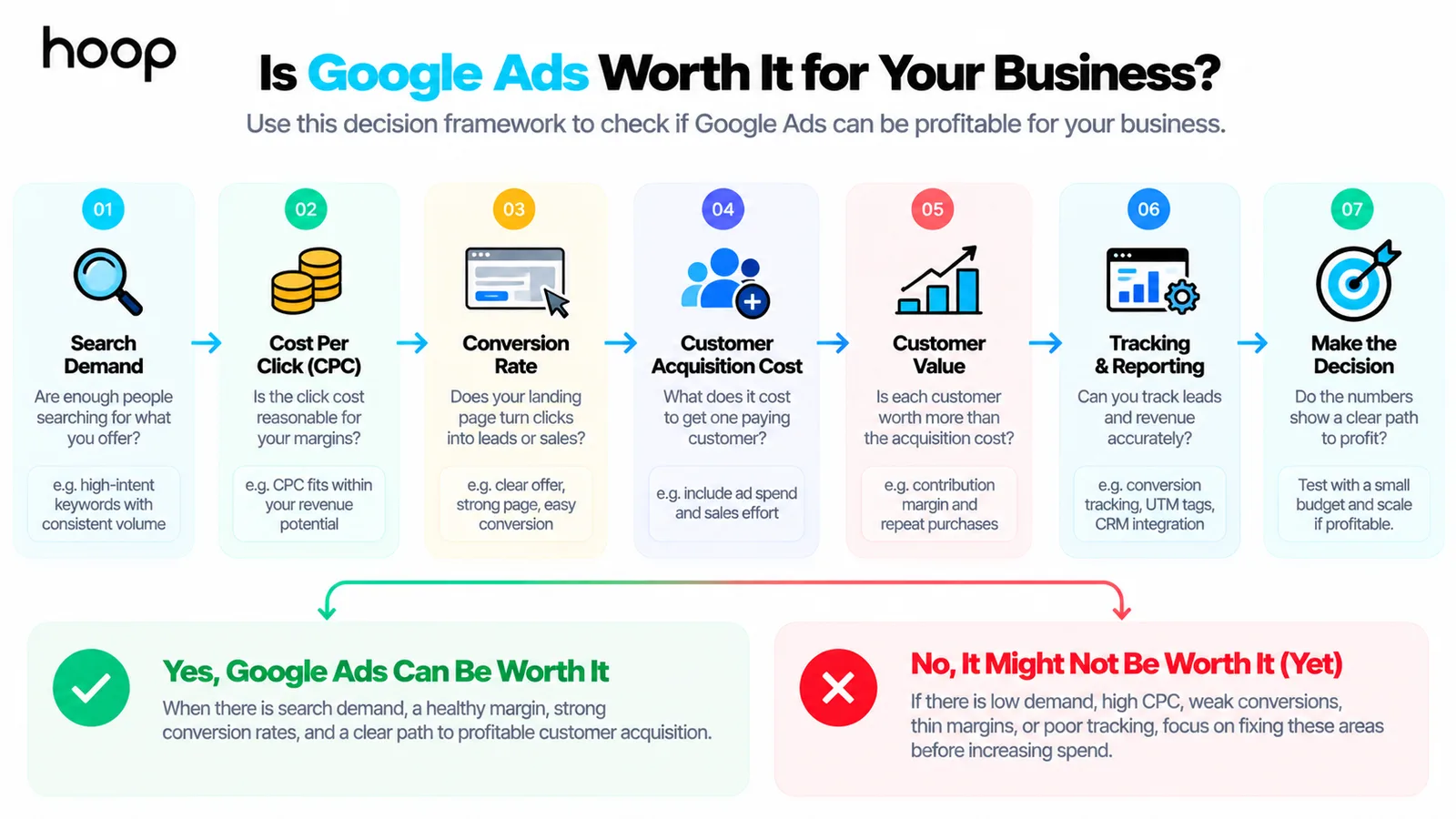
To decide whether Google Ads are worth it, compare realistic acquisition cost with the gross profit and lifetime value of a new customer. Then test whether your funnel can actually reach those numbers.
Start with search demand. Estimate realistic CPC. Estimate the conversion rate from click to lead or sale. Include the lead-to-customer close rate for service or SaaS businesses. Calculate the resulting customer acquisition cost. Compare that cost with gross profit and payback requirements.
Next, check the funnel. Confirm that the ad message matches the landing page. Confirm that tracking records meaningful conversions. Confirm that the sales process can respond quickly. Confirm that your budget can buy enough data to make a decision.
The final answer should come from your numbers, not from a universal benchmark. Industry averages can frame expectations, but your margins and conversion system decide profitability.
Quick Google Ads Viability Check
| Factor | Healthy Signal | Warning Signal | What to Check |
|---|---|---|---|
| Demand | Buyers search with commercial intent | Very low or vague search demand | Keyword volume and search terms |
| Economics | Customer value exceeds realistic CAC | Thin margin leaves no acquisition room | Gross profit and lifetime value |
| Page | Focused message and clear action | Generic page with competing actions | Conversion rate and user behavior |
| Tracking | Revenue actions tracked correctly | Micro-actions treated as success | Calls, forms, sales, purchases |
| Sales | Fast response and good close rate | Slow response or poor lead handling | Lead quality and close rate |
Make the Decision With Your Numbers
Google Ads are worth it when the channel can acquire customers below an acceptable cost and the business can convert that demand reliably. Search volume alone cannot answer the question. Click prices alone cannot answer the question. Your unit economics and funnel decide the result.
If you want a campaign built around qualified leads, sales, and return on ad spend, explore Hoop Interactive’s Google Ads management service and start with a profitability-focused review.
“The right question is not whether Google Ads work. The right question is whether Google Ads work for your margins, market, offer, and sales process.”
Key takeaways
- 01Work backward from gross profit per customer, not forward from a daily budget.
- 02A $30 click can be profitable and a $2 click ruinous — the margin decides, not the price.
- 03Smart Bidding and Performance Max amplify your conversion data; bad tracking makes automation worse, not better.
- 04Most losing campaigns fail after the click: generic landing pages, micro-conversions counted as wins, and slow sales follow-up.
Written by
Sahar
Content Writer
Frequently Asked
Questions
Everything you need to know before booking a strategy call. Can't find your answer? Contact us directly.
Yes, when the business has proven demand, a clear offer, and enough budget to collect useful conversion data. New businesses should start tightly rather than target every keyword.
Yes, when CPC is low enough for the budget to buy meaningful traffic. A small budget becomes ineffective when expensive clicks produce too little data.
Spend enough to test a realistic number of clicks and conversions for your market. The correct test budget depends on CPC, conversion rate, and sales cycle.
No, the channels solve different problems. Google Ads buy immediate visibility, while SEO builds organic visibility that can compound over time.
Yes, if you understand campaign structure, tracking, search terms, bidding, and profitability. Complex accounts often benefit from specialist management and deeper attribution.
Keep reading
All articles →
Facebook Ads vs Google Ads: Which Wins for Your Business?
Jul 15, 2026 · 9 min read
Digital Marketing ROI: How to Measure and Maximize Returns 2026
Jul 24, 2026 · 11 min read