Why Hire a Digital Marketing Agency? When It Makes Sense
Hire an agency when the opportunity cost of doing marketing yourself exceeds the fee — when the work needs specialist depth, coordination across channels, or measurement your team cannot build. Judge the agency on economic value, not task volume.
Sahar
Content Writer
Why hire a digital marketing agency? Hire one when specialist skills, faster execution, and better measurement improve growth efficiently. A strong agency should connect strategy, channels, tracking, and optimization to business outcomes.
The real question is not whether you can run marketing yourself. The real question is whether doing every marketing task yourself produces the best return on time, money, and attention.
Modern tools make execution easier. Canva can produce creative, AI can draft copy, and ad platforms can automate bidding. Those tools still need clear goals, sound judgment, accurate tracking, and disciplined decisions.
That is where the agency decision becomes practical. You are not paying for more activity. You are paying for capability, coordination, speed, and accountability that the business would otherwise need to build internally.
Why Hire a Digital Marketing Agency Instead of Doing Everything Yourself?
Why hire a digital marketing agency rather than keep every task in-house? The answer starts with opportunity cost.
You hire an agency when the opportunity cost of DIY marketing becomes higher than the agency fee. That point arrives when marketing needs more time, specialization, or coordination than your team can provide.
A founder can write posts, launch ads, send emails, and review analytics. Those tasks become harder when several channels must support one commercial goal.
A good agency links search engine optimization, paid media, content, conversion rate optimization, email, and analytics. The agency also decides which channel deserves attention first.
That coordination matters because isolated activity can look productive without improving revenue. More posts, clicks, or website sessions do not automatically create more customers.
What Does a Digital Marketing Agency Actually Do?
A digital marketing agency diagnoses growth problems, sets strategy, executes selected channels, measures results, and improves performance.
The exact work depends on the business. One company may need paid search and landing page optimization. Another may need technical SEO, content, email automation, and analytics.
A full-service agency can coordinate several disciplines under one plan. Hoop Interactive groups SEO, paid media, social, content, analytics, CRO, automation, ecommerce, and lead generation inside its digital marketing services.
The most useful agency does not sell every service by default. The agency selects the services that solve the specific business problem.
10 Reasons Businesses Hire Digital Marketing Agencies
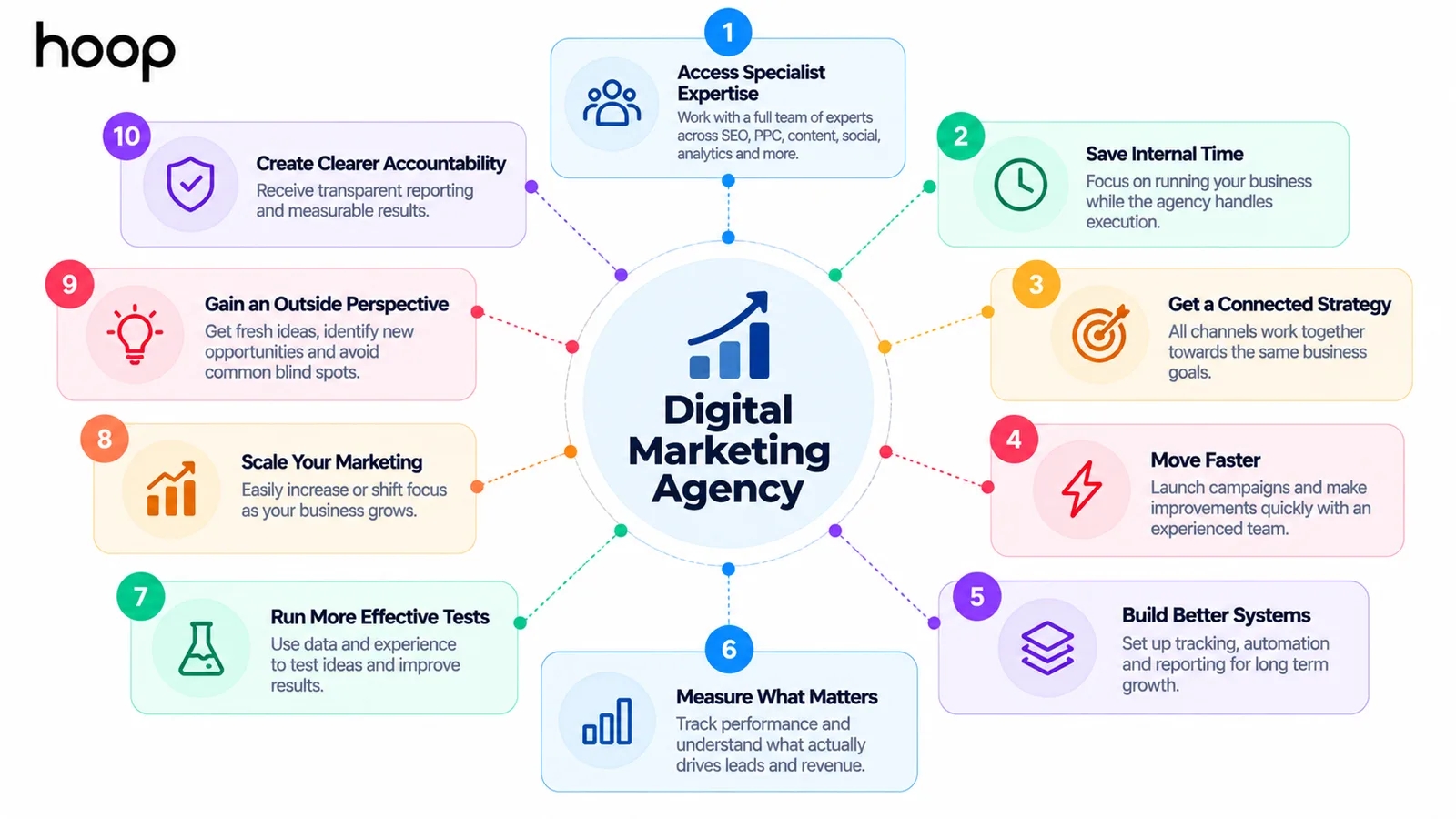
1. Access Specialist Expertise
A strong agency gives you access to specialists without requiring separate full-time hires. Different problems need different skills.
An SEO specialist improves organic visibility. A pay-per-click specialist manages media economics. A copywriter improves messaging. An analyst connects campaign activity to business outcomes.
One generalist rarely performs every discipline at the same level. An agency can assemble the right mix around the work.
2. Save Internal Time for Higher-Value Work
An agency can remove recurring execution work from founders and internal leaders. That time can return to product, sales, operations, or customer experience.
Time savings only matter when the agency also reduces management burden. Constant corrections, vague reports, and repeated explanations can erase the benefit quickly.
3. Build One Connected Marketing Strategy
A coordinated strategy prevents channels from working against each other. Search, paid media, social, email, and conversion work should support the same customer journey.
For example, paid search can reveal high-intent terms. Content can answer deeper questions around those terms. Email can nurture leads that are not ready to buy.
4. Launch and Learn Faster
Experienced teams can move from diagnosis to execution faster because they already have proven workflows, specialists, and review processes.
Speed matters when the business needs evidence quickly. Faster testing can reveal weak offers, poor landing pages, or stronger customer segments before months pass.
5. Use Better Marketing Systems
Agencies often use analytics platforms, ad managers, SEO software, CRM systems, reporting tools, and testing workflows every day.
The software alone does not create value. The agency creates value by choosing the right tools, configuring them correctly, and using the data to make decisions.
6. Improve Tracking and Attribution
Marketing becomes easier to manage when you can trace actions from campaign to lead, customer, and revenue.
A capable agency can connect forms, calls, ecommerce transactions, customer relationship management data, and campaign sources. Better attribution reduces decisions based on impressions alone.
Strong marketing analytics services should connect campaign activity with leads, sales, and revenue. That connection helps teams move budget toward channels that create stronger business outcomes.
7. Test More Efficiently
Agencies can test creative, audiences, landing pages, offers, keywords, and messages across multiple campaigns. The goal is faster learning, not endless experimentation.
A structured test needs one hypothesis, a measurable outcome, enough data, and a clear decision rule. Random changes make performance harder to interpret.
8. Scale Capacity Without Immediate Hiring
Marketing workload rarely grows evenly. Product launches, seasonal campaigns, website projects, and expansion periods can create sudden demand.
Agency capacity can flex more easily than a fixed internal team. That flexibility can help businesses scale work before permanent hiring becomes necessary.
9. Add an Outside Perspective
Internal teams know the business deeply, but familiarity can hide assumptions. An external team can challenge positioning, funnel design, channel priorities, and reporting habits.
Outside perspective works best when the agency also learns the business. Generic recommendations rarely improve because the agency stays external.
10. Create Clearer Accountability
A good agency works against agreed objectives, deliverables, timelines, and performance measures. That structure can make marketing easier to evaluate.
Accountability requires specific reporting. The client should know what changed, why the team changed it, what happened, and what comes next.
Why Hire a Digital Marketing Agency When DIY Tools Are Easy?
Why hire a digital marketing agency when modern tools already simplify execution? Strategy and judgment remain the difference.
DIY tools can help you produce work faster, but tools do not own the business decision behind that work. Strategy still requires judgment.
A design tool can create an ad, but the tool cannot decide whether paid social deserves budget. An AI writer can draft 20 posts, but the model does not own your sales target.
Automation can optimize bids, but automation cannot fix weak economics. A campaign still needs correct conversion data, a competitive offer, and a landing page that converts.
The strongest reason to hire a digital marketing agency is not access to software. The strongest reason is access to people who can decide how different systems should work together.
Why Strategy Matters More Than More Marketing Activity
More activity only helps when the activity addresses a defined business problem. A busy marketing calendar can still produce weak results.
Start with the constraint. The problem may be weak demand, expensive acquisition, low conversion, poor retention, or limited brand awareness.
Then choose the channel that can influence that constraint. Paid search can capture existing demand. Content can support search visibility and buyer education. Email can improve follow-up and retention.
This is why a business should define the outcome before hiring. The agency should receive a problem to solve, not a vague instruction to “do marketing.”
Why Hire a Digital Marketing Agency for Better Measurement?
Why hire a digital marketing agency for measurement? A strong team can connect activity with qualified leads, sales, and revenue.
A good agency should report the metrics that connect marketing activity to business outcomes. The exact metrics depend on the business model.
Lead-generation companies should track qualified leads, cost per qualified lead, conversion rate, pipeline value, and customer acquisition cost. Ecommerce brands should track revenue, contribution margin, conversion rate, repeat purchase behavior, and return on ad spend.
Traffic, impressions, rankings, and engagement still provide useful context. Those metrics become dangerous when reports present them as the final definition of success.
A business should also keep access to its own data. The company should control analytics properties, ad accounts, domains, customer data, and other critical assets.
How Much Should Your Business Stay Involved?
Your business should stay involved in goals, customer insight, economics, approvals, sales feedback, and strategic decisions. The agency should not replace internal ownership.
The agency needs access to information that explains what happens after a lead arrives. Sales teams should share lead quality, objections, close rates, and lost opportunities.
Marketing improves when the agency can see the full funnel. Otherwise, the agency can optimize toward cheap leads that the sales team never closes.
A strong relationship divides responsibilities clearly. The client owns business context. The agency owns specialist execution and disciplined optimization.
Agency vs Freelancer vs In-House: Which Fits Your Problem?
Choose the operating model based on the problem’s scope, required skills, and need for continuous company context.
A freelancer often fits a narrow requirement, such as writing 4 monthly articles or rebuilding one landing page. A freelancer can offer specialist depth without agency overhead.
An in-house hire fits continuous work that needs deep company knowledge, daily collaboration, or direct ownership. Internal teams also retain context more naturally.
An agency fits broader problems that require several skills, faster capacity, structured testing, or coordinated execution across channels.
Businesses often use a hybrid model. Internal leaders own goals and brand context while an agency supplies specialist execution. For a deeper comparison, read Hoop’s agency vs in-house guide.
When Should You Not Hire a Digital Marketing Agency?
Do not hire an agency because the company feels pressure to do more marketing. Hire only for a defined problem.
An agency is a poor fit when the offer has not been validated. Marketing can amplify demand, but promotion cannot make an unwanted product desirable.
An agency also struggles without approvals, sales capacity, or access to performance data.
A narrow project may not justify an agency either. A specialist freelancer can solve one defined problem more efficiently when multi-channel coordination adds little value.
Expectations matter too. Avoid hiring an agency when the business expects guaranteed rankings, instant profitability, or predictable growth without testing.
How to Know Whether an Agency Is Worth the Cost
Why hire a digital marketing agency if the fee does not create measurable value? The economics must support the decision.
Judge the agency against economic value, not work volume. A longer task list does not prove a better return.
Start with revenue impact. Measure how marketing changes qualified pipeline, customer acquisition cost, conversion rate, retention, or sales.
Then measure capability gained. The agency may add technical expertise, creative capacity, analytics, or testing systems that would cost more to build internally.
Measure speed as well. Reaching a useful answer in 6 weeks can create more value than reaching the same answer after 6 months.
Finally, measure internal time saved. The agency should reduce pressure on founders and teams without creating a second management job.
What Should You Expect During the First 90 Days?
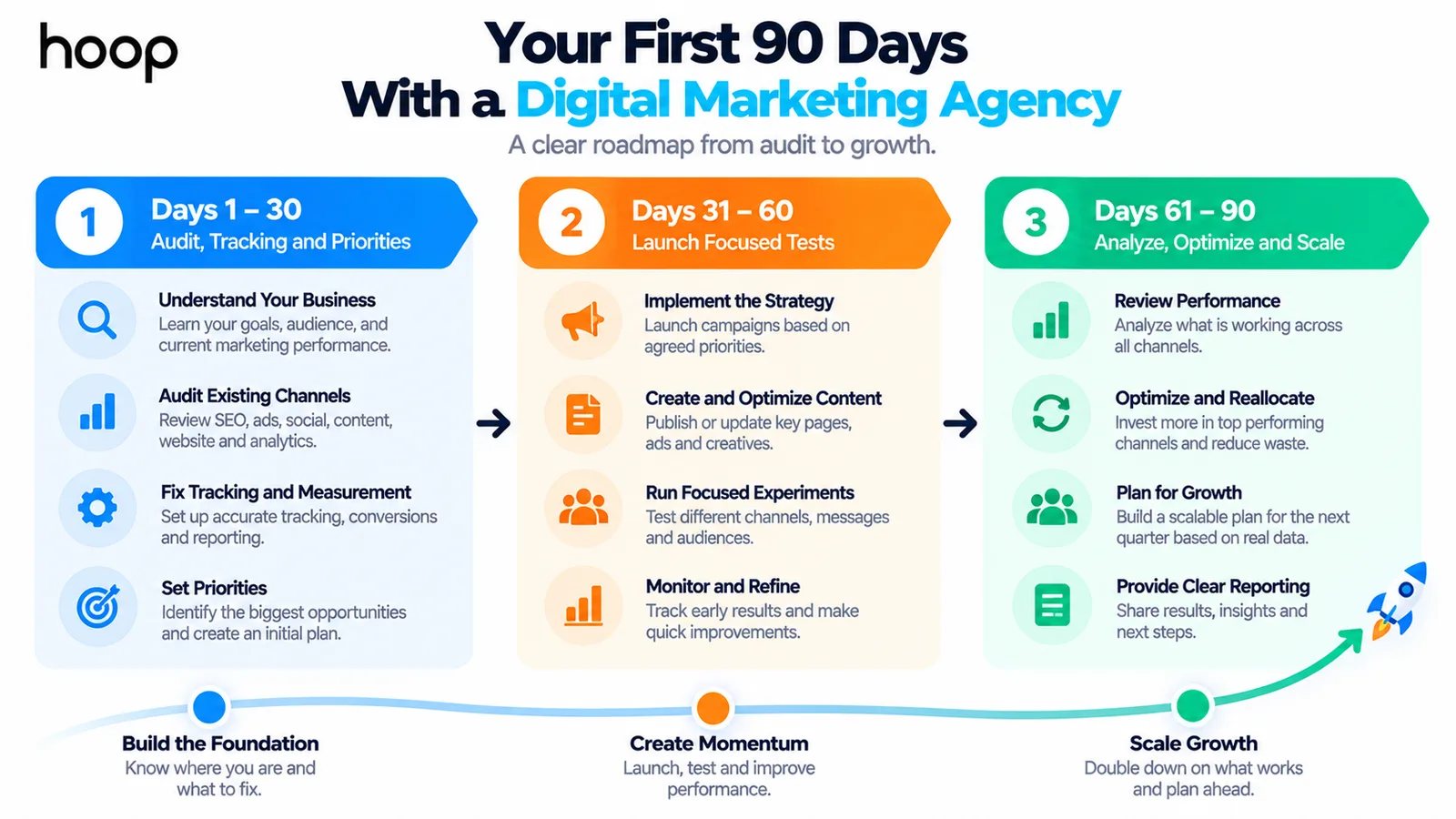
Days 1–30: Audit, Tracking, and Priorities
The first 30 days should create clarity. The agency should review existing channels, analytics, conversion paths, historical performance, customer segments, and business targets.
Tracking problems should receive early attention. Poor data makes every later optimization less reliable.
The agency should finish the first phase with clear priorities, owners, baselines, and a defined measurement plan.
Days 31–60: Launch Focused Tests
The next 30 days should turn priorities into controlled execution. The agency can launch campaigns, content, landing page changes, or technical fixes.
The agency should avoid changing everything at once. Focused tests make the results easier to interpret.
Days 61–90: Reallocate Resources
The final 30 days should use early evidence to increase, reduce, or redirect effort. Strong channels deserve more resources when the economics support expansion.
Weak channels deserve diagnosis before more spending. The agency should explain what failed, what the team learned, and what the next decision will be.
Quick Reference: When Agency Support Makes Sense
| Situation | Agency Value | What to Check | Difficulty |
|---|---|---|---|
| One narrow task | Low to medium | Compare with a specialist freelancer | Low |
| Several channels need coordination | High | Define one business objective | Medium |
| Tracking is unreliable | High | Fix analytics before scaling spend | Medium |
| Internal team lacks specialist depth | High | Name the exact missing capabilities | Medium |
| Offer is still unproven | Low | Validate demand before outsourcing growth | High |
Red Flags When Hiring a Digital Marketing Agency
Watch for warning signs that hide weak strategy, poor transparency, or bad incentives.
- Promises guaranteed rankings, leads, or revenue without explaining assumptions.
- Reports mainly impressions, clicks, or traffic while ignoring qualified leads and revenue.
- Keeps advertising accounts, analytics properties, or other core assets under agency ownership.
- Cannot name the people who will execute, review, and manage your account.
- Uses the same strategy for every client without adapting to business economics.
- Pushes more spend without explaining profitability, conversion quality, or diminishing returns.
Questions to Ask Before Hiring an Agency
Ask questions that reveal how the agency thinks, measures, communicates, and protects business assets.
- What business outcome will your first 90 days target?
- Who will work on the account, and who reviews their work?
- How do you define a qualified lead or successful conversion?
- Which accounts, data, and creative assets will our business own?
- How will you connect campaign activity with pipeline or revenue?
- What happens when a channel misses its target?
Why Hire a Digital Marketing Agency? The Decision Comes Down to Capability
The best reason to hire a digital marketing agency is access to capability that improves business performance. That capability can include expertise, coordination, speed, testing, measurement, and accountability.
The agency should solve a defined problem and connect marketing activity to meaningful outcomes. More posts, meetings, and reports do not justify a retainer by themselves.
Choose an agency when specialist depth or coordinated execution would take longer or cost more to build internally.
If your team needs that support, Hoop Interactive can connect strategy, execution, and measurement around clear business goals.
“You are not paying for more activity. You are paying for capability, coordination, speed, and accountability that the business would otherwise need to build internally.”
Key takeaways
- 01The decision is opportunity cost, not capability: tools make execution easy, but strategy and judgment stay with people.
- 02A good agency reports qualified leads, cost per lead, and revenue — not impressions, clicks, and rankings alone.
- 03Keep ownership of your analytics properties, ad accounts, domains, and customer data whatever happens to the contract.
- 04Do not hire an agency before the offer is validated — promotion cannot make an unwanted product desirable.
Written by
Sahar
Content Writer
Frequently Asked
Questions
Everything you need to know before booking a strategy call. Can't find your answer? Contact us directly.
Yes, when the agency adds specialist capability, faster execution, better measurement, or stronger economics than the business can create alone.
Yes, when the business has a validated offer, enough budget for meaningful execution, and a clear growth problem to solve.
Choose a freelancer for a narrow specialist task. Choose an agency when the problem requires several disciplines, coordination, and ongoing optimization.
Judge progress against the channel, sales cycle, baseline, and agreed milestones. Do not use one fixed timeline for every marketing problem.
You should control core accounts, analytics, domains, customer data, advertising access, and essential assets after the contract ends.
Keep reading
All articles →
Digital Marketing ROI: How to Measure and Maximize Returns 2026
Jul 24, 2026 · 11 min read
Content Marketing vs Social Media Marketing: What’s the Difference?
Sep 27, 2026 · 10 min read