What Is Lead Generation? Meaning, Process, and Examples
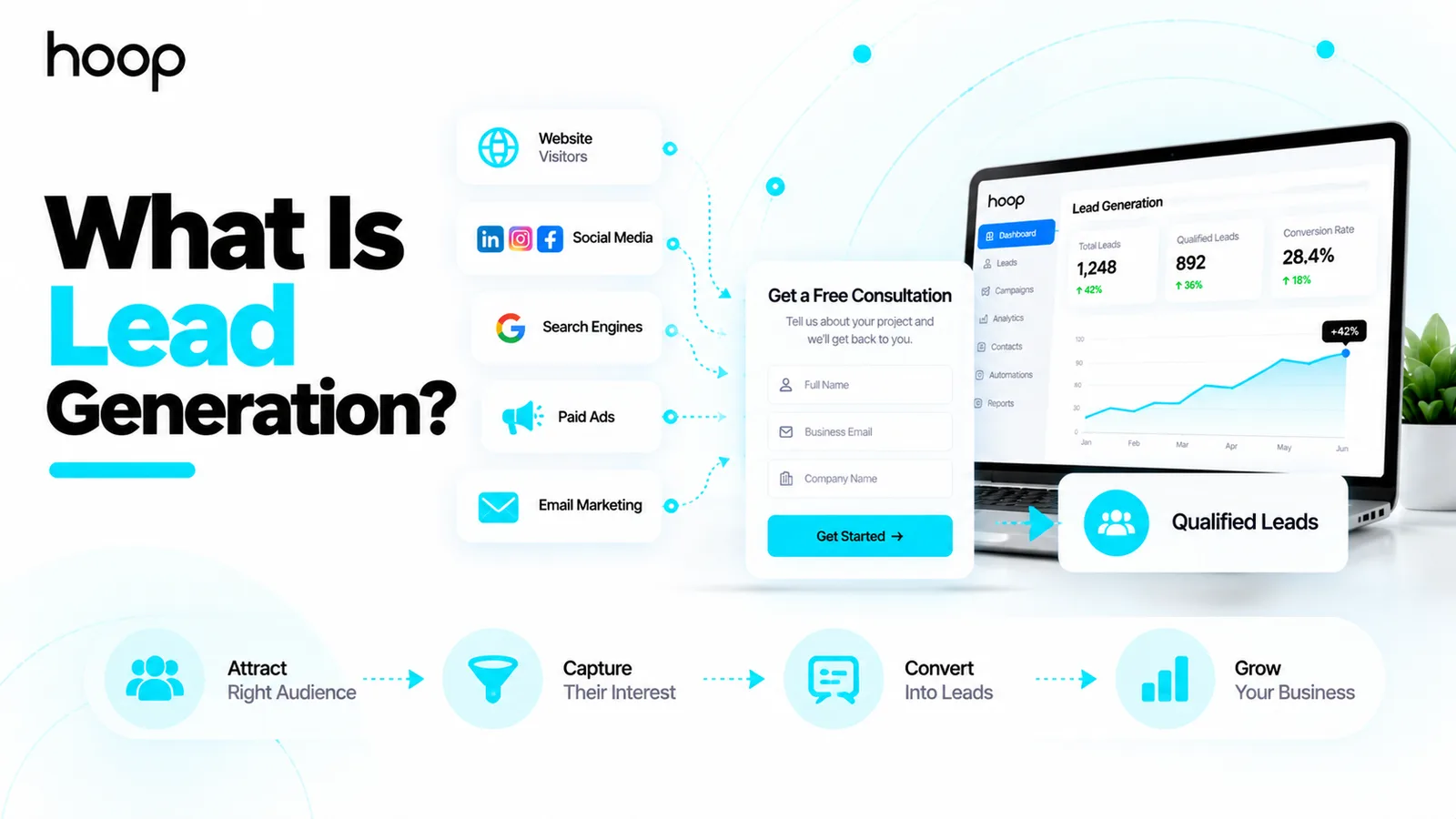
Lead generation turns anonymous attention into contactable sales opportunities through five stages: attract, capture, qualify, nurture, convert. Volume alone proves nothing.
Sahar
Content Writer
What is lead generation? Lead generation means attracting people who might buy your product or service and creating a way to contact them. A business generates a lead when someone requests a quote, books a consultation, signs up for a trial, or shares contact details for relevant follow-up.
Lead generation does not mean that every website visitor becomes a customer. The process turns anonymous attention into identifiable sales opportunities. You still need to understand each person’s requirements, earn trust, and help suitable prospects make a purchasing decision.
Need this done right?
Hoop builds the strategy, design and development behind sites like this one — talk to us about yours.
What Does Lead Generation Mean in Simple Words?
Lead generation connects your business with people who have a possible reason to buy. You attract interest, offer a useful next step, and capture enough information to continue the conversation.
A lead is a person or organization you can contact about a potential purchase. An inquiry from a customer seeking a price is a lead. A company requesting a software demo is another lead. Someone reading your homepage without interacting is only a visitor.
A simple lead generation example
Imagine you run a company that builds appointment-booking software for clinics. A clinic manager searches for ways to reduce missed appointments and reads your website guide. The manager downloads a checklist and provides a work email address. Your team sends a useful follow-up, discusses the clinic’s current system, and offers a relevant demo.
The checklist request created a lead. The later consultation determined whether that lead matched your service. A signed contract would turn the qualified lead into a customer. Every stage serves a different purpose.
Is a lead the same as a customer?
No. A lead shows interest or meets an identified prospecting criterion; a customer completes a purchase. Some leads only want information. Some need another 6 months to approve a project. Other leads request quotes from 3 providers before choosing one.
Your sales team should record both the interest level and the next action. A contact record alone does not prove purchasing intent.
Why Do Businesses Need Lead Generation?
Businesses need lead generation to identify new buyers, start relevant conversations, and create opportunities for sales. Without a repeatable process, your customer pipeline depends heavily on chance inquiries or referrals.
Build a more reliable sales pipeline
A sales pipeline tracks opportunities from first contact through a purchase decision. Lead generation supplies new opportunities. Qualification and nurturing help your team decide which opportunities deserve attention.
A service company can track 30 inquiries, 12 qualified conversations, and 4 contracts in one reporting period. The 3 numbers reveal more than a single website traffic total.
Spend sales time on relevant prospects
Your team can ask about business needs, project scope, budget, and purchasing timeline before preparing a long proposal. Strong qualification reduces wasted discovery meetings while protecting relationships with future customers.
Learn which marketing activities produce revenue
Lead generation connects campaigns to outcomes. You can compare a search campaign that produces 10 serious consultations against a social campaign that produces 100 low-intent signups. The better channel depends on cost, quality, and eventual sales.
How Does the Lead Generation Process Work?
The lead generation process follows 5 linked stages: attract, capture, qualify, nurture, and convert. Your business can adapt the stages to its sales cycle, price point, and buyer preferences.
1. Attract the right audience
To attract relevant prospects, define the business problem you solve and create useful material around that problem. Search articles, customer case studies, videos, local search listings, and targeted ads can attract interested people.
For example, a bookkeeping firm can publish an article about preparing business accounts. A software agency can publish a guide about choosing a customer relationship management system. Useful content makes the next step relevant.
2. Capture a clear expression of interest
To capture interest, offer a specific next action. Visitors can request a quote, register for a webinar, book a demo, or download a planning template. A short form should collect only information needed for that action.
Make the offer clear before asking for personal details. State what the visitor receives and how your business will use their information. A newsletter signup should not silently become permission for unrelated sales calls.
3. Qualify each inquiry
To qualify a lead, assess fit and purchasing readiness. Ask what the person needs, whether your service matches, who approves the decision, and when the prospect wants to act.
A student researching software development is not the same opportunity as a company requesting implementation next month. Both visits have value, but only the second inquiry suggests near-term purchasing intent.
4. Nurture prospects who are not ready
To nurture a lead, share information that answers the prospect’s next question. Send a relevant case study, pricing explanation, implementation guide, or educational email when the person has agreed to receive updates.
A simple sequence can introduce your service, address a common objection, and invite a consultation. Well-designed email nurturing workflows help your business follow up consistently without sending the same message to everyone.
5. Convert qualified leads into customers
To convert a qualified lead, recommend a solution that fits the buyer’s needs. Explain scope, deliverables, timeline, price, and the next decision. Answer genuine questions instead of pushing an immediate commitment.
After the sale, record which channel generated the original inquiry. That information helps your team improve future acquisition campaigns.
What Are the Main Types of Leads?
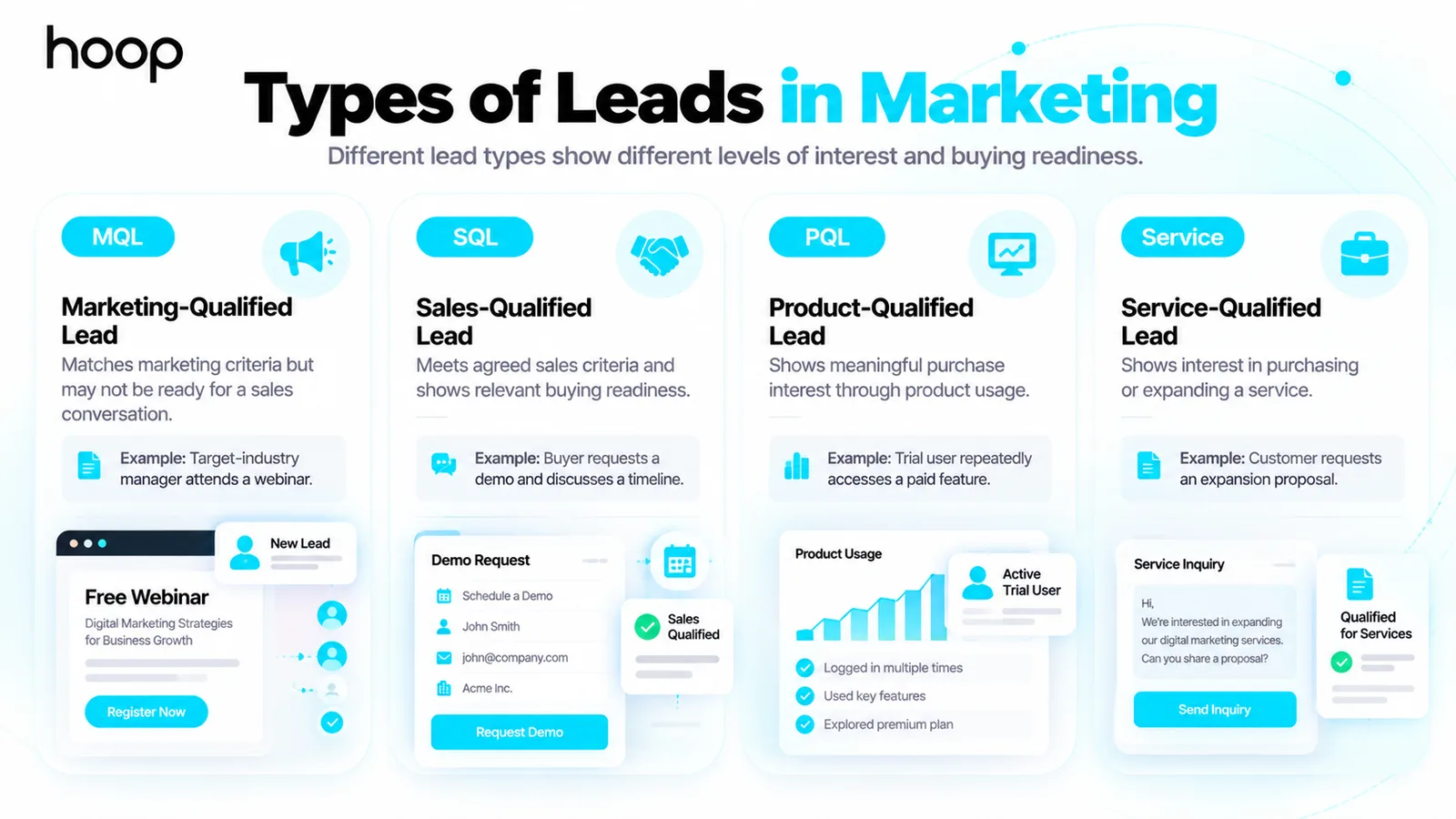
Businesses classify leads by interest, fit, and readiness. The 3 common working categories below help marketing and sales teams decide on the next action.
Marketing-qualified leads (MQLs)
A marketing-qualified lead (MQL) meets marketing-defined criteria. A target-industry manager who registers for a relevant webinar can qualify as an MQL. That designation does not mean the person is ready for a sales call.
Sales-qualified leads (SQLs)
A sales-qualified lead (SQL) meets criteria agreed upon by sales and marketing. A buyer who requests a demo, describes a real problem, and discusses a workable timeline can become an SQL after review.
Product-qualified and service-qualified leads
A product-qualified lead (PQL) shows meaningful interest through product use. For example, a free-trial user who repeatedly accesses a paid feature shows a relevant product signal. A service-qualified lead indicates interest in a specific service, such as requesting an expansion proposal.
Lead labels are internal operating definitions. Your team should document each label instead of assuming every organization uses identical criteria.
What Is the Difference Between Inbound and Outbound Lead Generation?
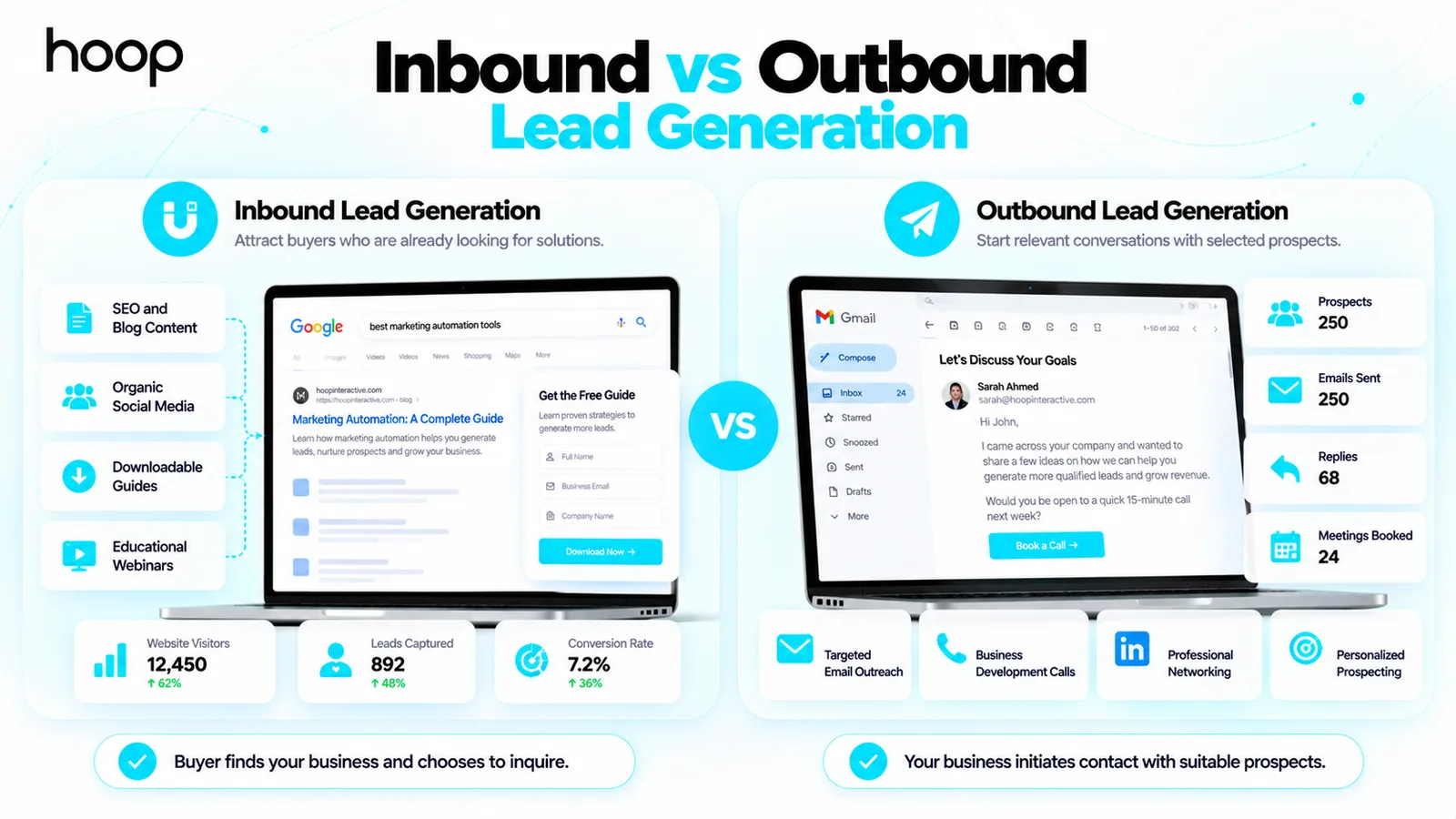
Inbound lead generation attracts people already seeking answers or solutions. Outbound lead generation starts relevant conversations with selected prospects, including people who have not contacted your business.
Inbound lead generation examples
Inbound methods include search engine optimization (SEO), educational blogs, organic social content, downloadable guides, and helpful webinars. Someone searches for a problem, finds your content, and chooses to inquire.
An informative page can support long-term discovery, although rankings and inquiry volume are never guaranteed. A clear call to action gives interested visitors a practical next step.
Outbound lead generation examples
Outbound methods include targeted email outreach, business development calls, and professional networking messages. Your team identifies a suitable organization, researches its business situation, and explains a relevant offer.
Follow applicable privacy, consent, and anti-spam requirements. Personalization improves relevance, but a purchased contact list does not establish permission or genuine buying interest.
Which method should you choose?
Choose inbound when your customers search for the problems you solve and you can invest in useful content. Choose outbound when you serve a narrow business niche and can identify decision-makers accurately. Many B2B businesses combine both approaches.
A company offering highly specialized software can publish technical comparison guides while contacting organizations that match its ideal customer profile. Track lead quality for each channel separately.
Which Lead Generation Channels Work for Different Businesses?
The right channel depends on your customer, offer, purchasing cycle, and resources. Local services often benefit from search visibility and referrals. B2B consultants often benefit from targeted professional outreach and case studies.
Search, content, and website forms
Search traffic works when your website answers questions that potential buyers already ask. An effective page pairs relevant information with a quote form, consultation link, or product trial.
Your broader digital marketing channels should match the customer journey. A general educational blog serves a different need from a pricing page aimed at a ready buyer.
Paid advertising and landing pages
Search ads can reach people using purchase-related phrases, such as “commercial cleaning quote.” Social ads can reach selected audiences through interests and business characteristics. Campaign performance depends on targeting, offer quality, and landing-page clarity.
A focused landing page needs a specific benefit, credible proof, and one clear primary action. Remove unnecessary form fields and check whether mobile visitors can complete the form easily.
Referrals, events, and partnerships
Customer referrals bring introductions from people who already know your work. Industry events can create conversations with relevant prospects. Partnerships with complementary providers can introduce your services to buyers with related needs.
Track the original source for every inquiry. Otherwise, referrals and partnership opportunities disappear inside a generic “other” category.
How Can You Tell Whether a Lead Is Good Quality?
A high-quality lead matches the customer profile you serve and shows a real reason to consider your offer. Lead volume alone cannot tell you whether marketing is working.
Check fit, need, and timing
Review the prospect’s industry, organization size, location, problem, budget expectations, and decision process. A promising lead does not need to answer every question immediately. Record missing information for a short discovery conversation.
Separate interest from buying intent
A blog subscriber has shown some interest. A person requesting a detailed proposal has shown a stronger intent signal. Neither action guarantees a sale. Evaluate behavior alongside business context.
Score leads without overcomplicating the process
Create a simple 100-point model: 30 points for customer fit, 30 for clear need, 20 for timing, and 20 for purchasing access. Review your scoring assumptions against actual closed deals. Treat the score as a priority aid, not a verdict.
How Do You Measure Lead Generation Results?
Measure lead quantity, lead quality, cost, and customer conversion together. A campaign that produces inexpensive contacts can still perform poorly when almost nobody buys.
Calculate conversion rate
Lead conversion rate equals leads divided by relevant visitors, multiplied by 100. For example, 25 inquiries from 1,000 landing-page visitors represent a 2.5% visitor-to-lead conversion rate.
Calculate cost per lead
Cost per lead (CPL) equals campaign spending divided by leads generated. A $600 campaign that produces 20 leads has a $30 CPL. Compare acquisition cost with the number of qualified conversations and the revenue from closed customers.
Track the metrics that matter
Use a customer relationship management (CRM) system or a spreadsheet to record source, inquiry date, fit, next action, and outcome. Track meetings booked, MQL-to-SQL progression, closed deals, and customer acquisition cost.
Avoid treating email opens, website sessions, or social impressions as sales results. Those measures explain activity, but purchases and qualified opportunities show business impact.
How Can a Beginner Start Lead Generation?
To start lead generation, choose 1 target audience, 1 problem, 1 offer, and 1 channel. A focused first experiment creates clearer results than running 6 unrelated campaigns at once.
Week 1: Define your customer and offer
Describe the buyer you want to reach. Write down 3 recurring problems, your service outcome, and a specific call to action. Set up a simple form and a process for recording inquiries.
Week 2: Publish one useful entry point
Create a service page, focused landing page, or educational article that addresses the buyer’s problem. Include a practical next step, such as requesting a consultation or pricing guide.
Week 3: Promote the offer
Use the channel your buyer already uses. Share educational posts, improve search visibility, seek relevant referrals, or test a modest paid campaign. Record which source produces each inquiry.
Week 4: Follow up and improve
Contact prospects who requested a response. Review inquiry relevance, form completion, and booked meetings. Improve your message or targeting based on specific objections rather than assuming all traffic has equal value.
For a channel-by-channel version of this plan, see our guide on how to generate leads.
What Lead Generation Mistakes Should You Avoid?
Avoid collecting contacts without a clear purpose, sending unsolicited bulk messages, and measuring success only through form submissions. Poor qualification can send irrelevant inquiries to your sales team.
Do not create a long form for a simple educational download. Ask for essential information first, then discuss detailed requirements during a consultation. Avoid promising a fixed number of customers from an untested campaign.
Build a follow-up process before increasing traffic. A business loses opportunities when genuine inquiries receive no response. Assign responsibility for every incoming lead and keep the next step visible.
Build a Lead Generation Process That Produces Useful Conversations
Lead generation works when your business connects relevant visitors with a clear reason to inquire and a reliable follow-up process. Start with a defined buyer, useful offer, simple capture method, and measurable sales outcomes.
If you need help connecting acquisition campaigns with qualification and conversion, review Hoop Interactive’s lead generation services and discuss your business goals with the team.
“Build a follow-up process before increasing traffic. A business loses opportunities when genuine inquiries receive no response.”
Key takeaways
- 01A lead is someone you can contact about a purchase — a visitor who never interacts is not one.
- 02MQL, SQL, PQL and service-qualified are internal definitions; write yours down.
- 03Inbound suits searchable problems; outbound suits narrow niches with identifiable buyers.
- 04Measure conversion rate, cost per lead and closed revenue together, not form fills alone.
Written by
Sahar
Content Writer
Frequently Asked
Questions
Everything you need to know before booking a strategy call. Can't find your answer? Contact us directly.
No. Lead generation identifies potential buyers and creates opportunities. Sales evaluates suitable opportunities, recommends solutions, and seeks purchasing commitments. The activities work together but measure different stages.
Yes. You can generate leads through referrals, events, professional networking, local listings, and direct inquiries. A website still helps you show proof, explain your offer, and capture interest consistently.
No. Business-to-business and business-to-consumer organizations both generate leads. An accounting firm can collect consultation requests, while a home services business can collect repair estimates.
No. You can start with a contact form, a business email account, and a well-maintained spreadsheet. Use CRM and automation tools when inquiry volume and team coordination justify the cost.
Lead generation timing depends on the channel and offer. Paid campaigns can collect inquiries soon after launch, while organic search content often needs more time. Evaluate qualified opportunities and actual sales before judging performance.
Keep reading
All articles →
What Is a Sales Pipeline? Stages, Examples, and How It Works
Oct 22, 2026 · 10 min read
How to Generate Leads: 10 Methods That Attract Buyers
Oct 22, 2026 · 10 min read