How to Qualify Sales Leads: 7 Practical Methods
Qualification separates fit, need, and readiness. Screen the cheap facts before a call, confirm the expensive ones in conversation, and record why every prospect passed or failed.
Sahar
Content Writer
To qualify sales leads, check customer fit, verify a real problem, and confirm buying readiness. Then score each prospect and assign the right follow-up. You can screen most poor-fit contacts before a sales call. Save detailed discovery for prospects with genuine potential.
A full inbox does not guarantee a healthy pipeline. Some contacts want free advice, some need a future solution, and others lack purchasing authority. A consistent qualification process helps you separate those situations without dismissing promising buyers too early.
Need this done right?
Hoop builds the strategy, design and development behind sites like this one — talk to us about yours.
What Does Sales Lead Qualification Mean?
Sales lead qualification evaluates whether a contact fits your offering and deserves active sales attention. A qualified lead combines customer fit, a relevant need, and evidence of buying readiness. Qualification never guarantees a sale. Qualification helps you choose the next sensible action.
For example, a SaaS vendor receives 2 inquiries. A student requests a feature demonstration for research. An operations director reports an urgent reporting problem and requests pricing. Both contacts show interest, but the director presents stronger commercial intent.
Which lead types should you distinguish?
A marketing-qualified lead (MQL) meets marketing criteria, such as customer fit and meaningful engagement. A sales-qualified lead (SQL) passes sales review and justifies direct pursuit. A product-qualified lead (PQL) demonstrates valuable product usage during a trial or free plan.
Set written definitions for each stage. A whitepaper download alone should not trigger the same treatment as a requested implementation proposal.
Why Should You Qualify Sales Leads Before Outreach?
Early screening protects research hours, discovery calls, and proposal preparation. Check easy facts before asking prospects to explain complex problems. Public information can reveal company industry, location, workforce size, and probable technology fit.
Sales teams lose time when every inquiry receives an hour-long consultation. Prospect qualification also improves campaign feedback. Marketing can compare which channels produce serious opportunities, not simply contact forms.
Which facts can you confirm without a conversation?
Check company websites, verified professional profiles, job listings, and published product pages. Record industry, geography, product category, target role, and clear compatibility issues. Mark missing information as unknown rather than inventing answers.
Which facts require direct questions?
Ask about purchasing budget, project importance, decision criteria, and deadlines during an actual discussion. Hiring announcements never prove available funds. A senior job title never proves final purchasing authority.
How to Qualify Sales Leads in 7 Practical Steps
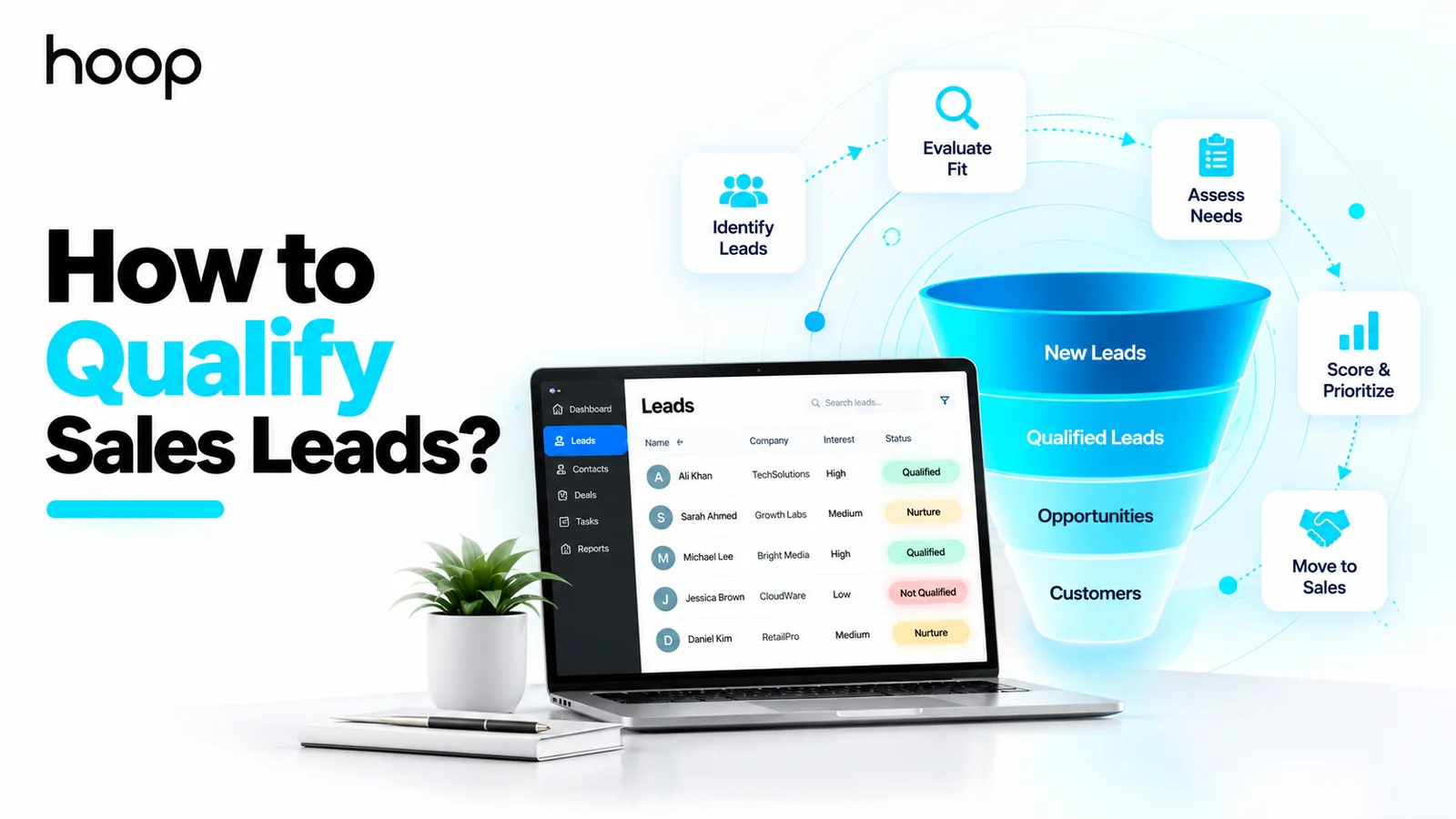
To qualify sales leads consistently, follow 7 decisions from initial screening through sales handoff. Use the same qualification rules for comparable prospects. Adjust requirements for smaller services and complex enterprise deals.
Step 1: Define your ideal customer profile
Write your ideal customer profile (ICP) using successful customer records. Define suitable industries, company sizes, service regions, and operational needs. For a B2B software company, a practical segment might include logistics firms with 20–200 employees.
Add exclusion rules as well. A service limited to US businesses should flag prospects outside supported markets. Clear exclusions save more time than vague descriptions of ideal buyers. Review your existing customers before setting thresholds.
Step 2: Verify company and contact details
Confirm each company website, contact role, and business email before investing in personalized outreach. Check whether your offering supports the prospect’s industry. Find 1 specific reason the prospect matches your ICP.
Avoid treating purchased contact databases as guaranteed truth. People change employers, businesses change priorities, and job titles conceal real responsibilities. Validate important information before making sales commitments.
Step 3: Identify a concrete business problem
Ask what the prospect wants to improve and why progress matters. Request 1 operational example. A prospect asking for a CRM might struggle with duplicate records, missed follow-ups, or inconsistent sales reporting.
Replace generic questions with measurable ones. Ask, “How many inquiries does your team handle each month?” Then ask what happens when an inquiry receives no response. Specific pain gives qualification a business reason.
Step 4: Check budget fit without demanding an exact figure
Discuss realistic investment ranges early. Ask whether the buyer has allocated funding, expects approval, or needs a scoped estimate. An unknown budget does not always mean a weak lead.
Give prospects a relevant starting range when your delivery costs support one. Ask whether the range aligns with expectations. Stop producing detailed unpaid proposals when the required investment clearly exceeds purchasing capacity.
Step 5: Map the buying decision and timeline
Identify the project sponsor, financial approver, end users, and purchasing process. Ask who reviews proposals and who signs contracts. Define the expected start date and any fixed business deadline.
A manager without signing authority can still champion your proposal. Focus on access to decision-makers rather than demanding immediate contact with the chief executive. Record the next decision checkpoint.
Step 6: Evaluate buying behavior and urgency
Look for concrete buyer actions, such as a requested proposal, a booked technical review, or a shared requirements document. Compare those actions with passive signals, including page visits and content downloads.
A pricing-page visit shows interest, not proof of a purchase. A clear project deadline strengthens urgency. Combine observed behavior with direct confirmation before marking a lead sales-ready.
Step 7: Score, route, and record the outcome
Assign a fit score and an intent score. Then classify the prospect for immediate outreach, continued nurturing, or rejection. Record the owner, next action, and expected follow-up date in your customer relationship management (CRM) system.
A sales representative should receive the reason behind each score. Avoid sending a bare number without context. Document why a prospect passed or failed each important check.
Which Sales Qualification Framework Should You Choose?
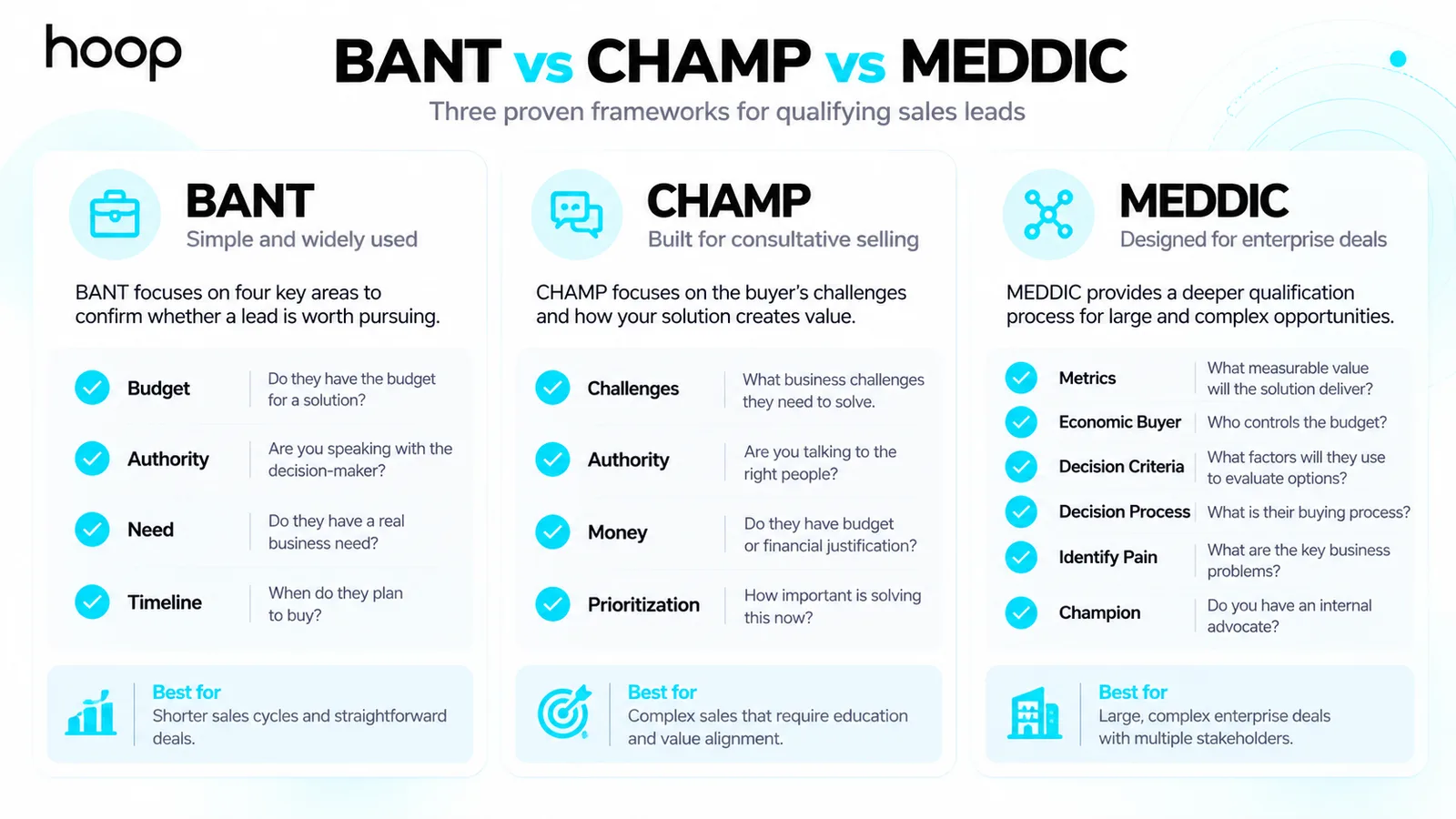
Choose a framework that matches your deal complexity. BANT suits simpler purchases; CHAMP starts with customer problems; MEDDIC supports complicated buying committees. Frameworks guide conversations. Frameworks cannot replace judgment or verified business context.
BANT for shorter sales cycles
BANT means Budget, Authority, Need, and Timeline. Ask whether the buyer can fund a solution, influence a decision, describe a problem, and name a realistic purchase window. Avoid rejecting a strong prospect solely because procurement has not approved a budget.
CHAMP for consultative services
CHAMP means Challenges, Authority, Money, and Prioritization. Begin with operational pain, then determine stakeholders, financial feasibility, and urgency. Agencies and consultants often need a problem-first conversation before discussing solution scope.
MEDDIC for enterprise opportunities
MEDDIC means Metrics, Economic Buyer, Decision Criteria, Decision Process, Identify Pain, and Champion. Larger deals require measurable value and documented approvals. Use MEDDIC when buying committees, security reviews, or procurement decisions extend the sales cycle.
How to Qualify Sales Leads Before the First Meeting
To qualify sales leads before the first meeting, combine a short form with public research and a clear invitation. Limit initial forms to 3–5 essential fields. Ask for company, business problem, solution category, timeline, and optional budget range.
Screen inbound inquiries without creating friction
Use conditional questions instead of forcing every visitor through a long form. A business requesting lead generation support needs campaign goals and current acquisition challenges. A software buyer needs product requirements and a deployment window.
Connect qualification questions to clear service descriptions rather than asking for unrelated financial information. Keep detailed discovery after the first eligibility check.
Research outbound prospects before pitching
Start with a verified list and 1 relevant trigger for each business. For example, a SaaS company opening a second market might need multilingual onboarding. A professional services firm hiring 5 sales representatives might need better lead routing.
Send a concise message about the observed business challenge. Ask 1 focused question instead of demanding a 30-minute meeting immediately. Do not infer a confirmed need from a job posting alone.
Protect proposals and free discovery time
Offer a brief initial screening conversation before extensive planning. Confirm suitable budget, business need, and access to project stakeholders. Quote a paid discovery phase when technical scoping requires substantial research or architecture work.
Use polite exit language when the fit fails. For example: “Your current scope falls below our project minimum. A smaller specialist could suit your requirements better.” Respectful disqualification protects future referrals.
What Sales Qualification Questions Reveal Genuine Intent?
Ask open questions that reveal need, authority, timing, and obstacles. A useful answer names a business problem and a next step. Use follow-up questions naturally instead of reading a rigid script.
- Problem: “What problem triggered your search for a new provider?”
- Impact: “How does the current process affect cost or customer response?”
- Alternatives: “What solutions have you already tried?”
- Budget: “What investment range does your team expect?”
- Authority: “Who will review and approve the final decision?”
- Timeline: “What date drives the implementation schedule?”
- Priority: “What happens if your team delays the project?”
- Next step: “What information would help you make a decision?”
Listen for clear examples and specific commitments. Prospects who refuse every basic scope question rarely justify a lengthy proposal. Prospects who ask informed questions deserve thoughtful follow-up even without finalized budgets.
How Should You Score and Route Qualified Sales Leads?
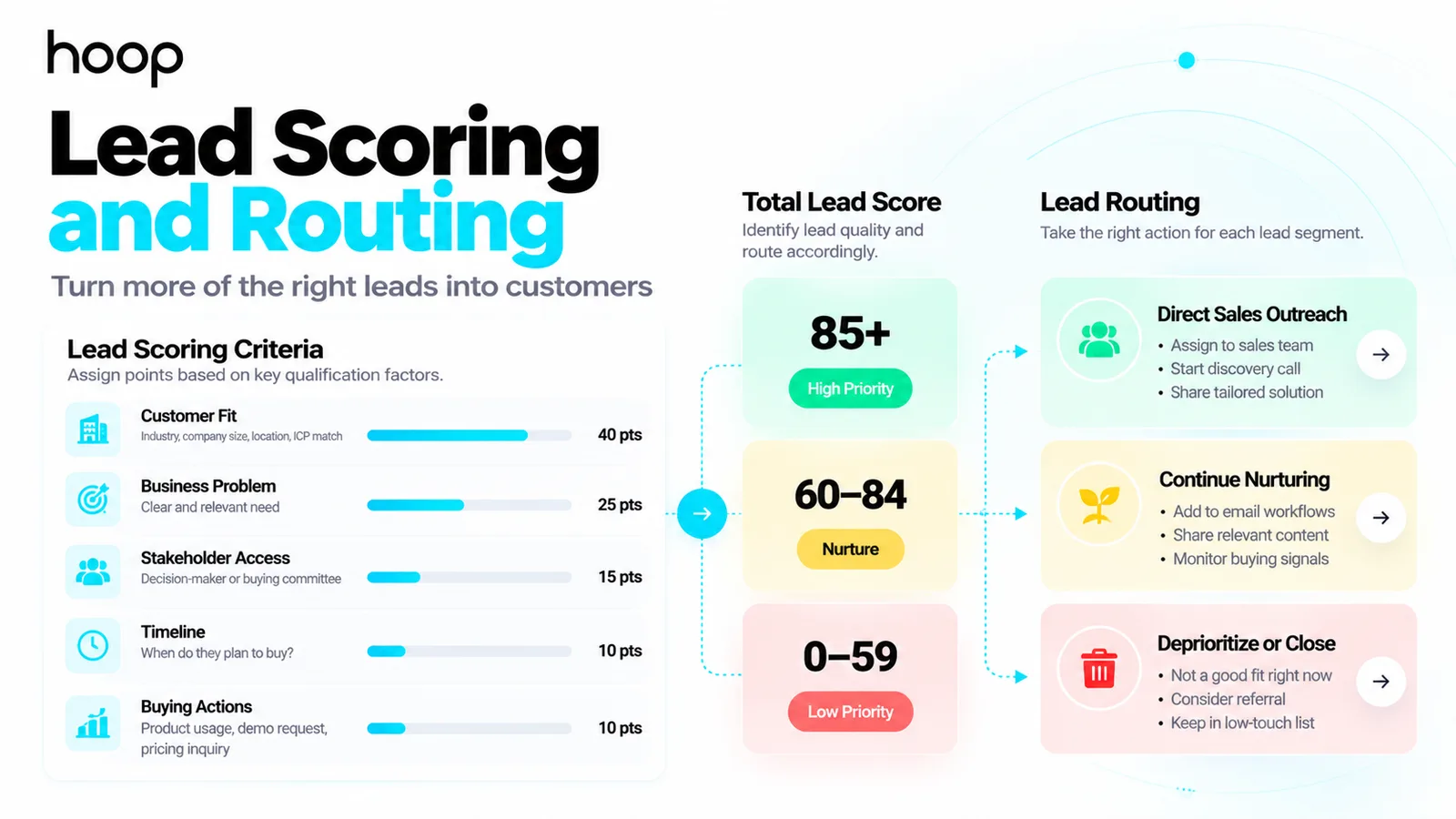
Use a scoring model with positive and negative criteria. Separate customer fit from purchase intent, because a perfect-fit company can lack immediate demand. Treat scoring thresholds as starting assumptions, not industry benchmarks.
For example, assign 40 points to customer fit, 25 to the business problem, 15 to stakeholder access, 10 to timeline, and 10 to buying actions. Deduct 30 points for an unsupported market. Deduct 20 points for an incompatible service requirement.
A prospect scoring 85 points can receive direct sales attention. A prospect scoring 60 points can enter a nurture sequence. A prospect scoring 25 points can receive a respectful referral or closure. Review actual closed deals before trusting these illustrative thresholds.
A quick-reference qualification workflow
| Task | Suggested timing | Method | Difficulty |
|---|---|---|---|
| ICP screening | 2 minutes | Website and company profile | Low |
| Contact verification | 2 minutes | Role and email checks | Low |
| Need confirmation | 5 minutes | Short form or reply | Medium |
| Buyer and budget check | 10–15 minutes | Discovery conversation | Medium |
| Score and routing | 2 minutes | CRM scorecard | Low |
Route leads to the right next action
Give high-priority inbound prospects a named sales owner and a prompt response target. Send research-stage prospects relevant examples or educational emails. Route clear mismatches out of the active pipeline with a documented reason.
Use marketing automation workflows to track engagement and move prospects between stages. Keep a human review for expensive or unusual projects. Automated scores should support decisions, not dictate them.
How Do You Qualify SaaS and Service Leads Differently?
SaaS buyers can demonstrate readiness through product activity. Service buyers usually reveal readiness through project details and purchasing conversations. Choose signals that reflect your real sales model.
SaaS: focus on meaningful product actions
Track account setup, team invitations, repeated feature use, integrations, and requests for a paid plan. Count actions that predict customer value, not every login. A trial account with 4 active teammates can warrant outreach before an inactive trial with 20 page views.
Agencies: focus on scope and project ownership
Ask for project objectives, service location, budget range, stakeholder access, and target dates. An agency prospect requesting a full campaign plan without discussing implementation can consume extensive unpaid time. Offer a paid audit when serious planning requires specialized labor.
Support longer buying cycles with an inbound marketing strategy that connects content, lead capture, and follow-up. Match the next message to the prospect’s current decision stage.
Which Lead Qualification Mistakes Waste the Most Time?
Avoid 4 recurring mistakes: confusing engagement with intent, demanding a perfect budget, overloading first forms, and ignoring negative scoring. A lead should progress because evidence supports the next step.
First, stop treating downloads and email opens as purchase commitments. Second, distinguish missing budgets from impossible budgets. Third, ask only the questions needed for the next decision. Fourth, record explicit reasons for rejection.
Review lead sources each month. Compare sales-qualified leads, meetings completed, proposals accepted, and customers won. A campaign producing 100 weak contacts can underperform a campaign producing 20 suitable opportunities.
How Can You Measure Whether Qualification Works?
Measure stage conversion and sales effort together. Track the marketing-qualified-lead-to-sales-qualified-lead rate, qualification time, opportunity creation, and customer close rate. Add reasons for lost opportunities, including budget mismatch and missing decision access.
Suppose marketing generates 120 leads. Sales accepts 36 leads and wins 9 customers. The lead-to-sales-qualified rate equals 30%. The sales-qualified-to-customer rate equals 25%. Compare those rates across different campaigns before increasing spending.
Check how long representatives spend before rejecting poor-fit leads. Reduce unnecessary steps without weakening qualification. Refresh your ideal customer profile and scoring weights after reviewing actual customer wins and losses.
Build a Sales Pipeline Around Qualified Opportunities
To build a stronger sales pipeline, qualify fit before outreach, confirm actual needs through discovery, and route each prospect deliberately. Track why opportunities progress or stall.
Hoop Interactive helps businesses connect campaign targeting, lead scoring, and sales handoffs through its lead generation services.
“A campaign producing 100 weak contacts can underperform a campaign producing 20 suitable opportunities.”
Key takeaways
- 01Public research settles industry, size, and compatibility; only a conversation settles budget, authority, and timing.
- 02Pick the framework by deal complexity: BANT for simple, CHAMP for consultative, MEDDIC for enterprise committees.
- 03Score fit and intent separately — a perfect-fit company can have no current demand.
- 04A missing budget is not the same as an impossible one; disqualifying on it alone loses good buyers.
Written by
Sahar
Content Writer
Frequently Asked
Questions
Everything you need to know before booking a strategy call. Can't find your answer? Contact us directly.
Yes. Confirm need, customer fit, buying process, and urgency first. Discuss financial feasibility before extensive proposals or paid implementation.
No. Identify whether the contact can influence the buyer or introduce the correct stakeholder. Disqualify only when the buying path remains unrealistic.
Verify company fit and one relevant business trigger. Confirm contact details, then ask one targeted question before booking a long call.
Start with 3 to 5 essential fields. Capture company, business need, project type, timeline, and an optional budget range. Test completion quality.
No. A score estimates priority using available evidence. Confirm the buyer’s needs and purchasing process before forecasting revenue.
Keep reading
All articles →
What Is Sales Automation? How It Works, Examples, and Benefits
Oct 22, 2026 · 10 min read
What Is Lead Generation? Meaning, Process, and Examples
Oct 22, 2026 · 10 min read