What Is a Sales Pipeline? Stages, Examples, and How It Works
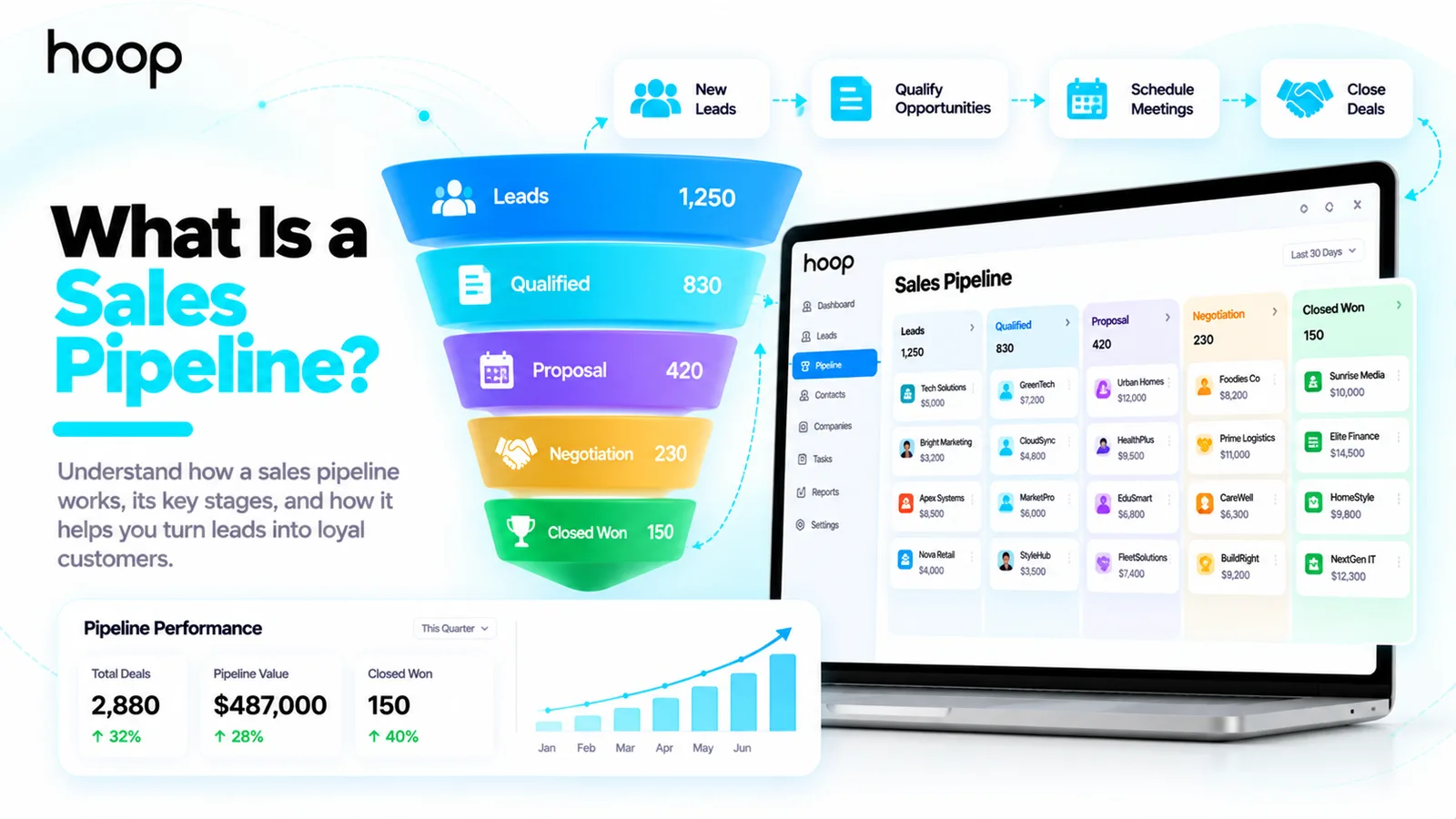
A sales pipeline tracks individual deals by stage, owner, value, and next action. Stage changes should follow buyer evidence, not salesperson optimism.
Sahar
Content Writer
A sales pipeline is a system for tracking potential deals from first contact to a purchasing decision. It shows which opportunities need attention, who owns each deal, and what happens next. You can use a spreadsheet or customer relationship management (CRM) software to maintain one.
For example, a web development agency might have 4 open opportunities: 2 discovery calls, 1 proposal, and 1 contract awaiting approval. The pipeline records each potential contract separately, rather than grouping every email contact into one list. A clear pipeline helps you see whether conversations are progressing or simply accumulating.
Need this done right?
Hoop builds the strategy, design and development behind sites like this one — talk to us about yours.
What Does a Sales Pipeline Mean in Simple Terms?
A sales pipeline records potential purchases as opportunities or deals, then organizes each deal by its current sales stage. Every deal should include a buyer, estimated value, owner, next action, and expected decision date. You can review those details to prioritize your work and estimate possible revenue.
A lead is a person or company showing possible interest. A contact is a saved individual. An account represents a company. A deal represents a specific potential purchase. One account can therefore have 3 contacts and 2 separate deals. Keeping those records distinct prevents inflated opportunity counts.
Pipeline language also becomes easier once you separate 3 related terms. Pipeline value is the combined value of open deals. Pipeline generation means creating qualified new opportunities. Pipeline coverage compares open pipeline value with a sales target. None of those figures equals money already earned.
What does an open pipeline include?
An open pipeline includes opportunities that have not reached a final outcome. For example, a $12,000 CRM implementation proposal and an $8,000 website redesign estimate create $20,000 in open pipeline value. You have not earned that revenue until the customer purchases and the required revenue recognition conditions are met.
Is a pipeline just a list of prospects?
No. A prospect list includes people you could contact. A functioning pipeline records qualified opportunities with real progress and measurable next steps. A list of 500 scraped email addresses does not automatically represent 500 active sales opportunities.
What Are the Main Sales Pipeline Stages?
Most businesses use 5 to 7 stages that match their purchasing process. You should define each stage using buyer evidence rather than salesperson activity alone. The following 6-stage model fits many B2B services, agencies, and software providers.
1. Prospecting and initial contact
Identify relevant companies and start conversations through referrals, website inquiries, outbound email, or LinkedIn outreach. Record the source and contact owner. Do not create a forecastable deal solely because someone opened an email or accepted a connection request.
2. Qualification
Confirm that the prospect has a real problem, fits your offering, and can follow a plausible purchasing process. Ask about project goals, urgency, stakeholder involvement, and budget expectations. Move unsuitable contacts to a nurturing list rather than leaving them permanently open as deals. Our guide on how to qualify sales leads covers the questions worth asking.
3. Discovery or demonstration
Schedule a discovery meeting, product demonstration, or needs assessment. Record the buyer’s current process, desired outcome, and evaluation criteria. Advance the opportunity only after both parties agree on a meaningful next step.
4. Proposal or quote
Present the service scope, deliverables, costs, timeline, and commercial terms. A proposal stage should require an actual quote shared with the prospect. Preparing an internal estimate does not prove the buyer has reached the proposal stage.
5. Negotiation and approval
Resolve procurement requirements, security reviews, commercial objections, and contract revisions. Identify who can sign, which conditions remain outstanding, and when the buyer expects approval. A buyer requesting an additional discount is not the same as a committed purchase.
6. Closed-won or closed-lost
Mark a deal closed-won after the buyer formally commits under your company’s sales rules. Mark a deal closed-lost when the opportunity ends without a purchase. Record the loss reason, such as budget mismatch, timing, competitor selection, or missing product capability. Keep inactive deals out of active forecasts.
How Does a Sales Pipeline Work in a Real Business?
A sales pipeline works by connecting each opportunity to a defined stage, an accountable owner, and a next action. Consider a SaaS provider selling a $6,000 annual subscription to a 30-person company. The prospect requests a demo, confirms a reporting problem, reviews a proposal, and approves the subscription.
The record begins as a new inquiry, advances after confirmed discovery, and ends as closed-won when the contract becomes effective. Another prospect might stop responding after receiving a proposal. That deal stays visible for follow-up, but the sales team should not keep moving its close date without new buyer evidence.
For a service agency, the same structure might track a $15,000 custom mobile app project. The team qualifies the business need before preparing a detailed scope. A clear process protects the agency from spending 8 unpaid hours preparing proposals for buyers with no realistic budget.
What information belongs on every deal record?
Store the company name, buyer contact, estimated value, current stage, assigned owner, lead source, last interaction date, next activity date, and expected close date. Add qualification notes and known blockers. A short mandatory field set is more useful than 30 fields that nobody updates.
What happens when a deal stops moving?
Flag a stalled opportunity when the next action passes its due date or the buyer fails to complete an agreed milestone. Contact the buyer with a specific question about the next decision. Move the opportunity to nurturing or closed-lost when evidence shows no active purchase. Avoid inventing progress to protect a forecast.
How Do You Build a Sales Pipeline From Scratch?
To build a sales pipeline, map your actual buying process, define stage entry rules, and create a consistent record for each qualified opportunity. Start with the simplest setup your team can maintain.
- Define your ideal customer profile using company type, project size, customer problem, and service fit.
- Choose 5 to 7 stages that represent customer decisions, including a final won or lost outcome.
- Write stage entry and exit criteria. For example, a deal enters Proposal only after the buyer receives a priced scope.
- Select a shared spreadsheet or CRM platform and assign a clear owner to each opportunity.
- Add essential fields: value, stage, expected decision date, next activity, source, and loss reason.
- Run a weekly review to identify stalled deals, missing next steps, and unrealistic dates.
- Compare actual wins with forecasts monthly and revise stage definitions when outcomes show a mismatch.
For a longer walk-through of that setup, see our guide on how to build a sales pipeline. Your acquisition channels should feed prospects into the qualification step, not automatically into the sales forecast. For relevant inbound and outbound approaches, review Hoop Interactive’s lead generation services.
Should small businesses use a spreadsheet or CRM?
Start with a spreadsheet when 1 owner manages a limited number of opportunities and can maintain records consistently. Move to a CRM when multiple team members need shared notes, reminders, reporting, permissions, or connected email history. Compare the cost of software with the cost of missed follow-ups and duplicate work.
Which sales pipeline tools can you use?
HubSpot, Salesforce, Pipedrive, and Zoho CRM offer ways to store deals, customize stages, assign owners, and build reports. The right tool depends on your budget, security requirements, integration needs, and team capacity. Test a simple workflow before paying for features your representatives will not use.
How Do You Manage a Sales Pipeline Every Week?
To manage a sales pipeline every week, review deal progress, evidence, and next actions rather than asking representatives to read every contact record aloud. Keep the meeting focused on decisions and obstacles.
| Task | Timing | Method | Difficulty |
|---|---|---|---|
| Check new deals | Daily | Confirm owner, fit and next step | Low |
| Review overdue actions | Daily | Filter by next-activity date | Low |
| Inspect stalled deals | Weekly | Review last buyer response and blocker | Medium |
| Audit stage criteria | Weekly | Confirm buyer evidence before advancing | Medium |
| Update close forecast | Weekly | Review dates, value and buyer commitment | Medium |
| Analyze loss reasons | Monthly | Group closed-lost deals by cause | Medium |
An effective review asks 4 questions: What changed since the last buyer interaction? What evidence supports the current stage? Which action happens next? Who owns that action and when is it due? A salesperson should leave the review with clear decisions, not extra administrative work.
Good pipeline hygiene also depends on useful source data. Check email addresses, decision-maker roles, and company information before outreach. Flag duplicate accounts and outdated contact records. Automate routine reminders carefully, but keep negotiations and high-stakes customer conversations personal.
What Is the Difference Between a Sales Pipeline and a Sales Funnel?
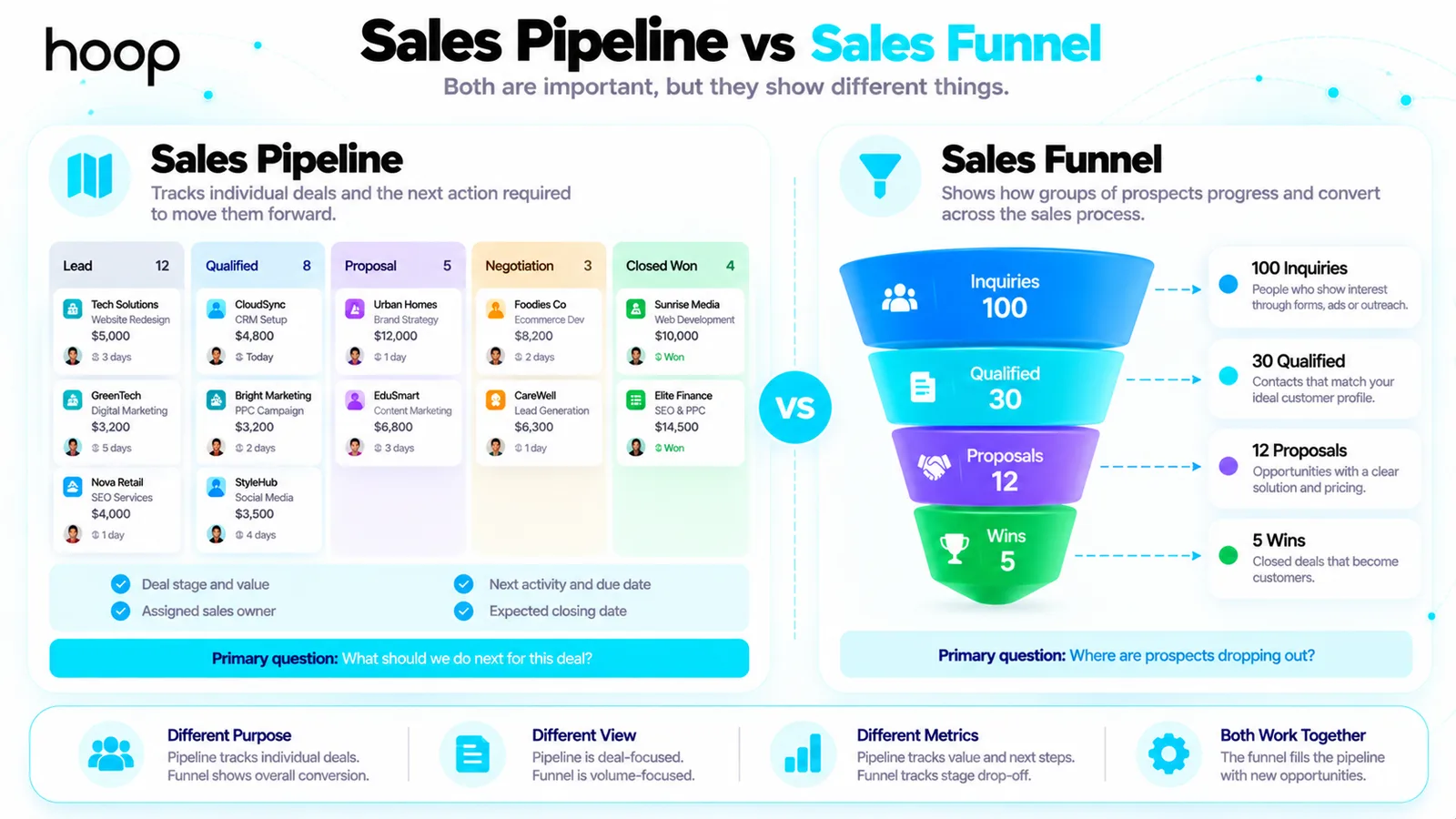
A sales pipeline tracks individual deal progress, while a sales funnel summarizes how groups of prospects convert between stages. A pipeline helps a representative decide what to do for a specific buyer. A funnel helps a manager see where conversion rates decline across many buyers.
For example, a funnel might show 100 inquiries, 30 qualified opportunities, 12 proposals, and 5 wins. The pipeline shows the names, owners, values, and next actions of those 30 opportunities. Both views serve different management decisions and can use the same underlying customer records.
Marketing channels create awareness and demand before a buyer enters an active opportunity. Our social media marketing ideas illustrate ways to encourage relevant inquiries. Your qualification criteria then decide which inquiries belong in the sales pipeline.
Which Sales Pipeline Metrics Should You Track?
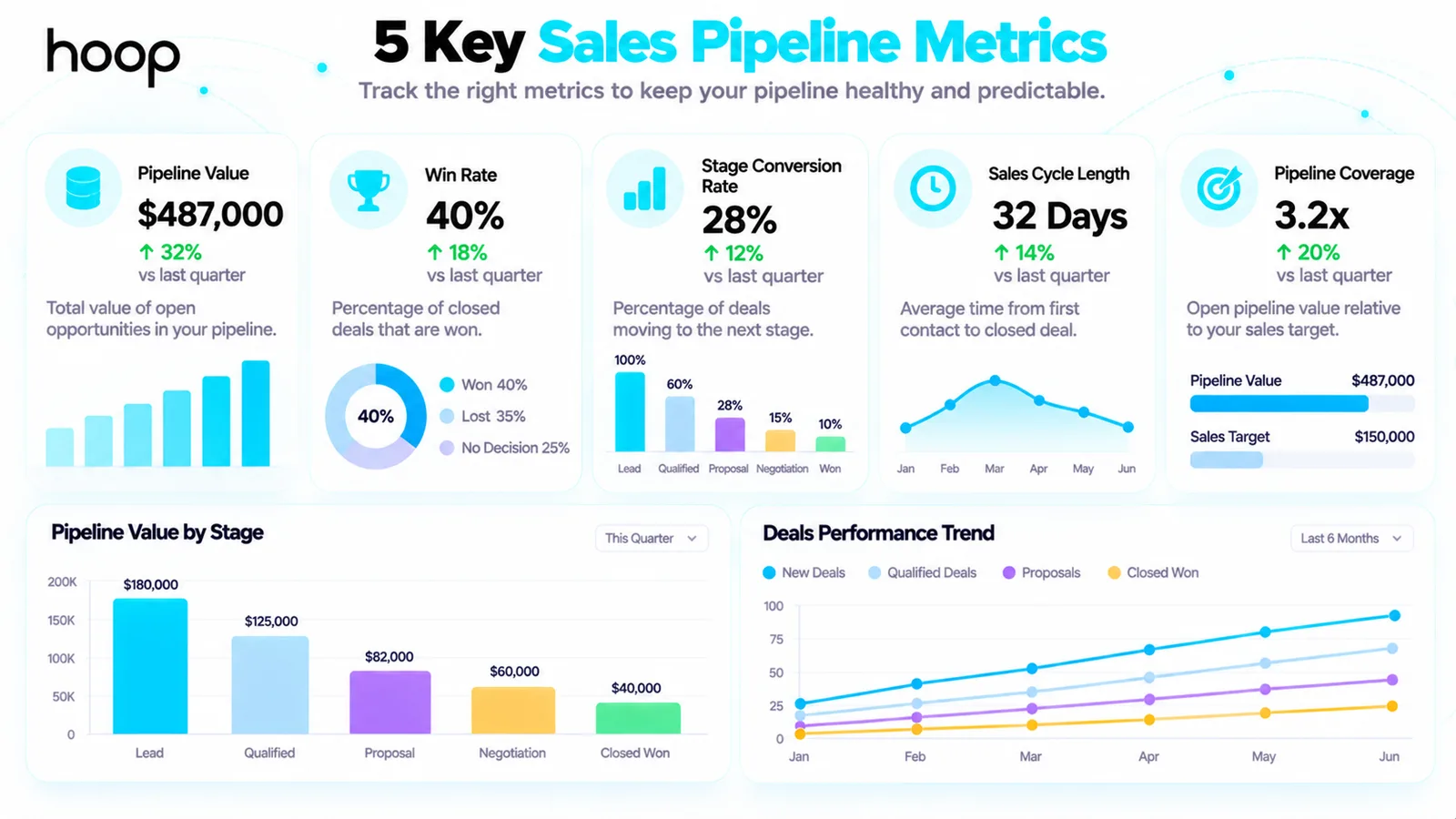
Track pipeline value, win rate, stage conversion, deal age, and sales cycle length before adding complex dashboards. The right figures help you identify weak stages and distinguish forecasted opportunities from completed revenue.
Pipeline value and weighted pipeline
Open pipeline value equals the sum of active deal amounts. If you have 3 opportunities worth $5,000, $10,000, and $15,000, the total open value is $30,000. A weighted pipeline multiplies each deal by its estimated win probability. Use probabilities grounded in historical outcomes, not hopeful guesses.
Win rate and stage conversion
Calculate win rate by dividing won opportunities by all decided opportunities in the same period. If your team wins 12 deals and loses 18, the win rate is 40%. Stage conversion measures how many opportunities progress from one defined stage to the next. Review conversion by lead source and deal size for useful context.
Sales cycle length and pipeline velocity
Measure sales cycle length from a consistently defined start point to the closed-won date. Pipeline velocity combines opportunity count, average deal value, win rate, and sales cycle length. The common calculation divides their product by average cycle days. Use comparable deals and periods to avoid misleading results.
Forecast accuracy and pipeline coverage
Compare your predicted closed revenue with actual results over the same period. Pipeline coverage divides relevant open opportunity value by the sales target. A 3-times ratio does not guarantee hitting quota because deal probabilities, timing, and average value differ by business. Never treat a coverage benchmark as universal.
Why Do Sales Pipelines Become Unreliable?
Sales pipelines become unreliable when opportunities lack buyer evidence, employees avoid updating records, or managers reward inflated forecasts. A full-looking board can hide stalled proposals and duplicate deals.
Too many unqualified deals
Remove contacts that lack a defined business need or a realistic purchasing path. Store early interest in a separate lead list. Create a sales opportunity when a specific purchase becomes plausible. The distinction improves forecast quality without discarding future prospects.
No next activity or clear owner
Assign one accountable deal owner and a dated next step. Set reminders for unanswered proposals, scheduled demos, and pending approvals. A generic status such as “following up” does not tell your team what action will move the deal forward.
Changing dates instead of resolving blockers
Ask why an expected closing date moved. Record the buyer’s stated reason, such as finance approval or legal review. Repeated unexplained date changes suggest weak qualification or an inactive opportunity. Review those records before counting revenue in the forecast.
Finally, connect acquisition reports with actual opportunity outcomes. A broader digital marketing strategy guide explains how SEO, advertising, and content support customer acquisition. Your CRM should show which channels produce sales opportunities, not just website traffic.
What Should You Do When Your Pipeline Is Empty?
An empty pipeline usually signals an acquisition or qualification problem, not a reporting problem. Review your recent inquiry sources, then identify the channel that produced your last 5 successful opportunities. Contact appropriate past prospects, request relevant customer referrals, and publish useful information that answers common buying questions. Record each response before deciding whether a real opportunity exists.
Do not fill the pipeline with unverified names just to improve an activity report. Instead, track 3 separate figures: new contacts, qualified conversations, and new sales opportunities. The difference shows whether your team needs stronger targeting, better messaging, or improved discovery calls. Review results after a consistent period and adjust one weakness at a time.
How Can You Turn Pipeline Visibility Into Better Sales Decisions?
A useful sales pipeline does more than count prospects. It gives each active opportunity a clear stage, an accountable owner, and a credible next action. Start with simple rules, maintain accurate buyer information, and review stalled deals regularly.
Hoop Interactive helps businesses connect demand generation with measurable sales outcomes. Talk to the team through our lead generation services.
“A list of 500 scraped email addresses does not automatically represent 500 active sales opportunities.”
Key takeaways
- 01Five to seven stages, each with written entry and exit criteria.
- 02A lead, a contact, an account, and a deal are four different records.
- 03Open pipeline value is not revenue — and a 3x coverage ratio guarantees nothing.
- 04The weekly review asks what changed, what evidence supports the stage, what happens next, and who owns it.
Written by
Sahar
Content Writer
Frequently Asked
Questions
Everything you need to know before booking a strategy call. Can't find your answer? Contact us directly.
No. A pipeline is a method of organizing sales opportunities. A CRM is software that can store pipeline records, contacts, communication history, and reports.
Yes. A shared spreadsheet can track stages, deal values, owners, and next steps. A CRM becomes useful as coordination and reporting requirements increase.
Start with 5 to 7 meaningful stages. Remove stages that do not represent a clear buyer milestone. Add a stage only when your sales process needs a distinct decision point.
No. Open pipeline value represents potential purchases, not confirmed sales. Forecast accuracy depends on qualification quality, realistic close dates, conversion rates, and buyer commitment.
Review overdue activities daily and overall deal health weekly. Analyze win rates, stage conversion, and loss reasons monthly to identify recurring process problems.