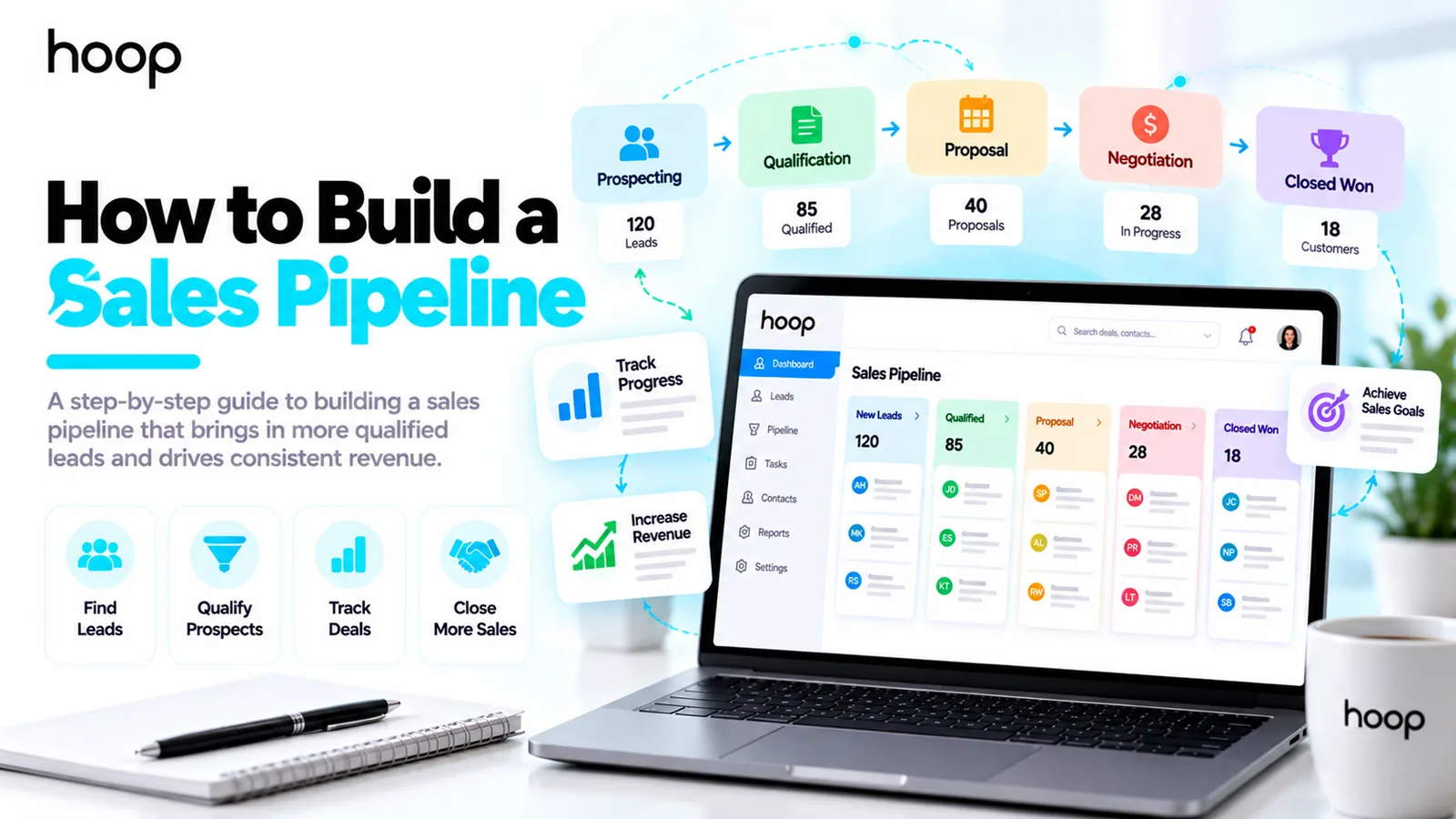
How to Build a Sales Pipeline
A pipeline is not a contact list. Every open deal needs a stage with entry evidence, an owner, and a dated next action — and a weekly review that moves it or closes it.
Sahar
Content Writer
To build a sales pipeline, define your ideal buyers, select clear deal stages, add qualified prospects, and track a next action for every opportunity. Review the pipeline weekly so leads move toward a decision instead of sitting in a contact list.
A full contact database does not automatically produce sales. A working pipeline connects specific buyers with a repeatable sales process, accountable owners, and measurable outcomes. You can start with a spreadsheet and improve the workflow as your business grows.
Need this done right?
Hoop builds the strategy, design and development behind sites like this one — talk to us about yours.
What Does Building a Sales Pipeline Actually Mean?
Building a sales pipeline means creating a repeatable system for finding, qualifying, progressing, and closing sales opportunities. Every open deal has a current stage, relevant buyer information, a responsible salesperson, and a recorded next step.
A pipeline differs from a sales funnel. A funnel summarizes how groups of potential customers convert across the buyer journey. A pipeline shows your team what to do with individual opportunities. For example, a CRM deal card can show that a marketing director reviewed a proposal and needs a follow-up on Friday.
Use pipeline management to answer 3 questions: Is the buyer suitable? What action moves the deal forward? Who owns the action? Buyers can pause or reverse decisions, so stage movement must reflect evidence rather than a salesperson’s optimism.
How to Build a Sales Pipeline in 8 Steps
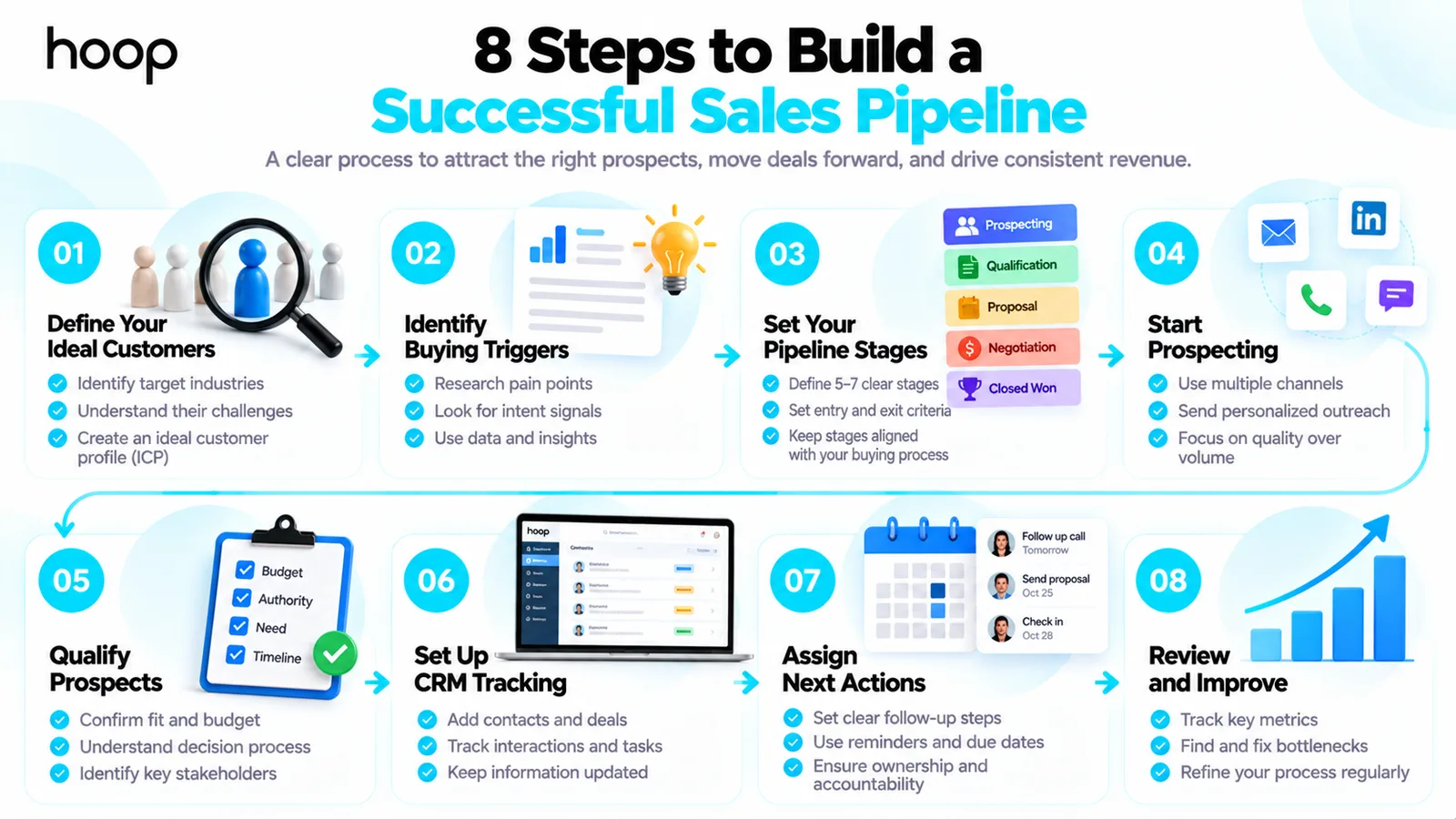
Step 1: Define Your Ideal Customer Profile
To define your ideal customer profile, describe the businesses that get measurable value from your offer. Record industry, company size, buying situation, core problem, and disqualifying factors. Build separate profiles when agencies and freelance consultants purchase differently.
For a B2B software product, you could focus on agencies with 10–50 employees and recurring client reporting demands. For a design agency, you could focus on funded brands preparing website migrations. These are example filters, not universal requirements.
Interview 5 existing customers or prospects. Ask what triggered their search, who approved the purchase, and what outcome mattered. Look for repeated patterns before expanding targeting.
Step 2: Identify Your Buyer and Buying Triggers
To identify buying triggers, look for signs of an active business change. Examples include a newly appointed revenue leader, a software migration, growing support volume, or an upcoming product launch. A trigger gives your outreach a relevant reason.
Map the economic buyer, daily user, and potential blockers. In a small business, the founder often fills each role. Enterprise accounts commonly require input from finance, procurement, security, and department heads.
Avoid treating company size or funding announcements as proof of intent. Confirm the problem through a conversation or a clear request before promoting a prospect to a qualified opportunity.
Step 3: Choose Stages With Entry and Exit Rules
To choose pipeline stages, trace the buyer’s real decision process. Start with 6 practical stages: prospect identified, contacted, qualified, discovery completed, proposal or evaluation, and decision. Track closed-won and closed-lost separately as final outcomes.
Write 1 entry rule and 1 exit rule for every stage. For example, move a deal into qualified only after confirming the business problem, fit, and next conversation. Never advance a deal because the salesperson sent another email.
Step 4: Create a Consistent Prospecting Routine
To create a prospecting routine, select 1 or 2 channels that reach your ideal buyer. Use targeted email, relevant professional conversations, referrals, search content, or partnerships. Start with smaller lists that you can research properly.
Set an initial activity plan, such as researching 10 suitable accounts each day and sending 5 contextual messages. Treat those numbers as a test. Record replies, meetings, and accepted opportunities to understand which activity earns progress.
Marketing and sales should agree on what qualifies as a lead. Hoop’s lead generation services page illustrates how inbound and outbound activities can connect with qualification and pipeline tracking.
Step 5: Qualify Before Creating Forecastable Deals
To qualify prospects, ask about their problem, current approach, business impact, decision process, and expected timing. Discuss budget without turning the first meeting into an interrogation. A lead belongs in the opportunity forecast only when a meaningful purchase is possible.
Separate research-stage inquiries from active sales opportunities. A free resource download shows interest, but not necessarily purchasing intent. Give early-stage contacts relevant education and revisit qualification after a clear buying signal.
Step 6: Set Up a CRM or Structured Spreadsheet
To set up a pipeline tracker, create fields for company, contact, source, deal value, stage, owner, next action, due date, and last contact. Include reasons for disqualification and closed-lost outcomes. Keep company records separate from opportunities so repeat purchases stay trackable.
A spreadsheet works for a small number of active deals. A customer relationship management (CRM) platform such as HubSpot, Pipedrive, or Salesforce provides stronger assignment, reminders, reporting, and integration features when workload grows.
Test the workflow with 5 example opportunities before importing hundreds of records. Confirm that each salesperson can update a deal within 30 seconds. Complex required fields often reduce data quality when sales teams avoid using the system.
Step 7: Assign Every Deal a Next Action
To assign a next action, record a concrete step, owner, and due date immediately after each meaningful interaction. Examples include sending technical requirements, scheduling a stakeholder demo, or confirming a procurement timeline.
“Follow up soon” is not an action. “Ask the finance director about approval by Thursday” names the person, purpose, and deadline. Clear actions prevent stalled deals from remaining invisible until month-end.
Step 8: Review Results and Adjust Your Pipeline
To review pipeline results, inspect new opportunities, stage conversion, time spent in each stage, and lost-deal reasons. Hold a short weekly review for active deals and a monthly review for trends. Adjust stage definitions only when buyer evidence supports a change.
Do not respond to low conversion by adding more leads automatically. Weak close rates can reflect poor targeting, unclear positioning, pricing mismatch, missing stakeholders, or slow follow-up. Diagnose the failing stage before increasing acquisition spend.
Which Stages Should Your Sales Pipeline Include?
A useful pipeline usually has 5–7 active stages, but the correct number depends on the buying process. Give each stage an observable milestone rather than an internal activity label. Keep closed outcomes outside the active forecast.
| Stage | Entry evidence | Required next action | Typical owner |
|---|---|---|---|
| Prospect identified | Matches target account profile | Research need and contact | Prospector |
| Contacted | Relevant outreach completed | Request conversation or reply | Sales rep |
| Qualified | Fit and business problem confirmed | Schedule discovery | Sales rep |
| Discovery completed | Requirements and buying process understood | Agree on solution review | Account executive |
| Proposal / evaluation | Buyer reviews scoped solution | Confirm decision criteria | Account executive |
| Decision | Approval path and timing confirmed | Resolve final objection or close | Deal owner |
For enterprise selling, you may need a separate technical validation or procurement stage. For a small local service business, discovery and proposal can sometimes happen in 1 call. Avoid adding stages simply to make a dashboard look detailed.
How to Fill a New Sales Pipeline Without Wasting Your Budget
To fill a new sales pipeline, begin with buyer research and focused outreach before scaling paid acquisition. The first goal is learning which prospects recognize the problem and accept a sales conversation. Traffic volume alone cannot show that demand exists.
Start With Narrow Outbound Targeting
To start outbound targeting, choose 1 buyer segment and build a list of 50 relevant accounts. Note each company’s likely business challenge and the observable reason for contact. Write short messages that offer a specific next step, such as an audit or demonstration.
Track positive replies separately from automated replies and polite refusals. A message that receives attention without meetings does not yet prove product demand. Improve relevance using feedback from calls rather than sending more identical messages.
Build Inbound Paths That Capture Intent
To build inbound paths, publish useful content for problems your buyer actively searches. Match every topic with a relevant offer, such as a consultation, checklist, or demonstration. Connect landing page submissions with your opportunity tracker.
Use search, professional social channels, and referral content based on buyer behavior. Hoop’s social media marketing ideas guide includes specific content approaches for earning relevant conversations rather than counting attention alone.
Test Partnerships and Warm Introductions
To test partnerships, identify 5 complementary providers serving the same buyers without competing directly. For a SaaS reporting product, partners could include analytics consultants and implementation agencies. Offer a specific joint resource or referral arrangement.
Warm introductions can shorten trust-building, but referrals still need qualification. Record their source and conversion rate. Avoid assuming every referred prospect has a funded project.
How to Build a Sales Pipeline for Different Business Models
SaaS: Prove the Use Case Before Scaling Acquisition
To build a SaaS pipeline, identify a narrow user problem and recruit early design partners. Track demo requests, activated trials, stakeholder evaluations, and paid conversions separately. A free sign-up is not the same as a qualified purchase opportunity.
For example, a reporting platform targeting SEO agencies can offer a demonstration built around existing reporting work. The founder can interview 10 users, identify repeated pain points, and refine the pitch before expanding advertising. Keep agencies and freelance consultants in separate segments when buying behavior differs.
Small Business: Keep Ownership and Follow-Ups Simple
To build a small-business pipeline, start with a spreadsheet, 5 stages, and a 15-minute daily follow-up review. Record every inquiry source, estimated project value, and next contact date. A founder can manage early volume without investing in complex software.
For a $180,000 annual revenue business, begin with existing customers, referrals, and relevant local demand. Study the actual average deal value before calculating needed opportunities. Revenue alone cannot determine the correct pipeline target.
Enterprise: Track Stakeholders and Decision Gates
To build an enterprise pipeline, map the buying committee and approval requirements before forecasting a close date. Record champions, economic buyers, technical reviewers, procurement steps, and contractual dependencies. Separate vendor selection from purchasing approval when those events happen at different times.
Enterprise opportunities can remain active for months. Review stakeholder engagement and agreed customer milestones instead of judging progress only by recent emails. Require evidence for proposal-stage and commit-stage forecasts.
How to Calculate Pipeline Targets and Sales Performance
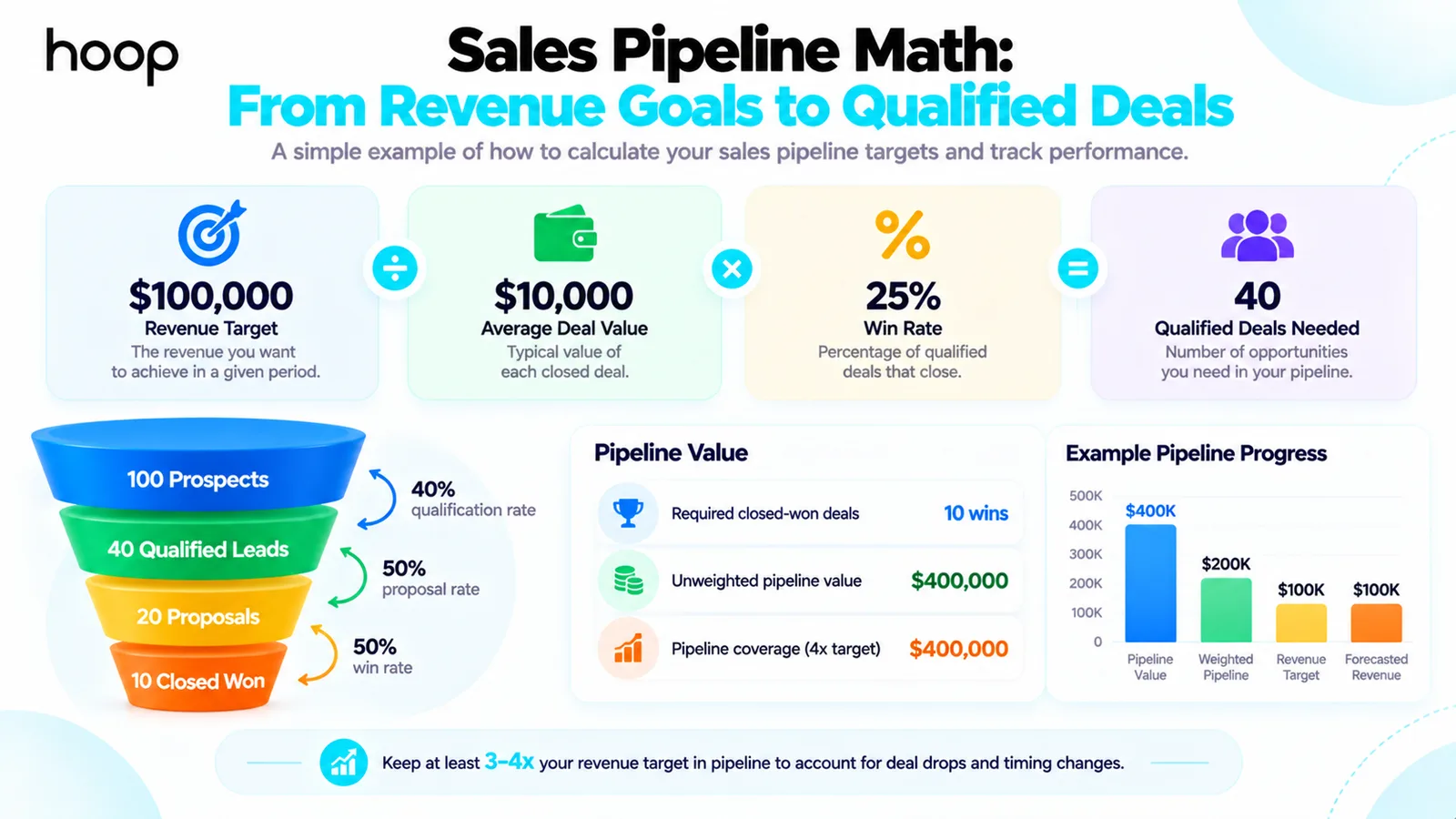
To calculate required pipeline volume, work backward from your revenue goal using observed close rates and average deal value. Keep targets as planning estimates until your own data confirms the assumptions.
Suppose your quarterly revenue target is $100,000, average won deal is $10,000, and opportunity win rate is 25%. You need approximately 10 wins and 40 qualified opportunities to meet the goal. Those 40 deals represent $400,000 in unweighted potential revenue.
Use win rate = won opportunities ÷ closed opportunities × 100. Calculate stage conversion using the number entering each stage as the denominator. Calculate sales cycle length from qualification date to close date for the same cohort.
A $400,000 pipeline is not a $400,000 forecast. Deals vary in likelihood, timing, and value. Weighted forecasts use stage-based probabilities, but reliable probabilities require historical evidence and regular review.
Track 4 metrics together: qualified opportunities created, stage-to-stage conversion, median days per stage, and revenue won. Add source-level customer acquisition cost when marketing expenses are available.
How to Manage a Pipeline and Fix Stalled Deals
To manage pipeline health, use a daily routine for overdue actions and a weekly review for major opportunities. A deal becomes risky when buyers miss agreed milestones, decision-makers disengage, or the next step remains unclear.
Run a 15-Minute Daily Review
To run a daily review, filter opportunities with overdue tasks, missing owners, or no scheduled action. Update actual contact outcomes and prioritize deals awaiting customer decisions. Reserve separate daily time for new prospecting so today’s urgent deals do not empty next month’s pipeline.
Use a Weekly Deal Inspection
To inspect deals weekly, ask what the buyer confirmed, what changed since the last review, and what happens next. Ask the deal owner to produce evidence rather than opinion. Move inactive opportunities into nurture or closed-lost status when no meaningful sales process remains.
A stalled proposal may need a shorter scope, a new stakeholder meeting, or a mutually agreed decision date. Repeated reminders cannot solve a poor fit. Record each lost reason to improve targeting and pricing.
Create a 30-Day Setup Plan
To create a 30-day plan, dedicate week 1 to buyer research and pipeline stages. Use week 2 to configure tracking and prospecting. Use week 3 to run discovery calls and refine qualification. Use week 4 to assess conversion, stage friction, and follow-up execution.
Treat the first month as a learning cycle, not a promise of immediate revenue. Keep the same segment and value proposition long enough to evaluate buyer responses. Change one major variable at a time.
Which Sales Pipeline Mistakes Should You Avoid?
Avoid confusing activity with progress. Sending 30 messages does not move a deal forward unless the buyer responds or commits to a meaningful milestone. Do not fill your forecast with contacts who have never confirmed interest.
- Avoid creating 10 stages for a 2-call purchase process.
- Avoid tracking only total deal value without stage age and win rates.
- Avoid moving opportunities forward based on internal tasks alone.
- Avoid importing unqualified mailing lists as active sales deals.
- Avoid leaving closed-lost reasons blank after a decision.
- Avoid replacing customer discovery with automated messages.
Sales and marketing planning should share the same qualification definitions. Hoop’s digital marketing strategy guide shows how acquisition channels can support measurable business outcomes rather than isolated traffic numbers.
Build a Pipeline That Supports Real Sales Decisions
A useful sales pipeline begins with buyer fit and ends with an accountable next action for every opportunity. Clear stages, relevant prospecting, disciplined qualification, and weekly review create better visibility into sales progress.
Hoop Interactive can help connect your marketing campaigns with a more structured lead qualification process. Contact the team to discuss your customer acquisition goals.
“A $400,000 pipeline is not a $400,000 forecast. Deals vary in likelihood, timing, and value.”
Key takeaways
- 01Start with 5 to 7 stages and give each one an entry rule and an exit rule tied to buyer evidence.
- 02Work pipeline targets backward from revenue: $100k at a $10k deal and 25% win rate needs 40 qualified opportunities.
- 03"Follow up soon" is not a next action. Name the person, the purpose, and the deadline.
- 04Low close rates usually mean a broken stage, not too few leads — diagnose before buying more traffic.
Written by
Sahar
Content Writer
Frequently Asked
Questions
Everything you need to know before booking a strategy call. Can't find your answer? Contact us directly.
Yes. Start with a spreadsheet that tracks buyer, deal stage, value, owner, and next action. Move to CRM software when team coordination and reporting become difficult.
Start with 5 to 7 active stages. Match the stages to buyer decisions. Add a stage only when the new milestone helps your team make a better decision.
A basic structure can take 1 to 2 days. Developing a reliable flow of qualified opportunities takes longer and depends on buyer demand, sales cycle, and outreach quality.
Start with targeted outreach, referrals, and useful content. Research a narrow buyer segment, personalize contact, record responses, and reinvest in channels that create qualified conversations.
No. Keep unqualified contacts in a separate lead list or nurturing workflow. Add forecastable opportunities after confirming fit, a relevant need, and an agreed next step.