

Social Media Marketing Ideas: 35 Ways to Grow Your Brand
Thirty-five social media ideas grouped by the outcome they serve — awareness, engagement, trust, leads, and low-budget execution — plus a weekly system for generating ideas from customer questions instead of waiting for inspiration.
Sahar
Content Writer
Social media marketing ideas work best when each idea supports a clear business goal. You should choose content that builds awareness, earns trust, creates conversations, generates leads, or supports sales.
A useful ideas list should do more than fill your content calendar. The list should help you create content that answers customer questions, removes buying objections, and gives people a reason to engage.
You also need a repeatable idea system. Random inspiration runs out quickly. Customer conversations, reviews, sales calls, search behavior, and past winners give you stronger inputs every week.
What Makes Social Media Marketing Ideas Worth Using?
A strong idea connects audience interest with a business outcome. The idea gives your audience useful information, proof, entertainment, access, or a clear next step.
A weak idea starts with a format. A stronger idea starts with a customer need. You can then choose Reels, carousels, Stories, polls, or text posts.
For example, a software company should not post a product screenshot without context. The company should show one user problem, one workflow, and one measurable result.
Your social media marketing ideas should also match your available resources. A 5-person team can support video, design, and community activity. A solo founder needs a simpler production system.
How to Choose Social Media Marketing Ideas for Your Goal
To choose social media marketing ideas for your goal, define the result before you select the post format. Each goal needs different content signals and calls to action.
Choose ideas for awareness
Use educational opinions, founder stories, timely commentary, collaborations, and recognizable problems. Awareness content should introduce your brand to qualified people.
Choose ideas for trust
Use customer proof, demonstrations, case studies, process explanations, and objection handling. Trust content should reduce uncertainty before a buyer takes action.
Choose ideas for leads and sales
Use checklists, audits, lead magnets, product walkthroughs, comparisons, and direct offers. Lead content should create a clear path from attention to action.
If you need a broader planning framework, Hoop’s social media basics guide explains how content, engagement, paid activity, and analytics fit together.
Social Media Marketing Ideas for Brand Awareness
Brand awareness content should make your expertise, perspective, and identity easy to recognize. The strongest ideas give people a reason to remember your brand.
- Share your founder story with one specific turning point, lesson, and business outcome.
- Publish a strong industry opinion and support the opinion with one clear reason.
- React to a relevant industry development and explain what the development changes for customers.
- Feature one employee and show the work, skill, or customer value behind the role.
- Collaborate with a complementary brand, creator, supplier, or partner on one useful topic.
- Turn one common misconception into a short myth-versus-fact post.
- Explain one industry term in plain language and connect the term to a real customer decision.
These ideas work because awareness grows through repeated, recognizable signals. Consistent topics and viewpoints help people understand what your brand represents.
Social Media Marketing Ideas for Engagement
Engagement ideas should make participation easy and meaningful. You should ask for opinions, choices, experiences, or reactions that relate directly to your market.
- Run a 2-option poll about a real customer preference, workflow, or buying priority.
- Ask one focused question that customers can answer in less than 30 seconds.
- Create a “choose one” post with 2 products, methods, or outcomes.
- Publish a short quiz that tests knowledge about your industry, service, or product category.
- Ask followers to submit questions for a weekly expert response series.
- Invite customers to share a result, setup, use case, or before-and-after example.
- Reply to one strong audience comment with a dedicated follow-up post or video.
Avoid engagement bait that has no connection to your business. Meaningful comments reveal language, objections, and topics you can reuse later.
Social Media Marketing Ideas for Building Trust
Trust content should prove capability and reduce risk. Buyers need evidence before buyers choose a company, product, service, or subscription.
- Share a customer testimonial with one specific problem and one specific result.
- Turn a successful project into a short case study with problem, action, and outcome.
- Show your process when the process demonstrates quality, expertise, safety, or care.
- Explain one common mistake and show the correct approach.
- Answer one sales objection directly, such as price, time, complexity, risk, or switching effort.
- Compare 2 approaches and explain which situations fit each approach.
- Show a product or service in use instead of relying on promotional claims.
Behind-the-scenes content works when the process creates trust or differentiation. A random office clip rarely helps a buyer make a decision.
Social Media Marketing Ideas for Generating Leads
Lead generation content should offer a useful next step. The next step can include a checklist, audit, guide, consultation, demo, template, or trial.
- Offer a practical checklist that solves one narrow problem for your target audience.
- Promote a mini audit that identifies one costly issue and gives one clear recommendation.
- Create a downloadable template for a recurring task, decision, or planning process.
- Publish a short product demonstration that ends with a specific demo or trial invitation.
- Share a before-and-after example with the steps that created the improvement.
- Build a recurring question series and invite qualified prospects to continue the conversation privately.
- Turn one high-intent customer question into a post with a direct service call to action.
Low-Budget Social Media Marketing Ideas
Low-budget ideas should depend on expertise, access, and customer insight instead of expensive production. A phone, simple design template, and clear message can support effective content.
- Record a 30-second answer to one question from a customer, prospect, or sales call.
- Republish one customer review as a branded proof post with the outcome highlighted.
- Create a simple screen recording that demonstrates one useful feature or workflow.
- Trade audience access with a micro-creator through a joint interview, live session, or educational post.
- Turn one internal team discussion into a short lesson for customers.
- Rework one high-performing post with a new hook, example, format, or customer segment.
- Publish one weekly recurring series, such as Monday audits, Friday lessons, or monthly customer wins.
The best low-budget ideas reduce production complexity. Repetition also helps your audience recognize recurring formats and topics.
Where Can You Find Fresh Social Media Marketing Ideas?
You can find strong ideas inside customer behavior, customer language, and business activity. You should treat real questions and objections as an ongoing research source.
Use customer questions and sales calls
Write down repeated questions from sales calls, discovery calls, consultations, and onboarding conversations. Each repeated question signals demand for a clear explanation.
Use comments, direct messages, and reviews
Comments and direct messages reveal what people misunderstand, want, fear, or compare. Reviews reveal the outcomes customers value after a purchase.
Use support tickets and service requests
Support tickets expose friction after purchase. Educational posts can reduce repeated confusion while showing prospects how your team solves problems.
Use search behavior and competitor comments
Search queries reveal active demand. Competitor comment sections reveal unanswered questions without forcing you to copy the competitor’s content.
Use your existing winners
A winning topic deserves more angles. Change the hook, audience, example, depth, or format before you abandon a proven subject.
How to Turn 1 Social Media Idea Into 5 Posts
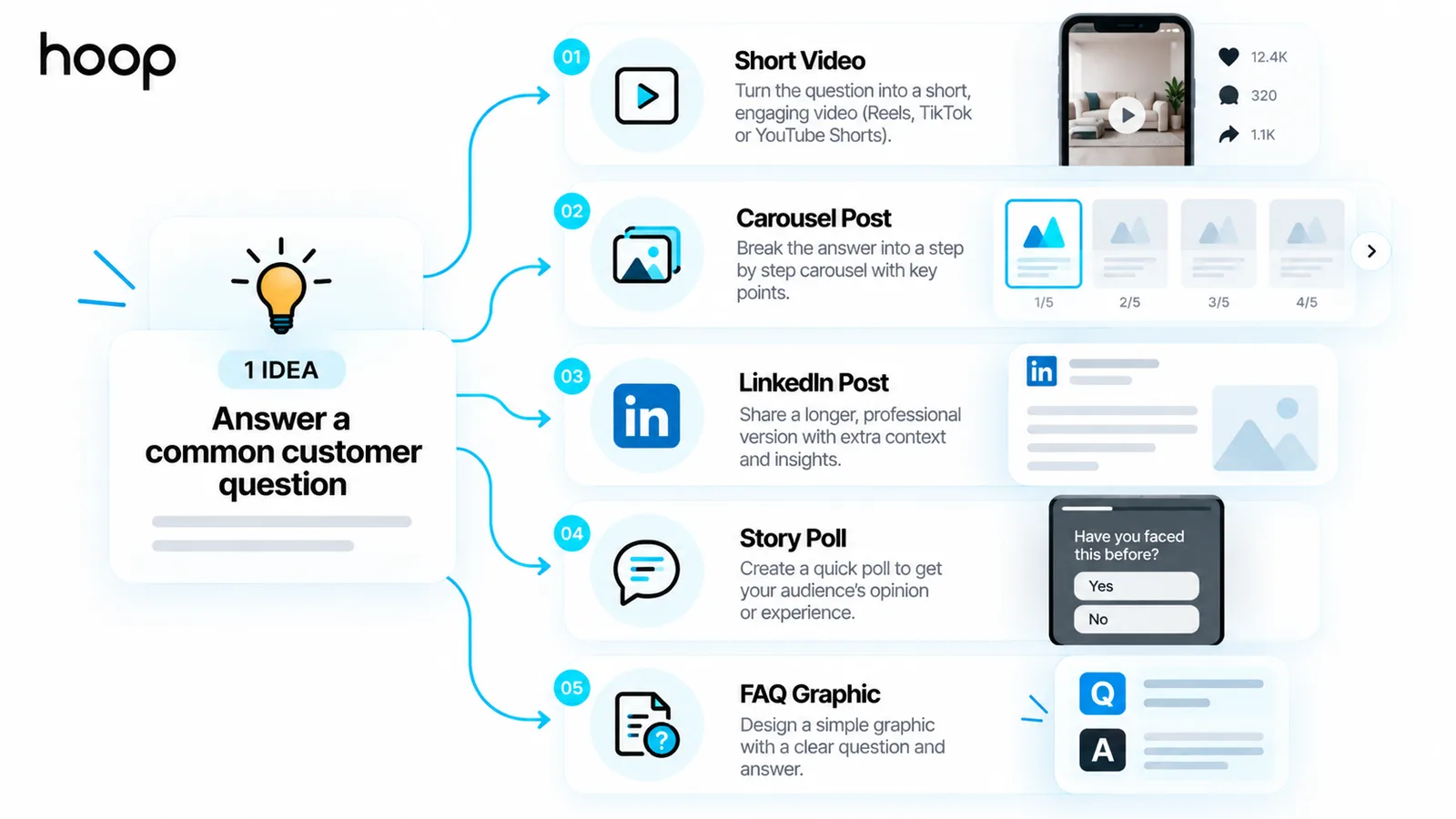
To turn 1 social media idea into 5 posts, keep the core insight and change the format or angle. Repurposing reduces research time without repeating identical content.
Start with one customer question: “Why does SEO take time?” You can create 5 assets from the same question:
- Record a 30-second short-form video with the direct answer.
- Create a 5-slide carousel that explains the timeline.
- Write a LinkedIn post about one common expectation gap.
- Run a Story poll about how long followers expect results to take.
- Publish an FAQ graphic with one concise answer and one action step.
Repurposing should change the experience, not only the dimensions. Each format should match the way people consume content on that platform.
For Instagram-specific execution, Hoop’s Instagram marketing strategy guide covers platform-focused planning, formats, and growth considerations.
How to Adapt Social Media Marketing Ideas Across Platforms
The core idea can stay consistent while the delivery changes by platform. You should adapt the hook, depth, format, and call to action for each audience.
Adapt ideas for LinkedIn
Use professional lessons, customer outcomes, founder viewpoints, process breakdowns, and business questions. LinkedIn rewards ideas that start useful conversations among relevant professionals.
Adapt ideas for Instagram
Use Reels for quick demonstrations, carousels for structured education, Stories for interaction, and proof posts for trust. Keep the first visual clear and specific.
Adapt ideas for TikTok
Use fast hooks, direct explanations, demonstrations, reactions, and recurring series. Show the value early because viewers decide quickly whether to continue watching.
Adapt ideas for YouTube
Use short videos for discovery and longer videos for detailed education, comparisons, demonstrations, and customer questions. Searchable topics can keep attracting viewers after publication.
Adapt ideas for Facebook
Use community discussions, customer proof, local content, event updates, offers, and educational posts. Groups can support deeper conversations around shared interests.
Do not copy the same caption and creative across every network. Platform-native execution gives each idea a clearer reason to exist.
How to Build a Weekly Idea System
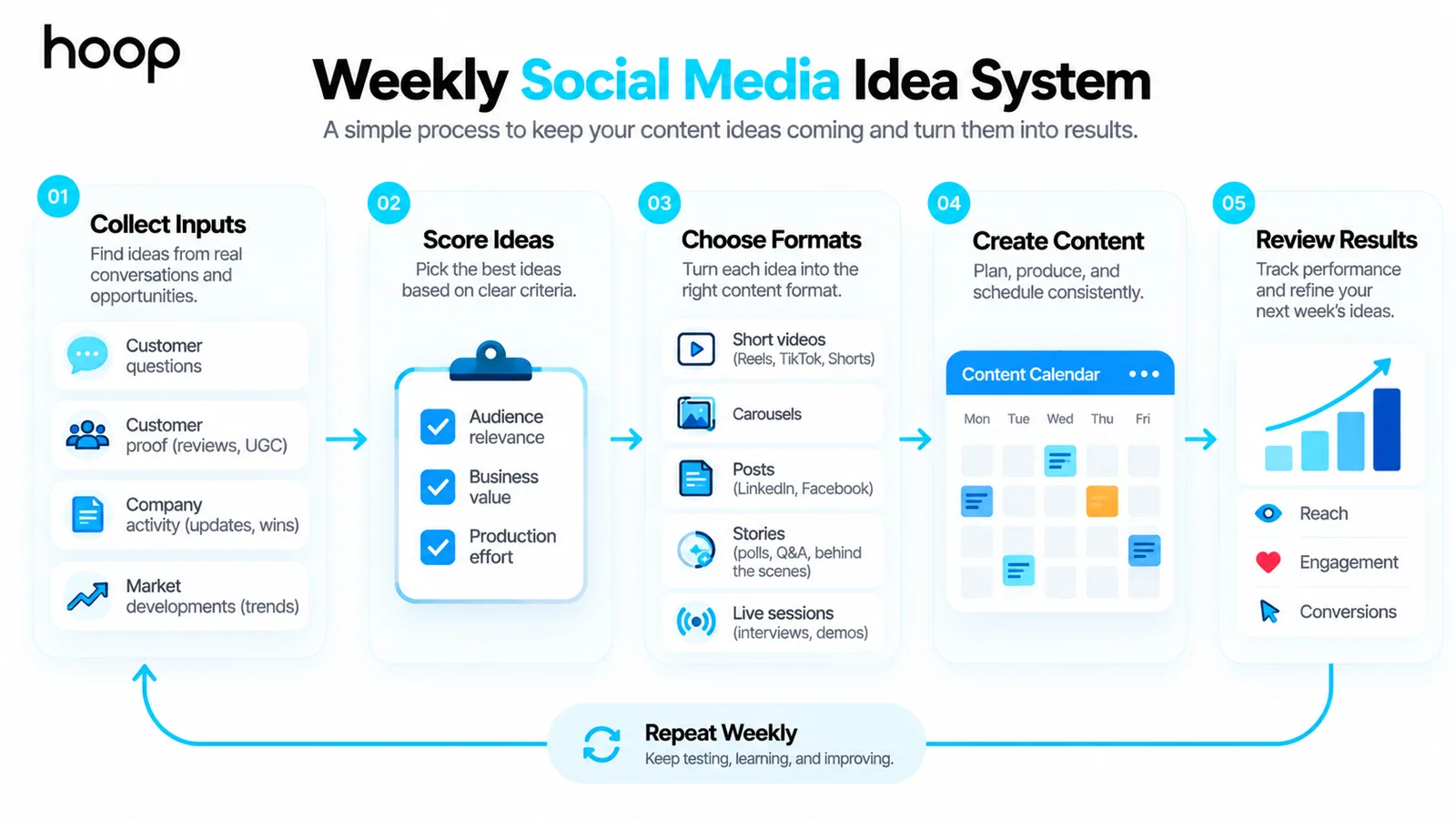
To build a weekly idea system, collect inputs continuously and review the inputs on one fixed day. A small idea bank removes pressure from daily content creation.
Use 4 categories: customer questions, customer proof, company activity, and market developments. Add at least 3 new notes to each category every week.
Keep one sentence beside every note that explains why the audience should care. The sentence forces you to connect the idea with a real need.
Then score each note against 3 factors: audience relevance, business value, and production effort. Publish high-value ideas first.
Reserve 1 slot for experiments each week. Test a new hook, format, topic, or call to action without replacing the entire content system.
| Task | Timing | Method | Difficulty |
|---|---|---|---|
| Collect inputs | 10 min | Capture questions, reviews, comments, calls, and support issues. | Easy |
| Score ideas | 10 min | Rate audience relevance, business value, and production effort. | Easy |
| Choose formats | 15 min | Match each idea with video, carousel, text, Story, or poll. | Medium |
| Create content | 60–180 min | Draft, record, design, edit, and prepare the call to action. | Medium |
| Review results | 20 min | Compare reach, engagement, leads, and sales against the post goal. | Medium |
A simple weekly system keeps your social media marketing ideas connected to real customer needs. The system also prevents trend chasing from replacing useful content.
How to Measure Which Social Media Marketing Ideas Work
To measure which ideas work, match each idea to one key performance indicator before publishing. Different goals require different metrics.
Measure awareness with reach and qualified profile activity
Track reach, profile visits, branded searches, and follower quality. A large reach number has limited value when the audience does not match your target market.
Measure engagement with meaningful actions
Track comments, saves, shares, replies, and direct messages. Meaningful actions show stronger interest than passive likes.
Measure leads with conversion actions
Track form submissions, booked calls, trial starts, downloads, and attributed inquiries. Add tracking parameters to links when your analytics setup supports campaign attribution.
Measure sales with revenue signals
Track purchases, opportunities, qualified pipeline, assisted conversions, and customer acquisition cost. Revenue metrics connect social activity to business performance.
What Mistakes Make Good Social Media Marketing Ideas Fail?
Good ideas fail when execution ignores audience fit, timing, clarity, or conversion paths. The idea alone cannot compensate for weak delivery.
- Avoid posting on every platform without a clear audience reason.
- Avoid copying trends that do not support your brand or customer needs.
- Avoid creating polished content that gives the audience no useful information.
- Avoid changing direction after 1 weak post or 1 quiet week.
- Avoid tracking likes when your real goal involves leads, sales, or retention.
- Avoid publishing without a next step when the content targets high-intent prospects.
A strong idea system combines creativity with discipline. You need enough consistency to learn which topics, formats, and messages actually perform.
Build a Repeatable Social Media Idea System
A strong social media marketing ideas library should grow from real customer needs, not random inspiration. Use questions, proof, objections, and business activity as your core inputs.
Choose each idea for a specific outcome, then match the idea with the right format, platform, and call to action. Review performance and repeat the themes that attract qualified attention.
If your team needs help turning ideas into a consistent growth system, explore Hoop Interactive’s social media services for strategy, content, community management, paid support, and reporting around measurable goals.
“A weak idea starts with a format. A stronger idea starts with a customer need.”
Key takeaways
- 01Start every idea with a customer need, not a format. The format is the last decision, not the first.
- 02Group ideas by business outcome so each post has one job and one matching metric.
- 03One customer question can become five assets: short video, carousel, LinkedIn post, Story poll, and FAQ graphic.
- 04Run a weekly idea bank fed by sales calls, comments, reviews, support tickets, and past winners.
Written by
Sahar
Content Writer
Frequently Asked
Questions
Everything you need to know before booking a strategy call. Can't find your answer? Contact us directly.
Customer questions, testimonials, demonstrations, local collaborations, educational videos, and recurring series work well for small businesses. Choose ideas that use existing expertise and access.
Collect ideas from sales calls, comments, reviews, support requests, search queries, and past winners. Review the idea bank on one fixed day each week.
Yes, when the trend fits your audience, message, and brand. Skip trends that create attention without relevance or a useful connection to your business.
Plan enough ideas to support your realistic publishing cadence. A business posting 3 times weekly needs at least 12 core ideas each month.
Yes. Adapt the hook, format, length, and call to action for LinkedIn, Instagram, TikTok, YouTube, or Facebook.