

Social Media Marketing Plan: How to Build One Your Team Can Run
A social media marketing plan is an operating document, not a posting schedule. Ten components — from one business outcome through platform roles, content pillars, ownership, and guardrail metrics — turn strategy into work your team can actually run for 90 days.
Sahar
Content Writer
A social media marketing plan turns business goals into a defined system for audience, platforms, content, ownership, budget, and measurement. A strong plan defines each task, assigns ownership, and shows how results guide the next decision.
The framework should stay useful beyond one platform update or trend cycle. Clear choices, repeatable workflows, and scheduled reviews keep execution focused.
What Is a Social Media Marketing Plan?
A social media marketing plan is an operating document that converts marketing goals into specific social media actions. The document names your audience, channel roles, content priorities, publishing cadence, resources, owners, budget, and success metrics.
A useful plan answers 6 questions: who, what, where, when, who owns the work, and how you measure results. The plan gives daily work a business purpose.
Your team should open the plan before approving a campaign, choosing a format, or adding another platform. Clear rules protect production time.
How Is a Social Media Marketing Plan Different From a Strategy and Calendar?
A strategy sets direction, a plan defines execution, and a content calendar schedules individual assets. Teams often confuse the 3 documents and jump directly into posting.
A social media strategy defines the audience change you want and the business result you need. A social media marketing plan converts that direction into platforms, campaigns, resources, owners, and metrics. A content calendar assigns dates to posts, videos, Stories, carousels, newsletters, or live sessions.
Keep each document separate enough to answer one question. Strategy answers why. The social media marketing plan answers how. The calendar answers what publishes next.
What Should a Social Media Marketing Plan Include?
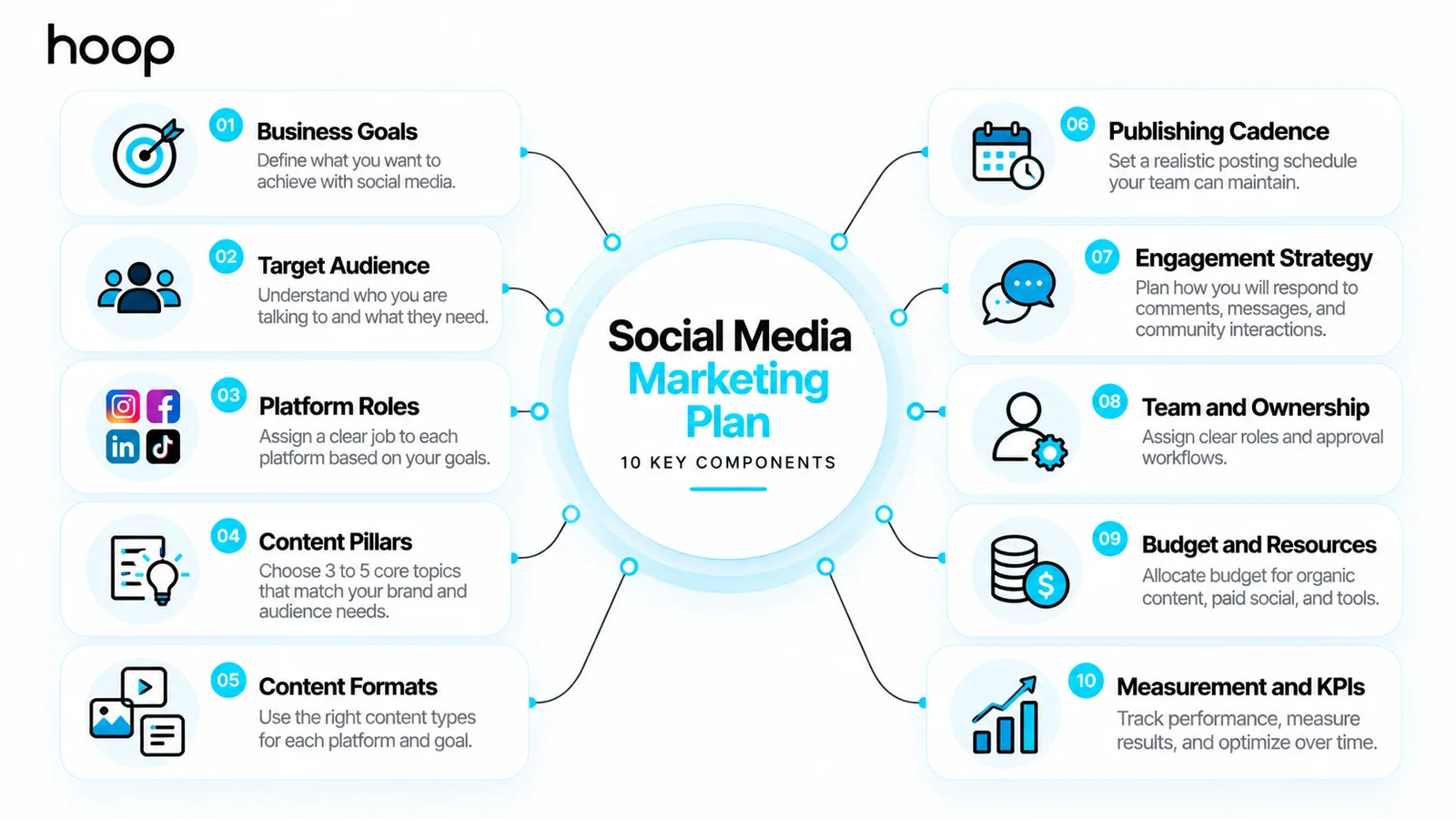
A complete social media marketing plan needs 10 connected components. Each component should guide a real decision rather than fill a template field.
- Write 1 business outcome with a numeric target and deadline.
- Define 1 priority audience using needs, objections, behavior, and buying stage.
- Assign each selected platform a specific job, such as discovery, demand, conversion, or retention.
- Choose 3 to 5 content pillars, such as education, proof, product, perspective, and community.
- Set a content mix using formats such as short video, carousels, text posts, Stories, and live sessions.
- Define a sustainable publishing cadence for each selected platform.
- Document engagement rules for comments, direct messages, mentions, complaints, and sales inquiries.
- Assign owners for research, writing, design, filming, approval, publishing, engagement, and reporting.
- Separate content, software, creator, agency, and paid media budgets.
- Choose key performance indicators, review dates, and rules for changing the plan.
The 10 components turn the document into an operating system. A list of post ideas cannot replace the same decision structure.
How to Build a Social Media Marketing Plan Around Business Goals
To build a social media marketing plan around business goals, start with 1 commercial outcome. Then define the audience action social media should influence.
Set 1 Business Outcome
Choose 1 outcome that leadership already cares about. Examples include 40 qualified leads, 200 product trials, 100 bookings, or $50,000 in attributed revenue.
Avoid goals such as “increase awareness” without a measurement rule. A stronger goal states the audience, action, number, and deadline. The social media marketing plan can then connect content activity to that target.
Define Social Media’s Role
Give social media 1 primary job for the planning period. Social media can build discovery, create demand, generate leads, support sales, improve retention, or strengthen community.
One business can use different channels for different jobs. LinkedIn can build business-to-business demand. Instagram can show product proof. YouTube can answer detailed buying questions.
Platform roles stop your plan from treating every channel like another place to repost the same asset.
Choose 1 Primary KPI and 2 Guardrails
Choose 1 key performance indicator tied to the business outcome. Then track 2 guardrail metrics. A lead goal can use qualified leads as the primary KPI.
Guardrails protect quality. Track cost per lead and lead-to-opportunity rate beside lead volume. A reach goal can track qualified website sessions and branded search demand beside impressions.
How to Identify the Right Audience and Platform Roles
To identify the right audience and platform roles, define who must act. Then identify where that audience consumes relevant information.
Define 1 Priority Audience
Describe 1 audience segment in buying terms, not demographic terms alone. Record the problem, desired outcome, objections, buying stage, preferred content, and common questions.
A software company can target operations leaders who need fewer manual workflows. A beauty brand can target buyers comparing finish, shade, wear, and application.
The strongest audience notes include customer language from sales calls, support tickets, reviews, search queries, and community discussions. Those sources reveal real wording and objections.
Assign Each Platform 1 Job
Assign each platform one main purpose before setting a posting schedule. The purpose should match audience behavior and your available content skills.
LinkedIn fits expert business content, founder perspectives, case studies, and lead generation. Instagram fits visual proof, demonstrations, creator content, and community. TikTok fits short-form discovery and rapid creative testing. YouTube fits detailed education and searchable video.
Use the Instagram marketing strategy guide when Instagram needs a dedicated channel plan. Keep the wider social media marketing plan focused on cross-channel decisions.
Use Competitor Research Without Copying
Study 5 to 10 direct competitors for patterns, gaps, and audience response. Record platform mix, posting frequency, formats, recurring topics, calls to action, and visible engagement quality.
Competitor research should reveal open space. Copying competitor topics creates another similar feed. Your plan should identify stronger proof or clearer expertise.
How to Build a Content System You Can Sustain
To build a content system you can sustain, connect recurring topics with repeatable formats. Match every format to realistic production capacity.
Choose 3 to 5 Content Pillars
Choose 3 to 5 recurring themes that connect audience questions with company expertise. A service company can use education, process, proof, objections, and perspective.
An ecommerce brand can use product education, demonstrations, customer results, lifestyle use, and offers. Each pillar needs a defined purpose.
Match Content Formats to Specific Jobs
Give each format a defined job. Short videos can attract new viewers. Carousels can teach steps. Case studies can prove outcomes. Stories can support active followers. Live sessions can answer detailed questions.
The format should serve the message. A complex comparison needs more space than a short hook. A simple demonstration benefits from motion and visual proof.
Set a Sustainable Publishing Cadence
Set the highest cadence your team can maintain for 90 days without lowering quality. Production capacity should decide frequency before ambition decides frequency.
Start with 2 to 4 strong weekly assets on a priority channel if your team has limited resources. Add output after the workflow becomes stable.
Your content plan should reserve capacity for timely posts, customer questions, launches, and strong ideas during execution.
How to Plan Community Management, Paid Support, and Conversion Paths
To plan community management, paid support, and conversion paths, define what happens after people see content. Publishing alone cannot handle buying intent.
Build a Comment and Direct-Message Workflow
Assign one owner and one response target for comments and direct messages. Create response categories for support, pricing, complaints, sales questions, partnerships, and spam.
Send qualified inquiries into a customer relationship management (CRM) system or sales workflow. Record source, need, owner, next action, and outcome.
The social media marketing plan should define escalation rules for legal claims, safety concerns, public complaints, and sensitive customer information.
Connect Organic and Paid Social
Use organic performance to inform paid tests, then use paid data to sharpen organic messaging. The 2 channels should share audience insights and creative lessons.
Promote content after saves, shares, clicks, profile visits, or qualified inquiries show useful audience response. Paid reach should expand proven messages rather than hide weak creative.
Budget planning deserves separate detail. Hoop’s social media marketing cost guide explains management, creative, software, and advertising costs.
Map the Conversion Path
Define the next action for each content category. Discovery content can drive profile visits. Education content can drive guides or demos. Proof content can drive consultations, trials, or product pages.
Use Urchin Tracking Module (UTM) parameters for website links. Connect platform analytics with Google Analytics 4 and your CRM when lead or revenue tracking matters.
How to Assign Budget, Owners, and Approval Rules
To assign budget, owners, and approval rules, document every recurring task. Give each task 1 accountable person.
Separate 5 budget lines: staff or agency time, production, software, creators, and paid media. Separate lines show which constraint limits output.
Define approval limits by risk. Routine educational posts can use a standard review. Pricing claims, legal statements, crisis responses, and regulated topics need named approvers.
Set approval deadlines before production starts. A 24-hour review target supports weekly publishing. Record backup owners for absences.
How to Turn the Social Media Marketing Plan Into 90-Day Execution
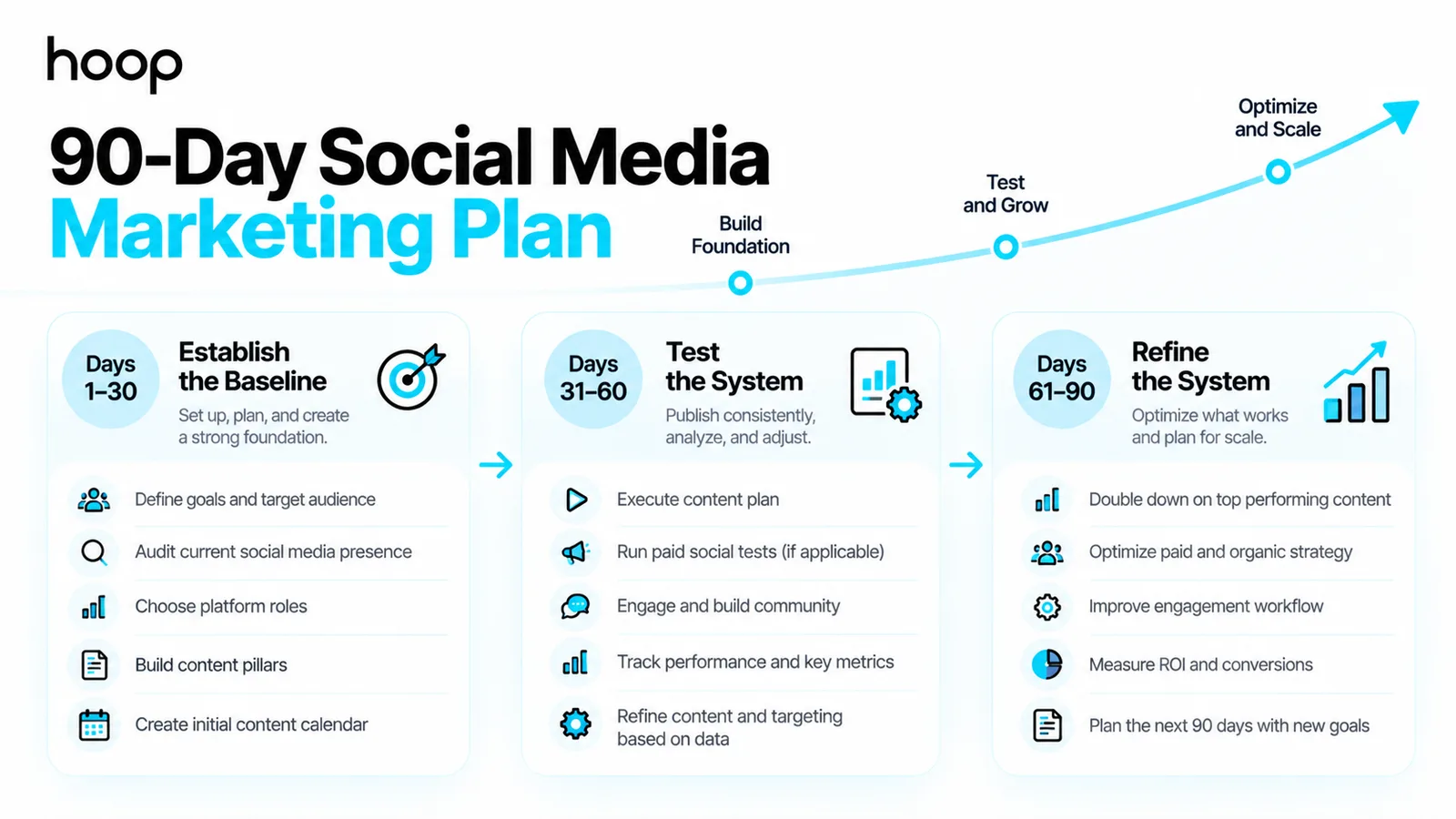
To turn the social media marketing plan into 90-day execution, divide the quarter into 3 phases: baseline, testing, and refinement.
Days 1 to 30: Establish the Baseline
Use the first 30 days to audit accounts, set tracking, confirm platform roles, and establish a workflow. Record baseline metrics before changing 5 variables at once.
Publish the planned content mix. Track reach, engagement quality, profile actions, website sessions, leads, and sales where available. Fix operational delays before increasing volume.
Days 31 to 60: Test the System
Use days 31 to 60 for controlled tests across hooks, formats, offers, and distribution channels. Change one major variable per test whenever practical.
Compare content against the same primary KPI. A reach winner can still fail a lead objective. Define what counts as a useful win.
Days 61 to 90: Refine the System
Use days 61 to 90 to repeat strong patterns and stop weak work. Increase resources behind formats, topics, and platforms that support the target outcome.
Document 3 decisions for the next quarter: what to keep, change, and stop. Keep the plan stable enough to learn.
| Task | Timing | Method | Difficulty |
|---|---|---|---|
| Audit current accounts | Days 1 to 5 | Export 90-day platform and website data | Medium |
| Set goal and KPI | Days 1 to 3 | Link 1 business outcome to 1 primary KPI | Low |
| Define audience | Days 3 to 7 | Use sales, support, search, and customer language | Medium |
| Assign platform roles | Days 5 to 10 | Choose 1 job for each selected channel | Medium |
| Build content system | Days 7 to 14 | Set 3 to 5 pillars, formats, cadence, and owners | High |
| Launch workflow | Days 15 to 30 | Publish, engage, track, and resolve approval issues | High |
| Run controlled tests | Days 31 to 60 | Test hooks, formats, offers, and paid support | High |
| Refine next quarter | Days 61 to 90 | Keep winners, change weak areas, stop waste | Medium |
Which Social Media KPIs Should You Track?
Track KPIs that match the job assigned to social media. A social media marketing plan should not treat every visible metric as equally important.
For awareness, track qualified reach, video completion, profile visits, branded search, and direct traffic. For engagement, track saves, shares, meaningful comments, direct messages, and repeat interactions.
For demand and traffic, track qualified website sessions, landing-page actions, email signups, demo views, and assisted conversions. For sales, track leads, opportunities, purchases, customer acquisition cost, revenue, and return on investment (ROI).
Add 2 guardrail metrics beside the primary KPI. Guardrails protect lead quality, cost, conversion rate, response time, or customer sentiment while your team scales activity.
What Does a Finished Social Media Marketing Plan Look Like?
A finished social media marketing plan fits on 1 to 3 working pages before supporting calendars and reports. The main document should help a teammate make decisions without another meeting.
Consider a business-to-business software company targeting operations directors. The business wants 60 qualified demo requests during one quarter. Social media will create demand and capture high-intent interest.
The company chooses LinkedIn for expert demand content and YouTube for detailed education. The team uses 4 pillars: operational pain, practical workflows, customer proof, and product education.
The team publishes 3 LinkedIn posts and 1 YouTube video each week. One marketer owns planning and copy. One designer owns visual assets. A subject expert reviews technical claims within 24 hours.
The primary KPI tracks qualified demo requests from social sources. Guardrails track cost per qualified lead and demo-to-opportunity rate. The team reviews operations weekly, performance monthly, and strategy quarterly.
The example creates a complete chain from business goal to channel activity. Every content decision has a measurable reason.
How Often Should You Review the Social Media Marketing Plan?
Review execution weekly, performance monthly, and strategy every 90 days. Different review cycles prevent daily fluctuations from forcing unnecessary strategic changes.
A weekly review should check publishing status, approvals, response coverage, campaign issues, and urgent opportunities. A monthly review should compare content, channels, leads, costs, and conversion quality.
A 90-day review should decide resource allocation, platform focus, content pillars, paid support, and targets. Rebuild the plan earlier after a major offer, audience, budget, or business change.
Which Social Media Planning Mistakes Waste Time?
The biggest mistakes separate content activity from business decisions. A social media marketing plan should prevent 7 common problems.
- Starting with post ideas before defining the business outcome.
- Using “brand awareness” without a target, audience, deadline, or measurement rule.
- Joining 5 platforms without enough production and community capacity.
- Treating content pillars as the full strategy instead of one content component.
- Tracking follower growth while ignoring qualified traffic, leads, sales, or retention.
- Publishing without a comment, direct-message, escalation, and lead-handling workflow.
- Changing the entire plan after 1 weak post or 1 strong viral result.
The strongest plan creates limits. Limits help your team reject weak channels, low-value content, and distracting metrics.
Build a Social Media Plan Your Team Can Run
A social media marketing plan should connect business goals with audience needs, platform roles, content, ownership, budget, and measurement. The strongest plan gives your team fewer guesses and clearer decisions.
Start with 1 outcome, choose focused channels, build a sustainable content system, and review real business signals. Hoop’s social media marketing services can help you build and run a plan tied to measurable growth.
“The strongest plan creates limits. Limits help your team reject weak channels, low-value content, and distracting metrics.”
Key takeaways
- 01Strategy answers why, the plan answers how, and the calendar answers what publishes next — keep the three separate.
- 02Give every platform one job (discovery, demand, conversion, or retention) before setting any posting cadence.
- 03Pair one primary KPI with two guardrail metrics so lead quality and cost do not slide while volume grows.
- 04Set the cadence your team can hold for 90 days at quality — capacity decides frequency, not ambition.
Written by
Sahar
Content Writer
Frequently Asked
Questions
Everything you need to know before booking a strategy call. Can't find your answer? Contact us directly.
A usable plan needs 10 components: goals, audience, platform roles, pillars, formats, cadence, engagement, owners, budget, and measurement. Each component should guide execution.
No. Start with 1 to 3 priority platforms that match audience behavior, business goals, and production capacity. Add another channel after the first system works.
Use a 90-day planning period for execution and learning. Keep the strategic direction longer when the audience, offer, and business goal remain stable.
Yes. Document paid social whenever advertising supports reach, retargeting, lead generation, or sales. Separate paid media budget from production and management costs.
Review operations weekly, performance monthly, and strategic choices every 90 days. Update the plan sooner after major business, audience, offer, or budget changes.
Keep reading
All articles →
How to Create a Social Media Marketing Campaign That Gets Results
Sep 27, 2026 · 10 min read
Social Media Marketing Ideas: 35 Ways to Grow Your Brand
Sep 27, 2026 · 9 min read