How to Create a Social Media Marketing Campaign That Gets Results
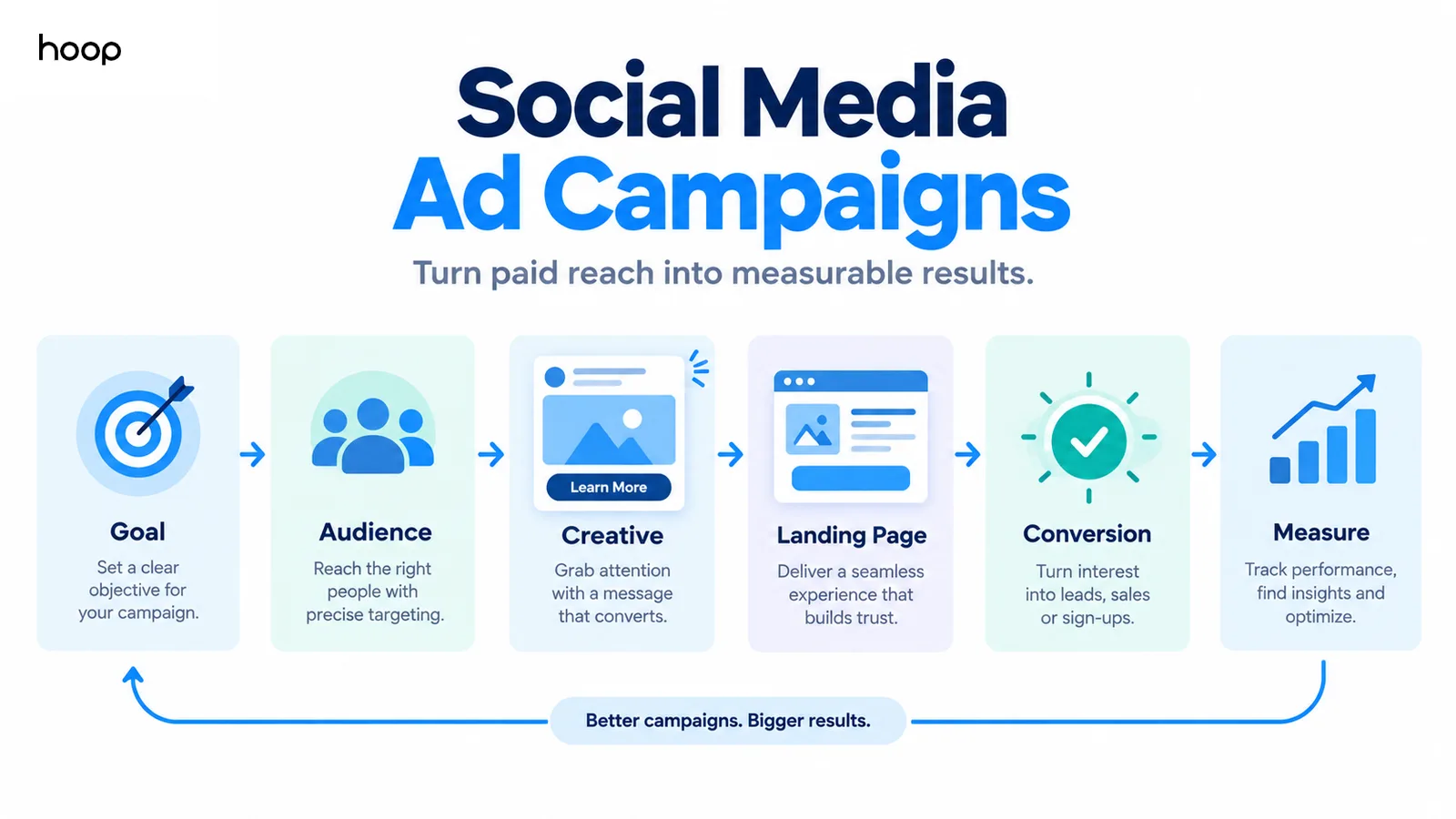
A campaign is one audience, one message, one action, and one tracking system inside a fixed window. Twelve steps take it from objective to post-campaign review, with the failure threshold agreed before anything goes live.
Sahar
Content Writer
A social media marketing campaign is a focused, time-bound effort designed to achieve one measurable business outcome. A strong campaign connects one audience, one message, one action, and one tracking system before content goes live.
You do not need more posts to improve campaign performance. You need clearer goals, better audience research, tighter execution, and stronger measurement. The process below shows you how to build that system from start to finish.
What Is a Social Media Marketing Campaign?
A social media marketing campaign coordinates content, distribution, and measurement around one defined objective for a limited period. Common objectives include product launches, lead generation, event registrations, brand awareness, sales promotions, and customer acquisition.
A campaign differs from routine posting because every campaign asset supports the same business outcome. The campaign ends after a defined period, even if your broader social media activity continues.
Read Hoop’s guide to social media basics if you need the wider foundation before building the campaign structure.
How Does a Social Media Campaign Differ From a Strategy or Content Calendar?
A strategy sets long-term direction, a plan organizes ongoing activity, and a campaign creates a focused push toward one outcome. A content calendar only schedules individual posts.
Your social media strategy defines who you want to reach, why social matters, and which outcomes support the business. Your social media marketing plan organizes channels, resources, workflows, budgets, and recurring activity.
A social media campaign coordinates a time-bound message, offer, audience, creative system, distribution plan, and measurement framework. A content calendar assigns dates, formats, captions, assets, owners, and publishing times.
Keep these layers separate. You can run multiple campaigns inside one long-term social media strategy without changing the strategy each month.
What Should a Social Media Marketing Campaign Include?
Every campaign needs 12 working parts before launch. The campaign brief should make each part clear enough for social, creative, paid media, and sales teams.
A complete campaign starts with one business objective, one primary audience, one audience problem or desire, one core message, one offer, and one primary action.
The campaign also needs a creative concept, selected platforms, organic and paid distribution rules, budget ownership, tracking, attribution, and clear success and failure thresholds.
A weak brief leaves teams guessing. A strong brief reduces rewrites, approval delays, inconsistent messaging, and unclear reporting.
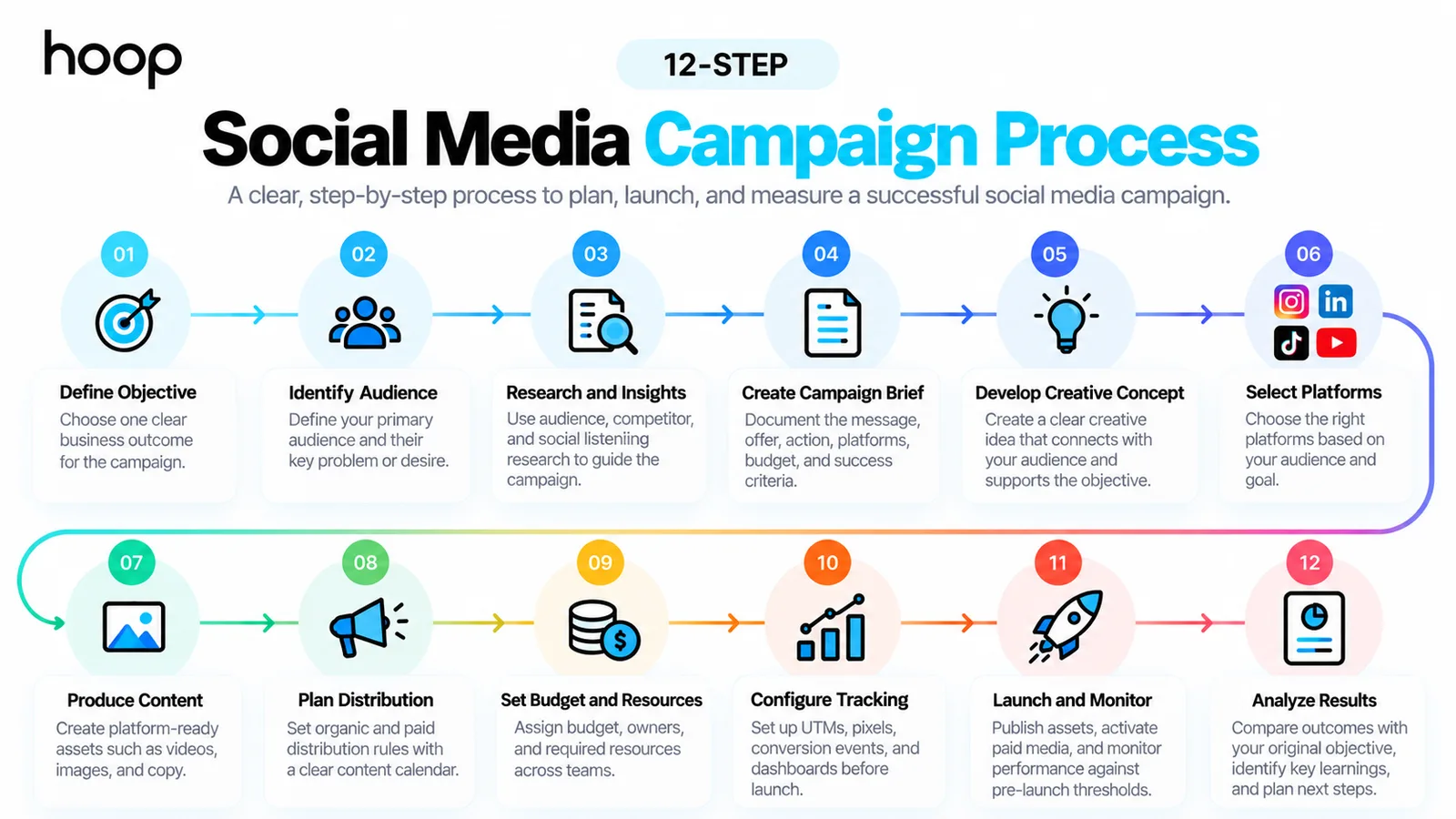
How to Create a Social Media Marketing Campaign in 12 Steps
1. Define One Business Objective
To define one business objective, choose the commercial result that matters most during the campaign period. Examples include 120 demo requests, 400 event registrations, or $25,000 in attributed sales.
Avoid goals such as “get more engagement” unless engagement directly supports a documented business objective. Engagement can support performance, but engagement rarely proves commercial impact alone.
2. Choose One Primary Audience
To choose one primary audience, identify the group whose action directly supports the objective. Define role, problem, motivation, buying stage, objections, and platform behavior.
A campaign aimed at everyone usually produces weak messaging. A campaign aimed at one clear audience can use sharper language, stronger proof, and more relevant creative.
3. Research What the Audience Already Cares About
To research audience demand, review customer questions, sales calls, support tickets, search queries, comments, reviews, and competitor conversations. Record repeated language instead of inventing marketing language.
Social listening also helps you identify objections, recurring frustrations, competitor complaints, and emerging topics before creative production starts.
4. Write the Campaign Brief
To write the campaign brief, convert research into one shared operating document. Include the objective, audience, message, offer, action, platforms, creative rules, budget, owners, deadlines, tracking, and success threshold.
Add a failure threshold before launch. For example, pause paid creative after 2,000 impressions when the click-through rate remains below 0.5%.
5. Develop One Core Campaign Concept
To develop the campaign concept, express the audience problem and the brand promise through one memorable creative direction. Keep the core message consistent across every channel.
Change the format by platform, not the central promise. A product launch can use a LinkedIn document post, Instagram Reel, TikTok demo, and YouTube walkthrough.
6. Choose Platforms by Purpose
To choose platforms, assign each network a specific campaign job. Use LinkedIn for B2B authority, Instagram for visual proof, TikTok for discovery, YouTube for depth, and Facebook for targeted reach.
Do not copy identical creative across all platforms. Adapt the opening hook, format, length, caption style, and call to action for each audience environment.
7. Build the Creative System
To build the creative system, create a small set of repeatable campaign formats. Use product demos, customer proof, founder videos, short educational clips, carousels, comparison posts, and objection-handling content.
Plan creative variations before launch. Different hooks and proof points help you identify what actually influences audience behavior.
8. Decide Organic, Paid, and Earned Distribution
To define distribution, assign each asset to organic reach, paid support, or external participation. Keep the role of each channel clear.
Organic distribution reaches followers, searchers, subscribers, employees, and other discoverable audiences. Paid distribution reaches new audiences, retargets interested visitors, and expands proven creative.
Earned distribution comes from creators, customers, partners, employees, and communities that choose to share the campaign.
A campaign does not need all 3 layers. Use each layer only when the campaign objective and available resources justify the work.
9. Set the Budget and Assign Owners
To set the campaign budget, divide available spend across creative production, paid distribution, creators, tools, landing pages, and reporting. Assign one owner to every deliverable and approval stage.
For a deeper budgeting reference, use Hoop’s breakdown of social media costs to estimate ongoing production and management expenses.
10. Configure Tracking Before Launch
To configure tracking, define naming conventions, UTM parameters, conversion events, landing-page goals, and lead-source fields. Set revenue attribution before publishing.
Use Google Analytics 4, platform pixels, customer relationship management fields, and reporting dashboards when those systems match your sales process.
Do not rely on reach and impressions alone. Campaign tracking should connect creative activity with meaningful audience actions.
11. Launch and Monitor Performance
To launch the campaign, publish the approved assets, activate paid distribution, and monitor performance against the pre-launch thresholds. Check comments, direct messages, leads, spend, conversions, and creative fatigue.
Make controlled changes instead of changing everything at once. Test one variable, such as the hook, visual, audience, offer, or call to action.
12. Analyze Results After the Campaign
To analyze results, compare campaign outcomes with the original objective, budget, audience assumptions, creative hypotheses, and failure thresholds. Record lessons before the team starts another campaign.
Separate high-reach content from high-value content. The asset with the most views does not automatically create the most qualified leads or revenue.
Quick-Reference Social Media Campaign Workflow
Use the workflow below to keep planning, production, launch, and reporting connected.
| Task | Timing | Method | Difficulty |
|---|---|---|---|
| Set objective and audience | 2–4 weeks before launch | Brief and audience research | Medium |
| Build creative and landing assets | 1–3 weeks before launch | Production and approvals | High |
| Configure tracking | 3–7 days before launch | UTMs, pixels, conversion events | Medium |
| Launch and monitor | Campaign period | Publishing, paid media, community response | Medium |
| Review performance | Weekly during campaign | KPI and creative analysis | Medium |
| Complete post-campaign review | 1–5 days after campaign | Results, lessons, next tests | Low |
What Should a Social Media Campaign Brief Include?
A campaign brief should give every contributor the same definition of success. Keep the document short enough to use during production and specific enough to prevent conflicting decisions.
Start the brief with the objective, primary audience, audience insight, core message, offer, and desired action. Those fields give every contributor the same definition of the campaign.
Then define the creative formats, visual rules, proof, tone, distribution channels, owners, approval path, deadlines, tracking, attribution, key performance indicators, and failure thresholds.
A brief should help a copywriter, designer, media buyer, and account manager make compatible decisions without repeated clarification.
Which Social Media Campaign Types Can You Run?
The right campaign type depends on the business objective. Choose one type before you choose formats or channels.
- Product launch campaigns move interested users toward a trial, purchase, or demo. Lead generation campaigns exchange useful value, such as a guide or audit, for qualified contact information.
- Brand awareness campaigns increase relevant reach around a message or category. Sales promotion campaigns create a defined purchase window around an offer, bundle, or limited incentive.
- Event campaigns drive registrations, attendance, live participation, or follow-up. Creator campaigns use experts or partners to extend trust and audience access.
- Customer campaigns encourage testimonials, reviews, referrals, or user-generated content. Seasonal campaigns connect an offer with a relevant calendar event, buying period, or industry moment.
How to Adapt One Campaign Across Social Platforms
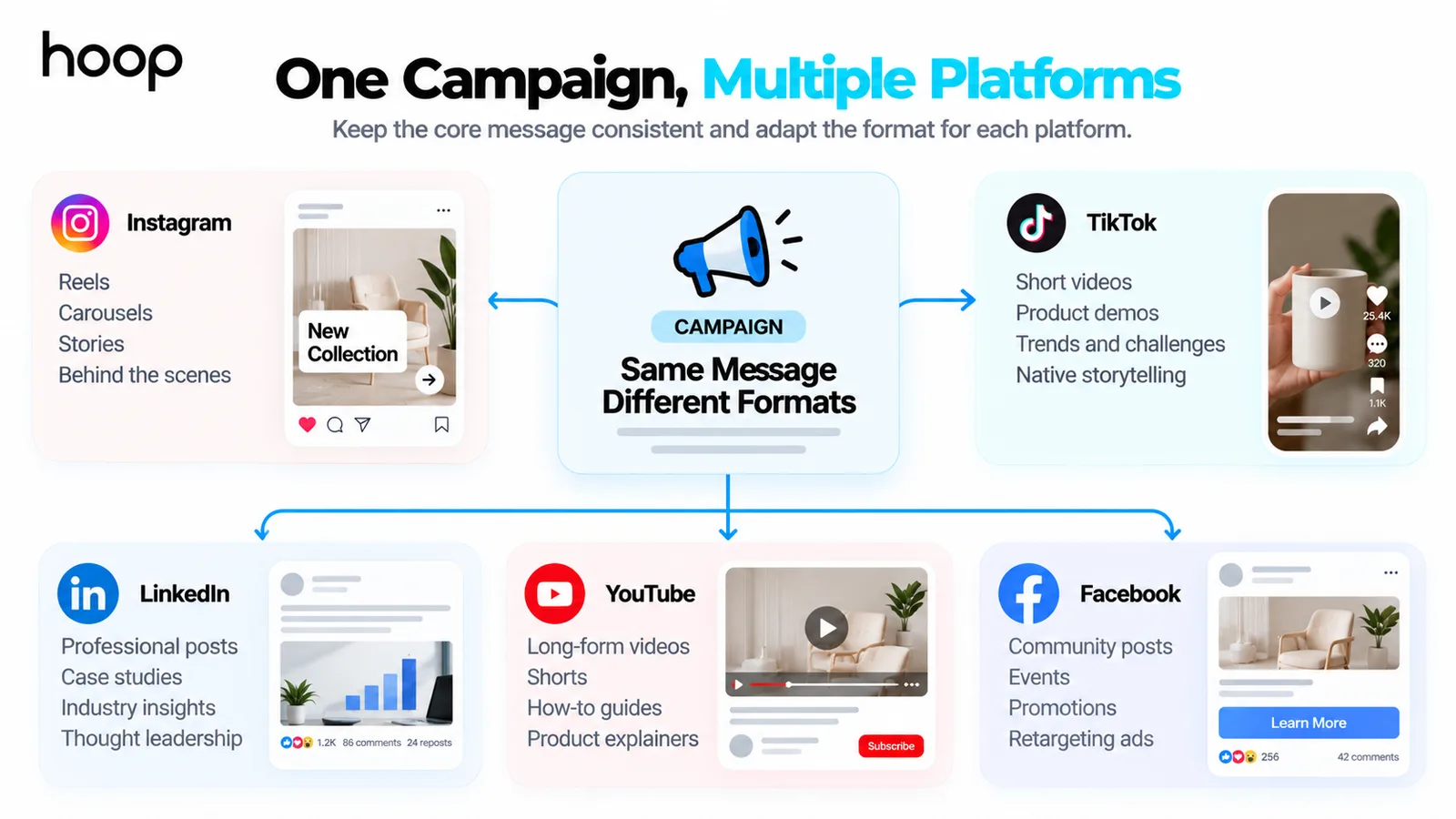
To adapt one campaign across platforms, keep the core message consistent and change the delivery mechanics. Each network rewards different behavior, formats, and audience expectations.
Use founder perspectives, document posts, customer proof, employee advocacy, and lead-generation ads. B2B campaigns should connect expertise with a clear commercial action.
Use Reels, carousels, Stories, creator partnerships, customer proof, and direct-message flows. Strong visuals should support a specific message rather than replace the message.
TikTok
Use fast demonstrations, direct explanations, reactions, creator-led content, and native storytelling. Avoid copying polished advertising formats that ignore platform behavior.
YouTube
Use detailed demonstrations, educational videos, Shorts, customer stories, and retargeting. YouTube can support both discovery and deeper consideration during longer buying journeys.
Use community content, customer proof, retargeting, promotional creative, and event activity. Audience selection and creative relevance matter more than posting volume.
Which Tools Help Manage Social Media Campaigns?
Choose tools by workflow problem, not by feature count. The right stack reduces friction without replacing campaign strategy.
For planning and approvals, use tools such as Planable, Asana, or ClickUp. For creative production, use Canva, Adobe Express, CapCut, or Adobe Premiere Pro.
For scheduling, use Buffer, Hootsuite, Sprout Social, or native platform schedulers. For analytics, pair native platform data with Google Analytics 4 and Looker Studio.
For tracking, use UTM parameters, platform pixels, conversion events, and customer relationship management fields. For listening, use monitoring tools that capture brand mentions, audience conversations, and competitor themes.
Artificial intelligence can speed up research, caption variants, transcript cleanup, and repurposing. Human teams should still define audience insight, campaign positioning, proof, and final creative judgment.
Which Metrics Should a Social Media Marketing Campaign Track?
Track metrics that match the campaign objective. A brand-awareness campaign and a lead-generation campaign should not use the same primary KPI.
For awareness campaigns, track qualified reach, video completion, branded search lift, profile visits, and relevant mentions. For engagement campaigns, track saves, shares, comments, replies, direct messages, and meaningful interaction rates.
For traffic campaigns, track landing-page sessions, click-through rate, cost per click, and engaged sessions. For lead campaigns, track qualified leads, conversion rate, cost per lead, booked calls, and lead quality.
For revenue campaigns, track purchases, customer acquisition cost, attributed revenue, and return on ad spend. Match every primary metric to the business objective.
Report secondary metrics only when they help explain the primary result. Large reach does not compensate for poor conversion in a sales campaign.
How to Analyze a Social Media Campaign After It Ends
To analyze a campaign after it ends, compare results with the objective and isolate the variables that influenced performance. Record findings while the execution details remain fresh.
Start by asking which message produced the strongest action, which creative format created the highest-quality traffic, and which platform produced qualified conversions. Then compare audience segments, offers, and conversion paths.
Review where users dropped out, which organic assets deserve paid support, which paid assets deserve organic reuse, and which assets should stop. Finish by defining one hypothesis for the next campaign.
Campaign reporting should change future decisions. A report that lists numbers without changing the next brief adds little strategic value.
What Common Mistakes Make Social Media Campaigns Fail?
Most campaign failures come from unclear decisions rather than a lack of content. The mistakes below weaken both execution and reporting.
Starting with content before defining the objective weakens campaign focus. Targeting too many audiences also produces vague messaging, while identical creative across platforms ignores different user behavior.
Ignoring tracking prevents reliable attribution. Chasing vanity metrics hides commercial performance, and automating strategy replaces audience judgment with generic output.
Skipping community response wastes live audience signals. Ending the process at publication also prevents optimization, learning, and a documented post-campaign review.
Hoop’s social media marketing service can support strategy, creative, paid distribution, and reporting across the full campaign lifecycle.
Build Campaigns Around Decisions, Not Posting Volume
A strong social media marketing campaign starts with one business goal and one audience action. Clear briefs, platform-specific execution, reliable tracking, and post-campaign learning turn content into a repeatable growth system.
Use the next campaign to test one focused hypothesis, document the result, and carry the learning into the next brief. Better campaigns come from better decisions, not simply more posts.
“Campaign reporting should change future decisions. A report that lists numbers without changing the next brief adds little strategic value.”
Key takeaways
- 01Set a failure threshold in the brief — for example, pause paid creative below a 0.5% click-through rate after 2,000 impressions.
- 02Configure UTMs, pixels, conversion events, and lead-source fields before launch, not after the first results arrive.
- 03Keep the core message identical across platforms and change only the hook, format, length, and call to action.
- 04The highest-reach asset is rarely the highest-value one; separate the two in every post-campaign review.
Written by
Sahar
Content Writer
Frequently Asked
Questions
Everything you need to know before booking a strategy call. Can't find your answer? Contact us directly.
Most campaigns run for a defined period tied to the objective. Product launches can last 2 to 6 weeks, while event campaigns follow registration deadlines.
No. Organic campaigns can work when the brand already has audience access, strong distribution partners, or highly shareable content.
Use only the platforms that support the audience and objective. A focused 2-platform campaign often performs better than a weak 5-platform rollout.
No. Keep the message consistent, but adapt the format, hook, length, and call to action to each platform.
Compare the primary KPI with the original target, budget, and attribution data. Supporting metrics should explain why the result happened.