Social Media Ad Campaigns 2026: How to Plan, Launch, and Optimize
A paid social campaign is six connected parts — objective, audience, creative, offer, destination, and measurement — not just an ad. Set the acceptable acquisition cost first, verify tracking before spending, and change one variable per test.
Sahar
Content Writer
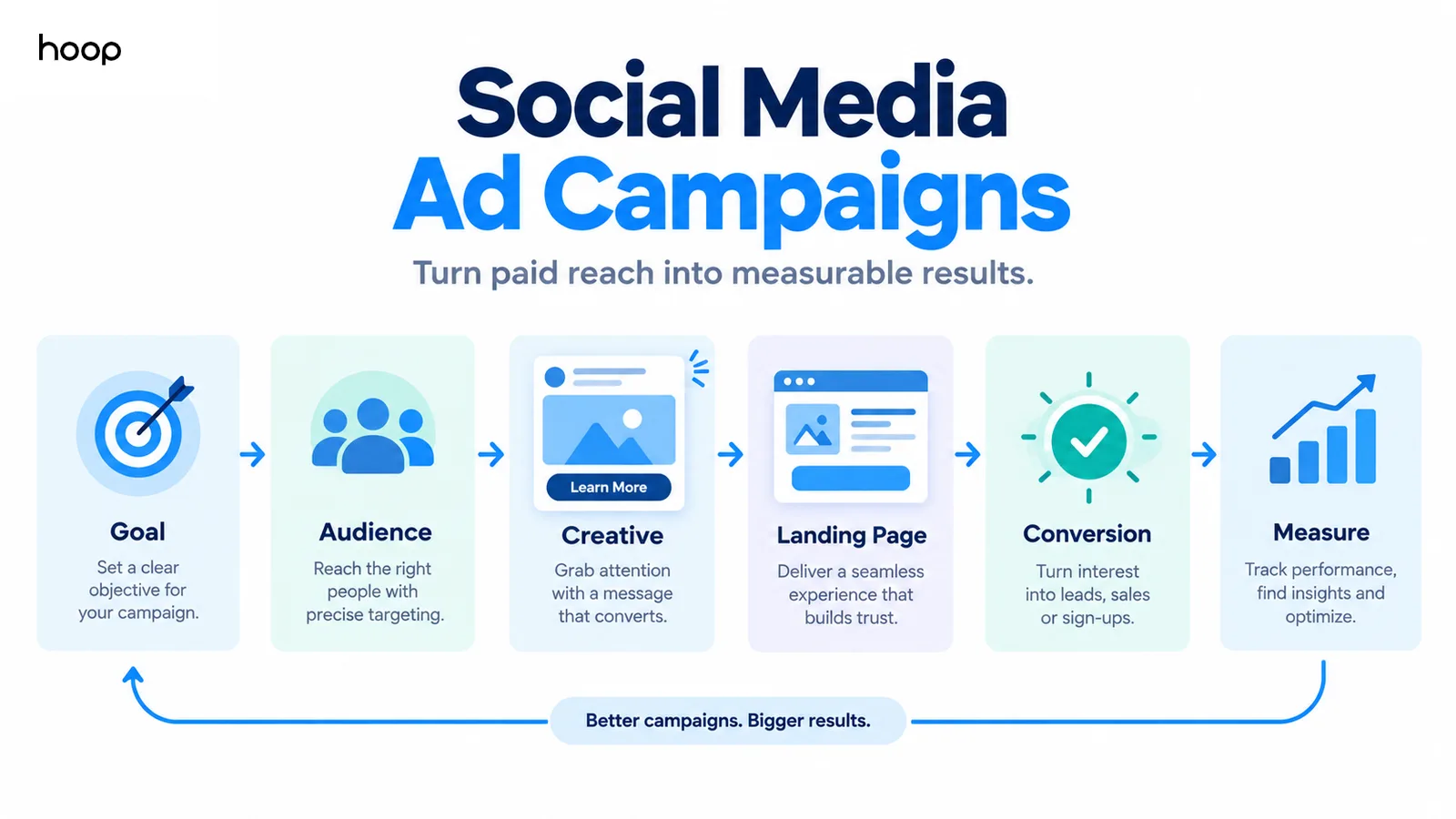
Social media ad campaigns connect one business goal with an audience, creative, offer, destination, budget, and measurement plan. Strong campaigns create a clear path from paid reach to leads, sales, sign-ups, or another defined business outcome.
Paid social becomes expensive when you treat the ad as the whole campaign. Well-planned campaigns create a repeatable learning system. The ad only starts the journey. Your targeting, creative, landing page, tracking, offer, and follow-up also shape the result.
That distinction matters because businesses often ask the same practical questions. Which platform should you choose? How much should you spend? What creative should you test? Which metrics matter? When should you pause or scale an ad? A useful campaign system answers those questions before spend grows.
What Are Social Media Ad Campaigns?
Social media ad campaigns are coordinated paid ads built around 1 measurable objective. Common objectives include brand awareness, website traffic, lead generation, app installs, ecommerce purchases, and retargeting conversions.
A campaign normally includes 6 connected parts: objective, audience, creative, offer, destination, and measurement. Facebook, Instagram, LinkedIn, TikTok, YouTube, Pinterest, X, and Reddit all support paid promotion. Each platform uses different formats, targeting options, auctions, and reporting systems.
Social media advertising differs from organic social media marketing. Organic content builds reach and trust without paying for each impression. Paid social advertising buys distribution to selected audiences and optimizes delivery around a campaign objective.
Hoop combines organic strategy and paid distribution across content planning, community, and paid testing. The same audience insights can support both organic content and advertising decisions.
How Do Social Media Ad Campaigns Work?
Social media ad campaigns give an advertising platform a goal, audience signals, creative assets, budget, and conversion data. The platform enters eligible ads into auctions. The system then delivers ads toward the selected objective.
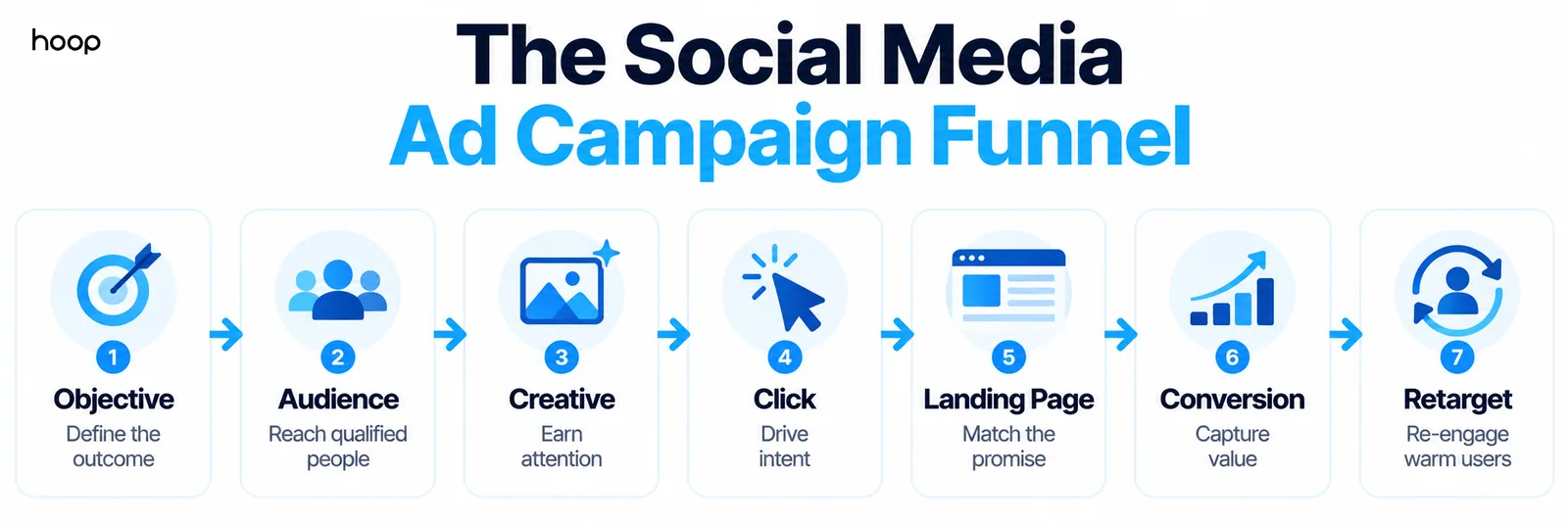
Start with one campaign objective
Choose one primary outcome before you build the campaign. Awareness, leads, purchases, and app installs require different optimization signals.
A lead campaign should optimize for qualified form submissions, calls, or booked consultations. An ecommerce campaign should optimize for purchases or another revenue event. A brand campaign can focus on qualified reach, video completion, or another awareness signal.
Define the audience and buying context
Build an audience hypothesis around readiness, problems, interests, customer data, and previous behavior. Demographic filters alone rarely explain purchase intent.
Cold audiences include people without a recent brand interaction. Warm audiences include website visitors, video viewers, engaged followers, and existing leads. Customer audiences include buyers, subscribers, and account holders.
Match creative with the offer
Creative earns attention, while the offer gives the audience a reason to act. Strong creative makes the problem, value, proof, and next action easy to understand.
Useful creative formats include short videos, static images, carousels, creator-style videos, document ads, and product demonstrations. Test formats that fit the platform and the buying decision.
Connect the ad with the conversion path
Send each ad to a destination that matches the message and action. Destinations include landing pages, product pages, lead forms, app stores, direct messages, and booking pages.
A campaign loses efficiency when the ad promises one outcome and the destination presents another. Message match reduces confusion after the click.
How to Choose the Right Platform for Social Media Ad Campaigns
To choose the right platform, match audience behavior, campaign objective, creative format, and conversion path. Strong campaigns start with audience behavior, not platform popularity. Do not select a platform only because another brand uses it.
Use Meta for broad consumer reach and retargeting
Facebook and Instagram support ecommerce, local services, lead generation, video, product catalogs, and retargeting. Meta also gives advertisers multiple placements across feeds, Stories, Reels, and other surfaces.
Hoop’s Facebook Ads services connect creative testing, tracking, retargeting, and campaign optimization for Meta campaigns.
Use LinkedIn for professional buying audiences
LinkedIn fits business-to-business campaigns aimed at decision-makers, job functions, industries, company sizes, and professional interests. The platform can support lead forms, content promotion, event registration, and high-value services.
Higher click costs can still make business sense when each qualified conversion carries significant revenue potential.
Use TikTok, YouTube, Pinterest, or Reddit for specific behavior
TikTok fits short-form discovery and creator-style storytelling. YouTube fits video education, product explanation, remarketing, and high-consideration decisions.
Pinterest fits visual planning and shopping behavior. Reddit fits interest-based communities and contextual conversations. Platform selection should follow audience behavior instead of platform popularity.
How to Build Social Media Ad Campaigns Step by Step
To build social media ad campaigns, connect the business goal to a measurable event first. Build each campaign component around that event before you launch.
1. Define the business outcome and primary KPI
Choose 1 business result and 1 primary Key Performance Indicator (KPI). A lead campaign can use qualified leads and Cost Per Lead (CPL). An ecommerce campaign can use purchases and CPA. Revenue campaigns can use Return on Ad Spend (ROAS).
Secondary metrics can diagnose performance. Secondary metrics should not replace the business outcome.
2. Build an audience hypothesis
Describe the people you expect to convert and why. Use customer interviews, sales calls, search behavior, CRM data, analytics, and organic engagement to shape the hypothesis.
Create separate audience groups when the buying context changes. A first-time visitor and a previous cart abandoner should not receive identical messages.
3. Create 3 distinct creative angles
Build 3 angles around different reasons to care. One angle can focus on the problem. A second can focus on the desired outcome. A third can focus on proof.
Create 2 variations for each angle. A 6-ad starting batch gives you useful creative diversity without changing every variable at once.
4. Match the landing page with the ad promise
Keep the headline, offer, proof, and Call to Action (CTA) consistent from the ad to the page. Remove unnecessary distractions from campaign-specific landing pages.
Hoop’s landing page optimization service focuses on message match, form friction, CTA clarity, speed, and conversion behavior.
5. Set up conversion tracking before launch
Track the business event before you spend. Common platform tools include Meta Pixel, Conversions API, TikTok Pixel, and LinkedIn Insight Tag. Measurement tools include Google Analytics 4, UTM parameters, and Customer Relationship Management (CRM) records.
Test every event yourself. Confirm that page views, forms, purchases, revenue values, and source parameters reach the correct systems.
6. Launch, collect data, and document learning
Launch the campaign after creative, links, events, budget, and destination pages pass quality checks. Record the hypothesis behind each test.
A campaign should produce learning even when an ad loses. Successful campaigns use testing to improve decisions, not just dashboards. Document the audience, angle, offer, result, and next decision.
What Does a Social Media Ad Campaign Workflow Look Like?
| Task | Timing | Method | Difficulty |
|---|---|---|---|
| Define goal and KPI | 30–60 minutes | Choose 1 business outcome and 1 primary KPI | Low |
| Verify tracking | 1–3 hours | Test pixels, tags, UTMs, forms, and revenue events | Medium |
| Build audience groups | 1–2 hours | Separate cold, warm, and customer audiences | Medium |
| Produce creative batch | 1–2 days | Build 3 angles with 2 variations each | Medium |
| Align landing page | 1 day | Match promise, proof, CTA, and form experience | Medium |
| Launch campaign | 30–60 minutes | Check budget, placements, links, events, and naming | Low |
| Review early signals | 3–7 days | Compare creative and funnel metrics against the KPI | Medium |
| Scale or refresh | Weekly | Increase proven spend or add new creative angles | High |
How Much Should You Spend on Social Media Ad Campaigns?
Set the budget from customer economics and testing needs, not a universal daily amount. Profitable campaigns start with an acceptable acquisition cost. Work backward from that limit.
A business earning $500 from a new customer has different limits from a business earning $50. Gross margin, repeat purchase rate, sales close rate, and customer lifetime value also change the acceptable cost.
Separate the budget into 2 jobs. The first job funds proven campaigns. The second job funds structured tests for creative, audiences, offers, or landing pages.
Do not treat every test dollar as wasted spend. Testing buys information when the test answers a defined question.
How to Test Social Media Ads Without Wasting Budget
To test social media ads efficiently, change 1 meaningful variable. Define the decision before launch. A clean test tells you what caused the result.
Test one question at a time
Ask 1 specific question. For example, ask which creative angle produces lower qualified lead cost. Keep the audience, destination, and offer consistent during that comparison.
Do not change creative, targeting, offer, and landing page together. A multi-variable change can improve performance without explaining why.
Collect enough data for the decision
Judge results against the campaign’s economics, not a fixed 24-hour rule. High-cost conversions need more spend and time than low-cost clicks.
Set stop conditions before launch. A stop condition can use spend relative to target CPA, repeated zero-conversion spend, or a severe funnel failure.
Keep a testing log
Record the hypothesis, variation, spend, result, and decision. The log prevents your team from repeating failed ideas without new evidence.
A testing library also reveals patterns. Winning hooks, offers, proof types, formats, and objections can guide the next creative batch.
What Metrics Should You Track for Social Media Ad Campaigns?
Track social media ad campaigns at 3 levels: attention, conversion, and business value. Each level answers a different question.
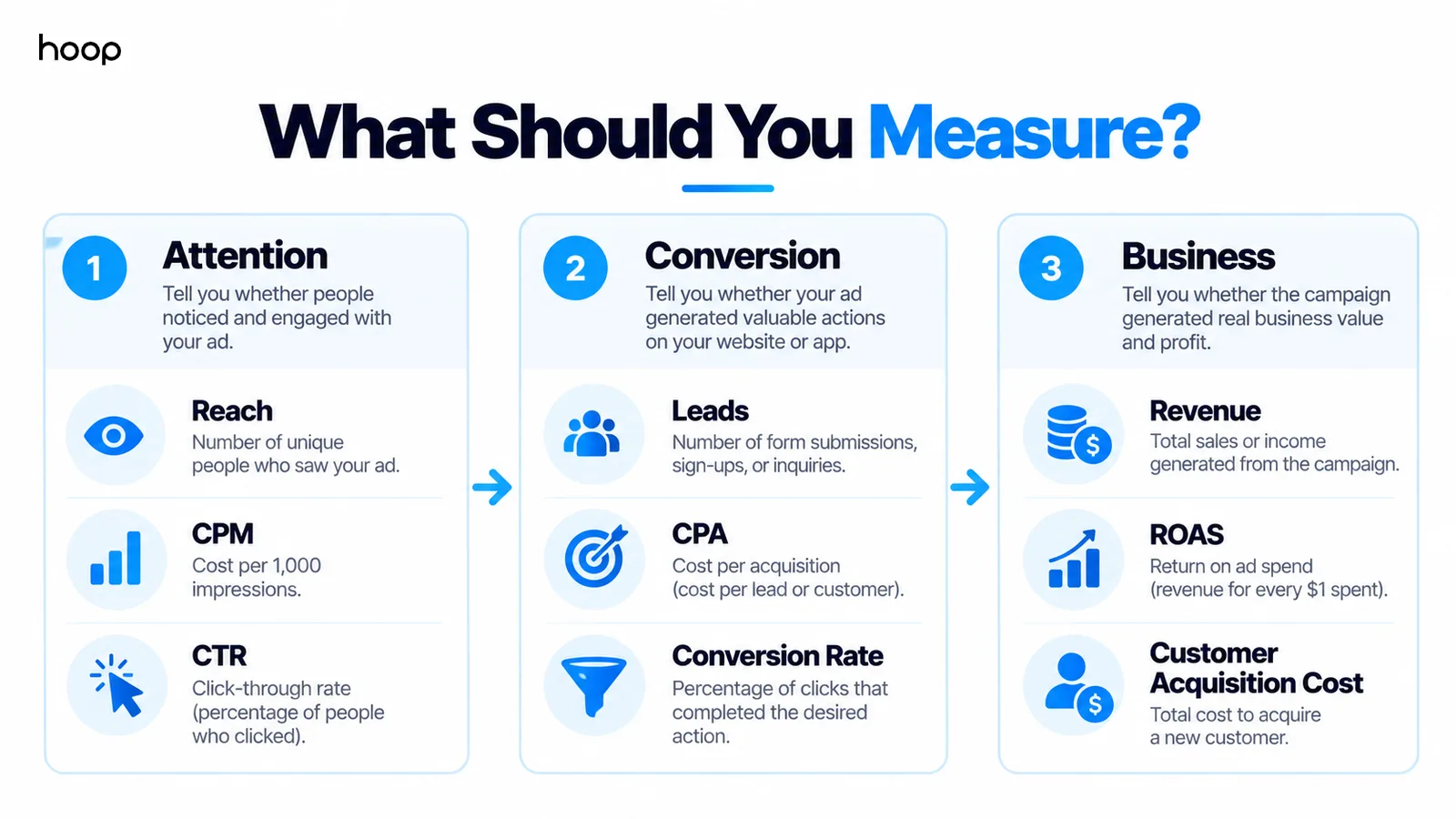
Attention metrics show whether the ad earns interest
Use Reach, Cost Per Mille (CPM), Click-Through Rate (CTR), video watch rate, and frequency to diagnose delivery and attention. These metrics help you compare creatives and audience response.
A strong CTR does not prove profitability. CTR only shows that people clicked relative to impressions.
Conversion metrics show whether traffic takes action
Use conversion rate, lead volume, Cost Per Lead, Cost Per Acquisition, and qualified lead rate. These metrics reveal whether the offer and destination convert paid traffic.
A weak conversion rate can signal message mismatch, poor page experience, low trust, or the wrong audience.
Business metrics show whether the campaign creates value
Use revenue, ROAS, Customer Acquisition Cost (CAC), pipeline value, close rate, and customer lifetime value. Business metrics connect ad performance to financial outcomes.
Compare ad-platform reporting with analytics, ecommerce records, CRM data, and actual revenue. Attribution systems can credit the same customer differently.
Why Do Social Media Ad Campaigns Fail?
Campaigns usually fail because 1 connected component breaks. Paid social does not fail as a channel by default. Diagnose the problem by funnel stage.
Weak objectives create noisy optimization
A campaign cannot optimize clearly when the business wants awareness, leads, sales, and engagement from one setup. Pick the primary outcome first.
Weak creative loses the auction for attention
Ads compete with content, messages, entertainment, and other advertisers. Generic creative gives the audience little reason to stop.
Strong campaign ideas often create participation or personal relevance. Personalized recaps, product demonstrations, challenges, and user-generated concepts give audiences something worth sharing.
Weak landing pages waste good clicks
A strong ad can still lose money after the click. Slow pages, long forms, unclear pricing, weak proof, and mismatched headlines reduce conversions.
Broken tracking produces bad decisions
Missing events, duplicate events, incorrect revenue values, and weak UTM discipline distort performance. Teams can scale losing campaigns or pause profitable campaigns when data fails.
When Should You Pause, Change, or Scale Social Media Ad Campaigns?
Pause, change, or scale campaigns with predefined rules tied to conversion economics. Do not make major changes because 1 daily result looks unusual.
Pause an ad when spend passes your stop condition without enough value. Change creative when attention metrics weaken while the funnel still converts. Fix the landing page when clicks remain healthy but conversion rate falls.
Scale a campaign when conversion quality remains acceptable and the business can serve more demand. Increase budget gradually or expand through new creative, audiences, placements, or markets.
Creative fatigue requires a production system. Scalable campaigns depend on fresh creative and reliable tracking. Refresh the message before the campaign depends on one winning ad for too long.
Brand Campaigns vs Performance Campaigns: What Changes?
Brand and performance campaigns solve different jobs, and their success measures should reflect those jobs. A brand campaign builds memory, reach, participation, or demand. A performance campaign targets measurable actions.
Brand campaigns can use reach, video completion, branded search lift, direct traffic, or engagement quality. Performance campaigns can use leads, purchases, CPA, ROAS, or pipeline value.
Some of the strongest social campaign ideas earn voluntary distribution. Personalized content, interactive demonstrations, and participatory concepts give audiences a reason to share the campaign themselves.
Do not judge every brand campaign by last-click sales. Do not judge every performance campaign by likes and comments.
How to Build a Repeatable Paid Social Process
To build a repeatable paid social process, separate the work into 5 stages. Use strategy, creative production, campaign operations, measurement, and learning. Give each stage a clear owner and output.
Use a weekly operating rhythm. Review the primary KPI, creative performance, funnel conversion, lead quality, spend, and tracking health. Then choose the next action.
Keep creative production continuous. Build new angles from customer objections, sales conversations, winning organic posts, search questions, reviews, and previous ad results.
Keep reporting decision-focused. A useful report should say what changed, why the change matters, and what the team will do next.
Why Should Social Media Ad Campaigns Focus on Business Results?
Social media ad campaigns perform better when every part supports the same business outcome. Connect your objective, audience, creative, offer, landing page, tracking, and testing process before you scale spend.
Hoop can plan, create, manage, and measure the full campaign system. Explore Hoop’s social media marketing services to build campaigns around leads, sales, and measurable growth.
“Do not treat every test dollar as wasted spend. Testing buys information when the test answers a defined question.”
Key takeaways
- 01Give each campaign one objective and one primary KPI; mixed goals produce noisy optimization.
- 02Start with 3 creative angles and 2 variations each — six ads gives diversity without confounding the test.
- 03Set stop conditions and tracking before launch, not after the first disappointing week.
- 04Measure at three levels: attention (CPM, CTR), conversion (CPL, CPA), and business (revenue, ROAS, CAC).
Written by
Sahar
Content Writer
Frequently Asked
Questions
Everything you need to know before booking a strategy call. Can't find your answer? Contact us directly.
Yes. Small businesses can use social media ad campaigns for local leads, ecommerce sales, bookings, awareness, and retargeting. Results depend on offer, audience, creative, economics, and tracking.
Run the campaign until you have enough data for the defined decision. Conversion cost, budget, traffic, and sales cycle shape the evaluation period.
The best platform matches your audience behavior, objective, and creative. Meta, LinkedIn, TikTok, YouTube, Pinterest, and Reddit serve different buying contexts.
Use an ad manager for structured performance campaigns. Ad managers provide stronger control over objectives, audiences, creative tests, conversion tracking, budget, and reporting.
The most important metric connects directly to the business outcome. Lead campaigns can prioritize qualified cost per lead. Ecommerce campaigns can prioritize CPA or ROAS.