LinkedIn Marketing Strategy: B2B Growth Guide 2026
A LinkedIn marketing strategy gives B2B teams a structured plan for authority, lead generation, and pipeline — combining executive content, company distribution, employee advocacy, ads, and measurement.
Sahar
Content Writer
A LinkedIn marketing strategy gives your B2B team a structured plan for authority, lead generation, and pipeline revenue. In 2026, the strongest plan combines executive content, company distribution, employee advocacy, targeted ads, and CRM-linked measurement.
Your LinkedIn marketing strategy should connect every post, comment, message, and campaign to a defined buyer stage. Random publishing creates activity, but a clear LinkedIn marketing strategy creates qualified conversations and measurable sales opportunities.
Need this done right?
Hoop builds the strategy, design and development behind sites like this one — talk to us about yours.
What Is a LinkedIn Marketing Strategy in 2026?
A LinkedIn marketing strategy connects content, people, advertising, and measurement to one defined B2B growth goal. Your strategy sets priorities for audience selection, publishing, engagement, lead capture, sales follow-up, and performance review.
The plan should coordinate 3 operating layers: organic authority, human distribution, and paid demand capture. Each layer supports a different buyer need and produces a different performance signal.
Organic Authority
Organic authority comes from original expertise, clear opinions, useful frameworks, and credible proof. Strong examples include customer lessons, market analysis, operational checklists, and expert demonstrations.
Your LinkedIn content strategy should answer questions that buyers ask before contacting sales. Use customer interviews, sales calls, search queries, and proposal objections to choose topics.
Executive and Employee Distribution
Executives create trust because buyers connect expertise with identifiable people. Employees expand distribution through credible comments, personal posts, and customer-facing insights.
Assign clear roles across 3 groups: company page editors, executive contributors, and employee advocates. Clear ownership protects quality and prevents duplicate publishing.
Paid Demand Capture
Paid campaigns place proven messages before selected decision-makers. Useful formats include Sponsored Content, Lead Gen Forms, Document Ads, and Thought Leader Ads.
A complete LinkedIn marketing strategy uses organic results to guide paid testing. Promote messages that already attract relevant comments, profile visits, and qualified clicks.
How to Set Goals for Your LinkedIn Marketing Strategy
To set goals for your LinkedIn marketing strategy, connect every activity to one measurable business outcome. Choose awareness, demand creation, lead generation, pipeline acceleration, recruitment, or customer retention.
Match Goals to Buyer Stages
Map each goal to 4 buyer stages: problem awareness, solution research, vendor comparison, and purchase approval. Each stage needs distinct messages, offers, and calls to action.
Use educational posts for problem awareness and detailed guides for solution research. Use case studies, demos, and consultation offers for vendor comparison and purchase approval.
Define the Ideal Customer Profile
Document your ideal customer profile [ICP] before planning content or ads. Record industry, company size, region, revenue range, technology, growth stage, and buying triggers.
Add 3 buyer roles for each target account: economic buyer, technical evaluator, and daily user. Each role needs different proof and language.
Choose 5 Core Metrics
Track 5 core metrics for every LinkedIn marketing strategy: qualified reach, meaningful engagement, conversion rate, sales-qualified leads, and attributed pipeline. The 5 metrics connect attention with revenue.
Define targets from your own baseline rather than public averages. Compare performance by audience, topic, format, offer, and buying stage every month.
How to Optimize LinkedIn Profiles and Company Pages
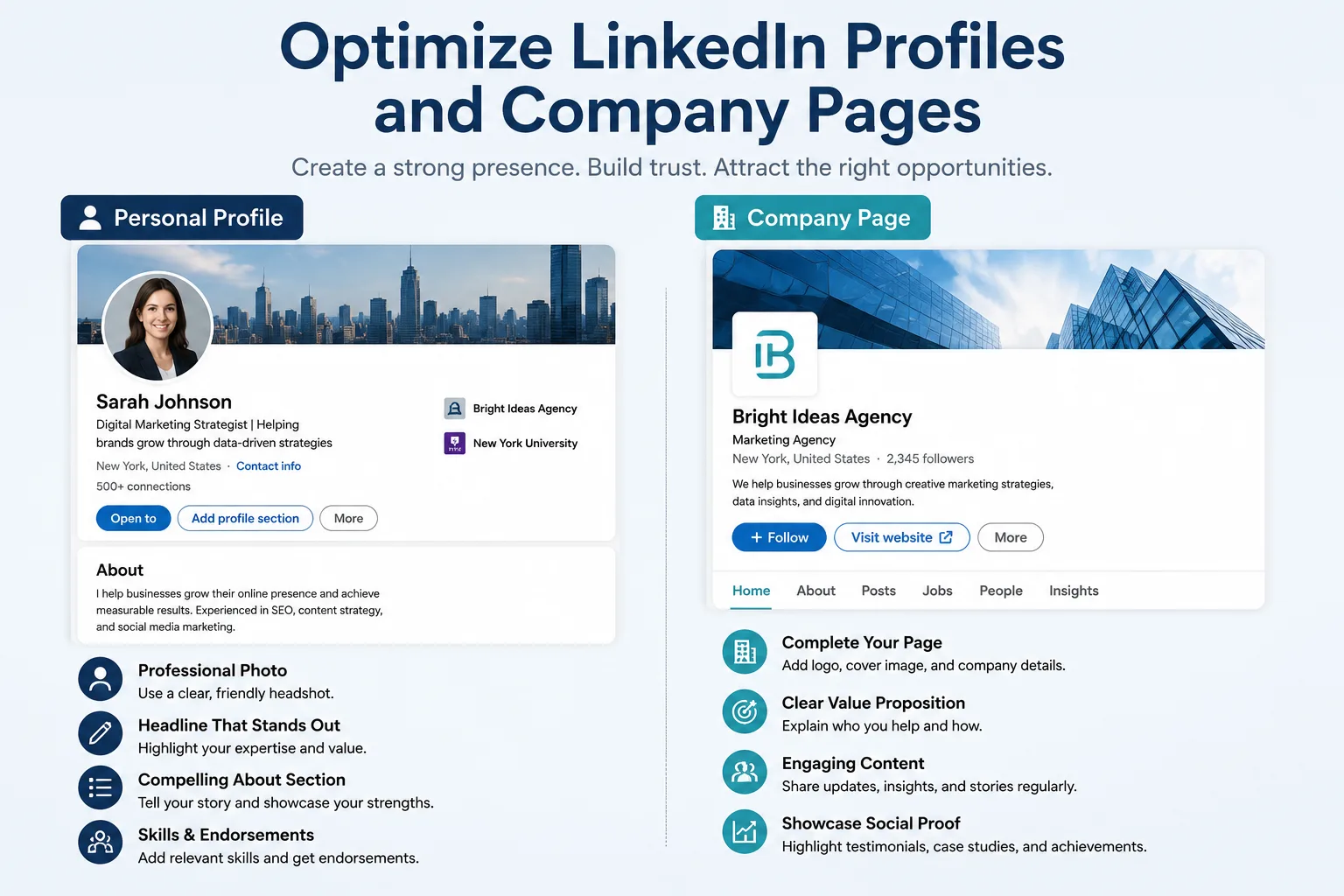
To optimize LinkedIn profiles and Company Pages, make your audience, expertise, proof, and next action immediately clear. Every visible field should help a buyer understand your relevance.
Complete the Company Page
Use a descriptive tagline, focused overview, accurate industry, current website, location, and service details. Add keywords that buyers use for your category and problem.
Create a banner that states one business outcome. Pin or feature content such as a case study, report, webinar, or product demonstration.
Strengthen Executive Profiles
Write executive headlines around expertise and customer outcomes, not internal job titles alone. Use the About section to explain problems, methods, proof, and contact options.
Feature 3 assets on each executive profile: a customer result, a practical guide, and a clear service page. Consistent proof improves profile conversion.
Create Clear Conversion Paths
Send every high-intent visitor toward one relevant next step. Choose a demo, strategy call, audit, report, newsletter, or event registration.
Match the destination page with the post promise. Short forms work for early interest, while detailed forms qualify late-stage demand.
How to Build a LinkedIn Content System
To build a LinkedIn content system, create repeatable pillars, formats, workflows, and review rules. A stable system improves quality without forcing your team to invent topics daily.
Choose 4 Content Pillars
Build 4 content pillars around buyer problems, expert methods, customer proof, and company perspective. Each pillar should support a defined offer and buyer stage.
Create 12 topic briefs every month, with 3 briefs under each pillar. Each brief should include one question, one answer, one example, and one call to action.
Use a Balanced Format Mix
Use 4 main formats: text posts, document posts, native videos, and newsletters. Text supports opinions, documents teach processes, videos demonstrate expertise, and newsletters develop depth.
Record videos in a quiet space with clear lighting and readable captions. Use vertical framing for mobile viewing and show a human expert whenever possible.
Set a Weekly Publishing Cadence
Publish 3 to 5 times weekly and reserve 20 minutes daily for focused engagement. Choose consistency that your team can maintain for 90 days.
A practical LinkedIn marketing strategy can schedule 2 expert posts, 1 customer proof post, and 1 video weekly. Add 1 monthly newsletter for deeper education.
Create content in batches every 2 weeks. One 90-minute interview can produce posts, video clips, sales notes, and newsletter sections.
Use AI With Human Review
Use artificial intelligence [AI] for transcription, topic clustering, draft outlines, and content repurposing. Keep subject experts responsible for claims, examples, opinions, and final approval.
Your LinkedIn marketing strategy should reject AI-generated posts without original experience. Add first-hand examples, named methods, customer evidence, and a clear viewpoint before publishing.
How to Grow LinkedIn Reach and Engagement
To grow LinkedIn reach and engagement, create relevant conversations before chasing impressions. LinkedIn rewards content that earns thoughtful responses from the right professional audience.
Comment Before Publishing
Leave 5 useful comments on relevant posts before publishing your own post. Choose posts from customers, prospects, partners, employees, and respected experts.
Write comments that add evidence, experience, a counterpoint, or a practical step. Generic praise adds little value and builds weak recognition.
Use Executive-Led Distribution
Publish important viewpoints through the executive who owns the expertise. Let the Company Page support distribution through comments, reposts, and related proof.
A strong LinkedIn marketing strategy separates executive voice from corporate announcements. Executives should teach, explain decisions, and share credible operating lessons.
Build Employee Advocacy
Give employees optional post prompts, source material, and approved facts. Invite employees to add personal experience rather than copy identical company text.
Recognize participation through internal updates, leadership feedback, and performance examples. Never force employees to post from personal profiles.
How to Generate B2B Leads Without Spam
To generate B2B leads without spam, earn attention first and request action after showing relevant value. Your LinkedIn marketing strategy should create a clear path from content to conversation.
Offer High-Value Lead Magnets
Create lead magnets that solve one urgent business problem. Strong examples include calculators, audit templates, benchmark reports, implementation checklists, and decision guides.
Use one focused call to action for each asset. Explain the outcome, required time, intended audience, and next step before requesting contact details.
Track Intent Signals
Track intent signals such as repeated profile visits, event attendance, document engagement, link clicks, and relevant comments. Combine LinkedIn activity with website and CRM data.
Use Sales Navigator to monitor role changes, account growth, and relevant buyer activity. Record meaningful signals before sales outreach begins.
A full-funnel plan needs content, landing pages, ads, and attribution. Hoop'sdigital marketing services connect content, landing pages, ads, and attribution around measurable growth.
Create a Sales Handoff Rule
Define the exact signal that moves a contact from marketing to sales. Useful triggers include a demo request, pricing-page visit, target-account engagement, or lead-score threshold.
Send sales teams 5 details: source post, consumed asset, company profile, buyer role, and recommended opening question. Context creates better conversations than automated pitches.
How to Use LinkedIn Ads in 2026
To use LinkedIn Ads in 2026, start with one audience, one buyer problem, and one measurable conversion. Complex account structures hide weak messages and delay useful learning.
Choose Campaign Objectives and Formats
Select objectives that match the buyer stage. Use video views for awareness, website visits for education, and Lead Gen Forms for qualified demand capture.
Use Document Ads for reports, guides, and research assets. Use Thought Leader Ads to extend proven executive posts to defined professional audiences.
Segment Audiences Clearly
Create separate campaigns for industries, job functions, seniority levels, or named accounts. Separate segments reveal which audience creates better lead quality.
For account-based marketing [ABM], build named-account lists and separate priority tiers by revenue potential. Use LinkedIn Campaign Manager for audience and placement controls.
Exclude employees, existing customers, irrelevant regions, and converted leads. Clean exclusions protect budget and improve reporting accuracy.
Test Creative and Offers
Test 2 audience segments, 3 creative variations, and 2 offers during the first campaign cycle. Change one major variable between comparable tests.
Track every campaign with the LinkedIn Insight Tag, UTM parameters, and CRM source fields. Hoop'spaid advertising services connect targeting, creative testing, landing pages, and attribution.
Wait for 30 conversions or one full buying cycle before broad scaling. Short tests create false winners for long B2B sales cycles.
How to Measure Your LinkedIn Marketing Strategy
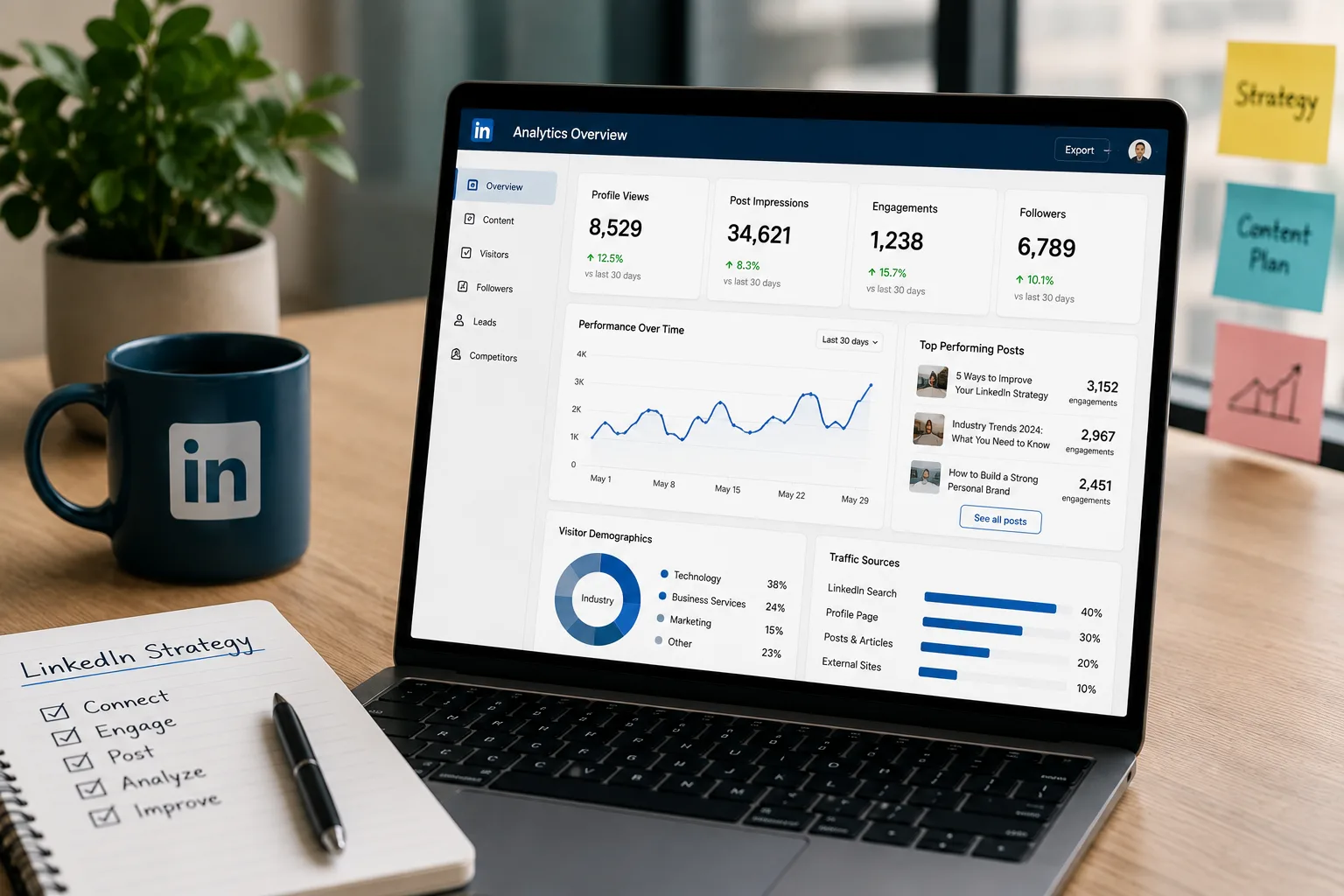
To measure your LinkedIn marketing strategy, connect platform activity with qualified leads, opportunities, and revenue. Likes and impressions describe attention, but pipeline metrics describe business impact.
Measure Organic Performance
Track qualified follower growth, engagement from target roles, profile views, clicks, newsletter subscribers, and inbound conversations. Review results by topic and format.
Record comments from decision-makers separately from total comments. One relevant buyer response carries more value than 20 unrelated reactions.
Measure Paid Performance
Track click-through rate [CTR], conversion rate, cost per lead [CPL], sales-qualified lead rate, and customer acquisition cost [CAC]. Compare lead quality across segments.
Calculate return on investment [ROI] with attributed revenue minus LinkedIn cost, divided by LinkedIn cost. Include media, labor, tools, and agency fees.
Connect LinkedIn with CRM Attribution
Store campaign, content, audience, and offer data inside your customer relationship management [CRM] system. Use HubSpot, Salesforce, Zoho, or another controlled system.
Connect Google Analytics 4 [GA4] with UTM parameters and CRM records. Consistent naming keeps channel reports accurate.
Review first-touch, lead-creation, opportunity-creation, and revenue attribution. A mature LinkedIn marketing strategy reports influence across the full sales cycle.
How to Run a 90-Day LinkedIn Marketing Strategy
To run a 90-day LinkedIn marketing strategy, build the foundation first, test second, and scale proven activity third. The 3 phases protect budget and create clear learning.
Days 1-30: Build the Foundation
Audit the Company Page, 3 executive profiles, existing content, audience data, and CRM tracking. Define goals, ICP segments, content pillars, offers, and ownership.
Publish 12 organic posts during the first 30 days. Use 4 topics across 3 formats to identify early audience response.
Days 31-60: Test Messages and Distribution
Increase the strongest topics and stop weak formats. Launch one paid campaign with 2 audience segments, 3 creatives, and 2 offers.
Train 5 to 15 employee advocates with optional prompts and comment guidance. Review lead quality with sales every week.
Days 61-90: Scale Proven Activity
Increase publishing around topics that create target-account engagement and qualified conversions. Promote proven executive posts and refine landing pages.
Document the winning message, audience, format, offer, and follow-up process. Your next 90-day LinkedIn marketing strategy should build from the documented findings.
90-Day LinkedIn Marketing Quick Reference
| Task | Timing | Method | Difficulty |
|---|---|---|---|
| Define goals and ICP | Week 1 | Stakeholder interviews, CRM review, audience research | Medium |
| Optimize LinkedIn assets | Week 1 | Company Page and 3 executive profile audits | Easy |
| Build content pillars | Week 2 | 4 pillars and 12 monthly topic briefs | Medium |
| Publish and engage | Weeks 3-4 | 3 to 5 posts weekly plus daily comments | Medium |
| Launch paid testing | Days 31-60 | 2 audiences, 3 creatives, and 2 offers | Hard |
| Review pipeline impact | Days 61-90 | UTM tracking, Insight Tag, and CRM attribution | Hard |
Which LinkedIn Marketing Mistakes Reduce B2B Growth?
Three mistakes reduce B2B growth most: corporate broadcasting, automated outreach, and vanity-metric reporting. Each mistake separates activity from buyer trust and revenue.
Corporate Broadcasting
Corporate broadcasting fills feeds with announcements, awards, hiring posts, and product claims. Buyers need useful analysis, credible proof, and clear expertise.
Keep company news below 20% of monthly content. Use the remaining 80% for buyer education, customer proof, expert analysis, and practical guidance.
Automated Outreach
Mass connection requests and scripted messages damage trust. Use automation for reminders, data hygiene, and scheduling rather than fake personal conversations.
Review every message before sending. Reference a real trigger such as an event, post, role change, report, or known business need.
Vanity-Metric Reporting
High reach does not prove revenue impact. Report target-account engagement, qualified leads, opportunity value, sales velocity, and attributed revenue.
A disciplined LinkedIn marketing strategy removes activities that produce attention without business movement. Reallocate time toward content, audiences, and offers that create qualified action.
Build a LinkedIn Marketing Strategy That Produces Pipeline
A successful LinkedIn marketing strategy aligns buyer research, expert content, human distribution, paid campaigns, and revenue measurement. Start with one audience, one problem, and one conversion goal. Then improve the system through 90-day review cycles.Book a strategy call with Hoop Interactive to build a LinkedIn growth plan tied to qualified pipeline.
“The strongest LinkedIn plan combines executive content, company distribution, employee advocacy, targeted ads, and CRM-linked measurement.”
Key takeaways
- 01LinkedIn is where B2B authority and pipeline are built
- 02Executive content and employee advocacy beat company posts alone
- 03Generate leads without spam — value first
- 04Measure with CRM-linked pipeline, not just impressions
Written by
Sahar
Content Writer
Frequently Asked
Questions
Everything you need to know before booking a strategy call. Can't find your answer? Contact us directly.
Post 3 to 5 times weekly. Choose a cadence your team can maintain for at least 90 days.
Yes. LinkedIn offers professional context, role-based targeting, company data, and direct access to business decision-makers.
Personal profiles should lead expertise, while the Company Page should support proof and distribution. Use both assets with separate roles.
Plan for 90 days of consistent execution. Organic authority grows gradually, while paid campaigns create faster testing data.
No. Start with organic content when your message, audience, offer, or tracking still needs validation.
Keep reading
All articles →
Social Media Marketing Ideas: 35 Ways to Grow Your Brand
Sep 27, 2026 · 9 min read
Content Marketing vs Social Media Marketing: What’s the Difference?
Sep 27, 2026 · 10 min read