
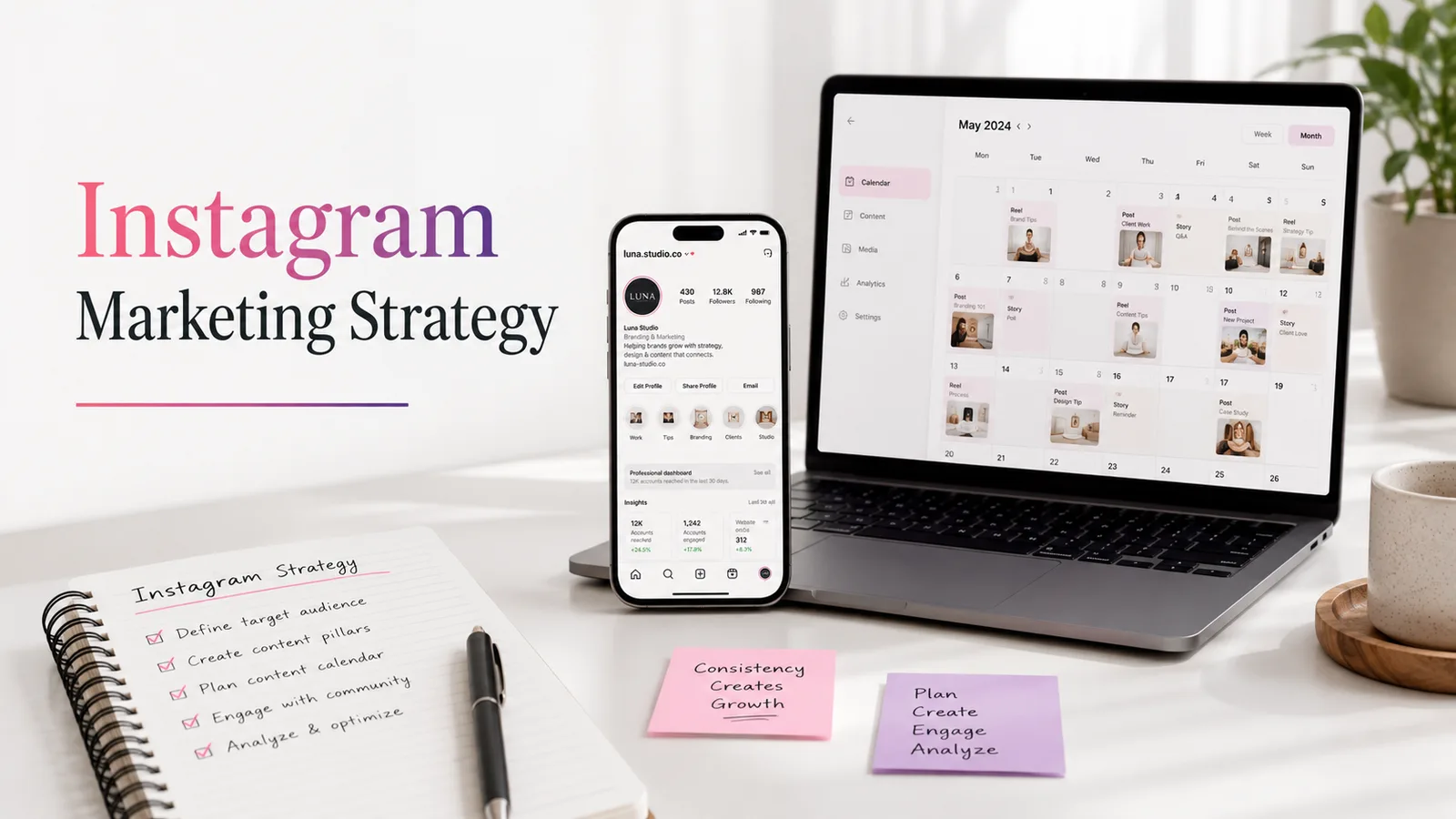
Instagram Marketing Strategy for Business in 2026
An Instagram marketing strategy gives your business a measurable plan for reach, engagement, leads, and sales — connecting content, community, paid distribution, and conversion tracking.
Sahar
Content Writer
An Instagram marketing strategy gives your business a measurable plan for reach, engagement, leads, and sales. A strong 2026 plan connects content, community, paid distribution, and conversion tracking.
Your Instagram marketing strategy should define one audience, one goal, four content pillars, a weekly cadence, and exact targets.
Need this done right?
Hoop builds the strategy, design and development behind sites like this one — talk to us about yours.
What Makes an Instagram Marketing Strategy Work in 2026?
A successful plan connects audience needs with platform-native content and measurable business outcomes. Random posting rarely produces stable growth or qualified demand.
Instagram now supports discovery, education, trust, conversation, shopping, and paid acquisition. Your Instagram marketing strategy must assign a clear purpose to each activity.
Reels reach new viewers. Carousels explain detailed ideas. Stories nurture active followers. Direct messages convert high-intent conversations. Ads expand proven messages.
A 2026 Instagram marketing strategy also needs social search. Customers search names, services, locations, product categories, and problems inside Instagram.
Use searchable profile fields, useful captions, accurate hashtags, location tags, and spoken keywords. Instagram can then understand your content topic more clearly.
Strong brands measure saves, shares, profile visits, website clicks, leads, sales, and customer acquisition cost. Follower growth alone cannot prove commercial value.
How to Build an Instagram Marketing Strategy Around Business Goals
To build an Instagram marketing strategy around business goals, choose one primary outcome for the next 90 days. Then connect supporting metrics to that outcome.
Choose 1 Primary Business Goal
Select one goal from four categories: awareness, demand, lead generation, or sales. A single priority keeps content decisions clear.
An awareness goal can target 150,000 qualified accounts reached. A demand goal can target 3,000 profile visits from target buyers.
A lead goal can target 80 enquiries. A sales goal can target 40 tracked purchases from Instagram traffic.
Write the goal with a deadline, target number, audience, and conversion definition. Avoid broad goals such as gaining popularity or improving presence.
Define a Measurable Audience Segment
Define your audience through buyer data, not broad demographics. Use customer interviews, sales records, website analytics, and Instagram Insights.
Document 5 details: buyer problem, desired result, purchase barrier, trusted proof, and preferred content format. Name examples such as tutorials, comparisons, demonstrations, testimonials, and founder explanations.
Separate audiences when buyer needs differ. A local clinic, ecommerce store, B2B consultancy, and mobile application need different messages.
Connect Instagram Metrics to Revenue
Map every Instagram metric to a buyer action. Reach supports awareness, while profile visits show stronger interest.
Website clicks show traffic intent. Form submissions, booked calls, purchases, and qualified direct messages show conversion activity.
Your Instagram marketing strategy needs 8 tracking fields: date, format, topic, hook, reach, saves, clicks, and conversions.
| Task | Timing | Method | Difficulty |
|---|---|---|---|
| Set goal and audience | Quarterly, 90 minutes | Sales data plus Insights | Medium |
| Plan 4 content pillars | Quarterly, 60 minutes | Buyer questions and offers | Medium |
| Create weekly content | Weekly, 4-6 hours | Batch Reels and carousels | High |
| Publish and optimize | 3-5 times weekly | Native posting or scheduler | Medium |
| Manage comments and DMs | Daily, 20-30 minutes | Saved replies plus escalation | Medium |
| Review performance | Weekly, 30 minutes | Instagram Insights dashboard | Low |
| Test paid distribution | Monthly, 2-4 weeks | Meta Ads Manager | High |
| Run strategic review | Every 30 days, 60 minutes | Content and conversion report | Medium |
How to Optimize Your Instagram Business Profile
To optimize your Instagram business profile, make the profile understandable within 5 seconds. Visitors should identify your audience, offer, proof, and next step.
Write a Searchable Name and Bio
Place your main service or product category in the name field. Add a city when local intent drives sales.
Write a bio with three parts: target audience, measurable outcome, and action. Use specific wording instead of slogans.
A useful bio example reads: 'Email systems for ecommerce brands. Increase repeat sales with automated flows. Book a strategy call.'
Your Instagram marketing strategy should use the same positioning across captions, website copy, sales pages, and advertisements.
Design Highlights for Buyer Questions
Create 5-7 Highlights that answer common buying questions. Useful Highlight names include Start Here, Services, Results, Reviews, Process, FAQs, and Contact.
Keep each Highlight focused on one decision. Add current proof, pricing guidance, delivery steps, customer questions, and clear actions.
Create a Clear Conversion Path
Choose one primary profile action. Examples include booking a call, shopping products, requesting a quote, downloading a guide, or joining email.
Use a dedicated landing page for Instagram traffic. A focused page gives visitors fewer distractions and cleaner tracking.
Hoop'sconversion-focused web design can connect profile traffic with fast landing pages, clear offers, proof, and tracked forms.
How to Build a Content System That Stays Consistent
To build a content system that stays consistent, separate strategy, production, publishing, engagement, and reporting. One weekly workflow reduces rushed decisions.
Select 4 Content Pillars
Choose 4 content pillars tied to buyer questions and company strengths. A service business can use education, proof, process, and perspective.
An ecommerce brand can use product education, demonstrations, customer content, and lifestyle use cases. A local brand can add location-specific topics.
Assign Each Format a Job
Assign Reels to discovery, carousels to education, Stories to relationship building, and Live sessions to deeper trust. Assign static posts to announcements or proof.
A strong Instagram marketing strategy values repeatable quality. One clear Reel beats 5 weak clips.
Create a Weekly Production Workflow
Plan 3-5 feed posts each week. Include 2 Reels, 1 carousel, and 1 proof-based post as a starting mix.
Publish Stories on 4-6 days. Use polls, questions, demonstrations, customer results, product updates, and direct offers.
Batch scripts on Monday, record on Tuesday, edit on Wednesday, and schedule on Thursday. Reserve Friday for analysis and community replies.
Professionalsocial media marketing services can manage research, production, publishing, community, paid distribution, and monthly reporting under one plan.
How to Use Reels, Carousels, and Stories
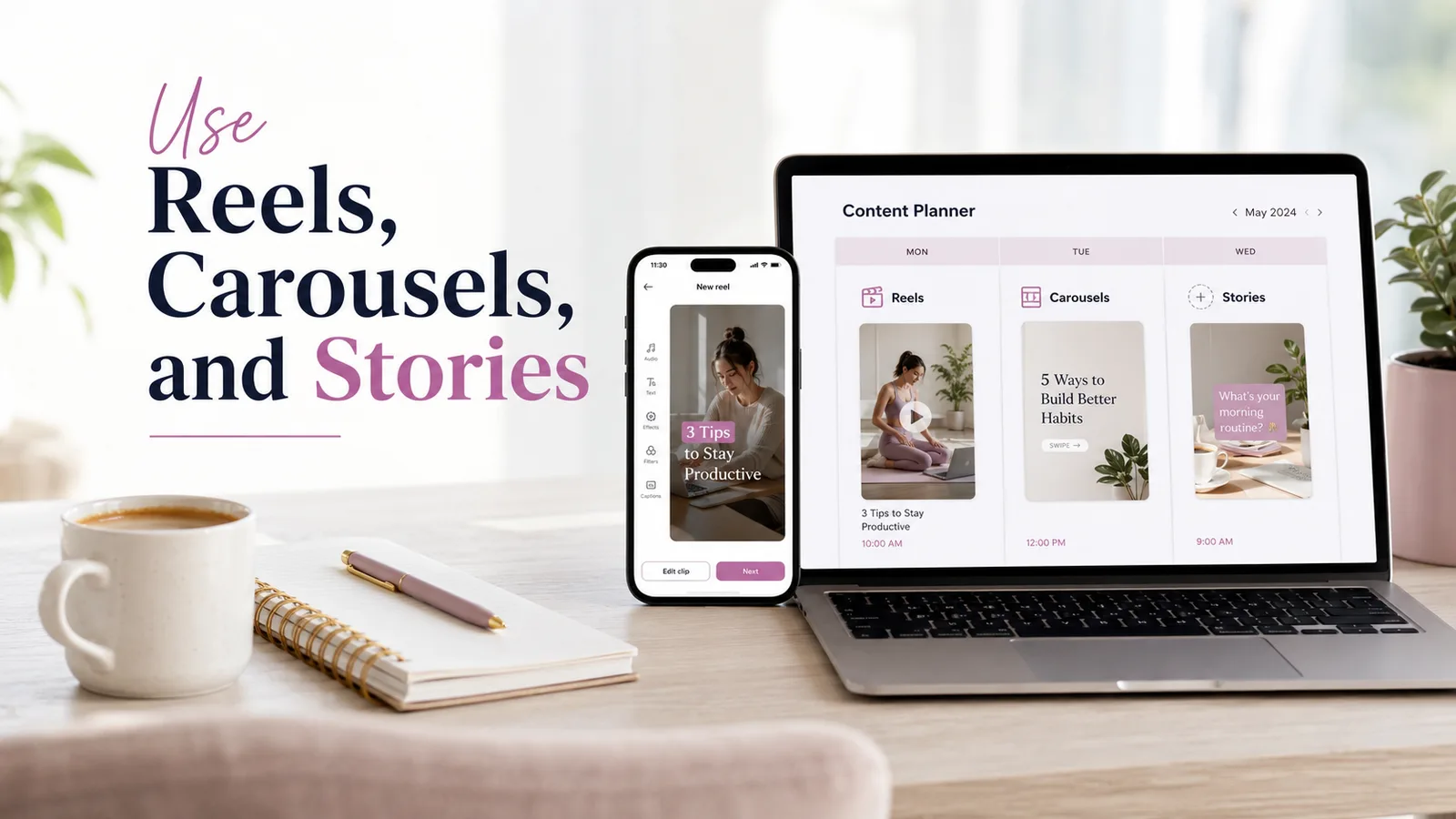
To use Instagram formats effectively, give every format one measurable role. Format variety should support the buyer journey, not fill a calendar.
Use Reels for New-Audience Discovery
Start each Reel with a specific problem, result, question, or contrast. Show the topic during the first 2 seconds.
Keep one main idea per Reel. Use spoken explanations, readable captions, relevant visuals, and a clear final action.
Test 3 Reel structures: direct tutorial, before-and-after demonstration, and objection response. Track completion, replays, shares, profile visits, and follows.
Your Instagram marketing strategy should repeat winning topics with new hooks. Repetition builds topic authority without copying the same post.
Use Carousels for Saves and Expertise
Use carousels for frameworks, checklists, comparisons, step sequences, and case-study breakdowns. Place one clear promise on slide 1.
Keep each slide focused on one point. Use readable text, visible hierarchy, consistent spacing, and specific examples.
End with one action such as save, share, comment, visit, or enquire. Multiple actions reduce response clarity.
Use Stories for Trust and Action
Use Stories to show daily work, decisions, proof, questions, offers, and team personality. Stories support frequent, lower-production communication.
Build Story sequences with 3-7 frames. Open with context, provide value, show evidence, and close with one action.
Use stickers such as polls, questions, links, countdowns, and quizzes. Each sticker should collect insight or support movement.
How to Improve Instagram Search and Discovery
To improve Instagram search and discovery, use topic keywords consistently across your profile and content. Search visibility now depends on clear relevance signals.
Place Keywords in Searchable Fields
Place the main category in your name field, bio, caption opening, on-screen text, and spoken script. Add service and product variations naturally.
For local discovery, add city and neighborhood terms. Examples include Islamabad bakery, Austin dentist, Manchester salon, and Dubai property consultant.
Your Instagram marketing strategy needs consistent language. Frequent topic changes weaken account relevance.
Use Hashtags and Locations Precisely
Choose 3-8 relevant hashtags per post. Mix category, problem, audience, branded, and location hashtags.
Add location tags for stores, events, restaurants, clinics, and regional services. Local signals support discovery among nearby users.
Increase Shares, Saves, and Completion
Create content people want to keep or send. Useful examples include templates, checklists, pricing guidance, scripts, comparisons, and decision frameworks.
Improve completion by removing slow introductions and repeated points. Every frame or second should add information.
Your Instagram marketing strategy should compare reach quality with engagement quality. A smaller relevant audience can produce more sales.
How to Turn Instagram Attention Into Leads and Sales
To turn Instagram attention into leads and sales, connect every content theme with a defined next step. Buyers need direction after interest appears.
Match Every Post to One Next Step
Choose one call to action based on buyer readiness. Use save or follow for early interest, then use visit or enquire for stronger intent.
Match educational posts with guides or consultations. Match product demonstrations with product pages, collections, or purchase links.
Avoid constant selling. A useful ratio starts with 3 educational or proof posts for every 1 direct promotional post.
Track Profile-to-Website Conversions
Add Urchin Tracking Module [UTM] parameters to Instagram links. Google Analytics 4 can then identify sessions, leads, and purchases.
Track 5 conversion points: profile link click, landing-page visit, form start, form completion, and qualified sale. Ecommerce brands should also track add-to-cart and purchase.
Use Meta Pixel and Conversions API for paid campaigns. Clean tracking helps your Instagram marketing strategy target real outcomes.
Build a Direct-Message Response System
Set a response target of 4 business hours during working days. Fast replies protect high-intent opportunities.
Create saved responses for 6 categories: pricing, availability, services, shipping, booking, and support. Personalize every saved response before sending.
Move qualified conversations into a customer relationship management [CRM] system. Record source, need, next action, value, and owner.
How to Combine Organic Content, Ads, and Creators
To combine organic content, ads, and creators, let organic results guide paid tests. Paid distribution should expand proven messages instead of hiding weak content.
Promote Proven Organic Content
Choose posts with strong saves, shares, profile visits, clicks, or direct messages. High likes without buyer actions provide weak evidence.
Run paid tests for 7-14 days with one audience and one conversion goal. Test hooks, offers, proof, and formats separately.
Hoop'spaid advertising services connect Instagram Ads with audience research, creative testing, retargeting, conversion tracking, and revenue reporting.
Use Retargeting for Warm Audiences
Create audiences from video viewers, profile engagers, website visitors, product viewers, cart users, and customer lists. Match ads to prior behavior.
Show educational proof to early viewers. Show offers, testimonials, demos, or urgency to users with stronger purchase intent.
Exclude recent customers from acquisition ads when repeat sales do not apply. Exclusions reduce waste and improve reporting accuracy.
Choose Creators by Audience Fit
Choose creators through audience relevance, content quality, trust, comment quality, and past brand results. Follower count alone gives limited evidence.
Request 3 deliverables: original content, usage rights, and performance data. Add disclosure rules and approval deadlines to every agreement.
Your Instagram marketing strategy can reuse licensed creator content across posts, ads, product pages, and email campaigns.
How to Measure Your Instagram Marketing Strategy
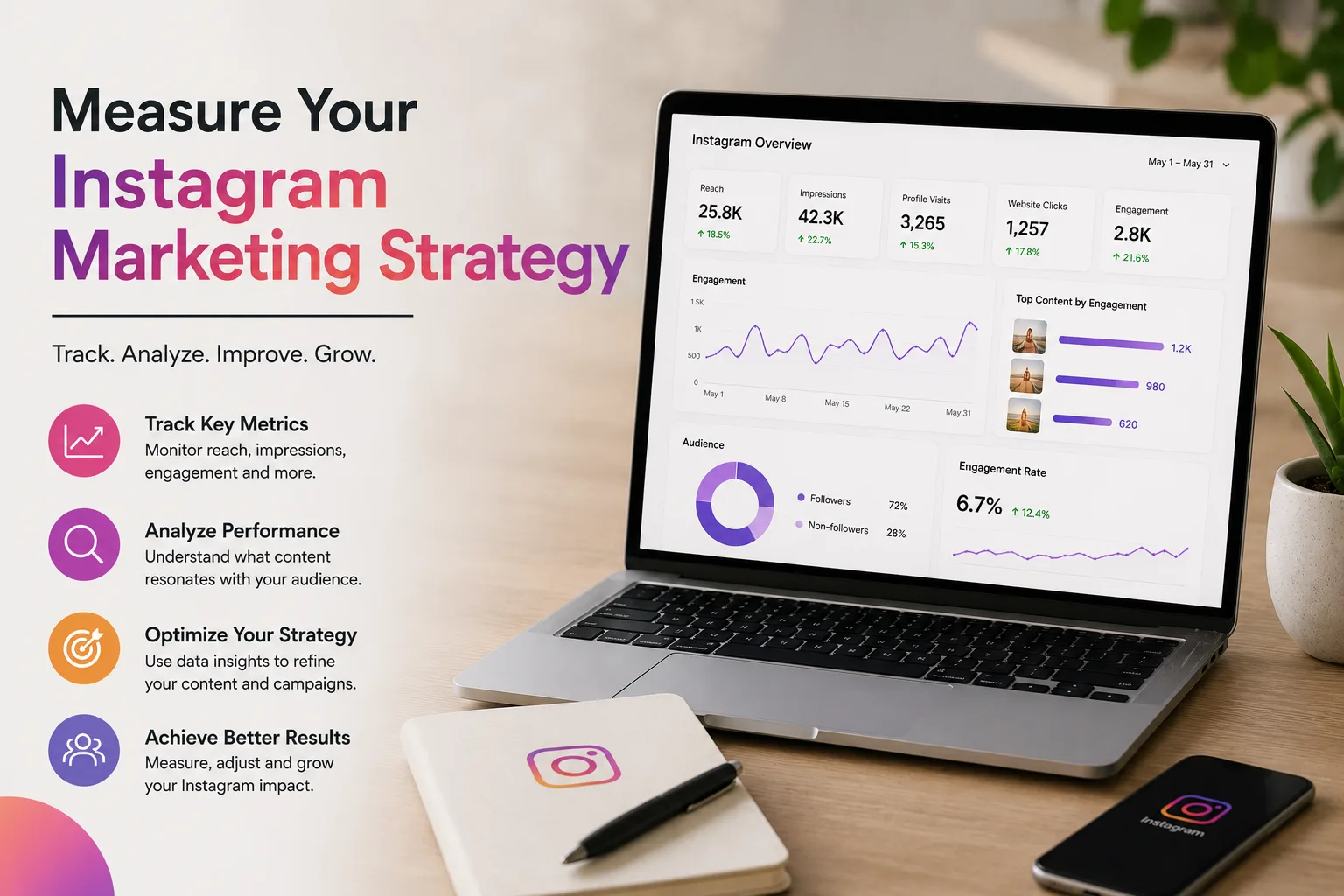
To measure your Instagram marketing strategy, group metrics by awareness, consideration, conversion, and retention. Each group answers a different business question.
Track Metrics by Funnel Stage
Track reach, non-follower reach, and video views for awareness. Track saves, shares, comments, and profile visits for consideration.
Track website clicks, direct-message leads, form submissions, purchases, and revenue for conversion. Track repeat purchases and customer content for retention.
Review Performance Every 30 Days
Review the top 5 and bottom 5 posts every 30 days. Compare topic, format, hook, length, action, and audience response.
Identify 3 winners to repeat and 3 weaknesses to fix. Do not replace the full strategy after one weak week.
Your Instagram marketing strategy needs enough data before major changes. Use at least 8-12 feed posts for a monthly pattern review.
Use Decision Rules Before Changing Direction
Create decision rules before publishing. Continue formats that beat account medians across 3 posts.
Rewrite hooks when completion stays low. Improve calls to action when reach grows but clicks remain flat.
Review the offer and landing page when clicks rise without leads. Review targeting when paid leads lack buyer quality.
How to Run a 90-Day Instagram Marketing Strategy
To run a 90-day Instagram marketing strategy, build foundations in month 1. Test in month 2 and scale in month 3.
During days 1-30, define goals, audience, pillars, profile copy, tracking, and weekly workflow. Publish 12-20 feed posts and document baseline metrics.
During days 31-60, test 3 Reel structures, 2 carousel styles, 2 Story sequences, and 2 calls to action. Start direct-message tracking.
During days 61-90, repeat winning topics, improve weak conversion paths, and promote proven content. Add retargeting when audience size supports delivery.
A repeatable Instagram marketing strategy should become easier after each quarter. Clear templates and decision rules reduce production waste.
Which Instagram Marketing Mistakes Reduce Results?
The most damaging mistakes separate content activity from buyer intent and measurement. A busy account can still produce weak business results.
- Chase follower growth without measuring audience relevance, leads, or sales.
- Copy trends without connecting each trend to a product, service, or buyer problem.
- Post across unrelated topics that weaken account positioning and search relevance.
- Publish without a consistent response system for comments, questions, and direct messages.
- Use one content format despite different discovery, education, trust, and conversion needs.
- Boost weak posts without testing offers, tracking, landing pages, or qualified outcomes.
- Change direction after limited data instead of reviewing a full 30-day content sample.
- Rely on artificial intelligence content without adding experience, evidence, opinion, or brand knowledge.
Your Instagram marketing strategy should protect focus. Remove tactics that increase workload without improving audience quality or commercial results.
Build a Business-Focused Instagram System
A productive Instagram marketing strategy connects clear positioning, useful content, active community management, paid testing, and conversion tracking. The plan should support revenue, not post volume.
Set one 90-day goal, build four content pillars, publish consistently, track buyer actions, and review results every 30 days. Start with Hoop'ssocial media marketing services to build a strategy tied to measurable business growth.
“A strong 2026 Instagram plan connects content, community, paid distribution, and conversion tracking.”
Key takeaways
- 01Tie your Instagram plan to business goals, not vanity metrics
- 02Build a consistent content system across Reels, carousels, and Stories
- 03Optimize for Instagram search and discovery
- 04Turn attention into leads and sales, and measure it
Written by
Sahar
Content Writer
Frequently Asked
Questions
Everything you need to know before booking a strategy call. Can't find your answer? Contact us directly.
Most businesses should publish 3-5 feed posts weekly and use Stories on 4-6 days. Quality and response speed matter more than daily volume.
Yes. Reels support non-follower discovery, while carousels and Stories support education, trust, and conversion.
Yes. Use 3-8 precise hashtags that describe the topic, audience, category, brand, or location.
Use 90 days for a strategic evaluation and review performance every 30 days. Paid tests can provide earlier directional data.
Yes. B2B companies can use founder content, case studies, educational carousels, direct messages, lead forms, and retargeting.
Keep reading
All articles →
Social Media Marketing Plan: How to Build One Your Team Can Run
Sep 26, 2026 · 10 min read
Social Media Ad Campaigns 2026: How to Plan, Launch, and Optimize
Sep 28, 2026 · 10 min read