TikTok for Business: Complete Marketing Guide 2026
TikTok for business helps brands reach new audiences and sell through organic and paid content. A strong 2026 plan connects account setup, TikTok SEO, creators, advertising, commerce, and conversion tracking.
Sahar
Content Writer
TikTok for business helps brands reach new audiences, build trust, generate leads, and sell through organic and paid content. A strong 2026 plan connects account setup, TikTok SEO, creators, advertising, commerce, and conversion tracking.
Your TikTok for business plan should define one audience and one primary goal. The plan also needs five content pillars, a weekly workflow, and exact targets.
Need this done right?
Hoop builds the strategy, design and development behind sites like this one — talk to us about yours.
What Is TikTok for Business and Why Should Brands Use the Platform?
TikTok for business combines a business profile, organic publishing, creator partnerships, advertising tools, analytics, and commerce features. Brands use the system to move viewers from discovery toward measurable action.
TikTok differs from follower-first networks because content reaches interested viewers through recommendation and search systems. A small account can reach qualified users when videos match clear interests.
Ecommerce brands can demonstrate products, answer objections, publish customer videos, and support TikTok Shop. Local businesses can show services, staff, locations, results, and customer questions.
TikTok for business works when your company publishes useful platform-native content and tracks commercial outcomes. Random trend copying creates unstable attention and weak buyer intent.
How to Set Up TikTok for Business Correctly
To set up TikTok for business correctly, choose the right account, optimize every profile field, and connect tracking tools. A clean setup prevents reporting gaps and unclear conversion paths.
Choose the Right Account Structure
Create a dedicated business account or convert an existing brand account. A business account provides analytics, business tools, advertising access, and commercial audio options.
Use one account for one clear brand promise. Separate accounts only when audiences, languages, countries, or product categories require different strategies.
Assign account ownership to a company email address. Store recovery details, access roles, and approval responsibilities inside a secure operations record.
Optimize the Profile for Search and Action
Write a searchable name field with your brand and main category. Add a city when local customers drive revenue.
Use the bio to state the audience, result, proof, and next step. A clear bio can outperform a clever slogan.
Choose one primary profile action, such as shopping, booking, requesting a quote, or visiting a landing page. Match the linked page with the profile promise.
Connect Business, Advertising, and Tracking Tools
Connect TikTok Business Center when multiple employees, agencies, creators, or ad accounts need controlled access. Assign the lowest permission level required for each role.
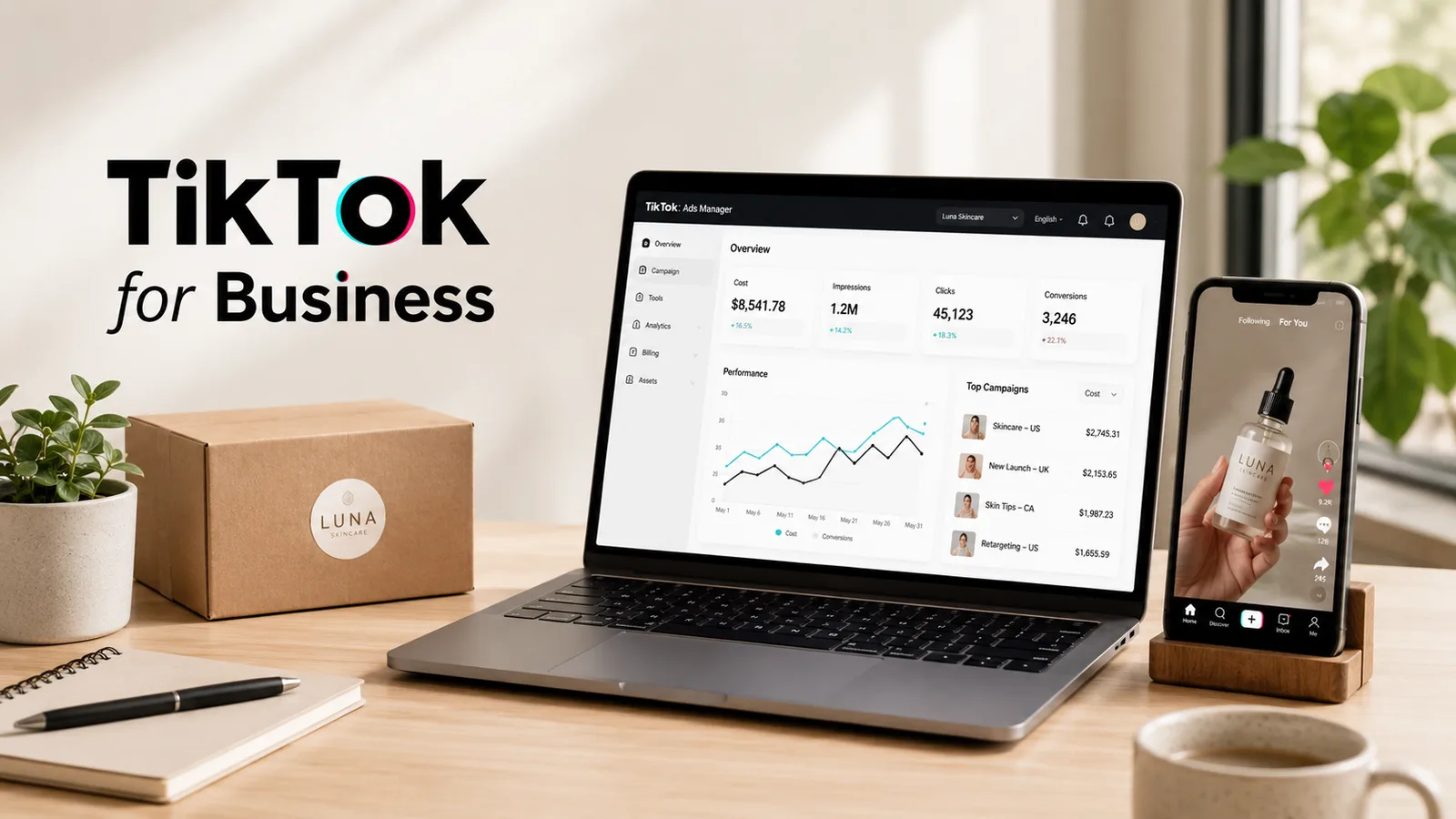
Connect TikTok Ads Manager before paid campaigns start. Install TikTok Pixel and Events API tracking on key pages, such as products, forms, checkout, and confirmation pages.
Add Urchin Tracking Module [UTM] parameters to profile and campaign links. Google Analytics 4 can then separate organic, creator, and paid TikTok traffic.
How to Build a TikTok for Business Strategy
To build a TikTok for business strategy, choose one commercial priority and connect every activity with that priority. A focused plan produces clearer creative decisions and reporting.
Choose 1 Primary Business Goal
Select one 90-day goal from four categories: awareness, demand, leads, or sales. A single primary goal keeps resource allocation clear.
Define a Specific TikTok Audience
Build an audience profile from customer interviews, sales records, search queries, support questions, and competitor comments. Avoid broad labels such as young adults or business owners.
Document seven details: problem, desired result, purchase trigger, objection, trusted proof, preferred creator style, and search language.
Set Baselines and 90-Day Targets
Record current values for views, average watch time, completion rate, profile visits, clicks, leads, sales, and cost per acquisition.
Set one primary target and four supporting targets. Supporting targets should explain progress toward the business result.
Your TikTok for business dashboard should compare weekly activity, content quality, audience response, and conversion performance.
How to Create TikTok Content That Drives Results
To create TikTok content that drives results, build repeatable topics, strong openings, useful scripts, and native visual execution. Every video should serve one audience need.
Build 5 Repeatable Content Pillars
Choose five content pillars tied to buyer questions and company strengths. Useful pillars include education, demonstration, proof, process, and perspective.
An ecommerce brand can publish product tests, customer routines, comparisons, founder stories, and problem-solving tutorials.
Write Hooks and Scripts for Retention
Open every video with a specific problem, result, question, disagreement, or visual outcome. Show the topic within the first 2 seconds.
Use a four-part script: hook, context, value, and action. Keep one main idea inside each video.
TikTok for business content should sound direct and human. Formal corporate language weakens retention and audience trust.
Record Platform-Native Videos
Record vertical video at a 9:16 ratio and 1080 by 1920 pixels. Use clear lighting, clean audio, readable captions, and visible subject movement.
Place essential text away from interface areas near the right edge and lower screen. Preview every video inside TikTok before publishing.
Use the Commercial Music Library for business-safe audio. Confirm usage rights for creator clips, customer videos, music, images, and brand assets.
How to Use TikTok SEO for Search Discovery
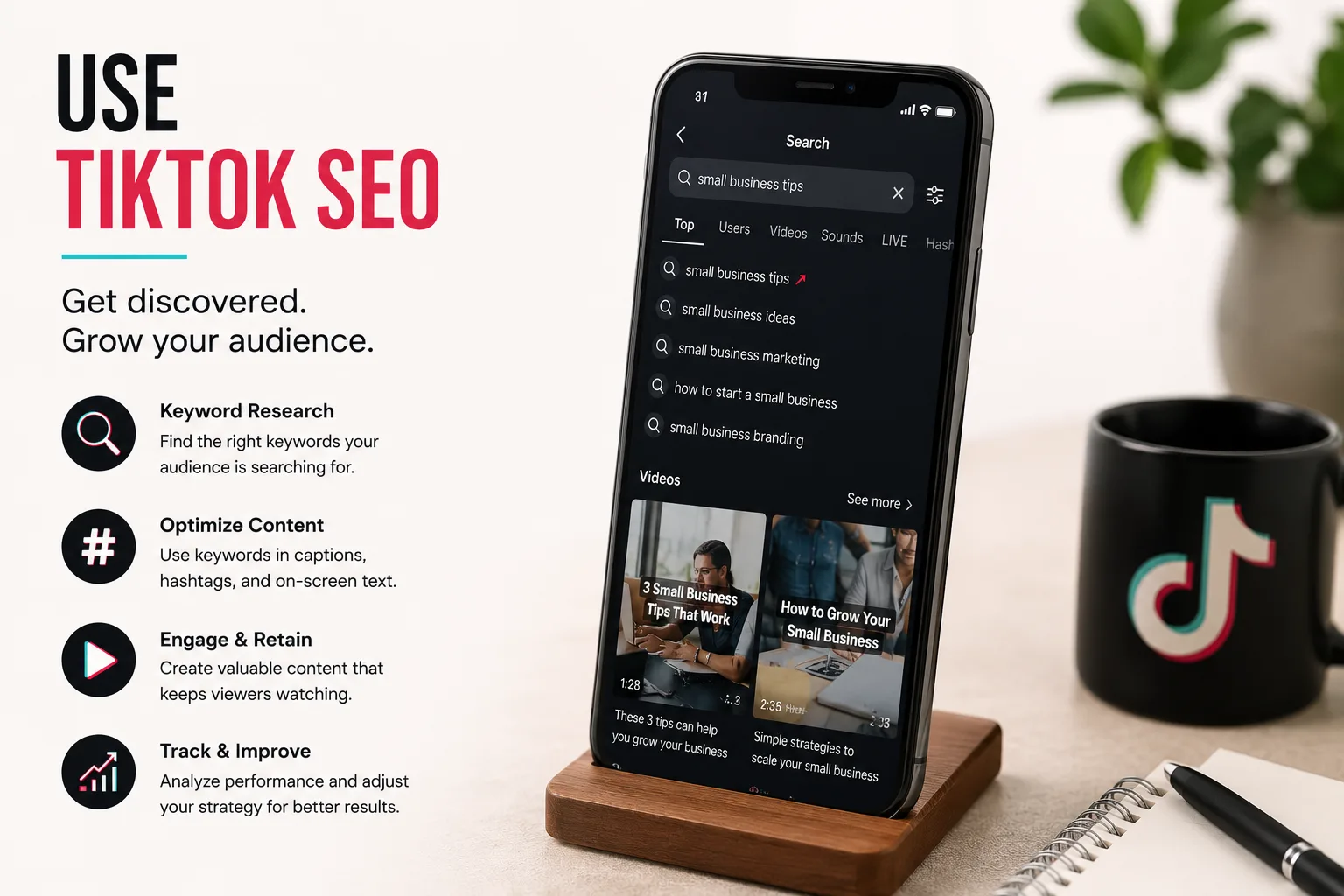
To use TikTok Search Engine Optimization [SEO], match videos with the exact questions buyers search. TikTok SEO increases discovery beyond the For You feed.
Find Search Terms From Buyer Questions
Start with TikTok search suggestions, Creative Center trends, customer questions, competitor comments, and website search data.
Build keyword groups around problems, products, locations, comparisons, reviews, tutorials, and purchase decisions.
Examples include best running shoes for beginners, Lahore wedding photographer prices, and CRM setup for small teams.
Place Keywords Across 5 Video Elements
Place the main phrase in five elements: spoken audio, on-screen text, caption opening, cover title, and relevant hashtags.
Use one primary search phrase and two supporting phrases. Keyword repetition should support clarity rather than create unnatural captions.
TikTok for business profiles should repeat stable category language across bios, videos, playlists, and landing pages.
Measure Search-Led Performance
Review search queries, search traffic, profile visits, website clicks, and conversions for each searchable topic.
Update videos when searches reveal a new question or objection. Create follow-up videos instead of editing successful posts.
How to Build a Weekly TikTok Workflow
To build a weekly TikTok workflow, separate research, scripting, recording, editing, publishing, engagement, and reporting. A defined workflow protects consistency.
Plan a Sustainable Publishing Cadence
Start with 3 to 5 quality videos each week. Increase volume only after your team maintains quality and response coverage.
Professionalsocial media marketing services can manage strategy, scripts, production, publishing, engagement, paid support, and reporting.
| Task | Timing | Method | Difficulty |
|---|---|---|---|
| Research audience questions | Weekly, 45 minutes | Search, comments, sales notes | Medium |
| Write 5 video scripts | Weekly, 90 minutes | Hook, context, value, action | Medium |
| Record 5 videos | Weekly, 2 hours | Batch by location and speaker | High |
| Edit and caption videos | Weekly, 3 hours | Native edits or editing software | High |
| Publish TikTok content | 3-5 times weekly | Native publishing or scheduler | Low |
| Reply to comments and DMs | Daily, 20 minutes | Saved answers plus personal replies | Medium |
| Review performance | Weekly, 30 minutes | Analytics and conversion dashboard | Medium |
| Run strategic review | Every 30 days, 60 minutes | Keep, improve, stop, test | Medium |
Batch Production Without Reducing Quality
Group scripts by speaker, location, product, and visual setup. Batching reduces setup time without forcing identical videos.
Record multiple hook variations before recording full scripts. Use the strongest hook during editing.
Manage Comments and Direct Messages
Reply to relevant comments within one business day. Fast responses improve community trust and reveal new content ideas.
Turn repeated questions into video replies. Video replies connect community management with searchable content production.
Create approved response paths for prices, complaints, support, partnerships, and sales enquiries. Escalate sensitive issues to named owners.
How to Use Creators and User-Generated Content
To use creators and user-generated content, choose audience alignment before follower size. Clear evidence and usage rights protect performance and budget.
Select Creators Through Audience Evidence
Review audience location, age, interests, comment quality, average views, content consistency, and previous brand partnerships.
Request screenshots from recent analytics when creators can share data. Compare median performance instead of one viral result.
Write a Clear Creator Brief
Define one audience, one message, three required points, one action, and prohibited claims. Leave room for the creator's natural delivery.
Provide product details, proof, deadlines, disclosure requirements, review stages, and contact information.
TikTok for business creator briefs should protect accuracy without producing scripted advertisements.
Secure Usage Rights Before Promotion
Write usage rights into every agreement. Name the channels, countries, duration, edit permissions, paid media rights, and renewal costs.
Confirm Spark Ads authorization before campaign launch. Record authorization dates, codes, post links, and expiration dates.
How to Run TikTok Ads for Business Growth
To run TikTok ads for business growth, match campaign objectives with buyer readiness and proven creative. Paid reach cannot repair a weak offer.
Choose a Campaign Objective From the Funnel
Use awareness goals for qualified reach and video exposure. Use traffic goals for landing-page visits when tracking works correctly.
Use lead generation for consultations, quotes, applications, and service enquiries. Use sales objectives for tracked purchases and repeatable ecommerce funnels.
Promote Proven Organic Videos
Test organic videos before large paid investment. Promote posts that show strong retention, shares, saves, profile visits, or qualified comments.
Use Spark Ads to promote approved brand or creator posts. Spark Ads preserve native engagement and social proof.
Set a promotion rule before testing. For example, promote videos that beat the account median completion rate by 25%.
Test Creative and Landing Pages Together
Test three to five hooks, two offers, and two calls to action. Change one major variable during each structured comparison.
Send each advertisement to a landing page that matches the video's promise. Use fast pages, visible proof, short forms, and clear next steps.
Hoop'spaid advertising services connect TikTok Ads, creative testing, targeting, conversion tracking, landing pages, and reporting.
TikTok for business advertising should track cost per result, conversion quality, revenue, and return on ad spend.
How to Use TikTok Shop and Social Commerce
To use TikTok Shop and social commerce, prepare products, fulfilment, customer support, and content before launching. Confirm regional feature access first.
Prepare Products and Operations
Choose products with clear visual value, stable inventory, competitive pricing, reliable delivery, and manageable return rates.
Assign owners for inventory updates, order issues, refunds, creator samples, and customer questions.
Create Shoppable Content
Show products inside real use cases. Demonstrate results, setup, fit, texture, size, features, limitations, and buyer suitability.
Use three content types: founder demonstrations, customer-style reviews, and creator tutorials. Each type answers different buyer concerns.
TikTok for business commerce content should educate before asking for a purchase.
Use LIVE Sessions With a Clear Plan
Plan every LIVE session around one product group, event, launch, tutorial, or question theme.
Assign one host and one moderator. The moderator should answer questions, manage links, record objections, and flag support issues.
Track viewers, average watch time, product clicks, orders, revenue, and repeated questions after every session.
How to Measure TikTok for Business Performance
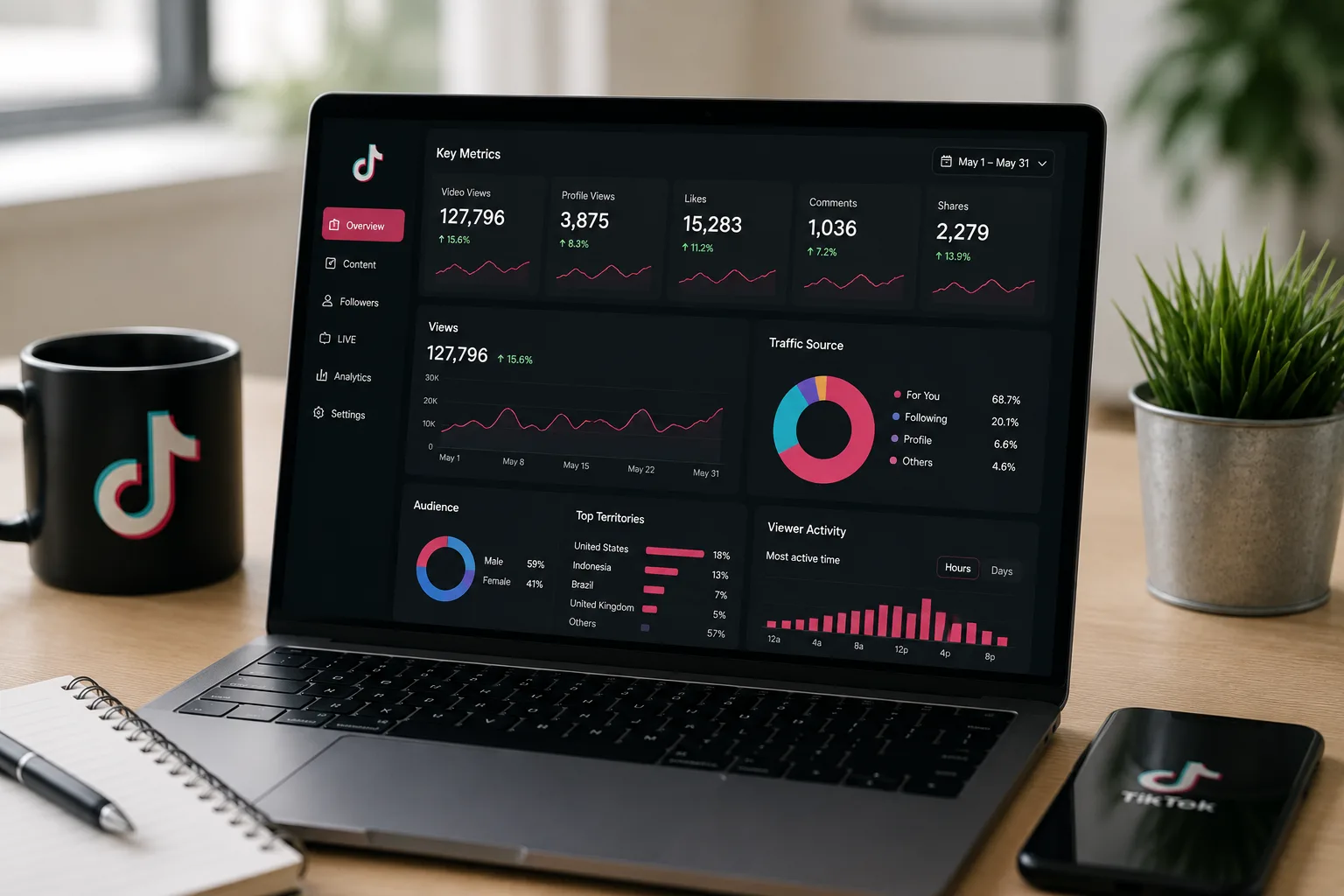
To measure TikTok for business performance, connect platform metrics with website, lead, sales, and customer data. Views alone cannot prove business impact.
Track Metrics by Funnel Stage
Track awareness through qualified reach, views, and audience relevance. Track content quality through watch time, completion, rewatches, shares, and saves.
Track business results through leads, purchases, revenue, customer acquisition cost, and return on ad spend.
Connect TikTok With Analytics and CRM Data
Use UTM parameters for organic, creator, and paid links. Use consistent source, medium, campaign, and content values.
Connect TikTok Pixel and Events API data with website events. Test event accuracy before increasing advertising spend.
Send qualified leads into a customer relationship management [CRM] system. Record source, campaign, offer, lead quality, value, and sales outcome.
Apply 30-Day Decision Rules
Keep topics that produce strong retention and commercial actions. Improve topics that attract the right audience but lose viewers early.
Stop formats that underperform across three controlled attempts. Test one new format, message, creator, or offer during each review cycle.
Your TikTok for business review should separate content problems, audience problems, offer problems, and tracking problems.
How to Run a 90-Day TikTok for Business Plan
To run a 90-day TikTok for business plan, divide execution into setup, validation, and growth phases. Each phase needs clear outputs.
Days 1 to 30 should establish the account, tracking, audience, content pillars, workflow, and baseline metrics. Publish 12 to 20 videos.
Days 31 to 60 should validate topics, hooks, search phrases, creators, and conversion paths. Promote only proven organic content.
Days 61 to 90 should scale winning topics, improve landing pages, expand creator partnerships, and refine paid campaigns.
Review results on days 30, 60, and 90. Document decisions, owners, deadlines, and expected metric changes after every review.
TikTok for business success requires disciplined learning. One viral video cannot replace a repeatable acquisition system.
Which TikTok for Business Mistakes Waste Time and Budget?
The costliest mistakes include copying trends without strategy, targeting broad audiences, and tracking views without conversions. Each mistake weakens commercial learning.
·Posting unrelated topics that confuse audience and search signals.
·Using slow openings that hide the video's value.
·Publishing polished advertisements that feel unnatural inside the feed.
·Ignoring comments, direct messages, and repeated buyer questions.
·Hiring creators through follower counts without audience evidence.
·Running paid campaigns before testing offers and conversion tracking.
·Sending traffic toward slow or mismatched landing pages.
·Using copyrighted audio or creator content without clear rights.
·Changing strategy after one weak post or one strong viral post.
·Reporting reach without leads, sales, revenue, or customer quality.
A documented TikTok for business process gives teams clear standards for creative, approvals, tracking, and budget decisions.
Build a Revenue-Focused TikTok System
TikTok for business performs best when content, search, creators, advertising, commerce, and tracking support one measurable goal. Start with a focused 90-day plan and improve decisions through evidence.
Hoop Interactive'sdigital marketing services can connect TikTok strategy, content, creators, paid media, landing pages, analytics, and revenue reporting. Book a strategy call to build a TikTok growth plan around your audience and business goals.
“TikTok for business helps brands reach new audiences, build trust, generate leads, and sell through organic and paid content.”
Key takeaways
- 01TikTok reaches new audiences and builds trust fast
- 02Combine organic content, TikTok SEO, creators, and ads
- 03Use TikTok Shop and social commerce to sell directly
- 04Track conversions — not just views
Written by
Sahar
Content Writer
Frequently Asked
Questions
Everything you need to know before booking a strategy call. Can't find your answer? Contact us directly.
Yes. TikTok can help small companies reach niche audiences through useful, searchable, and platform-native content. Small teams need a sustainable schedule and clear conversion path.
Yes. A business account supports business analytics, advertising access, commercial audio, and account tools. Feature access can vary by market.
Start with 3 to 5 quality videos each week. Increase publishing volume after your team maintains quality, engagement, and reporting.
Yes. B2B companies can publish education, process explanations, expert opinions, customer stories, recruiting content, and product demonstrations.
Use a 90-day strategy with formal reviews every 30 days. Weekly reviews should track production, retention, traffic, leads, sales, and costs.