Content Marketing vs Social Media Marketing: What’s the Difference?
Content marketing builds owned assets that compound through search; social media marketing rents platform attention that moves fast. They answer different growth problems, and most businesses need one core asset engine feeding one focused social channel.
Sahar
Content Writer
Content marketing vs social media marketing compares two connected disciplines with different jobs. Content marketing builds useful assets, while social media marketing creates platform reach, conversation, and action.
The decision depends on ownership, discovery, lifespan, speed, and measurement. Most businesses perform better when both channels support one growth goal.
What Is the Main Difference Between Content Marketing and Social Media Marketing?
The comparison starts with where value lives and how people discover it. Content marketing often creates owned assets, while social media marketing operates mainly on platform-controlled channels.
A blog guide can rank in search, collect email signups, support sales, and remain useful for years. A social post can generate attention faster, start conversations, and reach people who were not actively searching.
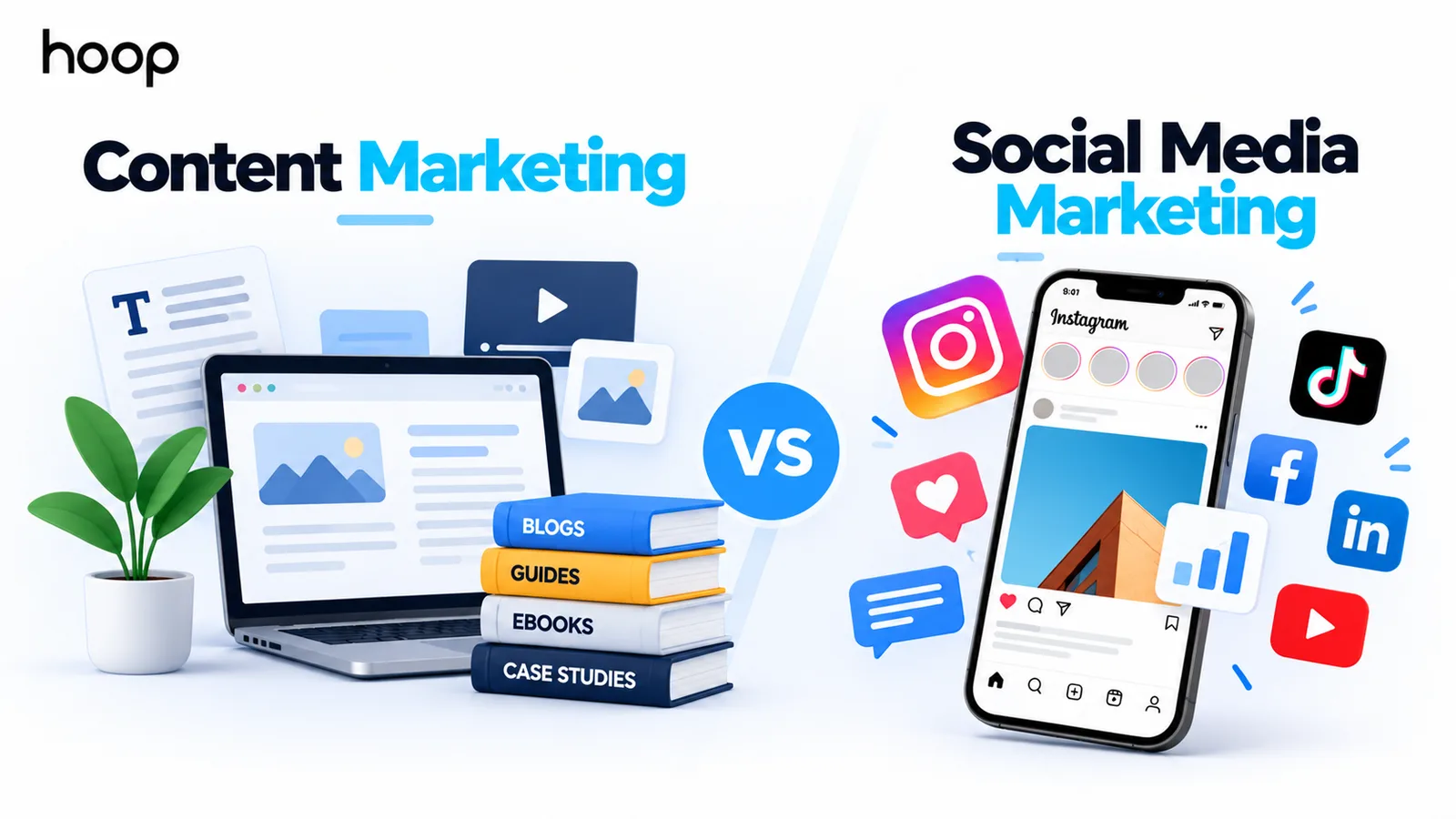
Content marketing answers demand through assets such as guides, case studies, videos, emails, reports, and landing-page resources. Social media marketing builds distribution and interaction through platforms such as LinkedIn, Instagram, TikTok, Facebook, and YouTube.
The boundary is not rigid. Social posts are content, and strong content often needs social distribution. The distinction matters because each channel solves different growth problems.
Content Marketing vs Social Media Marketing at a Glance
| Factor | Content Marketing | Social Media Marketing |
|---|---|---|
| Primary role | Build durable assets that attract, educate, nurture, or convert. | Create reach, engagement, conversation, community, and platform actions. |
| Ownership | Often lives on websites, email lists, and other owned channels. | Usually lives on third-party social platforms. |
| Discovery | Often search-led, referral-led, or email-led. | Often feed-led, recommendation-led, or community-led. |
| Lifespan | Strong assets can create value for months or years. | Most posts create value for shorter periods. |
| Speed | Usually compounds more slowly. | Can create visibility and feedback quickly. |
| SEO value | Directly supports search visibility and topical authority. | Supports distribution and branded demand more than direct rankings. |
| Interaction | Often one-to-many. | Strongly conversational and community-driven. |
| Core metrics | Organic traffic, leads, assisted conversions, downloads, revenue. | Reach, engagement, referral traffic, leads, community growth, revenue. |
How Does Content Marketing Work?
Content marketing creates useful material for a defined audience, and each asset connects to a business outcome. The asset can educate a prospect, answer a search query, reduce objections, capture a lead, or support a sale.
For example, a company selling accounting software can publish a tax-planning guide for small businesses. Strong blog writing services can turn that guide into an organic search asset instead of a one-week campaign.
The content marketer still needs distribution. Search engine optimization, email, partnerships, paid promotion, and social media can all bring the right audience to the asset.
Publishing more content does not automatically create a content strategy. Each asset needs a clear audience, purpose, format, distribution route, and measurement plan.
How Does Social Media Marketing Work?
Social media marketing uses social platforms to reach audiences, start conversations, and create measurable actions. The activity can include organic publishing, community management, creator partnerships, paid promotion, and platform-specific campaigns.
A strong social media marketing program does more than schedule posts. The program also manages community feedback, platform behavior, distribution, creative testing, and conversion paths.
A software company can use LinkedIn to publish founder insights, customer proof, short videos, document posts, and product announcements. Each format serves a different role inside the same platform strategy.
Social media also gives marketers fast audience feedback. Comments, shares, saves, direct messages, and click behavior can reveal which problems deserve deeper content.
Content Marketing vs Social Media Marketing: 7 Key Differences
1. Ownership and Control
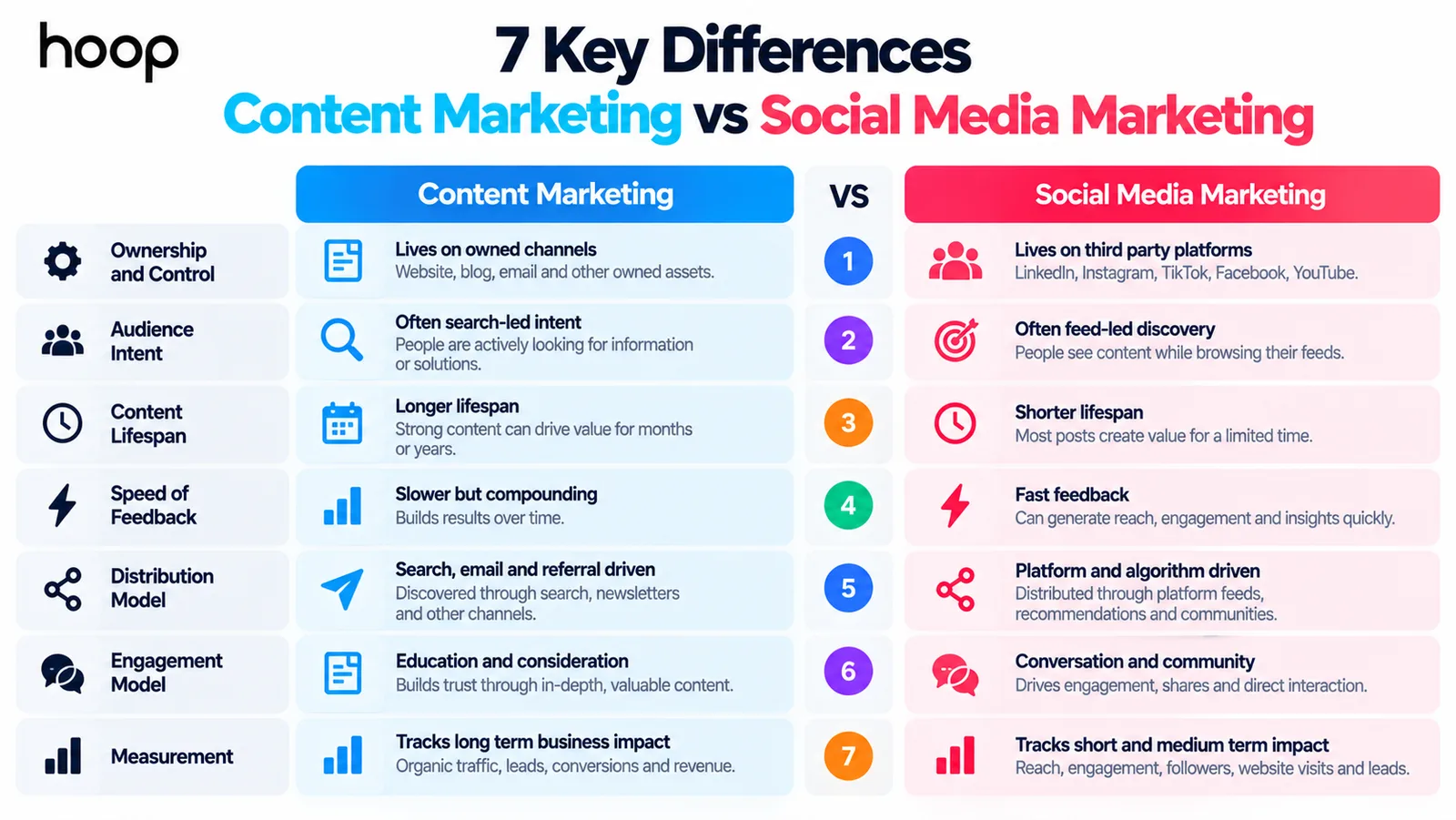
Ownership creates a major difference. Content marketing often creates assets on channels the business controls. Website articles, email lists, downloadable guides, and case studies remain accessible without depending on one platform’s feed rules.
Social media marketing depends more heavily on platform policies, algorithms, formats, and account access. A change on LinkedIn or TikTok can alter reach without changing your underlying message.
2. Audience Intent
The two also differ by audience intent. Content marketing often captures people who already want an answer. A search for “best payroll software for small business” shows clear information or buying intent.
Social media often reaches people before they actively search. A useful video or founder post can create interest, shape preferences, or introduce a problem the audience had not prioritized.
3. Content Lifespan
Lifespan differs sharply. Evergreen content can keep attracting traffic long after publication. A strong guide can support search visibility, email nurture, sales conversations, and social repurposing for years.
Most social posts have shorter attention windows. High-performing posts can still create meaningful value, but feed visibility usually declines faster than search visibility.
4. Speed of Feedback
Social media usually delivers audience feedback faster. Marketers can see reactions, comments, shares, click patterns, and conversation quality within hours or days.
Content marketing often needs more time. Search visibility, backlinks, email growth, and assisted conversions can build over weeks or months.
5. Distribution Model
Content marketing needs a distribution plan because a strong asset can remain invisible without promotion. Search, email, paid media, partnerships, and social channels can all distribute the same asset.
Social media combines content and distribution inside the same environment. The platform can recommend the post, users can share it, and paid promotion can extend its reach.
6. Engagement Model
Content marketing often supports deeper consumption. Readers can spend several minutes with a guide, case study, comparison page, webinar, or email sequence.
Social media favors faster interactions and public conversation. Replies, shares, comments, reactions, and direct messages create a visible feedback loop around the content.
7. Measurement
Content marketing usually emphasizes organic traffic, search visibility, leads, downloads, assisted conversions, and content-attributed revenue. Social media adds reach, engagement, community growth, referral traffic, leads, and social-attributed revenue.
Shared business metrics matter more than isolated channel metrics. Both teams should connect activity to qualified leads, pipeline, sales, retention, or another defined outcome.
Which Is Better for SEO?
Content marketing has the stronger direct SEO role. Search engines can index and rank owned assets. Long-form guides, comparison pages, case studies, and topic clusters can build organic visibility around valuable queries.
Social media can still support SEO indirectly. Strong social distribution can increase branded searches and expose content to journalists or creators. That exposure can create more links and mentions.
Use content marketing when organic discovery is a major growth goal. Use social media to increase distribution, feedback, and brand demand around those assets.
Which Is Better for Brand Awareness?
Social media usually creates faster brand visibility. Platforms can distribute content beyond existing followers. Short videos, creator content, comments, shares, and paid amplification can increase reach quickly.
Content marketing builds awareness differently. Search-focused assets can introduce the brand when a prospect researches a problem. Reports and guides can build authority through depth.
Choose social media for faster exposure and conversation. Choose content marketing for deeper education and durable discovery. Many brands need both stages.
Which Is Better for Lead Generation?
There is no universal lead-generation winner. The better channel depends on buying intent, sales cycle, audience behavior, offer strength, and conversion path.
A B2B company can attract high-intent leads through search-focused content, then use LinkedIn to nurture trust and retarget decision-makers. An ecommerce brand can use social content to create demand and website content to answer objections before purchase.
Measure lead quality instead of counting form fills alone. A smaller number of qualified leads can create more revenue than a larger volume of weak inquiries.
Which Costs More?
Costs depend on the production model rather than the channel label. Content marketing can require research, writing, design, SEO, video production, and distribution. Social media can require daily creative work, community management, paid amplification, creators, and reporting.
Content often has a higher upfront production cost per durable asset. Social media often creates a higher ongoing production rhythm because platforms reward frequent, format-specific output.
Do not compare channels only by monthly spend. Compare cost against useful asset life, qualified leads, revenue contribution, and the internal time required to sustain each program.
Should a Small Business Choose Content Marketing or Social Media Marketing?
A small business should match the channel to its biggest growth constraint. Limited resources make focus more valuable than trying to maintain every channel.
- Choose content marketing first when customers actively search for your expertise, service, product category, or problem.
- Choose social media first when discovery, local awareness, community, visual proof, or frequent customer interaction drives demand.
- Choose both when the business can create one strong core asset and adapt it into several platform-specific pieces.
- Delay a channel when the team cannot publish consistently, respond to leads, or measure business outcomes from the work.
How Do Content Marketing and Social Media Marketing Work Together?
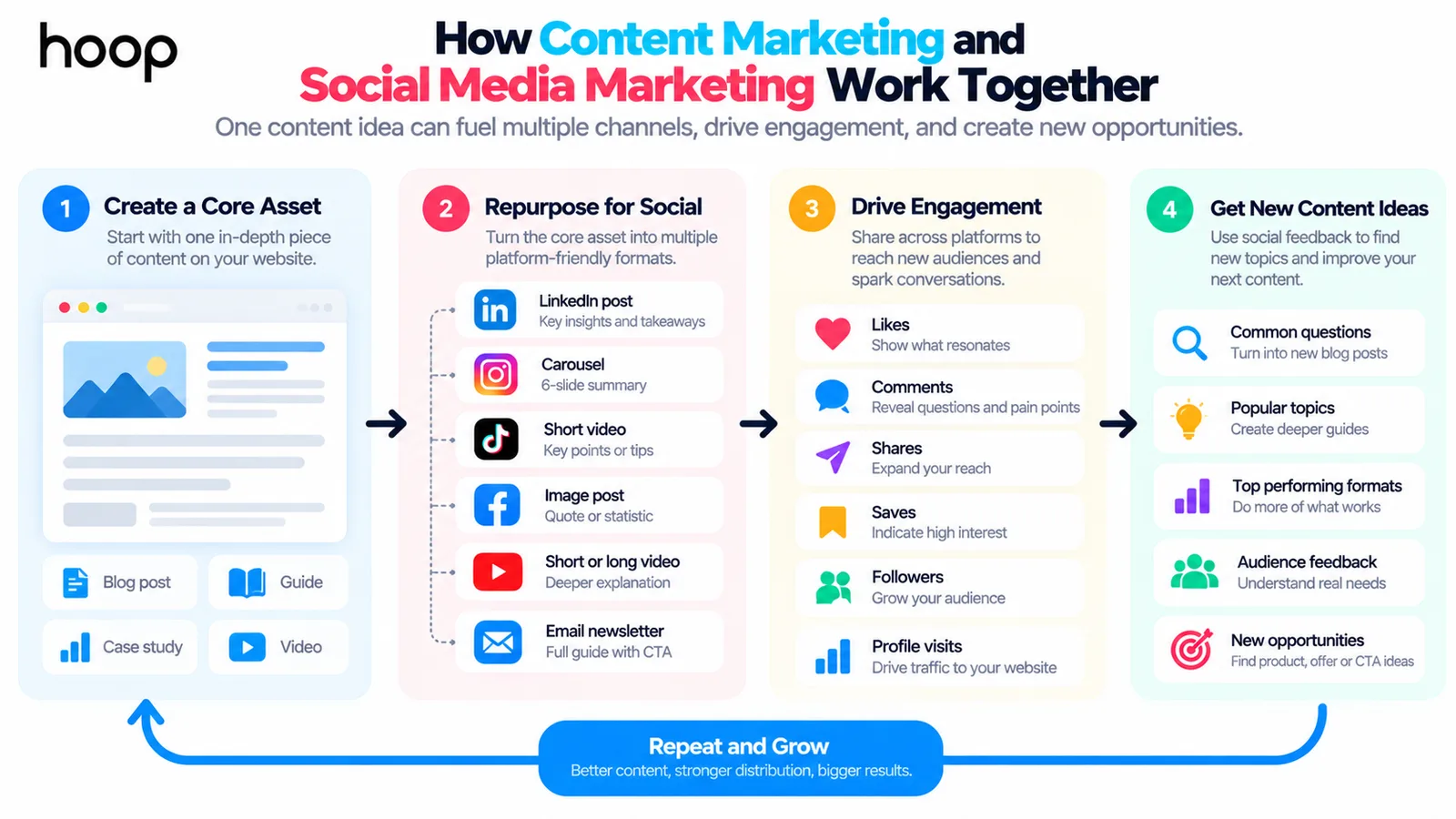
The strongest model uses content to create depth, while social media creates distribution, conversation, and feedback. Each channel improves the other when both teams share the same customer problem and business goal.
Create One Core Asset
Start with one high-value asset. Useful choices include a guide, case study, research report, webinar, or customer interview. The asset should answer a real question or support a defined decision.
Adapt the Idea by Platform
Turn the core idea into platform-native formats. A 2,000-word guide can become a LinkedIn post, 6-slide carousel, short video, email, quote graphic, and sales talking point.
Use Social Feedback to Improve Future Content
Track comments, saves, shares, replies, and questions. Repeated confusion or strong engagement reveals topics that deserve deeper guides, landing pages, videos, or email sequences.
Connect Both Channels to One Growth System
A broader digital marketing strategy should connect search, content, social, email, and paid media. The same system should connect conversion paths. Channel teams perform better when they optimize toward shared business outcomes.
How Should You Split Budget Between the Two?
Budgets should follow the customer journey, not an arbitrary 50/50 split. A search-led business needs more investment in durable content. A discovery-led brand needs more social production and distribution.
Start by identifying where qualified demand enters the funnel. A legal service, software company, or B2B consultancy can benefit from search-focused guides and comparison pages. A fashion brand, restaurant, or creator-led product can need stronger social reach and visual proof.
Next, compare asset lifespan against production rhythm. One strong guide can support search, email, sales, and social repurposing for months. Social platforms usually demand more frequent creative output, community responses, and testing.
Then compare conversion evidence. Increase investment where qualified leads, sales, assisted conversions, or customer retention justify the cost. Reduce activity that produces attention without meaningful customer movement.
A practical starting point is to fund one durable content engine and one focused social channel. Expand only after the team can publish consistently, measure outcomes, and reuse strong ideas across both channels.
Content Marketer vs Social Media Marketer: What Does Each Role Do?
The role split becomes clearer through daily responsibilities. A content marketer usually owns research, editorial planning, long-form assets, SEO collaboration, and distribution planning. The role can also own lead magnets, case studies, email content, and performance analysis.
A social media marketer usually owns platform strategy, publishing, community management, social creative, and creator relationships. The role can also own trend monitoring, campaign execution, paid social coordination, and platform analytics.
Smaller companies often combine both roles because one person manages content creation and social distribution. Larger teams usually separate the disciplines because each requires specialized planning, production, and measurement.
The overlap explains why job descriptions often look confusing. The role title matters less than the outcomes, channels, and responsibilities written into the position.
Common Mistakes Businesses Make With Both Channels
The most common mistake is publishing without a defined audience or business outcome. A weekly content quota does not become a strategy simply because the team hits the schedule.
Another mistake is copying one format across every channel. A search guide, LinkedIn post, Instagram Reel, and email need different structures. Each piece can still use the same core idea.
Businesses also separate content and social teams too aggressively. The content team loses audience feedback, while the social team loses access to deeper expertise and reusable assets.
Vanity metrics create another problem. High reach or pageviews can look impressive while producing little qualified demand. Both teams need goals tied to the customer journey.
Which Strategy Should You Prioritize?
Prioritize content when long-term organic discovery and authority matter most. Prioritize social media marketing when faster reach, conversation, community, and real-time feedback matter most.
The decision should follow the customer’s behavior. Search-led buyers need strong content. Feed-led discovery needs strong social distribution. Complex purchases often need both.
Start with the channel closest to the current growth problem, then connect the second channel when resources allow. The goal is not channel balance. The goal is efficient customer acquisition and retention.
Build One System Instead of Two Silos
Content marketing vs social media marketing works best when both channels share one audience, one message system, and one measurement framework. Content creates depth. Social creates distribution, interaction, and feedback.
Choose the channel that solves the most urgent growth problem first. Then connect the second channel so strong ideas travel further and audience signals improve future content.
If your team needs coordinated content, social, SEO, and paid media, Hoop Interactive can build the system around measurable growth. Explore our digital marketing strategy services to see how the channels can work together.
“Publishing more content does not automatically create a content strategy. Each asset needs a clear audience, purpose, format, distribution route, and measurement plan.”
Key takeaways
- 01Ownership is the real dividing line: content lives on channels you control, social lives on platforms that can change the rules.
- 02Content captures existing demand through search; social creates demand before anyone searches.
- 03Content marketing carries the direct SEO value; social supports it indirectly through branded search, links, and mentions.
- 04Split budget by where qualified demand enters the funnel, not by an arbitrary 50/50 rule.
Written by
Sahar
Content Writer
Frequently Asked
Questions
Everything you need to know before booking a strategy call. Can't find your answer? Contact us directly.
No. Content marketing creates and distributes useful assets across channels. Social media marketing focuses on social platforms, communities, and platform-driven actions.
Yes, in some strategies. Social media can distribute content marketing assets. Social strategy also includes community management, creators, paid promotion, and platform-specific campaigns.
Content marketing is better for direct SEO. Websites, guides, and landing pages can rank in search results and build topical authority.
Yes. Search, email, partnerships, and paid distribution can support content marketing without a major social presence.
Yes, when resources allow. A small business can create one valuable core asset and repurpose the same idea into several social formats.