What Is a Good CPC for Google Ads? Costs, Examples, and Targets
There is no universal good CPC. Multiply what a customer contributes by your click-to-customer rate, and that is your break-even click price — benchmarks are only context.
Ibrahim
Content Writer
A good cost per click (CPC) for Google Ads is one that helps you acquire profitable customers, not simply one below an industry average. Calculate your acceptable CPC from conversion rate and customer value, then compare actual results with that limit. A $10 click can outperform a $1 click when the expensive visitor buys and the cheaper visitor leaves.
There is no fixed good CPC across every market. Your price changes with location, search intent, competition, ad relevance, and bidding. A business selling legal consultations faces different economics from a restaurant advertising lunch reservations. Use industry data as context, not as a universal target.
Need this done right?
Want a team to handle it? Our Google Ads management services take this from plan to results.
Explore our Google Ads management servicesWhat Does CPC Mean in Google Ads?
CPC means cost per click: the amount you pay when someone clicks your advertisement. Average CPC equals total click spending divided by the number of clicks. If your campaign spends $240 on 80 clicks, its average CPC is $3. Google Ads reports average CPC at campaign, ad group, keyword, and other levels.
How is average CPC different from your maximum bid?
Your maximum CPC bid is a limit you choose under applicable bidding settings; actual click prices vary by auction. Google considers competing bids, ad quality, thresholds, and other auction factors. The CPC reported after traffic arrives describes what you actually paid on average. Do not treat Keyword Planner estimates as guaranteed prices.
Why does cost per click differ between campaigns?
Searches such as “emergency roof repair quote” suggest immediate buying interest. A broad search such as “roof design ideas” often signals research instead. Other influences include geography, device, seasonality, competitor demand, and the landing page. Compare similar search themes before judging performance.
What Is a Good CPC for Google Ads by Industry?
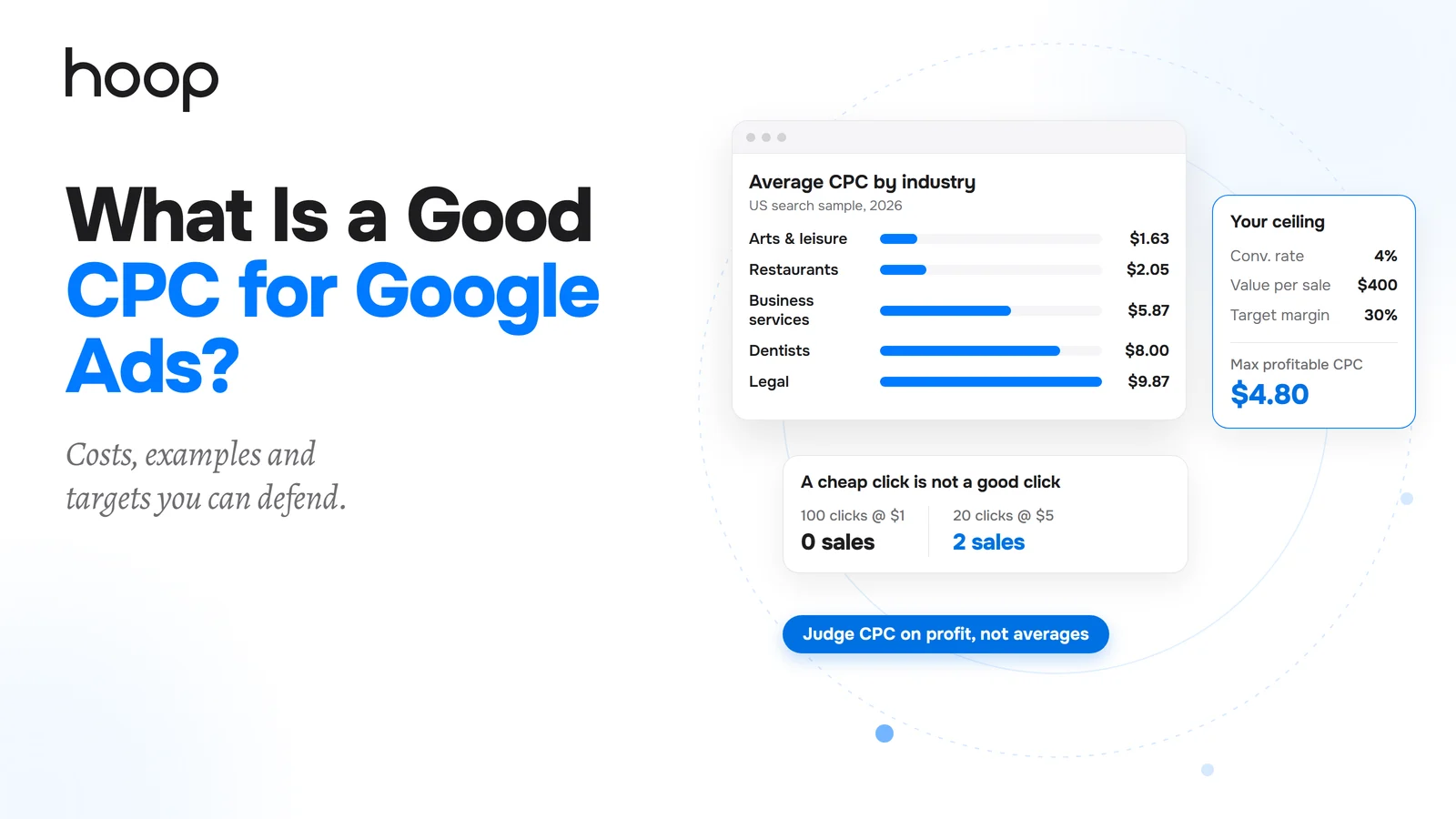
A useful CPC benchmark reflects a comparable industry, country, campaign type, and reporting period. WordStream and LocaliQ reported an overall $5.42 average CPC for a US search-advertising sample in 2026. The sample covered over 13,000 campaigns from April 2025 through March 2026 and includes Google and Microsoft search advertising. These historical figures are reference points, not permanent prices.
The published sector examples show why one universal target is misleading:
| Industry | 2026 sample CPC | What the figure tells you |
|---|---|---|
| Arts and entertainment | $1.63 | Lower benchmark in this sample |
| Restaurants and food | $2.05 | Different economics from high-ticket services |
| Business services | $5.87 | Useful broad context for B2B providers |
| Dentists and dental services | $8.00 | Higher competition and customer value |
| Home and home improvement | $8.33 | Urgent services and local markets vary |
| Attorneys and legal services | $9.87 | Higher-priced demand in this sample |
Source: WordStream and LocaliQ, 2026 US search advertising benchmarks. Values describe the study sample, not a quote for your account. Even businesses within the same category can face radically different prices by city, offer, and keyword.
Is a $1 CPC good for Google Ads?
A $1 CPC is attractive only when the traffic fits your target customer and converts at a sustainable cost. Consider 100 clicks at $1 with no sales versus 20 clicks at $5 that produce 2 profitable customers. Both campaigns spend $100, but only the second creates measurable revenue. Cheap traffic without intent can waste the entire budget.
Is a $10 or $20 CPC too expensive?
No. An expensive click can be rational for a high-margin service or a customer worth thousands of dollars. A $20 CPC becomes unsustainable when visitors rarely convert or each new customer generates only a small contribution margin. Evaluate acquisition economics rather than using a fixed threshold.
How Do You Calculate a Profitable Google Ads CPC?
To calculate a profitable CPC, start with what a customer contributes after direct delivery costs. Then estimate how often clicks become customers. The result provides a break-even click-cost ceiling before additional overhead and agency fees. Use conservative estimates until actual campaign data becomes available.
Step 1: Calculate contribution per new customer
Suppose a local service company charges $500 per completed job and spends $300 on labor, materials, and other direct costs. Each job contributes $200 before fixed overhead and advertising. The business cannot sustainably spend more than $200 acquiring each customer if it needs any contribution left for overhead and profit.
Step 2: Calculate click-to-customer conversion rate
Suppose 200 ad clicks generate 10 genuine customers. The click-to-customer conversion rate equals 10 divided by 200, or 5%. A form-fill rate alone is not sufficient when many leads never purchase. When sales take weeks, connect your Google Ads tracking to confirmed customer outcomes.
Step 3: Set your target CPC below break-even
Multiply $200 contribution per customer by a 5% click-to-customer rate. Break-even CPC equals $10. For example, a business targeting a 40% contribution reserve could set an initial target around $6 per click. The $6 target is an internal planning choice, not an industry benchmark. Include management fees and other acquisition costs before finalizing the limit.
A compact alternative for lead generation is: acceptable CPC = target cost per qualified lead × visitor-to-qualified-lead conversion rate. A $60 target cost per qualified lead and 8% qualified-lead rate yield $4.80 per click. Validate lead quality and close rates before trusting the result.
What Matters More Than a Low CPC?
A low CPC improves efficiency only when the clicks produce valuable actions. Compare cost per qualified lead, customer acquisition cost, conversion rate, and revenue outcomes together. These measures reveal whether lower click prices actually improve your business.
Cost per lead versus cost per qualified lead
Cost per lead (CPL) equals advertising spend divided by recorded leads. Cost per qualified lead uses only contacts meeting agreed fit and intent rules. A campaign spending $600 for 30 forms has a $20 CPL. If only 6 inquiries qualify, the qualified CPL is $100. Both numbers matter, but the second better reflects sales workload.
Customer acquisition cost and return on ad spend
Customer acquisition cost (CAC) measures the cost of gaining customers, often including advertising and related sales costs. Return on ad spend (ROAS) compares attributed revenue with ad spend. (see Google Ads for small business) An ecommerce store might measure ROAS directly; a consulting firm should also track close rates and profit. A high ROAS can still disappoint when margins are thin.
Conversion rate and lead quality
A landing page that converts 2% of clicks into qualified inquiries needs twice as many clicks as one converting 4%, all else equal. Improve conversion tracking and message relevance before assuming bids cause poor results. For deeper page improvements, our landing page optimization services focus on conversion problems.
Why Is Your Google Ads CPC So High?
High CPC often reflects competitive search demand, broad or mismatched targeting, poor relevance, or bidding choices. Investigate the search terms and conversion results before reducing bids. The highest-cost keyword is not necessarily the weakest keyword.
Competition and search intent
Advertisers compete more aggressively for some searches because the potential customer value is high. A law firm targeting a specific case type can face a different auction from a firm targeting educational searches. Compare actual search queries, not just the keywords in your account, to understand why clicks cost more. Competitor research shows who else is bidding.
Ad relevance and landing page experience
Google describes Quality Score as a diagnostic based on expected click-through rate, ad relevance, and landing page experience. The visible 1–10 score is not a direct auction input. Use its components to identify weak messages and pages rather than treating the score itself as your performance goal. A relevant page answers the promise in your ad.
Bidding strategy and limited conversion data
Manual CPC, Maximize Clicks, Maximize Conversions, and target cost-per-acquisition approaches optimize for different outcomes. A new campaign without trustworthy conversion data needs careful monitoring and realistic expectations. Avoid claiming that one strategy universally delivers cheaper customers. Review how the chosen objective changes traffic quality and volume.
How to Estimate CPC Before Launching Google Ads
To estimate CPC before launch, use Keyword Planner for relevant terms and locations, then create a conservative testing budget. Google states that Keyword Planner forecasts use inputs such as bid, budget, seasonality, and historical ad quality. Forecasts are estimates rather than promises.
Use Keyword Planner for relevant search terms
Enter purchase-oriented phrases, select the correct location and language, and inspect low-range and high-range top-of-page bid estimates. Build separate groups for different services. A software agency might separate “CRM implementation company” from “what is CRM.” The two searches express different purchasing readiness.
Test a budget that can produce useful evidence
At a projected $5 CPC, $500 buys roughly 100 clicks before variation in actual prices. With a 4% conversion rate, that sample would produce about 4 conversions on average. Small samples fluctuate widely. Avoid declaring a campaign profitable or unprofitable from one day of spending or one accidental lead. Our guide to Google Ads costs covers budget planning in more detail.
Track results beyond the first contact
Record form submissions, phone calls, qualified opportunities, completed purchases, and revenue where feasible. Confirm that tracking counts genuine actions rather than page visits or duplicate events. Once your numbers stabilize, calculate acceptable CPC from actual conversion rates and profit instead of assumptions.
How Can You Lower CPC Without Losing Valuable Traffic?
To lower CPC without sacrificing lead quality, remove irrelevant searches, improve message match, and focus budgets on terms with useful outcomes. The objective is profitable traffic, not the cheapest possible click.
Add negative keywords and tighten intent
Review the Search Terms report for irrelevant queries such as jobs, free templates, or unrelated product categories. Add appropriate negative keywords after verifying their meaning. Keep relevant commercial searches even when those clicks cost more. A lower CPC achieved by attracting unqualified visitors does not improve acquisition.
Write specific ads for each service
Match headlines to the customer problem and offer. For example, a bookkeeping firm can describe monthly bookkeeping support rather than advertising generic financial advice. Clear expectations discourage accidental clicks and direct suitable visitors to the right page. Test the resulting qualified leads, not only click-through rate.
Improve pages instead of only cutting bids
A page with unclear pricing, slow loading, or a long form can waste good clicks. Align its headline with the ad, show trustworthy service details, and make contact easy. Businesses creating a new campaign can use conversion-focused landing page design before buying additional traffic.
Shift budget toward profitable segments
Compare conversion performance by device, geography, campaign, and search theme. Move spend toward segments that create qualified sales at sustainable costs. Keep enough time for attribution, delayed conversions, and normal week-to-week variability. Do not judge a low-volume market using only one unusual customer. Our Scrap Cars 4 Cash case study shows search ads measured against real enquiries.
When Should You Accept a Higher CPC?
Accept a higher CPC when the click generates enough additional customer value to cover its cost. A high-priced B2B consultation, emergency repair, or repeat-purchase customer can justify a different ceiling. Calculate contribution, not only headline revenue.
Consider 2 fictional campaigns. Campaign A buys 100 clicks at $2 and produces 1 customer who contributes $100 before advertising. Campaign B buys 40 clicks at $8 and produces 4 customers contributing $200 each. Campaign A spends $200 against $100 contribution. Campaign B spends $320 against $800 contribution. Campaign B delivers the better advertising economics despite its higher CPC.
Check quality before increasing spend. A campaign with only 2 conversions offers too little evidence for strong forecasting. Use longer windows and inspect individual inquiries before changing budgets aggressively. Strong performance rests on verified customer outcomes, not impressive dashboard averages.
What Google Ads CPC Mistakes Should You Avoid?
Avoid treating average CPC as the only success metric. Separate Search, Display, Shopping, and other campaign types before drawing comparisons. A low-cost Display click does not represent the same buyer intent as a specific Search inquiry.
- Compare CPC only across similar audiences, locations, and campaign types.
- Include agency fees, sales labor, and fulfillment economics in acquisition decisions.
- Exclude duplicate conversions and poor-quality leads from performance judgments.
- Check search terms before cutting the most expensive keywords.
- Use enough data before interpreting short-term changes as lasting trends.
When your team needs help with tracking, campaign structure, and search-term control, our Google Ads management work ties costs to qualified opportunities and customer outcomes.
Set a CPC Target Based on Profit, Not Guesswork
A good Google Ads CPC is the price your business can afford while still acquiring valuable customers. Use published benchmarks for orientation, but set your own limits with contribution margin, click-to-customer conversion rate, and reliable tracking. Review search intent, landing page performance, and lead quality before chasing cheaper clicks.
If you need a campaign audit or a clearer path from spend to sales, review our Google Ads management services.
“A $10 click can outperform a $1 click when the expensive visitor buys and the cheaper visitor leaves.”
Key takeaways
- 01A 2026 US search sample put the cross-industry average at $5.42, ranging from $1.63 to $9.87 by sector.
- 02Break-even CPC = contribution per customer × click-to-customer conversion rate.
- 03A $1 click that never converts is more expensive than a $10 click that does.
- 04Quality Score is a diagnostic, not an auction input or a price guarantee.
Written by
Ibrahim
Content Writer
Frequently Asked
Questions
Everything you need to know before booking a strategy call. Can't find your answer? Contact us directly.

Ask hoop
Usually replies in minutes
Is $2 a good CPC for Google Ads?
Yes, if those clicks convert into customers at a profitable cost. A $2 click with no buying intent is still wasted spend. Compare your conversion rate and contribution margin.
PEOPLE ALSO ASK
Swipe for 4 more questions →
Can't find your answer? Contact us directly.
Keep reading
All articles
How Much Are Google Ads? Costs, Budgets, and Real Examples
Nov 23, 2026 · 9 min read
How PPC Can Help SEO: 8 Ways Paid Search Improves Organic Strategy
Nov 23, 2026 · 10 min read