How to Analyze PPC Competitor Ads and Find Better Opportunities
You can see a rival’s ads, landing pages and likely keywords. You cannot see their bids, costs or profit. Useful competitor research keeps those two categories apart.
Sahar
Content Writer
To learn how to analyze PPC competitor activity, identify the advertisers competing for your buyers, inspect their ads and landing pages, then compare auction visibility with your own campaign results. Record each finding, verify what the evidence actually shows, and test one improvement at a time.
You do not need a competitor’s private Google Ads account to find useful patterns. Public ad libraries, keyword research tools, website reviews, and your own auction data reveal plenty. The challenge is deciding which observations deserve action. An expensive-looking ad does not prove a profitable campaign, and a third-party spending estimate is not an invoice.
Need this done right?
Want a team to handle it? Our Google Ads management services take this from plan to results.
Explore our Google Ads management servicesWhat Is PPC Competitor Analysis?
Pay-per-click (PPC) competitor analysis examines how other advertisers attract similar buyers through paid campaigns. Research covers the searches advertisers appear for, their offers, ad messages, destinations, and visibility in shared auctions. Your goal is to identify opportunities to improve your own campaign, not to copy a rival’s advertising.
A roofing company and a national home-service directory might appear for the same emergency repair search. They compete in the paid results even though their business models differ. Similarly, a software company can compete against review sites, comparison platforms, and larger enterprise providers.
Business competitors versus auction competitors
Direct competitors sell a similar solution to similar customers. Auction competitors are advertisers entering overlapping ad auctions. Keep both categories in your research sheet. A directory can consume search visibility without offering the same service, while a direct competitor might not advertise in your selected location.
What competitor analysis can and cannot reveal
Public tools show observable ads, potential keyword coverage, and message patterns. Google Ads Auction Insights shows relative visibility in auctions shared with your account. Outside tools estimate other advertisers’ traffic and spending. None of these sources establishes a competitor’s actual bids, customer acquisition cost, revenue, or campaign profit.
How to Analyze PPC Competitor Activity in 8 Steps
To analyze PPC competitor activity, move from buyer intent to observable evidence and then to a limited test. Follow the same steps for each rival so your results are comparable.
Step 1: Identify the advertisers that compete for relevant searches
Start with 10 buying-intent searches related to your product or service. Include location and device context where appropriate. For a CRM implementation company, examples include “CRM setup service,” “HubSpot migration consultant,” and “sales pipeline software implementation.” Avoid repeated manual searches that generate unnecessary ad impressions.
List 5 to 8 advertisers that consistently appear in relevant research sources. Group them as direct providers, marketplaces, comparison sites, or indirect alternatives. Record the advertised location, offer, and landing page. Use Google Ads data when you already run campaigns, since auction overlap can reveal unfamiliar names.
Step 2: Check Google Ads Auction Insights
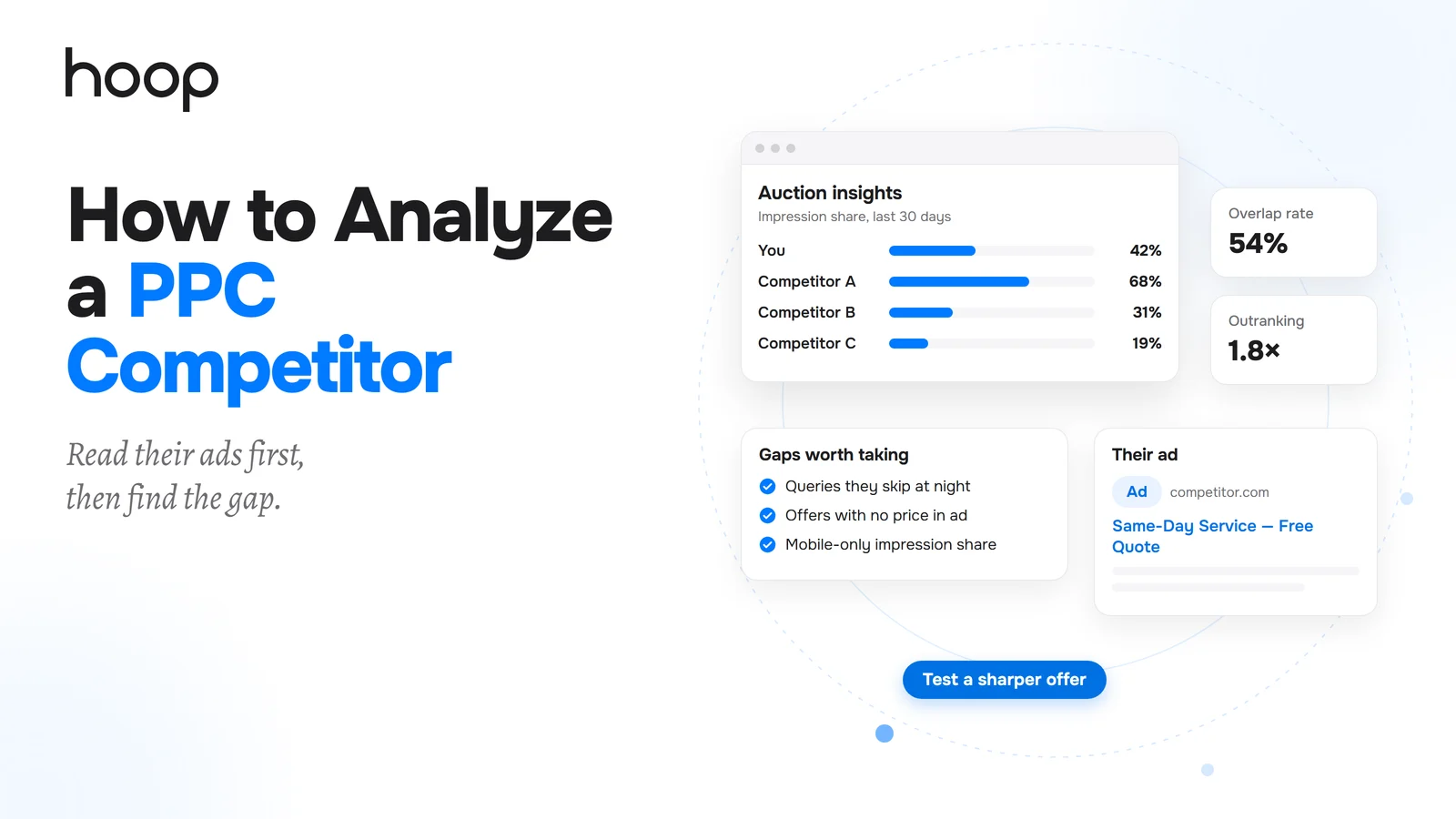
To check Auction Insights, open your Google Ads campaign, ad group, or eligible Search keyword and select the Auction insights report. Review a consistent period, such as the most recent 30 days. Availability depends on campaign type and sufficient activity. Search, Shopping, and Performance Max have different report coverage.
Focus on impression share, overlap rate, position above rate, top-of-page rate, absolute top-of-page rate, and outranking share for Search. Google defines these as auction-visibility metrics rather than financial results. A rival appearing above you frequently is not proof that its campaigns convert better.
Step 3: Review competitor ads in the Transparency Center
To review public Google ads, search for the advertiser name or website in the Google Ads Transparency Center. Filter by region and platform when the interface offers those choices. Record ad themes, product promises, destinations, and variations. Capture the date because public ad visibility changes.
Look for repeated benefits such as faster implementation, flexible contracts, an extended trial, or a free consultation. Evaluate whether the wording addresses a specific buyer objection. Do not assume the longest-running ad is the best performer; campaign survival alone cannot establish conversion quality.
Step 4: Compare paid keywords and search intent
To compare paid keywords, use Google Keyword Planner with your own buyer phrases and relevant competitor websites. Keyword Planner suggests related terms and estimated search demand. Semrush, Ahrefs, and SpyFu provide additional paid keyword observations and modeled traffic figures.
Group candidates by intent: research, comparison, branded, and ready-to-buy. For example, “what is CRM” serves education; “CRM implementation agency” suggests a service purchase. Prioritize terms tied to your offer and realistic acquisition economics rather than targeting every phrase a larger competitor appears to buy.
Step 5: Break down competitor ad copy and offers
To analyze ad copy, record the main benefit, proof, price reference, urgency, and call to action. Compare whether a headline describes features or outcomes. A software agency promising “custom integrations” uses a different angle from one offering “reduce manual data entry.”
Note visible assets such as sitelinks, prices, promotions, images, and call extensions. Inspect whether claims are specific and supported. Build your own differentiated message from the problems your customers report. Do not reuse a competitor’s distinctive wording or imply certifications you have not earned.
Step 6: Audit the landing page experience
To audit landing pages, open the destination directly and inspect the mobile experience. Check message match between ad and page, headline clarity, trust evidence, form length, load speed, and the next action. A competitor can have a persuasive ad yet lose buyers on a confusing page. Conversion rate optimization covers this in depth.
For your own site, compare the same factors before increasing bids. Our landing page optimization service focuses on improving message relevance, forms, and conversion paths rather than buying more traffic to compensate for poor pages.
Step 7: Estimate opportunities without inventing spend figures
To estimate opportunities, separate observed data from modeled estimates. A third-party report might suggest that a competitor purchases traffic for a keyword, but the tool lacks the competitor’s actual invoices and conversions. Use estimates to decide what deserves further investigation, not to claim exact spend.
Compare your own cost per click, qualified lead rate, conversion rate, and contribution margin. A competitor bidding aggressively may have higher customer value, a temporary promotion, or an inefficient account. Your own economics determine whether entering the same auction makes sense, which is where a break-even CPC target helps.
Step 8: Turn findings into one controlled experiment
To turn findings into a test, choose one hypothesis with a measurable outcome. For example: “A landing page that leads with a migration checklist will generate more qualified consultations than our generic service page.” Set a sufficient testing period and keep unrelated changes limited.
Record your baseline conversion rate, cost per qualified lead, and number of leads. Improve headline or offer, not every campaign setting simultaneously. Our Google Ads management services connect campaign targeting, conversion measurement, and landing page decisions to business outcomes.
Which PPC Competitor Tools Should You Use?
You can complete a useful first review with free tools. Paid research platforms become helpful when you monitor many advertisers, need historical patterns, or manage several accounts. Choose tools by the question you need answered, not by how many dashboard charts they display.
| Task | Tool | Evidence | Limitation |
|---|---|---|---|
| Shared auction visibility | Google Ads Auction Insights | Observed overlap and position metrics | Only eligible shared auctions |
| Public creative review | Ads Transparency Center | Public ad messages and formats | No private return data |
| Keyword ideas | Google Keyword Planner | Suggested phrases and forecasts | Not rival keyword account exports |
| Paid keyword patterns | Semrush / SpyFu / Ahrefs | Modeled keywords and trends | Estimated spend and traffic |
| Landing page audit | Browser and page testing | Visible offers and form experience | No competitor conversion data |
Free research for a small budget
Begin with your own Google Ads reports, Keyword Planner, the Transparency Center, and a manual landing page checklist. Save screenshots and URLs so another team member can reproduce the observation. Use a spreadsheet with one row per advertiser and an explicit evidence date.
Paid tools for deeper historical research
Semrush Advertising Research, SpyFu PPC Research, and Ahrefs Paid Search reports help reveal potential keyword overlap, creative history, and estimated traffic. Results differ because each provider uses its own collection methods. Compare patterns across sources before proposing material budget changes.
How Do You Interpret Auction Insights Correctly?
Auction Insights measures relative exposure, not market share or profitability. Interpret the report alongside your own search terms, conversion quality, and campaign eligibility. Treat the same competitor differently across separate locations and products.
Impression share and overlap rate
Impression share describes impressions received relative to estimated eligible impressions. Overlap rate describes how often another advertiser showed when your ad showed. A 60% overlap rate means the competitor appeared in 6 of 10 auctions where you received an impression. It does not mean the rival owns 60% of the market.
Position above rate and outranking share
Position above rate shows how often a competing advertiser appeared higher when both ads showed. Outranking share describes how often your ad ranked higher or appeared when the competing ad did not. Neither metric tells you the rival’s exact bids or customer acquisition cost.
A worked competitive visibility example
Suppose your campaign records 10,000 impressions during a reporting period. A rival has a 40% overlap rate, so the rival appeared alongside your ad on roughly 4,000 of those impressions. A 65% position-above rate means the rival ranked higher in approximately 2,600 of those shared appearances. These hypothetical figures describe ad placement, not sales.
Next, compare your own search impression share lost to budget and rank, qualified conversions, and landing page performance. Raising bids without checking those figures can increase costs without improving the number of paying customers.
What Should You Look for on a Competitor Landing Page?
A useful landing page audit examines the full path from search phrase to promised action. Review the page like a prospective buyer. Note whether the offer explains exactly what happens after the click.
Message match, proof, and friction
Check whether the headline matches the searcher’s problem and the ad’s promise. Look for trustworthy evidence such as genuine customer reviews, case studies, clear pricing, or relevant product demonstrations. Count unnecessary form questions and inspect mobile readability before judging appearance alone.
Example of a B2B services comparison
Imagine 2 agencies bidding on “CRM setup consultant.” Agency A sends traffic to a generic homepage. Agency B uses a dedicated migration page with an implementation outline and a consultation form. Agency B has a clearer path for that specific intent, although actual conversion performance remains unknown without measured results.
How Often Should You Monitor PPC Competitors?
Review direct competitors monthly and investigate major changes when your own performance shifts. A weekly check can suit high-spend accounts with frequent offers. Quarterly research suits smaller campaigns with stable demand. Avoid treating every new ad as an emergency.
A practical monitoring record includes date, competitor, keyword group, platform, ad message, landing page, supporting evidence, confidence level, and proposed action. Revisit each experiment after enough conversion data accumulates to support a conclusion. Our Scrap Cars 4 Cash case study is an example of search ads reviewed this way.
What PPC Competitor Analysis Mistakes Waste Budget?
The most damaging mistake is copying an advertiser without knowing whether its strategy earns profit. Another mistake is taking estimated paid traffic and spend as exact financial data. A third is treating impression share as customer market share. Each error can push spending in the wrong direction.
Avoid repeatedly clicking competitors’ ads for research, copying protected creative, or pursuing irrelevant keywords simply because a larger brand advertises on them. Check search intent and your own economics first. Distinguish a competitor’s advertised offer from the actual purchase experience.
Do not ignore your conversion tracking. If your account counts newsletter signups as sales, a competitor review cannot fix the misleading optimization goal. Connect meaningful lead stages and actual sales to campaign measurement. That connection matters when you evaluate lead generation services or internal campaign improvements.
How Do You Report Competitor Research to Your Team?
Give decision-makers a short evidence-based summary, not a large export of unfiltered keywords. Start with 3 findings, 3 confidence ratings, and 3 proposed tests. Separate confirmed public observations, modeled third-party estimates, and hypotheses that require your own campaign data.
For example, report that a competitor advertises a free audit on 2 visible ad variants, not that the offer produces profitable leads. Recommend testing a distinct consultation benefit with tracking in place. Assign one owner, a review date, and a success metric such as cost per qualified consultation.
Use Competitor Research to Make Better PPC Decisions
PPC competitor analysis works best when you turn observable market activity into careful experiments. Identify overlapping advertisers, inspect their offers and landing pages, and confirm how your campaigns perform in the same search environment. Treat modeled budgets as clues, not facts. Focus on more qualified customers rather than winning every auction.
If your campaigns need clearer targeting, stronger measurement, or better landing page alignment, our Google Ads management team can help you evaluate the opportunities and choose the next improvement.
“An expensive-looking ad does not prove a profitable campaign, and a third-party spending estimate is not an invoice.”
Key takeaways
- 01Auction Insights measures shared visibility, never market share or profitability.
- 02Third-party spend figures are models, not invoices — treat them as leads to investigate.
- 03Audit the landing page on mobile: a strong ad often dies on a confusing page.
- 04End every review with one hypothesis, one owner, one metric, one review date.
Written by
Sahar
Content Writer
Frequently Asked
Questions
Everything you need to know before booking a strategy call. Can't find your answer? Contact us directly.

Ask hoop
Usually replies in minutes
Can you see a competitor’s exact Google Ads budget?
No. Public tools and Auction Insights do not disclose the advertiser’s exact budget. External research tools provide estimates, not verified account spending.
PEOPLE ALSO ASK
Swipe for 4 more questions →
Can't find your answer? Contact us directly.
Keep reading
All articles
How PPC Can Help SEO: 8 Ways Paid Search Improves Organic Strategy
Nov 23, 2026 · 10 min read
Are Google Ads Worth It? How to Know Before You Spend
Sep 28, 2026 · 10 min read