What Is SEO Audit? Guide to Website SEO Analysis
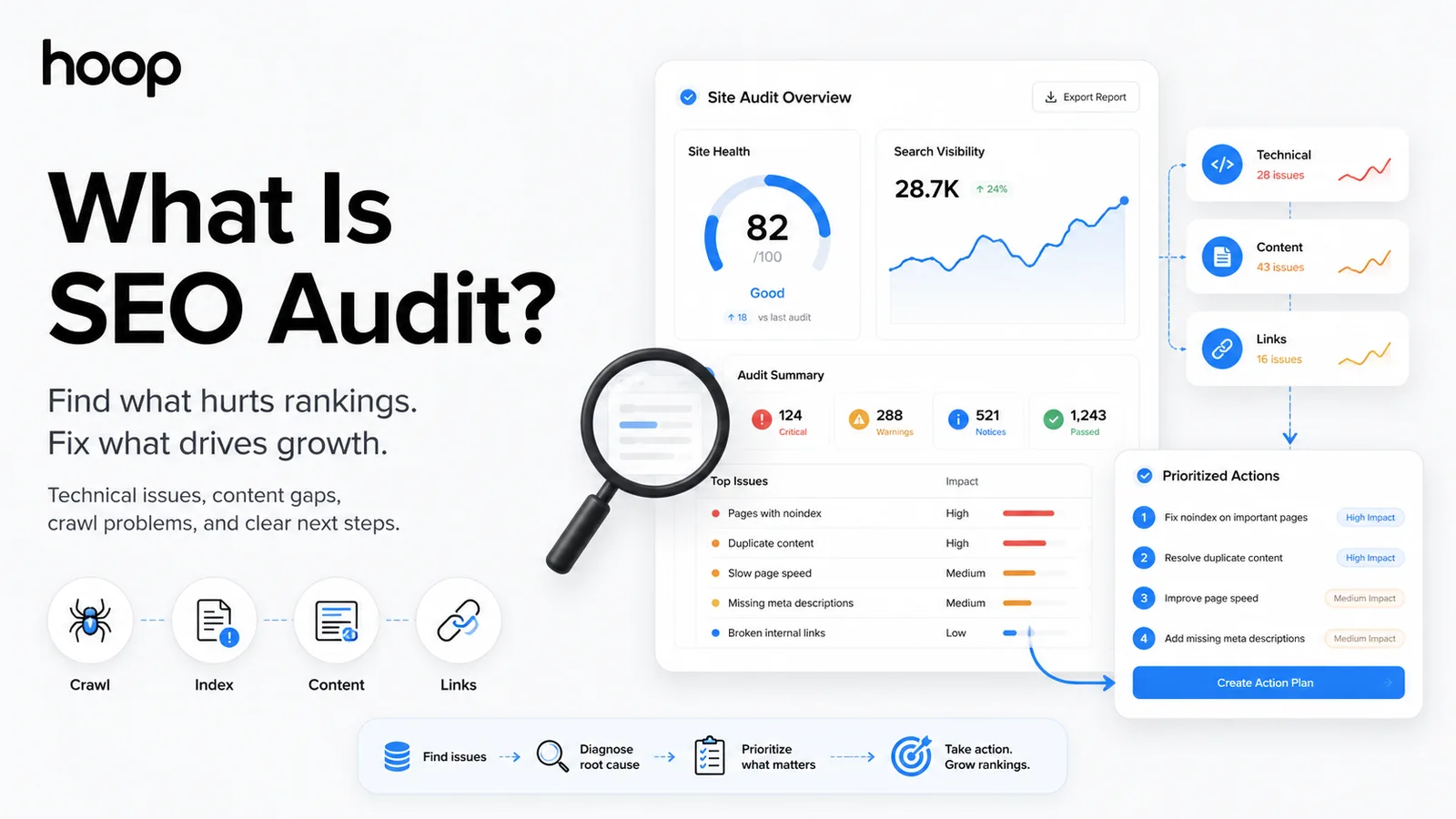
An SEO audit checks whether search engines can access, understand, and rank your important pages — then ranks the fixes by business impact. The value sits in diagnosis and prioritisation, not in the length of the error list a crawler produces.
Sahar
Content Writer
An SEO audit evaluates how effectively your website can perform in organic search. A strong audit identifies technical barriers, weak content, authority gaps, and missed opportunities, then ranks fixes by business impact.
An SEO audit should produce decisions, not a long list of warnings. You should finish with evidence, priorities, owners, and measurable next steps.
What Is an SEO Audit and What Does It Actually Check?
An SEO audit checks whether search engines can access, understand, and rank your important pages. The review also tests search intent and business value.
An audit reviews search visibility
A useful audit starts with current organic performance. You should review clicks, impressions, rankings, landing pages, conversions, and historical changes.
Google Search Console shows how Google discovers and indexes pages. Google Analytics 4 shows how organic visitors behave after reaching your website.
An audit is more than a crawler report
Automated crawlers can find errors, warnings, and patterns. Tools such as Screaming Frog, Ahrefs, and Semrush cannot decide every business priority.
A crawler can flag 500 duplicate titles. An experienced auditor asks which templates created them and whether Google should index those pages.
A useful audit combines software evidence with human judgment. That combination separates a diagnostic report from a generic site-health score.
An audit connects problems with actions
Every finding should answer 4 questions. What is wrong? Why does the issue matter? What fixes the issue? Who owns the fix?
Hoop’s professional SEO services connect technical findings with content, authority, search intent, and implementation priorities.
What Happens During an SEO Audit?
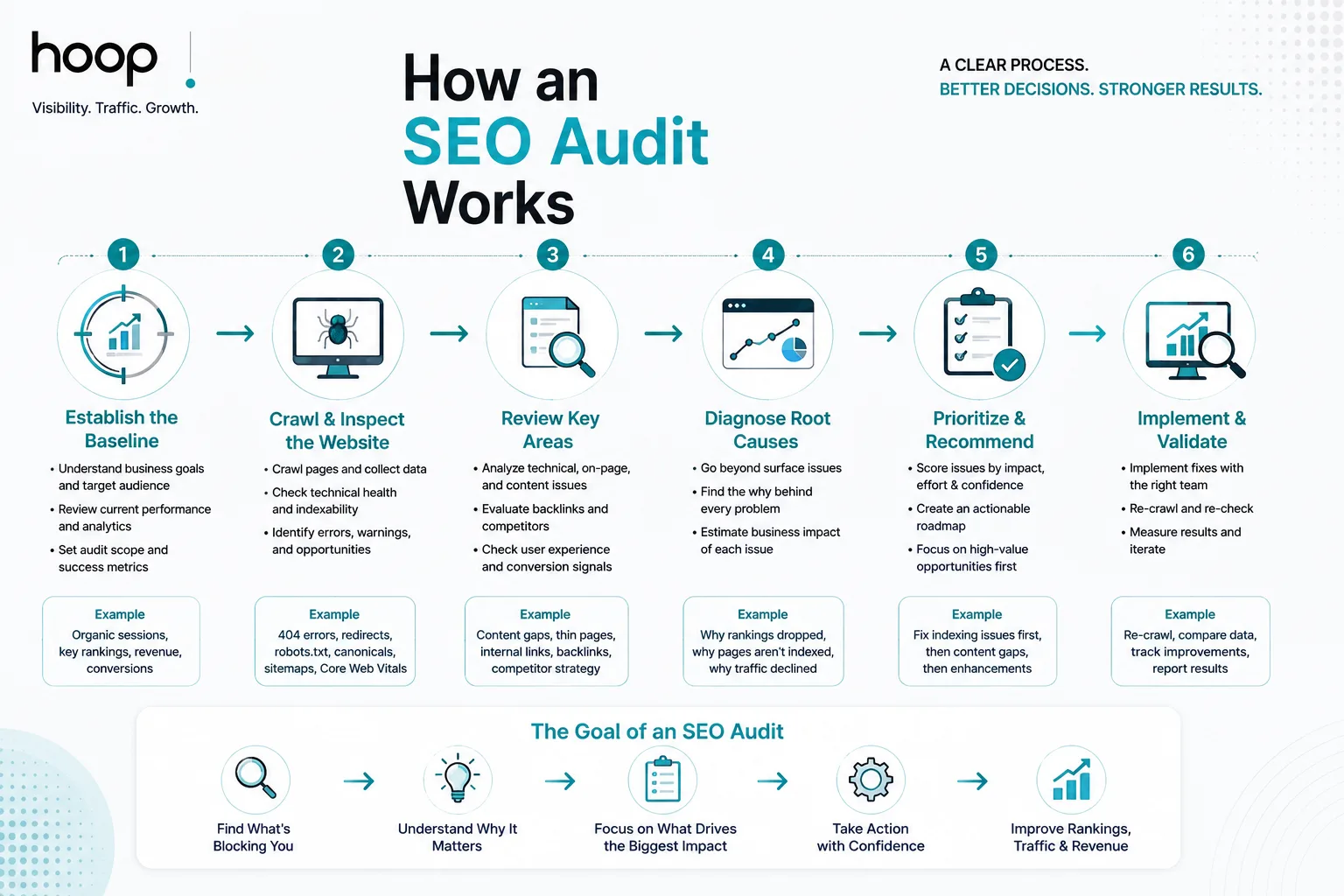
An SEO audit follows a repeatable sequence: establish a baseline, crawl the site, investigate findings, prioritize actions, and validate fixes.
Start with business and search baselines
Begin with the pages that matter commercially. Record organic clicks, leads, revenue, rankings, and indexed pages. Baselines stop teams from treating every technical warning as equally important.
Crawl and inspect the website
Use a crawler to inspect status codes, canonicals, titles, headings, internal links, directives, and duplicate patterns.
Then compare crawler findings with Google Search Console. Google’s SEO Starter Guide explains how Google crawls, indexes, and serves web pages.
Investigate causes before recommending fixes
Do not stop at symptoms. A 404 report shows missing URLs, but the real problem can involve broken navigation or migration errors.
A slow template can affect thousands of pages. Fixing one image on one URL will not solve a template-level performance problem.
Quick-reference audit workflow
| Task | Typical timing | Method | Difficulty |
|---|---|---|---|
| Baseline review | 1–2 hours | Search Console, analytics, ranking data | Easy |
| Technical crawl | 1–4 hours | Screaming Frog, Ahrefs, or Semrush | Moderate |
| Indexation review | 1–3 hours | Search Console, sitemap, directives | Moderate |
| Content review | 2–8 hours | Search intent, page quality, content gaps | Moderate |
| Link review | 1–4 hours | Backlink data, competitor comparison | Moderate |
| Prioritization | 2–4 hours | Impact, effort, confidence, revenue value | Hard |
| Implementation check | 1–3 hours | Recrawl, Search Console, page testing | Moderate |
What Does a Complete SEO Audit Include?
A complete audit covers technical SEO, content, architecture, backlinks, competitors, and organic performance. A tool-only scan covers only part of that scope.
Technical SEO audit
Technical SEO checks whether search engines can crawl, render, and index the correct URLs efficiently.
Common checks include robots.txt, XML sitemaps, canonical tags, redirects, status codes, HTTPS, structured data, and Core Web Vitals.
A technical audit also checks duplicate URL paths, faceted navigation, JavaScript rendering, crawl depth, and orphan pages.
On-page and content audit
An on-page audit reviews titles, headings, internal links, search intent, topical coverage, images, and page structure.
A page can pass every technical check and still perform poorly because the content misses the searcher’s actual need.
Content analysis should also identify pages that deserve consolidation, expansion, redirection, or removal from search.
Off-page and competitive audit
An off-page audit reviews referring domains, link relevance, anchor patterns, lost links, and competitor authority.
The goal is not to chase a high link count. The goal is to understand which links support authority and which gaps limit competition.
Hoop’s link building strategies guide explains how editorial links, digital public relations, and content assets support authority growth.
Which SEO Audit Issues Matter Most?
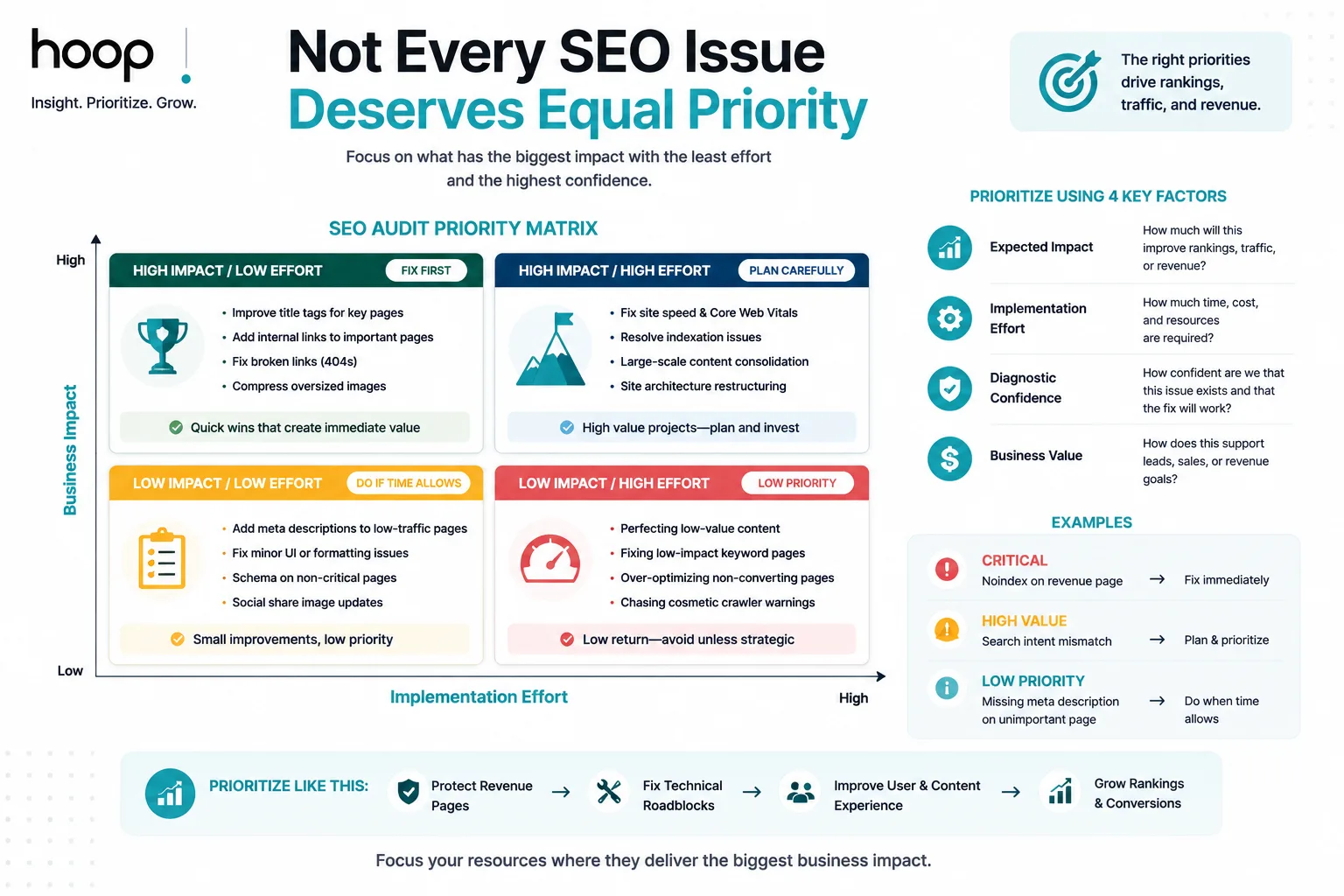
The most important SEO issues block valuable pages from discovery, indexing, relevance, authority, or conversion. Tool severity labels cannot set priorities alone.
Rank findings by impact and effort
Score each recommendation using 4 factors: expected impact, implementation effort, diagnostic confidence, and business value.
A noindex tag on a high-revenue category deserves immediate action. A missing meta description on an unused tag page deserves less attention.
You can use a simple 1–5 score for each factor. High-impact, low-effort, high-confidence actions should reach the top first.
Protect revenue and lead pages first
Prioritize pages tied to revenue or qualified leads. Named examples include product categories, pricing pages, service pages, and high-intent landing pages.
The marketing ROI framework helps connect traffic gains with qualified leads, revenue, and profit rather than raw visibility alone.
Separate real problems from tool warnings
SEO tools flag conditions, not guaranteed ranking losses. A warning deserves investigation before a team allocates development time.
A short title can still describe a page accurately. A long redirect chain creates a clearer technical problem.
An experienced auditor should explain why a condition matters on your specific site. Generic severity labels cannot replace that explanation.
SEO Audit Software or Manual Analysis?
SEO audit software collects and organizes evidence; manual analysis determines meaning, priority, and implementation. Strong audits need both functions.
What automated tools do well
Crawlers process large URL sets consistently. Tools can detect broken links, redirect chains, missing tags, duplicate elements, and crawl directives.
Platforms such as Ahrefs and Semrush add backlinks, keyword data, competitor visibility, and historical trends.
What human auditors add
Human auditors connect technical findings with business context. Experts can identify template causes, search-intent mismatches, migration mistakes, and weak prioritization.
A human can also challenge misleading tool outputs. False positives become expensive when developers spend time fixing harmless conditions.
The best auditor explains tradeoffs. Your team should understand why one fix moves first and another fix can wait.
Why first-party data changes the audit
First-party data shows which pages already generate clicks, leads, revenue, and engagement. Public crawlers cannot see your complete business performance.
A free scan can identify visible issues. A deeper audit uses private performance data to set better priorities.
What Should an SEO Audit Report Contain?
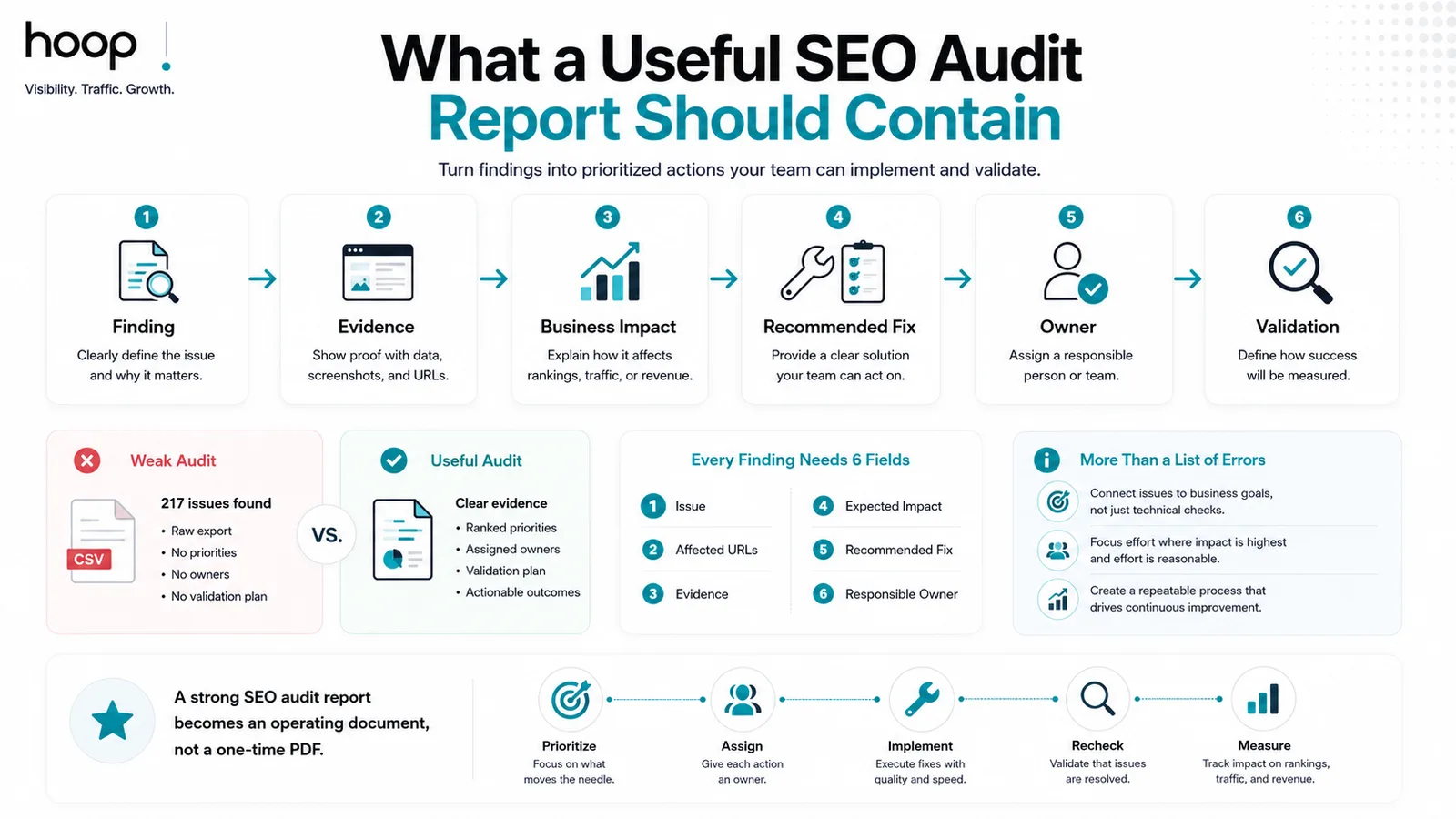
A useful SEO audit report converts findings into prioritized work with evidence, owners, and validation steps. Raw error exports do not provide enough guidance.
Every finding needs 6 fields
Each recommendation should include the issue, affected URLs, evidence, expected impact, recommended fix, and responsible owner.
Screenshots and crawl exports can support evidence. Clear instructions should tell the owner exactly what to change.
The report should show priorities
Group recommendations into immediate, near-term, and planned work. Time groups help teams avoid fixing low-value details first.
Immediate work should address serious indexation, migration, security, or revenue-page problems. Near-term work can address internal links, content gaps, and templates.
The audit needs a validation plan
Every recommendation needs a completion check. Recrawl technical changes, inspect live pages, and monitor Search Console after implementation.
Record pre-fix and post-fix metrics for major changes. Named metrics include indexed URLs, organic clicks, conversions, and Core Web Vitals.
A good report therefore becomes an operating document rather than a one-time presentation.
How Long Does an SEO Audit Take?
Audit time depends on website size, complexity, available data, and required depth. A serious audit rarely finishes with one button click.
Small websites need focused review
A focused website under 100 indexable URLs can often support a useful review within 1–3 business days.
The auditor still needs time for crawling, Search Console checks, content review, competitor comparison, and recommendations.
Larger websites need template analysis
Websites with 100–1,000 important URLs often need 5–10 business days for a deeper audit.
Large publishers, ecommerce stores, and marketplaces can require 2–6 weeks. Those sites demand sampling, template analysis, log review, and stakeholder input.
Timelines should reflect the output. A prioritized implementation roadmap takes more work than a raw crawler export.
Is an SEO Audit Worth Paying For?
Yes, a paid SEO audit is worth paying for when the audit diagnoses meaningful problems and creates executable priorities.
Pay for judgment, not a PDF
A paid audit should explain causes, impact, effort, and implementation. A branded PDF without context provides little additional value.
Ask how the provider prioritizes findings. Ask whether the provider reviews Search Console, analytics, content, links, and competitors.
Free audits serve a different purpose
Free audits can reveal obvious problems quickly. Named examples include broken links, missing tags, slow pages, and indexing warnings.
A paid audit becomes more valuable when organic search supports meaningful leads, sales, subscriptions, or pipeline.
Understand the cost before buying
Compare scope rather than headline price. A cheap scan and a developer-ready audit deliver different outputs. Use Hoop’s SEO pricing guide to understand how audit work fits within wider SEO retainers, projects, and implementation budgets.
How Often Should You Run an SEO Audit?
Run a structured audit at least 2 times each year for an active website. Add event-driven audits when risk increases.
Audit after major website changes
Run an audit after redesigns, migrations, domain changes, platform changes, and major navigation updates.
Those events can change URLs, internal links, directives, templates, and tracking. Early detection reduces the duration of preventable search losses.
Audit after unexplained performance drops
Review search data when organic clicks, rankings, indexed pages, or conversions fall without a clear business reason.
Do not assume an algorithm update caused every decline. A site change can create the same visible symptom.
Audit before major growth programs
Run an audit before large content programs, international expansion, ecommerce expansion, or aggressive link acquisition.
What Happens After an SEO Audit?
Implementation begins after the audit, and implementation creates the result. The audit itself does not repair rankings, traffic, or revenue.
Assign every recommendation
Turn the audit into tasks with owners and due dates. Named workstreams include development, content, analytics, design, and digital public relations.
Validate every important fix
Recrawl changed URLs after deployment. Check canonical tags, status codes, internal links, directives, and rendered content.
Google Search systems need time to recrawl and reassess changed pages.
Measure business outcomes
Track organic traffic alongside leads, sales, subscriptions, and qualified pipeline. Rankings alone do not show complete commercial performance.
Compare outcomes against the original baseline. Stronger organic visibility matters most when valuable users reach valuable pages.
How to Choose an SEO Audit Provider
To choose an SEO audit provider, ask how the provider investigates, prioritizes, implements, and validates findings.
Ask for the audit scope
Request a written scope covering technical SEO, content, internal linking, backlinks, competitors, and first-party data.
Ask which tools the team uses. Named tools can include Search Console, Screaming Frog, Ahrefs, Semrush, and analytics platforms.
Ask who performs the analysis
Confirm whether a senior specialist reviews your website. Ask who presents findings and who answers implementation questions.
Watch for audit red flags
Avoid providers that guarantee rankings, hide methodology, or deliver only automated scores.
Avoid reports that list hundreds of errors without impact or prioritization. Avoid recommendations that ignore your business model and conversion paths.
A credible provider should explain uncertainty when evidence remains incomplete. A credible provider should also separate urgent fixes from optional improvements.
Turn an SEO Audit Into a Search Growth Plan
A strong audit should end with action. Your audit should identify the highest-value problems, assign fixes, and measure results.
Hoop Interactive combines technical investigation, content analysis, authority review, and implementation planning. You can book a strategy call to discuss your website’s search priorities.
“An audit identifies actions. Implementation creates the result — the report itself repairs nothing.”
Key takeaways
- 01Score every finding on impact, effort, diagnostic confidence, and business value.
- 02Each finding needs 6 fields: issue, affected URLs, evidence, impact, fix, and owner.
- 03A noindex on a revenue category outranks a missing meta description on a tag page.
- 04Run one at least twice a year, plus after migrations, redesigns, or unexplained drops.
Written by
Sahar
Content Writer
Frequently Asked
Questions
Everything you need to know before booking a strategy call. Can't find your answer? Contact us directly.
No. A technical audit focuses on crawling, indexing, performance, directives, and infrastructure. A full audit also reviews content, links, competitors, and outcomes.
Yes. You can perform a basic audit with Search Console, crawlers, and analytics. Complex sites benefit from experienced technical and strategic review.
No. An audit identifies actions. Your team must implement, validate, and monitor those actions before search performance can change.
No single tool covers every audit need. Search Console, Screaming Frog, Ahrefs, and Semrush cover different evidence sources and workflows.
SEO audit cost depends on scope, site size, and depth. Compare deliverables, implementation support, and analyst expertise before comparing prices.