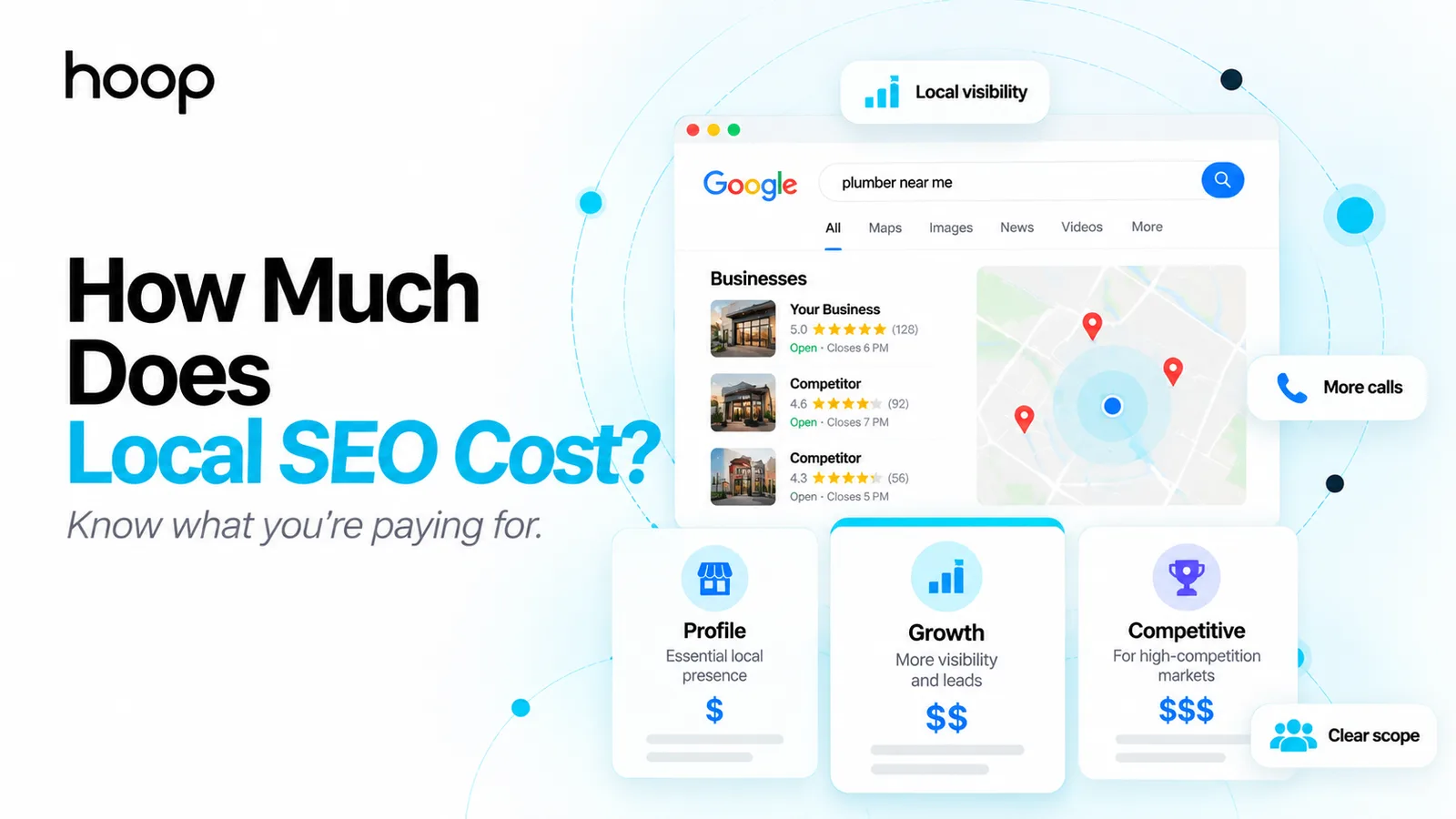

How Much Does SEO Cost in 2026? Agency Pricing Guide
SEO pricing ranges widely — most businesses spend $1,500–$10,000 per month depending on scope, competition, and goals. Cheap SEO usually costs more in the long run; treat it as an investment tied to growth.
Sahar
Content Writer
If you are asking how much does SEO cost, you want a clear answer before you spend your marketing budget. In 2026, most businesses pay between $1,500 and $10,000 per month for professional SEO. Smaller local campaigns may cost less. Large or competitive campaigns can cost much more.
Need this done right?
Hoop builds the strategy, design and development behind sites like this one — talk to us about yours.
How Much Does SEO Cost in 2026?
The honest answer is simple. SEO pricing depends on your business goals, website size, market, competition, and the amount of work needed.
Most professional SEO agency pricing falls into these general ranges:
Local SEO: $500–$2,500 per month<br /> Small business SEO: $1,500–$5,000 per month<br /> Mid-size business SEO: $3,000–$10,000 per month<br /> Competitive national SEO: $5,000–$15,000+ per month<br /> Enterprise SEO: $15,000–$50,000+ per month<br /> One-time SEO projects: $5,000–$30,000<br /> Hourly SEO rates: $100–$300 per hour
These numbers are not fixed rules. They are common pricing ranges. Your actual SEO services cost depends on what your website needs to compete.
For example, a small local dentist does not need the same SEO plan as a national ecommerce store. A home service company in one city may need local pages, Google Business Profile work, reviews, and service content. A large online store may need technical SEO, product page optimization, category page improvements, and content at scale.
That is why the better question is not only how much does SEO cost. The better question is: what level of SEO does your business need to grow?
Why SEO Pricing Varies So Much
SEO is not one single task. It is a mix of research, technical work, content, strategy, user experience, reporting, and authority building.
That is why SEO cost in 2026 can vary from a few hundred dollars to tens of thousands per month.
A business with a small website and light competition may only need basic monthly SEO. A business in a hard market may need a complete growth plan. That plan may include technical fixes, content creation, link building, local SEO, conversion tracking, and monthly reporting.
SEO pricing varies because every website starts from a different place.
Some websites already have traffic. Some have none. Some have strong backlinks. Some have a weak backlink profile. Some websites are technically clean. Others have broken pages, slow speed, duplicate content, and poor structure.
The more work your website needs, the higher the cost.
Common SEO Pricing Models
Most agencies use one of four pricing models. Each model works for a different type of business need.
Monthly SEO Retainer
A monthly SEO retainer is the most common pricing model. You pay a set monthly fee for ongoing SEO work.
This model is best for businesses that want long-term organic growth. SEO is not a one-time job. Search rankings change. Competitors keep working. Google updates its systems. Your website also needs fresh content and regular improvements.
A monthly retainer may include:
Keyword research<br /> Technical SEO<br /> On-page SEO<br /> Content planning<br /> Content creation<br /> Internal linking<br /> Local SEO<br /> Link building<br /> Monthly reporting<br /> Strategy calls<br /> Performance tracking
Most businesses choose this model because SEO works best with consistency. A monthly SEO plan gives your agency time to build, test, improve, and grow your organic search presence.
Hourly SEO Rates
Some consultants and agencies charge by the hour. In 2026, SEO hourly rates often range from $100 to $300 per hour. Very experienced consultants may charge more.
Hourly SEO can work well for audits, consulting, training, or small tasks. It may not be the best option for a full SEO campaign because SEO needs ongoing execution.
Hourly pricing is useful when you need expert help for a specific issue, such as:
Technical SEO review<br /> Website migration support<br /> SEO strategy session<br /> Content audit<br /> Google Search Console review<br /> Analytics setup<br /> Keyword mapping<br /> Internal linking plan
However, hourly SEO can become costly if the work is large. For full campaigns, a monthly retainer is often more stable.
Project-Based SEO Pricing
Project-based SEO is used for one-time work. This may include an SEO audit, website migration, technical cleanup, or content strategy.
A project may cost between $5,000 and $30,000, depending on the scope.
Project-based SEO may include:
Full SEO audit<br /> Technical SEO project<br /> Website structure plan<br /> Content strategy<br /> Keyword research project<br /> Local SEO setup<br /> Ecommerce category optimization<br /> SEO migration support
This model is best when your business has one clear need. But if you want lasting growth, you may still need monthly SEO after the project is done.
Fixed SEO Packages
Some agencies offer fixed SEO packages. These packages usually include a set number of services each month.
For example, a package may include five blog posts, technical checks, keyword tracking, and monthly reports.
Fixed packages can be useful for small businesses. They are simple and easy to understand. But they can also be limited.
The problem is that SEO is not always the same every month. One month may need technical work. Another month may need content. Another month may need internal links, landing page updates, or local SEO.
A custom SEO strategy is often better than a fixed package because it responds to what your website actually needs.
Average SEO Cost by Business Type
Different businesses need different SEO budgets. The right budget depends on your market and goals.
Local SEO Pricing
Local SEO pricing usually ranges from $500 to $2,500 per month. More competitive cities or industries may cost more.
Local SEO is for businesses that serve a clear area. This includes dentists, roofers, lawyers, plumbers, contractors, clinics, real estate companies, and local service providers.
Local SEO may include:
Google Business Profile optimization<br /> Local keyword research<br /> Service area pages<br /> Location pages<br /> Review strategy<br /> Local citations<br /> On-page SEO<br /> Local backlinks<br /> Map pack tracking<br /> Website content updates
Local SEO can be very valuable because local searches often have high buying intent. When someone searches “roof repair near me” or “emergency plumber in Dallas,” they are not just reading. They may be ready to call.
That is why local SEO is not only about rankings. It is about calls, forms, and booked jobs.
Small Business SEO Pricing
Small businesses often spend $1,500 to $5,000 per month on SEO.
This range works for businesses that need steady growth but do not have a large national campaign. It may include technical SEO, content creation, keyword research, service page updates, and reporting.
For small businesses, the focus should be on high-value keywords. You do not need to rank for every keyword. You need to rank for the terms your customers use before they contact you.
A good small business SEO plan should focus on:
Clear service pages<br /> Local search visibility<br /> Helpful blog content<br /> Technical website health<br /> Internal linking<br /> Lead tracking<br /> Google Business Profile<br /> Conversion-focused copy
Small business SEO should be practical. It should help real customers find your business and take action.
Ecommerce SEO Cost

Ecommerce SEO cost often ranges from $3,000 to $15,000+ per month. Large stores may spend much more.
Ecommerce SEO is more complex than basic service SEO. Online stores often have hundreds or thousands of pages. They may have product pages, category pages, filters, tags, duplicate content, and crawl issues.
Ecommerce SEO may include:
Category page optimization<br /> Product page SEO<br /> Technical SEO<br /> Schema markup<br /> Image optimization<br /> Internal linking<br /> Content strategy<br /> Blog content<br /> Crawl budget improvements<br /> Duplicate content fixes<br /> Page speed work<br /> Conversion tracking
For ecommerce websites, SEO can directly affect sales. Better rankings can bring more product views, more carts, and more purchases.
But ecommerce SEO must be done carefully. A small technical issue can affect many pages at once.
National SEO Pricing
National SEO usually costs $5,000 to $15,000+ per month. This is because the competition is much wider.
A national campaign is not limited to one city. Your website may compete with large brands, directories, publishers, and older websites with strong authority.
National SEO may include:
Advanced keyword research<br /> Content hubs<br /> Service page optimization<br /> Digital PR<br /> Link building<br /> Technical SEO<br /> Competitor analysis<br /> Conversion optimization<br /> Content updates<br /> Authority building<br /> Monthly strategy
National SEO takes time. It also needs consistent work. You are not only trying to rank. You are trying to build trust across a larger market.
Enterprise SEO Pricing
Enterprise SEO can cost $15,000 to $50,000+ per month. Some large brands spend even more.
Enterprise SEO usually involves large websites, complex teams, technical systems, and many content layers.
Enterprise SEO may include:
Large-scale technical audits<br /> Website architecture planning<br /> International SEO<br /> Advanced analytics<br /> Content governance<br /> Automation support<br /> Technical fixes across many pages<br /> SEO testing<br /> Cross-team coordination<br /> High-level reporting<br /> Executive strategy
Enterprise SEO is expensive because the work is complex. The risks are also higher. One wrong move on a large website can affect thousands of pages.
What Is Included in SEO Agency Pricing?
A good agency does not charge only for keywords. Professional SEO agency pricing includes strategy, execution, tracking, and improvement.
Here is what a strong SEO plan may include.
SEO Audit
An SEO audit checks the health of your website. It finds problems that may hurt rankings and traffic.
An audit may review:
Crawl errors<br /> Indexing issues<br /> Page speed<br /> Mobile performance<br /> Broken links<br /> Duplicate content<br /> Missing metadata<br /> Thin content<br /> Internal links<br /> Site structure<br /> Backlink profile<br /> Keyword gaps
An audit is often the first step. Without it, SEO becomes guesswork.
Keyword Research
Keyword research finds the words your customers use in search. It also helps decide which pages your website needs.
Good keyword research looks at:
Search volume<br /> Keyword difficulty<br /> Search intent<br /> Buying intent<br /> Local intent<br /> Competitor rankings<br /> Long-tail keywords<br /> Content gaps
The goal is not to chase the biggest keyword. The goal is to find keywords that can bring the right visitors.
Technical SEO
Technical SEO helps search engines crawl, read, and understand your website.
It may include:
Fixing crawl errors<br /> Improving page speed<br /> Improving mobile usability<br /> Fixing redirects<br /> Creating XML sitemaps<br /> Improving site structure<br /> Fixing duplicate pages<br /> Adding schema markup<br /> Improving Core Web Vitals<br /> Solving indexing issues
Technical SEO is one of the most important parts of any campaign. If your website is hard to crawl, your content may not perform well.
On-Page SEO
On-page SEO improves the pages users and search engines see.
It may include:
Title tag optimization<br /> Meta description writing<br /> Heading structure<br /> Content improvement<br /> Keyword placement<br /> Internal links<br /> Image alt text<br /> URL structure<br /> Calls to action<br /> FAQ sections
On-page SEO helps each page target the right keyword and match search intent.
Content Creation
Content is a major part of SEO pricing. High-quality content helps your website rank for more searches and answer more customer questions.
SEO content may include:
Service pages<br /> Location pages<br /> Blog posts<br /> Buying guides<br /> Comparison pages<br /> FAQs<br /> Case studies<br /> Industry pages<br /> Product content
Good content should be useful, clear, and written for real people. It should not feel stuffed with keywords.
Link Building
Links from other websites can help build authority. But quality matters more than quantity.
Good link building may include:
Digital PR<br /> Guest posting<br /> Local links<br /> Resource links<br /> Industry mentions<br /> Business directories<br /> Partner links<br /> Content promotion
Cheap link building can be risky. Low-quality links may hurt your website instead of helping it.
Reporting and Strategy
SEO reporting shows what is working and what needs improvement.
A good report may include:
Organic traffic<br /> Keyword rankings<br /> Impressions<br /> Clicks<br /> Conversions<br /> Lead tracking<br /> Top pages<br /> Technical issues<br /> Completed tasks<br /> Next steps
Reporting should not be confusing. It should help you understand progress.
What Affects SEO Cost?
Many factors affect monthly SEO cost. Here are the biggest ones.
Website Size
A small five-page website costs less to optimize than a large ecommerce store. More pages mean more work.
A large site may need technical fixes, content updates, internal linking, and tracking across many sections.
Competition
Competition has a major effect on cost. If your competitors invest heavily in SEO, you may need a stronger campaign to compete.
Harder markets need better content, stronger authority, and more time.
Business Goals
A business that wants a few local leads needs a different plan than a brand that wants national growth.
The bigger the goal, the bigger the strategy.
Current Website Health
A clean website costs less to improve. A broken website needs more work.
If your site has speed issues, indexing problems, duplicate pages, or poor content, the cost may be higher.
Content Needs
Some websites need a few page updates. Others need full content creation.
If your website needs service pages, blogs, location pages, and product content, the budget will increase.
Link Building Needs
If your website has weak authority, it may need link building. High-quality link building takes time and effort.
That can increase the monthly cost.
Agency Experience
Experienced agencies often cost more. But they may also save you from poor strategy, slow execution, and wasted spending.
With SEO, cheap work can become expensive if it creates problems later.
Cheap SEO vs Professional SEO

Cheap SEO may look attractive. But it can cost more in the long run.
Low-cost SEO often includes:
Thin content<br /> Weak keyword research<br /> Spammy backlinks<br /> Automated reports<br /> No real strategy<br /> No technical work<br /> No conversion tracking<br /> Generic blog posts<br /> Guaranteed ranking claims
Professional SEO is different. It is based on strategy, data, quality, and long-term growth.
A professional SEO agency should explain:
What work will be done<br /> Why the work matters<br /> What results are realistic<br /> How progress will be measured<br /> What timeline to expect<br /> What risks to avoid
Be careful with any agency that promises instant rankings. No serious agency can control Google. A good agency can improve your chances with the right work.
Is SEO Worth the Cost in 2026?
Yes, SEO is worth the cost when it is done well.
SEO can help your business get found by people who are already searching for your services. That makes it different from many other marketing channels.
A person who searches “best HVAC company near me” or “SEO agency for small business” already has intent. They are looking for a solution.
Good SEO helps your business appear at that moment.
SEO can support:
Brand visibility<br /> Organic traffic<br /> Lead generation<br /> Sales<br /> Local calls<br /> Online purchases<br /> Trust<br /> Long-term growth
The value of SEO is not only traffic. The value is qualified traffic. You want visitors who are likely to become customers.
That is why SEO ROI matters more than rankings alone.
How Much Should Your Business Budget for SEO?
Your SEO budget should match your goals.
If you are a small local business, you may start with $1,500 to $3,000 per month. If your market is competitive, you may need $3,000 to $7,500 per month. If you want national or ecommerce growth, your budget may need to be higher.
A practical way to think about budget is this:
Low budget: basic SEO and limited growth<br /> Medium budget: steady SEO with content and technical work<br /> Higher budget: stronger growth, more content, and authority building<br /> Enterprise budget: advanced SEO across large websites and markets
The right budget should be enough to make progress. Spending too little may lead to slow results. Spending more without a plan is also not smart.
A good agency should help you choose a budget that fits your goals and market.
Agency vs Freelancer vs In-House SEO
You have three main choices for SEO support.
SEO Agency
An agency gives you a team. This may include strategists, writers, technical SEO experts, link builders, and account managers.
An agency is best when you need full support.
SEO Freelancer
A freelancer may cost less than an agency. This can work well for small projects or specific tasks.
But one person may not have every skill. SEO needs technical knowledge, content skill, strategy, and reporting.
In-House SEO
An in-house SEO person works only for your company. This can be useful for larger brands.
However, in-house SEO also has costs. You must pay salary, tools, training, and sometimes outside support.
For many businesses, an agency gives the best mix of skill, speed, and support.
Why SEO Is an Investment, Not an Expense
SEO is often seen as a cost. But good SEO is an investment.
A paid ad disappears when the budget stops. A strong SEO page can keep bringing traffic for months or years if it stays useful.
That does not mean SEO is free after it is done. You still need updates, tracking, and improvements. But the value can compound over time.
Each strong page becomes an asset. Each ranking can bring more visibility. Each useful article can support trust. Each local page can help customers find your business.
That is why SEO should be viewed as a long-term growth channel.
How Hoop Builds SEO Pricing Around Real Growth
At Hoop, SEO is not treated as a generic package. Every business has a different market, website, and growth goal.
A smart SEO plan starts with understanding what your business needs. Then the work is planned around that goal.
Hoop focuses on:
SEO audits<br /> Keyword strategy<br /> Technical SEO<br /> Content planning<br /> Service page optimization<br /> Local SEO<br /> Ecommerce SEO<br /> On-page SEO<br /> Internal linking<br /> Reporting<br /> Growth strategy
The goal is not to sell random tasks. The goal is to build a search system that helps your business grow.
That means clear work, clear tracking, and clear next steps.
Conclusion: How Much Should You Pay for SEO?
So, how much does SEO cost in 2026? For most businesses, professional SEO costs between $1,500 and $10,000 per month. Local SEO may cost less. Ecommerce, national, and enterprise SEO may cost much more.
The right price depends on your goals, competition, website health, content needs, and growth plan.
SEO is not just a fee for keywords. It is the cost of building search visibility, trust, traffic, and leads over time.
If your business wants better rankings, stronger organic traffic, and a clear SEO plan, Hoop can help you choose the right strategy and budget.
The goal is not to spend the most. The goal is to invest wisely, track the right numbers, and build a search presence that keeps working.
Excerpt: SEO pricing in 2026 depends on your goals, competition, website size, and service needs. This guide explains agency pricing, monthly retainers, hourly rates, project costs, and how to choose the right SEO investment.
Meta Title: How Much Does SEO Cost in 2026? Agency Pricing Guide<br /> Meta Description: Learn how much SEO costs in 2026, including monthly retainers, hourly rates, local SEO pricing, ecommerce SEO cost, and agency pricing factors.<br /> Meta Tags: how much does SEO cost, SEO pricing, SEO agency pricing, SEO cost in 2026, monthly SEO cost, SEO services cost, local SEO pricing, ecommerce SEO cost, SEO packages, SEO ROI
“In 2026, most businesses pay between $1,500 and $10,000 per month for professional SEO.”
Key takeaways
- 01Most businesses pay $1,500–$10,000/month; local costs less, competitive costs more
- 02Common pricing models: monthly retainer, project-based, and hourly
- 03Price depends on competition, site size, content needs, and goals
- 04Cheap SEO often means weak results — judge cost against ROI, not the invoice
Written by
Sahar
Content Writer
Frequently Asked
Questions
Everything you need to know before booking a strategy call. Can't find your answer? Contact us directly.
How much does SEO cost depends on your website, goals, and competition. Most professional SEO campaigns cost between $1,500 and $10,000 per month. Larger campaigns can cost more.
The average monthly SEO cost for many small to mid-size businesses is between $1,500 and $5,000. Competitive campaigns may need $5,000 to $15,000+ per month.
Local SEO pricing often ranges from $500 to $2,500 per month. Competitive cities or industries may cost more.
Ecommerce SEO cost often ranges from $3,000 to $15,000+ per month. Large stores may need a higher budget.
Many SEO consultants charge $100 to $300 per hour. Senior experts may charge more.
SEO pricing may include audits, keyword research, technical SEO, on-page SEO, content creation, link building, local SEO, and reporting.
Cheap SEO is often risky. It may use thin content, weak links, or poor strategy. Professional SEO costs more because it takes real work.
No honest agency should guarantee rankings. SEO agencies can improve your website and strategy, but they cannot control Google.
Basic SEO packages can work for simple needs. But custom SEO is usually better because it is built around your website, market, and goals.
Yes, SEO is worth it when it brings qualified traffic, leads, and sales. The best SEO campaigns focus on long-term growth and clear ROI.