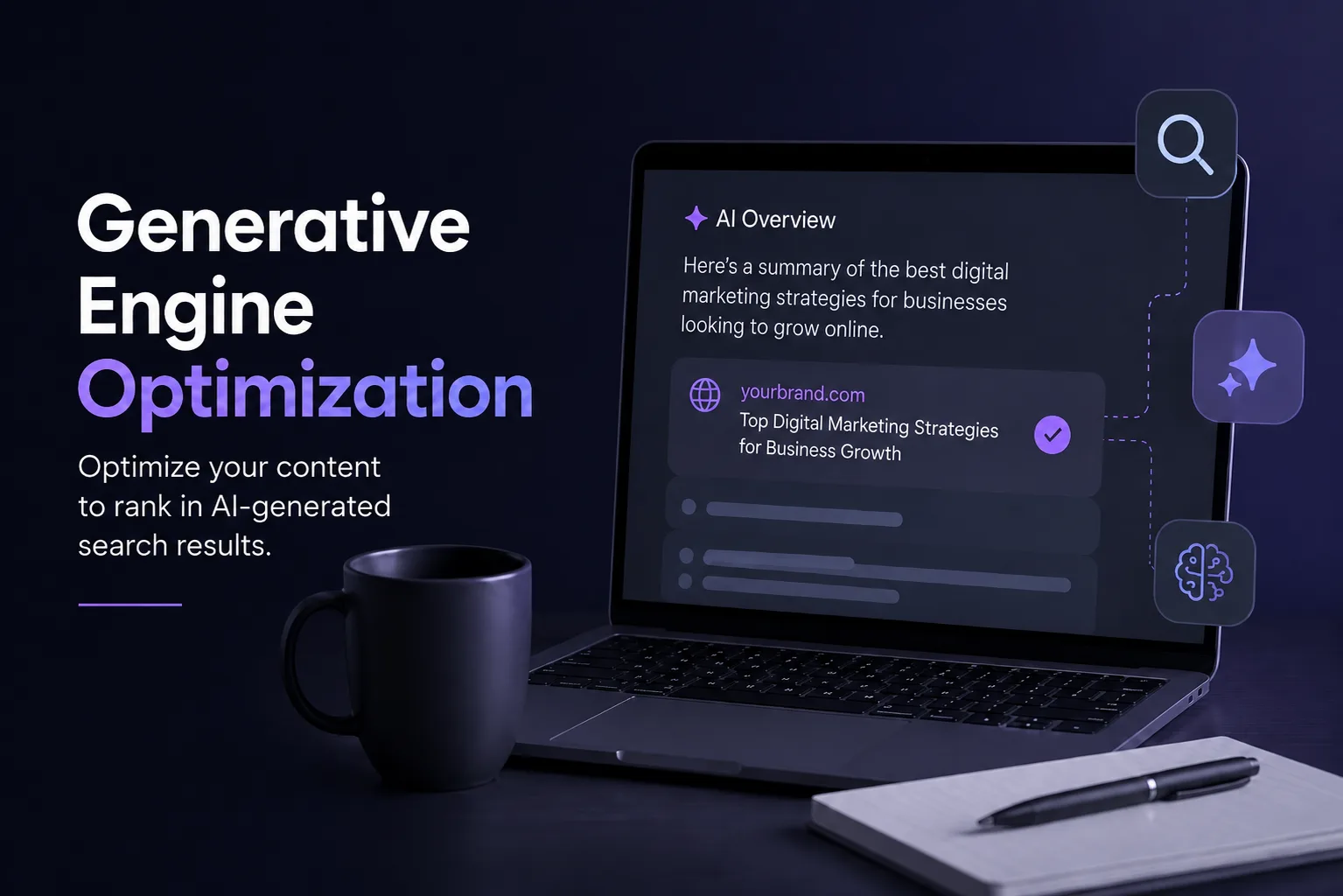
Generative Engine Optimization: How to Rank in AI Search (2026)
Generative engine optimization improves how often AI search systems mention, cite, or recommend your brand — by combining technical SEO, expert content, entity authority, and citation tracking.
Sahar
Content Writer
Generative engine optimization improves how often AI search systems mention, cite, or recommend your brand. A strong program combines technical SEO, expert content, entity authority, and measurable citation tracking.
AI discovery now spans Google AI Overviews, Google AI Mode, ChatGPT, Perplexity, Gemini, Claude, and Microsoft Copilot. Each platform retrieves and presents sources differently. Your strategy must improve discoverability, comprehension, credibility, and citation value across multiple systems.
Need this done right?
Hoop builds the strategy, design and development behind sites like this one — talk to us about yours.
What Is Generative Engine Optimization in 2026?
Generative engine optimization [GEO] makes your content easier for AI systems to retrieve, understand, cite, and represent accurately. Generative engine optimization targets generated answers rather than only traditional result positions.
Search engine optimization [SEO] still supports generative engine optimization. Search rankings, crawlability, links, page quality, and topical authority remain valuable inputs for AI discovery. Google states that its generative search features use core Search ranking and quality systems.
Generative engine optimization adds another goal: your brand must appear inside synthesized answers. A citation, recommendation, product mention, or accurate brand description can create visibility without a traditional click.
GEO Targets Mentions, Citations, and Recommendations
AI visibility has 3 outcomes. A mention names your brand. A citation links supporting evidence. A recommendation presents your brand as an option.
Track each outcome separately. A citation can drive traffic. A recommendation can influence consideration. An accurate mention can strengthen brand recall across repeated prompts.
GEO, AEO, and LLMO Describe Related Work
Answer engine optimization [AEO] focuses on direct answers across search features and assistants. Large language model optimization [LLMO] focuses on visibility within large language model [LLM] responses.
Marketing teams use GEO, AEO, and LLMO for overlapping work. Focus on measurable outcomes instead of labels.
GEO Does Not Replace Traditional SEO
Generative engine optimization extends SEO rather than replacing SEO. AI systems still need accessible pages, reliable information, clear entities, and credible external signals.
A page with weak access or trust rarely becomes a dependable AI source. Build technical and editorial quality first.
How Does Generative Engine Optimization Differ From SEO?
SEO aims for ranked listings, while GEO aims for inclusion and accurate representation inside generated answers. Both disciplines share technical, content, and authority foundations.
Traditional SEO usually measures rankings, impressions, clicks, organic sessions, and conversions. GEO measures mentions, citations, recommendation share, source frequency, sentiment, and AI-referred conversions.
Generative engine optimization works best inside a joined search and content strategy. Hoop’s full-funnel digital marketing approach connects search visibility with content, conversion, and revenue tracking.
Traditional Search Displays Ranked Pages
Traditional search results present titles, descriptions, maps, products, images, videos, and rich features. Users choose a result and visit the source.
Classic SEO improves indexation, relevance, authority, usability, and click appeal. Those improvements also support many generative search experiences.
AI Search Synthesizes Multiple Sources
AI search systems retrieve information from multiple sources and generate one response. Retrieval-augmented generation [RAG] grounds generated answers with selected documents or search results.
Google also documents query fan-out. Query fan-out creates related searches across subtopics before the system builds a response. One user prompt can therefore activate multiple information needs.
Generative Engine Optimization Requires Wider Brand Evidence
Generative engine optimization depends on evidence beyond one optimized page. AI systems compare owned content with external coverage, directory profiles, reviews, discussions, videos, and reference sources.
Consistent descriptions help systems connect brand entities. Contradictory names, categories, claims, and locations create ambiguity and weaken accurate representation.
How Do AI Search Systems Select Sources?
AI search systems select sources through retrieval, ranking, quality checks, and answer-generation processes. No public universal formula governs every platform.
Google AI features rely on indexed Search content and core ranking systems. ChatGPT search uses web search systems and OAI-SearchBot access. Perplexity uses its search index, PerplexityBot, and user-triggered retrieval.
Crawlability Creates Initial Eligibility
Public content must remain accessible to the relevant crawler. Review robots.txt, meta robots directives, response codes, canonical tags, and server logs.
OpenAI separates OAI-SearchBot for search visibility from GPTBot for potential model training. Perplexity separates PerplexityBot from Perplexity-User. Apply access rules deliberately.
Retrieval Matches Prompts With Candidate Sources
Retrieval systems connect prompts with pages covering relevant entities, questions, products, locations, and evidence. Exact keyword matching alone does not control selection.
Use topic clusters to cover connected needs. A cybersecurity cluster can include risk assessments, compliance, incident response, employee training, and vendor reviews.
Citation Selection Rewards Supportive Evidence
AI answers need sources that support specific claims. Clear definitions, original data, expert quotations, pricing details, process steps, and comparison criteria create useful evidence.
Generic summaries provide little citation value. First-hand research, documented experience, tested methods, and transparent limitations create stronger source material.
How to Audit Your AI Search Visibility
To audit your AI search visibility, test fixed prompts across 5 platforms and record each result. Build a baseline before changing content.
Use 30 prompts across awareness, comparison, evaluation, and purchase intent. Test ChatGPT, Perplexity, Gemini, Copilot, and Google AI Mode where available.
Build a Prompt Portfolio
Create 5 prompt groups: category, problem, comparison, recommendation, and brand. Add 6 prompts per group for a 30-prompt starting set.
Include buyer language, expert language, and regional wording. A software company can test “best inventory software” and “warehouse software in Dubai.”
Record Mentions and Source Links
Capture date, platform, prompt, mention, citation URL, competitors, sentiment, and accuracy. Save screenshots because generated answers can change.
Repeat the same prompt set monthly. Use a consistent account state and location where possible. Consistency improves trend analysis.
Score Citation Quality
Use a 4-point scale. Score 0 for no presence, 1 for an unlinked mention, 2 for a citation, and 3 for a recommendation.
Add an accuracy flag for correct, incomplete, or incorrect representation. A high mention count with inaccurate details creates risk rather than growth.
How to Build Content AI Engines Can Cite

To build citable content, publish direct answers with unique evidence and clear source context. Write for readers first, then improve extraction clarity.
Strong generative engine optimization content answers one defined question per section. Clear headings, concise opening answers, supporting details, examples, tables, and named sources improve comprehension.
Businesses needing a structured content system can review Hoop’sGEO content services.
Lead Every Section With the Answer
Place the direct answer in the first 1 or 2 sentences. Follow the answer with conditions, evidence, examples, and implementation steps.
Avoid long introductions before the answer. AI retrieval systems and readers both benefit from clear information placement.
Add Original Evidence
Publish benchmark studies, customer research, testing results, calculators, templates, and expert interviews. Original evidence gives other publishers a reason to cite your domain.
State the sample size, research date, method, and limitations. Transparent methodology strengthens trust and makes quotations safer.
Strengthen Entity Clarity
Use consistent names for your company, products, founders, services, and locations. Connect each entity through descriptive internal links and accurate organization details.
Add visible author credentials and editorial dates. Experience, Expertise, Authoritativeness, and Trustworthiness [E-E-A-T] signals help readers judge source quality.
Cover Query Fan-Out Topics
Map the related searches that support one complex prompt. A project-management query can trigger pricing, integrations, team size, security, migration, and comparison subqueries.
Build one strong pillar page and focused supporting pages. Avoid creating thin pages for every wording variation.
How to Strengthen Entity Authority and Earned Media
To strengthen entity authority, create consistent brand evidence across trusted external sources. Generative engine optimization depends heavily on online corroboration.
External sources include publications, partner pages, podcasts, review sites, professional profiles, and research citations. Pursue genuine coverage rather than manufactured mentions.
Standardize Brand Descriptions
Create one approved brand statement covering category, audience, location, main service, and verified differentiator. Use the same facts across your website and public profiles.
Update outdated profiles on LinkedIn, Crunchbase, Google Business Profile, GitHub, and industry directories. Remove unsupported claims and conflicting service descriptions.
Earn Third-Party References
Pitch original data, expert commentary, case studies, and practical frameworks to relevant publishers. Strong earned media helps AI systems validate your expertise beyond owned pages.
Choose publications based on topical relevance and editorial standards. One relevant reference can carry more meaning than many unrelated directory links.
Build Credible Community Presence
Contribute useful answers in communities such as Reddit, Stack Overflow, GitHub, Quora, and specialist forums. Follow each community’s disclosure and promotion rules.
Do not plant artificial recommendations. Manipulative activity creates reputation risk and can violate search spam policies.
How to Fix Technical Barriers for Generative Engine Optimization
To fix technical barriers, make key content crawlable, indexable, fast, and readable without fragile interactions. Technical clarity strengthens generative engine optimization across platforms.
Start with status codes, robots rules, canonicalization, sitemaps, internal links, rendering, mobile usability, and duplicate control. Search Console and server logs expose many failures.
Review Crawler Access Separately
List each crawler and business purpose before changing robots.txt. Allowing search discovery does not always require allowing model-training crawlers.
Confirm published user agents and Internet Protocol ranges. Attackers can spoof user-agent names, so security teams should validate requests before whitelisting traffic.
Keep Core Content in Rendered HTML
Place definitions, product facts, pricing, and answers in server-rendered HyperText Markup Language [HTML]. Avoid hiding essential information behind login walls or unsupported scripts.
Google can process JavaScript, but complex rendering adds failure points. Other crawlers offer different rendering capabilities, so accessible HTML reduces dependency.
Use Structured Data Correctly
Add Organization, Article, Product, LocalBusiness, BreadcrumbList, and Person schema only when each type matches visible content. Structured data does not guarantee AI citations.
Google states that special GEO schema does not exist. Google also states that llms.txt does not improve Google Search visibility.
Prepare for Agent Access
AI agents increasingly inspect interfaces, forms, product data, and accessibility trees. Use descriptive labels, logical forms, stable controls, and clear error messages.
Teams building RAG systems or agent-ready products can review Hoop’scustom AI development capabilities.
How to Measure Generative Engine Optimization Results

To measure generative engine optimization, track visibility, accuracy, traffic, and business outcomes together. A single citation count cannot prove value.
Use fixed prompts, analytics data, server logs, sales records, and competitive checks. Review results monthly and compare changes against published content and earned coverage.
Track 6 Core GEO Metrics
Track citation frequency, mentions, recommendation share, accuracy, competitor share, and AI referral conversions. Define every metric before reporting.
Separate platform results for ChatGPT, Perplexity, Gemini, Copilot, and Google AI features. Aggregated totals can hide platform-specific gains or losses.
Measure AI Referral Traffic
Create an analytics segment for known AI referrers. OpenAI states that ChatGPT search links include a chatgpt.com source parameter for referral tracking.
Review landing pages, engaged sessions, leads, assisted conversions, and revenue. Low traffic can still produce strong value when visitors arrive with advanced intent.
Connect Changes With Outcomes
Log content updates, technical fixes, public relations wins, and product changes. Compare those dates with citation and referral trends.
Avoid claiming causation from one prompt result. Generated responses vary by platform, query wording, location, model, and time.
Generative Engine Optimization Quick-Reference Workflow
Use the workflow below to establish a repeatable GEO operating cycle. Assign one owner for each task and document every monthly change.
| Task | Timing | Method | Difficulty |
|---|---|---|---|
| Build prompt portfolio | Week 1 | Create 30 prompts across 5 intent groups | Medium |
| Record AI baseline | Week 1 | Test 5 platforms and save evidence | Medium |
| Audit crawler access | Week 1 | Review robots.txt, logs, and directives | Medium |
| Improve priority pages | Weeks 2-4 | Add direct answers and original evidence | High |
| Standardize entities | Weeks 2-4 | Update profiles, schema, and organization facts | Medium |
| Earn external references | Monthly | Pitch research, commentary, and case studies | High |
| Track citations | Monthly | Repeat prompts and score visibility | Medium |
| Review conversions | Monthly | Segment AI referrals and qualified leads | Medium |
What Should Your 90-Day GEO Plan Include?
A 90-day generative engine optimization plan should establish baselines, improve source quality, and measure early visibility changes. The first cycle should prioritize learning over scale.
Days 1-30: Establish Eligibility and Baselines
Audit crawlability, indexation, rendering, structured data, authorship, profiles, and AI mentions. Build the 30-prompt portfolio and record competitors.
Select 5 priority pages with commercial or strategic value. Document current citations, traffic, conversions, and factual errors.
Days 31-60: Improve Content and Authority
Rewrite priority sections with direct answers, evidence, expert input, and clear entities. Add missing supporting pages around query fan-out topics.
Publish 1 original asset, such as a benchmark, survey, calculator, or case study. Pitch the asset to 20 relevant publishers or partners.
Days 61-90: Measure and Expand
Repeat every prompt test and compare results. Review referral traffic, citation accuracy, competitor share, and qualified conversions.
Expand methods that produced measurable gains. Stop activities that produced no evidence after a fair test window.
Which Generative Engine Optimization Myths Waste Time?
The biggest GEO myths promote shortcuts without platform evidence. Focus on useful content, technical access, earned trust, and measurement.
Myth 1: GEO Requires an llms.txt File
Google states that llms.txt does not affect visibility in Google Search. Other services can choose to use the file.
Maintain llms.txt only for a documented platform need. Do not treat the file as a universal ranking requirement.
Myth 2: Schema Guarantees AI Citations
Schema helps machines interpret visible facts and can support search features. Schema cannot force an AI system to cite a page.
Use valid markup that matches page content. Fix weak information before adding more markup.
Myth 3: More AI-Written Pages Create More Visibility
Scaled generic pages often repeat existing information and add no source value. Search systems reward useful, original, people-first content.
Use artificial intelligence for research support, classification, editing, and workflow speed. Keep human expertise, verification, and accountability in the final page.
Myth 4: One Prompt Proves Performance
One prompt produces an unstable sample. Query wording, location, platform, model, and timing can change the result.
Use at least 30 prompts and repeat the same set monthly. Trends provide stronger evidence than screenshots from one successful answer.
Build an AI Search Strategy That Produces Measurable Growth
Generative engine optimization works when technical SEO, citable content, entity consistency, earned authority, and tracking operate together. Start with a baseline. Improve high-value pages, earn credible references, and measure visibility across platforms. Book a strategy call through Hoop’sfull-funnel digital marketing team to build a measurable AI search program.
Excerpt
Generative engine optimization helps your content appear inside AI-generated answers from platforms such as Google AI Overviews, ChatGPT, Perplexity, and Gemini. This guide explains how to strengthen entity signals, create citation-ready content, improve technical accessibility, and build the authority AI search systems use when selecting trusted sources.
“Generative engine optimization improves how often AI search systems mention, cite, or recommend your brand.”
Key takeaways
- 01GEO optimizes for AI citations, not just blue-link rankings
- 02AI engines cite content with clear answers and entity authority
- 03Combine technical SEO, expert content, and earned media
- 04Measure AI visibility with citation tracking
Written by
Sahar
Content Writer
Frequently Asked
Questions
Everything you need to know before booking a strategy call. Can't find your answer? Contact us directly.
No. Generative engine optimization builds on SEO foundations such as crawlability, quality content, authority, and technical performance.
Yes. A small business can earn visibility through specialized expertise, local relevance, original evidence, and trusted third-party references.
No. OpenAI identifies OAI-SearchBot as the search crawler and GPTBot as the potential training crawler.
Yes, with limits. Structured data clarifies entities and visible facts, but structured data does not guarantee citations.
Most teams need 90 days for a reliable first cycle. Competitive authority growth and earned coverage require longer programs.