How to Run Facebook Ads: A Step-by-Step Guide for Beginners
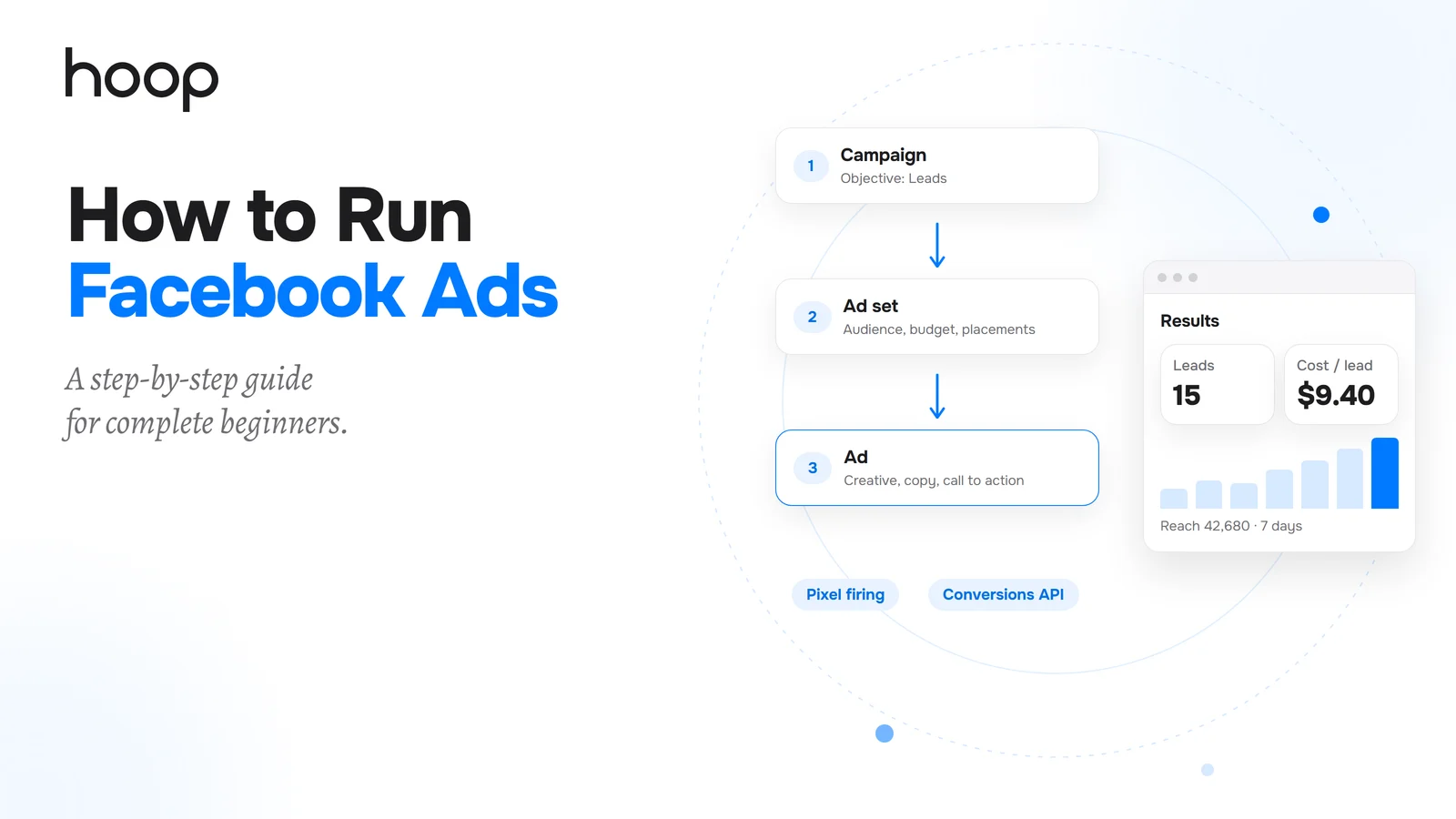
Campaign, ad set, ad. Pick the objective that matches the result you want, send clicks to a page that repeats the ad’s promise, and check the conversion event fires before you spend.
Maimoona
Content Writer
To learn how to run Facebook ads, create a Meta ad account, choose a business goal, define your audience, and publish an ad through Ads Manager. Track leads or purchases, then improve your creative, targeting, and landing page based on real results. You do not need a large budget to start testing, but you do need a clear offer and reliable measurement.
Facebook ads can also appear on Instagram, Messenger, and other eligible Meta placements. The platform controls delivery through an advertising auction. You control the campaign objective, spending limits, creative assets, audience settings, and destination. A successful first campaign starts before you press Publish.
Need this done right?
Want a team to handle it? Our Facebook Ads management services take this from plan to results.
Explore our Facebook Ads management servicesWhat Do You Need Before Running Facebook Ads?
You need a Facebook Page, access to Meta Business Suite and Ads Manager, a payment method, and a clear destination for interested people. Prepare your business offer, contact process, and tracking before spending. You can build these basics without hiring an agency.
Set up a business account and check permissions
Visit Meta Business Suite and create or access the business portfolio that owns your Page and ad account. Add the people who manage campaigns with appropriate permissions. Confirm that the payment method and business details are accurate. Keep business ownership separate from one employee’s personal login.
Set up two-factor authentication and check who can change billing or account settings. Account access problems can interrupt an otherwise healthy campaign. Avoid granting full control to outside contractors when narrower permissions meet their needs.
Prepare a destination that matches the offer
Choose one action you want a customer to take: buy a product, request a quote, book a call, or submit a lead form. Your destination should explain the same offer as your ad. A roofing quote ad should lead to a roofing estimate form, not an unrelated homepage.
Check mobile loading speed, product availability, forms, contact details, privacy information, and checkout. A clear call to action reduces confusion after the click. Our landing page optimization services focus on removing the page issues that prevent relevant visitors from converting.
Install tracking before the launch
Set up the Meta Pixel for website activity and evaluate the Conversions API for suitable server-side event reporting. Configure important events such as Lead, CompleteRegistration, or Purchase. Check event quality and duplicates with Meta’s diagnostic tools. Follow your applicable consent and privacy requirements.
For website campaigns, verify that a test submission or purchase creates the expected event. Also record leads and sales in your customer relationship management system or store reports. Meta’s reported conversions and your internal sales figures can differ because of attribution rules, privacy settings, and tracking gaps.
How to Run Facebook Ads in Meta Ads Manager
To run Facebook ads in Ads Manager, create a campaign, select a goal, configure its ad set, build the advertisement, and publish after review. Meta separates these choices into three levels: campaign, ad set, and ad. Keep the first setup simple enough to diagnose when results change.
Step 1: Create a campaign and choose an objective
Open Ads Manager and select Create. Choose the objective that matches the result you actually want. Meta offers Awareness, Traffic, Engagement, Leads, App promotion, and Sales objectives. Social media marketing covers this in depth. A service company seeking consultation requests usually starts by evaluating Leads, while an online store selling products evaluates Sales.
Do not choose Traffic merely because clicks look cheaper. A traffic campaign optimizes for a different outcome than a purchase campaign. Name your campaign with a readable system, such as service, location, objective, and launch date. Complete any required special ad category selections honestly.
Step 2: Set budget, schedule, and conversion location
Choose a daily or lifetime budget and an appropriate schedule. Daily budgets suit ongoing campaigns, while lifetime budgets suit defined promotional windows. Meta may vary daily delivery within its billing rules, so review the platform’s current spending controls rather than assuming identical daily charges.
For a lead campaign, choose whether people submit an Instant Form, visit your website, call, or use an available messaging option. Select the location that your team can handle reliably. An Instant Form reduces steps, while a website form gives you more control over context and qualification.
Step 3: Define the audience and placements
Choose the location your business serves and any other relevant audience constraints. Meta offers broader delivery and automated audience options, including Advantage+ features. Use clear geographic limits for local services. Avoid narrowing a new campaign with too many overlapping interests before you have performance evidence.
Advantage+ placements can distribute ads across eligible Meta surfaces. Manual placements provide more control when a creative or business requirement supports a restriction. Check how each image or video appears in feeds, Stories, and Reels. A horizontal graphic may look awkward in a vertical placement.
Step 4: Build creative and write your ad
Upload an original image, short video, or carousel that demonstrates the offer. Show the product, customer problem, or service outcome immediately. Write a short primary message, relevant headline, and clear call to action. Use truthful claims and avoid implying knowledge of sensitive personal attributes.
For a local cleaning company, show a real completed job, name the service area, and invite a quote request. For SaaS, demonstrate one useful task in the product. Test 2 or 3 different messages before producing dozens of similar graphics. Your first goal is to learn which offer and explanation attract suitable customers.
Step 5: Review, publish, and check delivery
Inspect every ad preview, destination link, tracking event, form, audience setting, and spending limit. Publish the campaign and allow Meta to review it against advertising rules. Approval times can vary, and some advertisements require changes before delivery.
Once the campaign starts, check that impressions, clicks, and conversion events appear as expected. Confirm that leads reach the correct inbox or CRM owner. If the ad receives clicks but your team receives no inquiries, test the form and tracking before making large budget changes.
Which Facebook Ad Objective Should You Choose?
Choose the objective based on a measurable business result, not the lowest displayed click cost. Every objective guides Meta toward different actions. One objective rarely serves every stage of the customer journey.
Use Leads for appointments and service inquiries
The Leads objective fits businesses seeking quote requests, consultation bookings, qualified calls, and signups. You can use an Instant Form or an eligible external conversion path. Ask only enough questions to route inquiries correctly. For a high-value service, one or two qualification questions can prevent unnecessary callbacks.
Use Sales for ecommerce purchases
The Sales objective fits stores with a functioning checkout and purchase tracking. Send shoppers to relevant product or collection pages. Check stock, shipping, returns, and mobile checkout before paying for traffic. Measure completed orders and profit, not just add-to-cart events.
Use Awareness, Traffic, or Engagement for specific supporting goals
Awareness supports reach and recall, Traffic supports visits, and Engagement supports interactions. App promotion supports app installs or eligible in-app actions. These objectives have legitimate uses, but high engagement alone does not prove customer acquisition. Set a separate success metric for each objective.
How Much Should You Spend on Your First Facebook Ads Campaign?
Start with a test budget your business can afford to lose while gathering data. There is no universal minimum that guarantees useful results. Costs change with location, competition, objective, season, audience, and creative quality. Budget planning should start with the economics of a customer.
Build a test budget around your target customer cost
Suppose a business can afford $40 to acquire a qualified lead. At $20 per day for 14 days, the test budget equals $280. If the campaign generates 7 qualified leads, the cost per qualified lead equals $40. These figures are hypothetical, not a platform benchmark.
A $5 daily budget totals approximately $150 across a 30-day month. That amount can test a narrow offer, but it may not produce enough conversions to judge multiple audiences and creatives. Concentrate your spending rather than splitting a tiny budget across 10 ad sets.
Separate ad spend from creative and management costs
Advertising spend goes to Meta. Additional costs include video production, design, landing page work, tracking setup, and agency management. Calculate your complete campaign cost when estimating return. A campaign can produce cheap clicks and still lose money after creative and fulfillment costs.
Give tests enough time to produce useful evidence
Avoid pausing an ad after a few clicks or changing its budget every hour. Review event delivery, spend, and response quality daily. Evaluate performance after a sensible number of conversions and enough time for follow-up. The necessary sample depends on conversion volume and business risk, not a fixed seven-day rule.
How Do You Choose a Facebook Ads Audience That Converts?
To choose a Facebook ads audience, start with the people who can buy your offer and the places you can serve. Use business knowledge before adding platform interest labels. Meta’s automated delivery can assist selection, but a weak product offer remains a weak offer.
Start with one clear customer group
Define location, customer problem, relevant product, and purchasing situation. A local gym may target residents within its service radius. A specialized B2B software company may need a distinct message for operations managers. Keep your promise relevant to the audience instead of relying on narrow targeting alone.
Use retargeting with suitable consent and scale
Retargeting can reconnect with eligible website visitors, existing customers, or people who engaged with your business. Respect privacy requirements and Meta’s audience rules. Exclude recent buyers from acquisition messages when appropriate. Very small audiences can create unstable delivery and repeated impressions.
Avoid treating lookalike or interest lists as guaranteed buyers
Lookalike audiences and interest suggestions offer starting signals, not proof of purchase intent. Compare outcomes against broader approaches using real qualified leads or sales. Audience performance also depends on the creative message, offer, and customer experience after the click.
What Facebook Ad Creative Works for Small Businesses?
Effective creative makes the offer clear within the first moments and shows credible evidence. You do not need cinematic production. You need an understandable product or service, a relevant reason to respond, and a clear next action.
Test different hooks instead of tiny cosmetic changes
Create three distinct concepts: demonstrate the problem, show the service in action, and explain the practical benefit. Use real photographs or authentic demonstrations wherever possible. Changing a background shade while keeping the same message rarely teaches you much about customer intent.
Match the format to the message
Use a short vertical video for a quick demonstration, a static image for one clear offer, or a carousel for a product range. Ensure text remains readable on mobile. Keep claims accurate, disclose material conditions, and use assets you own or have permission to publish.
Refresh creative when performance shows fatigue
Watch frequency, click-through rate, qualified conversions, and cost per result together. Rising costs and falling response can signal an exhausted message, but seasonality and competition can create similar patterns. Replace the weakest creative with a meaningfully different concept, then compare results.
How Do You Track Facebook Ads Performance?
To track Facebook ads performance, connect platform data with actual leads, orders, and customer value. Ads Manager provides delivery metrics, while CRM and order records confirm business outcomes. Review both before increasing spending.
Measure the right numbers for your goal
For lead campaigns, measure qualified leads, cost per qualified lead, appointment show rate, and customer acquisition cost. For ecommerce, measure purchases, cost per purchase, average order value, and return on ad spend. Click-through rate helps diagnose creative interest, but clicks alone do not pay your bills.
Calculate cost per lead and return on ad spend
Cost per lead equals advertising spend divided by leads generated. A $300 campaign producing 15 leads has a $20 cost per lead. If only 5 leads qualify, the cost per qualified lead is $60. That distinction protects you from optimizing for low-quality submissions.
Return on ad spend (ROAS) equals attributed revenue divided by advertising spend. $1,200 in attributed revenue from $400 ad spend equals 3.0 ROAS. That figure does not account for product costs, refunds, or fees. Compare revenue with profit before judging success.
Compare Meta reporting with your own records
Keep source tags, sales notes, and order records consistent. Check tracking errors, duplicate events, attribution windows, and delayed conversions. Do not expect Meta and your store analytics to match exactly. Investigate large differences before trusting automated optimization decisions.
Why Do Facebook Ads Spend Money Without Getting Sales?
Facebook ads lose money when targeting, offer, creative, website, measurement, or follow-up fails. Diagnose the weakest step rather than assuming the platform is the only problem. Use the following quick-reference checks.
| Problem | First check | Action | Difficulty |
|---|---|---|---|
| Clicks without leads | Form and mobile page | Test submission and message match | Low |
| Leads without sales | Lead quality and response time | Review qualification and follow-up | Medium |
| High cost per click | Creative relevance and competition | Test another angle and audience | Medium |
| Missing conversions | Pixel and server events | Audit event delivery and duplication | High |
| Rising cost over time | Frequency and offer response | Refresh concepts and review seasonality | Medium |
Fix the offer before increasing spend
A clear price range, delivery area, availability, and service promise help potential buyers decide. A vague offer attracts curiosity rather than action. Ask recent customers what persuaded them to buy and use those answers to improve messaging. A social media marketing plan covers this in depth.
Repair the website and lead follow-up process
Check the destination page on a phone, complete its form, and verify that someone receives the inquiry. Assign every new lead an owner and next action. For ongoing paid social support, our social media marketing services connect creative, campaign management, and outcome reporting.
Change one major variable at a time
Pause clearly broken ads, but avoid simultaneous changes to audience, destination, budget, and creative. Record the adjustment and the reason. Our Scrap Cars 4 Cash case study shows paid social run alongside search ads. This discipline helps you identify what improved results and what still needs work.
Can You Run Facebook Ads Yourself or Should You Hire an Agency?
You can manage a simple campaign yourself when you have time to learn Ads Manager, produce creative, check tracking, and review leads. An agency becomes useful when the account involves multiple products, complicated attribution, ongoing creative production, or substantial spend.
Ask any provider who owns the ad account, how budget changes receive approval, which conversions matter, and how often you receive reports. Keep your business portfolio, payment access, creative rights, and customer data under your control. A responsible provider explains decisions without promising guaranteed returns.
Start Your First Facebook Ads Campaign With a Measurable Goal
Running Facebook ads works best when every dollar supports a clear customer action. Set up reliable tracking, select the right objective, test distinct creative concepts, and measure qualified outcomes. Begin with a manageable budget and improve the weakest part of the journey before scaling.
For help with campaigns, creative testing, and attribution, review our Facebook Ads management services. If follower growth is the goal instead, see our guide to Instagram ads for more followers.
“Clicks alone do not pay your bills.”
Key takeaways
- 01Install the Pixel and verify a test lead or purchase before launch, not after.
- 02Choose Leads or Sales for commercial goals — cheap Traffic clicks optimize for the wrong thing.
- 03Work back from what a qualified lead is worth to set the test budget.
- 04Cost per lead and cost per qualified lead are different numbers; optimize for the second.
Written by
Maimoona
Content Writer
Frequently Asked
Questions
Everything you need to know before booking a strategy call. Can't find your answer? Contact us directly.
Ask hoop
Usually replies in minutes
Can you run Facebook ads with $5 a day?
Yes. You can set a small daily budget, but $5 per day limits testing speed and conversion volume. Focus on one narrow goal and track results before increasing spending.
PEOPLE ALSO ASK
Swipe for 4 more questions →
Can't find your answer? Contact us directly.