Affordable SEO for Small Business: What Actually Works
Affordable SEO is not the cheapest monthly price. It is a defined scope that fixes a measurable problem at a cost your business can sustain, starting with local visibility and the pages people actually buy from.
Sahar
Content Writer
Affordable SEO for small business means choosing search improvements that fit your budget and attract relevant customers. Start with your most valuable pages, local visibility, and measurement before paying for a broad agency package. A small budget works best when every task has a defined purpose.
You do not need to buy every SEO service at once. You do need a website that answers customer questions, appears for appropriate searches, and makes contacting your business easy. The goal is profitable inquiries rather than a long report full of rankings.
Need this done right?
Want a team to handle it? Our small business SEO services take this from plan to results.
Explore our small business SEO servicesWhat Does Affordable SEO for Small Business Really Mean?
Affordable SEO is the cost-effective management of search visibility. Affordable does not mean the lowest monthly price. A useful service fixes a measurable problem at a price your business can sustain. A cheap subscription that produces generic reports and little implementation can cost more than targeted professional help.
A local electrician needs different work from an online clothing retailer. The electrician should prioritize service-area visibility, a complete business profile, and clear service pages. The retailer needs category content, product indexing, internal navigation, and technical maintenance. Identical packages rarely reflect those differences.
How is affordable SEO different from cheap SEO?
Affordable SEO defines a scope, an owner, a deadline, and a useful outcome. Cheap SEO often sells a large number of activities without explaining their value. A promise of hundreds of directory submissions or instant first-page rankings deserves scrutiny. Ask what the provider will change and how you can inspect the work.
Can a small business do SEO without an agency?
Yes. Owners can improve page titles, write accurate service descriptions, answer customer questions, and maintain business listings. Google provides free tools for basic visibility checks. Professional help becomes useful when technical issues (see search engine optimization), competition, multiple locations, or limited staff time make execution difficult.
How Much Does Affordable SEO Cost?
Budget depends on market competition, site condition, service scope, and the staff work your business contributes. Treat advertised prices as planning references, not universal quotes. A one-time audit and an ongoing SEO retainer buy different amounts of work. An SEO audit covers this in depth.
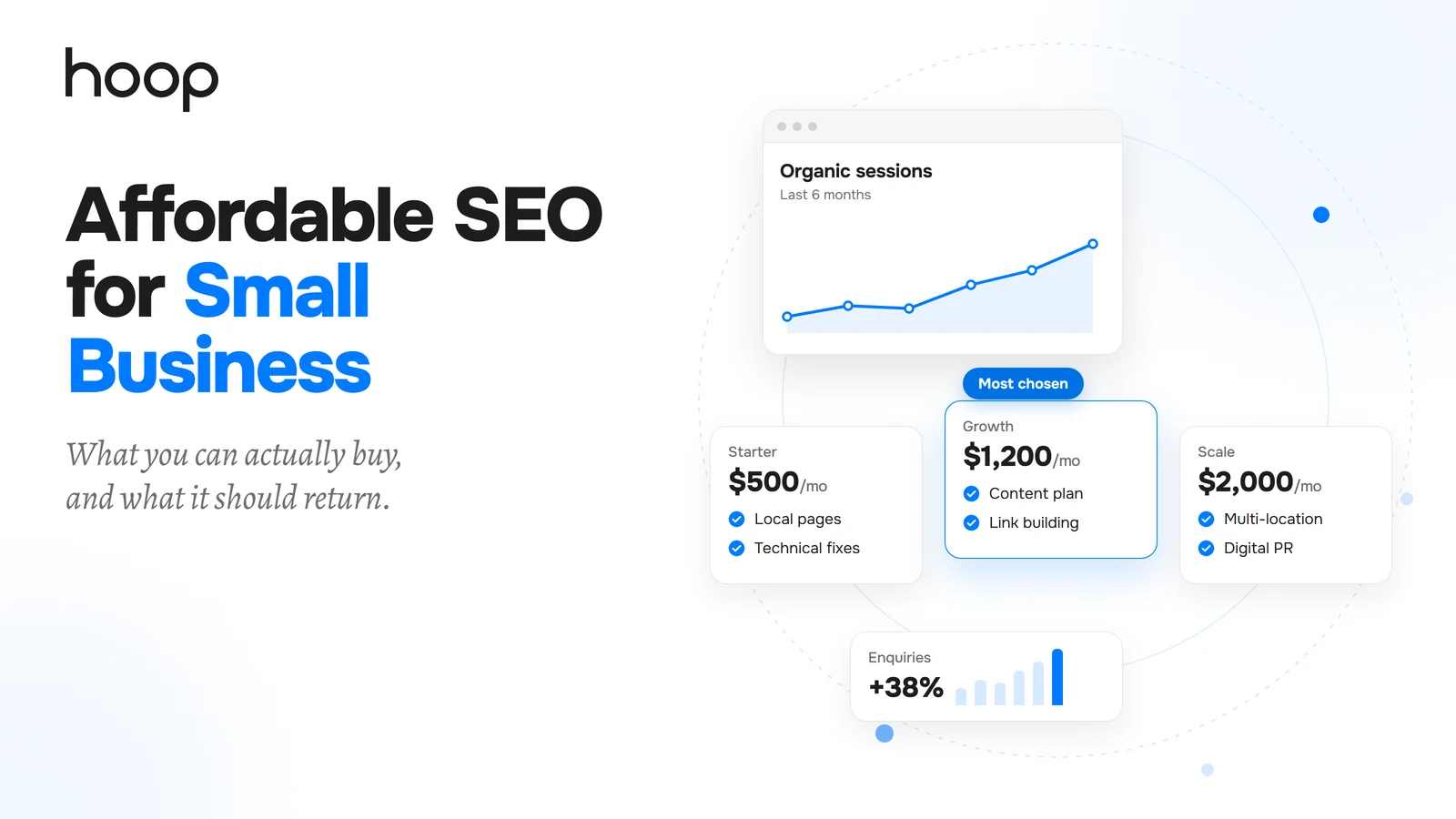
For businesses with only $100 to $300 each month, prioritize free tools and occasional paid guidance. An independent consultant can review a narrow issue or develop a task list, but a complete technical, content, and outreach program is unlikely at that budget. A broader small-business planning range runs from roughly $500 to $2,000 per month, with scope changing by business need.
Which budget model fits your business?
| Approach | Illustrative budget | Likely scope |
|---|---|---|
| DIY / guided start | $0–$300 per month | Owner implements content and local improvements; buy limited advice |
| Focused freelancer | $300–$750 per month | A defined set of pages, audits, or local tasks |
| Managed local program | $750–$1,500 per month | Recurring local, technical, and content work with reports |
| Expanded campaign | $1,500+ per month | More pages, competitive research, technical support, and outreach |
These brackets illustrate purchasing models rather than confirmed agency price averages. Ask each provider for deliverables before treating a monthly fee as good value. One well-executed service page can matter more than 10 thin articles.
Which SEO Tasks Should You Prioritize on a Limited Budget?
Prioritize tasks that remove barriers to relevant search traffic and customer contact. A short diagnostic review can identify missing pages, indexing problems, and weak calls to action before your business commits to a lengthy campaign.
Improve your Google Business Profile first for local demand
A location-based business should verify its business profile, correct the primary category, list genuine services, and maintain accurate opening hours. Add original photos and respond professionally to legitimate reviews. Verify address and phone consistency across important directories. Never purchase fabricated reviews or create profiles for locations you do not operate.
Local SEO is especially relevant to salons, plumbers, repair companies, and dental practices. Businesses without customer-facing local services should not spend heavily on location listings that do not match their model. A useful small business SEO plan should fit the geographic reach of actual customers.
Fix search visibility and page basics
Connect Google Search Console and review indexing status, search queries, and pages with useful impressions. Check whether primary service pages have descriptive titles, readable headings, relevant answers, and working contact options. Fix broken links and navigation errors. Avoid paying for complicated technical changes before checking whether visitors can access and understand your most important pages.
Publish pages for services people actually buy
Write individual pages for distinct commercial offerings when each service deserves its own explanation. A cleaning company might need office cleaning, end-of-tenancy cleaning, and carpet cleaning pages. Include service details, service area, practical answers, trustworthy proof, and a clear inquiry method. Avoid creating near-identical city pages merely to capture keywords.
How Can You Start DIY SEO With Almost No Budget?
To start DIY SEO, choose one business objective and improve your highest-value page first. Record the baseline before editing. Small businesses can use free Google tools, direct customer questions, and simple spreadsheets to organize work.
- List the 3 services that produce the most useful revenue or customer demand.
- Search for the exact phrases customers use when requesting those services.
- Inspect your current page titles, headings, copy, and contact paths.
- Choose 1 page to improve and document the original search performance.
- Publish accurate answers, pricing context where possible, and a visible call to action.
- Check indexing and search performance regularly rather than changing pages every day.
Do not assume a plugin score equals search success. Plugins can flag missing fields, but customers still need clear information and trustworthy service details. Use analytics to verify whether your improvements lead to inquiries.
Should You Hire a Freelancer, Consultant, or SEO Agency?
Choose based on work complexity, accountability, and the skills already inside your business. A specialist can be an excellent fit for one technical issue. An agency becomes useful when content, technical work, reporting, and coordination need multiple disciplines.
When is a freelancer the better choice?
A freelancer fits a defined project such as auditing 15 key pages, fixing profile categories, or improving local landing pages. Request a written scope that lists the pages, fixes, and final handover. Give the specialist access only to the systems required for the task.
When should you pay for an agency?
Consider an agency when your company needs continuing delivery across research, technical implementation, content, and conversion improvements. Ask who performs the work and who approves changes. Review professional SEO service options against your business goals instead of assuming a larger package always performs better.
What should an SEO proposal include?
A useful proposal lists target services, current problems, specific deliverables, expected review points, reporting methods, fees, ownership, and cancellation terms. Demand clarity on whether developers, writers, and external tools cost extra. Avoid signing solely because a provider promises a ranking position.
How Can You Tell Whether Affordable SEO Services Are Legitimate?
Ask the provider to explain the first 30 days in plain language. A good answer names the checks and work items. It does not require an unverifiable secret method. Request relevant examples of completed projects and the client results that can be documented responsibly.
- Request a prioritized audit with screenshots or exact affected URLs.
- Request a sample report showing leads, relevant traffic, and completed changes.
- Request ownership of your domain, analytics accounts, and business profile.
- Request a clear explanation of link acquisition and content creation methods.
- Request a contract that names costs, exit terms, and handover obligations.
Google does not sell positions in organic search. No provider can guarantee a permanent number-one ranking. Be cautious about promises of thousands of backlinks, undisclosed network sites, or automated pages with no meaningful customer value.
How Do You Measure SEO Results Without Wasting Money?
Measure relevant inquiries and customer outcomes alongside search visibility. A ranking improvement for a phrase nobody buys from adds little value. Connect forms, calls, and booked appointments with their traffic sources where practical and privacy-appropriate.
Which metrics matter for a local business?
Record search impressions, relevant organic clicks, qualified calls, quote requests, booking forms, and completed sales. For a local contractor, 6 qualified quote requests can be more valuable than 600 unrelated visits. Review the quality of each inquiry before increasing spend.
How can you calculate a basic SEO return?
Suppose SEO costs $600 in a month and produces 8 attributable customers with $150 contribution profit each. That equals $1,200 in contribution before deducting SEO cost, leaving $600. The simplified return on the SEO spend is 100%. Real attribution, repeat sales, and employee time affect the final calculation.
Use consistent reporting periods. Organic SEO changes often take time to appear in performance data, and search results change for reasons outside one provider’s control. A useful report explains completed work, business outcomes, uncertainties, and next priorities.
What SEO Mistakes Cost Small Businesses the Most?
Spreading limited funds across too many services weakens execution. A business paying for social posts, generic articles, backlinks, and extensive reporting with a tiny budget can end up fixing none of its actual search problems. Select fewer tasks and complete them well.
Other costly mistakes include copying competitor pages, publishing mass-produced location content, ignoring mobile usability, and allowing agencies to control core accounts. Do not assume every business needs backlinks immediately. Existing service clarity and indexability sometimes deserve attention first.
Also avoid paying for traffic alone. A website with confusing forms, no service evidence, or slow replies wastes interested visitors. Review your wider digital marketing service strategy when conversion and follow-up problems extend beyond organic search.
How Can You Build a 30-Day Affordable SEO Plan?
To build a 30-day affordable SEO plan, concentrate on diagnosis, one implementation cycle, and a review. The purpose of the first month is a trustworthy baseline and visible improvements, not a guaranteed revenue jump.
- Week 1: Verify website access, Search Console, business listings, and conversion tracking.
- Week 2: Research customer searches and improve 2 important service pages.
- Week 3: Resolve priority technical issues, improve internal navigation, and update local details.
- Week 4: Check indexing, form functionality, search queries, and completed task evidence.
Assign each task to a named owner. Keep a change log with dates and URLs. At month-end, select the next 2 tasks from observed problems rather than choosing randomly from a generic SEO checklist.
How Should Different Small Businesses Allocate Their SEO Budget?
The right allocation follows how customers buy. A storefront, a home-service contractor, and an online seller do not share the same conversion path. Map the buying journey before paying for keywords, articles, or link outreach. Businesses should also consider whether one lead produces a repeat customer or a one-time purchase.
Local service businesses: focus on search intent and trust
A roof cleaner or electrician benefits from pages naming actual services, neighborhoods served, and the easiest contact method. Photograph completed work with permission and describe realistic project types. Accurate service-area information matters more than dozens of thin location pages. Check whether phone calls and contact forms work on mobile devices.
Spend the first available budget on a strong business profile, clear service pages, and a reliable system for collecting genuine reviews. If the company has no physical customer location, follow the platform rules for service-area businesses. Do not publish a fabricated storefront address just to appear in local results. Our Chiltern Surface Co case study shows a connected website, CRM and local SEO system built the same way.
Professional service firms: build credibility before traffic
An accountant, consultant, or business law firm should explain qualifications, the engagement process, client eligibility, and service boundaries. Answer questions that prospects ask before an introductory meeting. A small collection of accurate, carefully maintained pages can outperform a large library of vague content. Make consultation booking and response expectations visible.
Track meaningful inquiries from business owners who fit the practice, not general page views. A page about the cost and scope of bookkeeping support serves a different purpose from a broad accounting definition. Both can help, but the service page typically deserves priority when the budget is tight.
Ecommerce stores: fix product discovery and purchase friction
An ecommerce shop should prioritize product availability, descriptive category pages, distinct product information, and usable filters. Review duplicate URLs and indexation before publishing a large article calendar. Missing variants and broken category navigation can waste existing organic demand. Measure revenue and completed orders as well as visibility.
Avoid treating every product as a separate SEO campaign. Group related products by clear customer needs and make navigation understandable. For example, a skincare store can organize cleansers by skin concern and explain product differences without forcing repeated keywords into every description.
How Do You Protect Your Budget After Hiring an SEO Provider?
Protect the budget by keeping an editable task log and requiring monthly evidence of work. Give your provider access through named user accounts, rather than surrendering domain ownership or sharing the main password. Ask for a list of pages changed, technical issues fixed, and new assets published.
Schedule one short review to connect the work with conversions. If rankings improve but lead quality falls, inspect search intent and landing page messaging. If traffic increases but inquiries remain flat, test forms, calls to action, and customer trust signals. If the agency reports only activity counts, request business outcomes and a specific plan for the next month.
When a contract ends, export reports, content files, login permissions, and any work product that your agreement says you own. Remove unneeded account access. A clean handover protects the business from paying twice for the same setup work.
Start With SEO Work Your Business Can Afford
Affordable SEO for small business starts with choosing the right work, completing it carefully, and tracking whether relevant customers respond. Improve local visibility and service pages before funding unnecessary complexity.
If you want a prioritized scope that matches your resources, review our small business SEO services and ask for a realistic plan for your website. For a side-by-side look at what providers bundle, read our guide to SEO packages for small business.
“One well-executed service page can matter more than 10 thin articles.”
Key takeaways
- 01Fix the Google Business Profile and your main service pages before funding anything broader.
- 02Under $300 a month buys advice or a narrow fix, not a full ongoing campaign.
- 03Judge a provider by deliverables and access ownership, never by a promised ranking.
- 04Measure qualified inquiries, not impressions: 6 real quote requests beat 600 unrelated visits.
Written by
Sahar
Content Writer
Frequently Asked
Questions
Everything you need to know before booking a strategy call. Can't find your answer? Contact us directly.

Ask hoop
Usually replies in minutes
Is $200 a month enough for SEO?
Yes, for a narrow scope or owner-led work. $200 rarely supports a complete ongoing agency campaign. Buy an audit, practical coaching, or a small set of priority fixes.
PEOPLE ALSO ASK
Swipe for 4 more questions →
Can't find your answer? Contact us directly.
Keep reading
All articles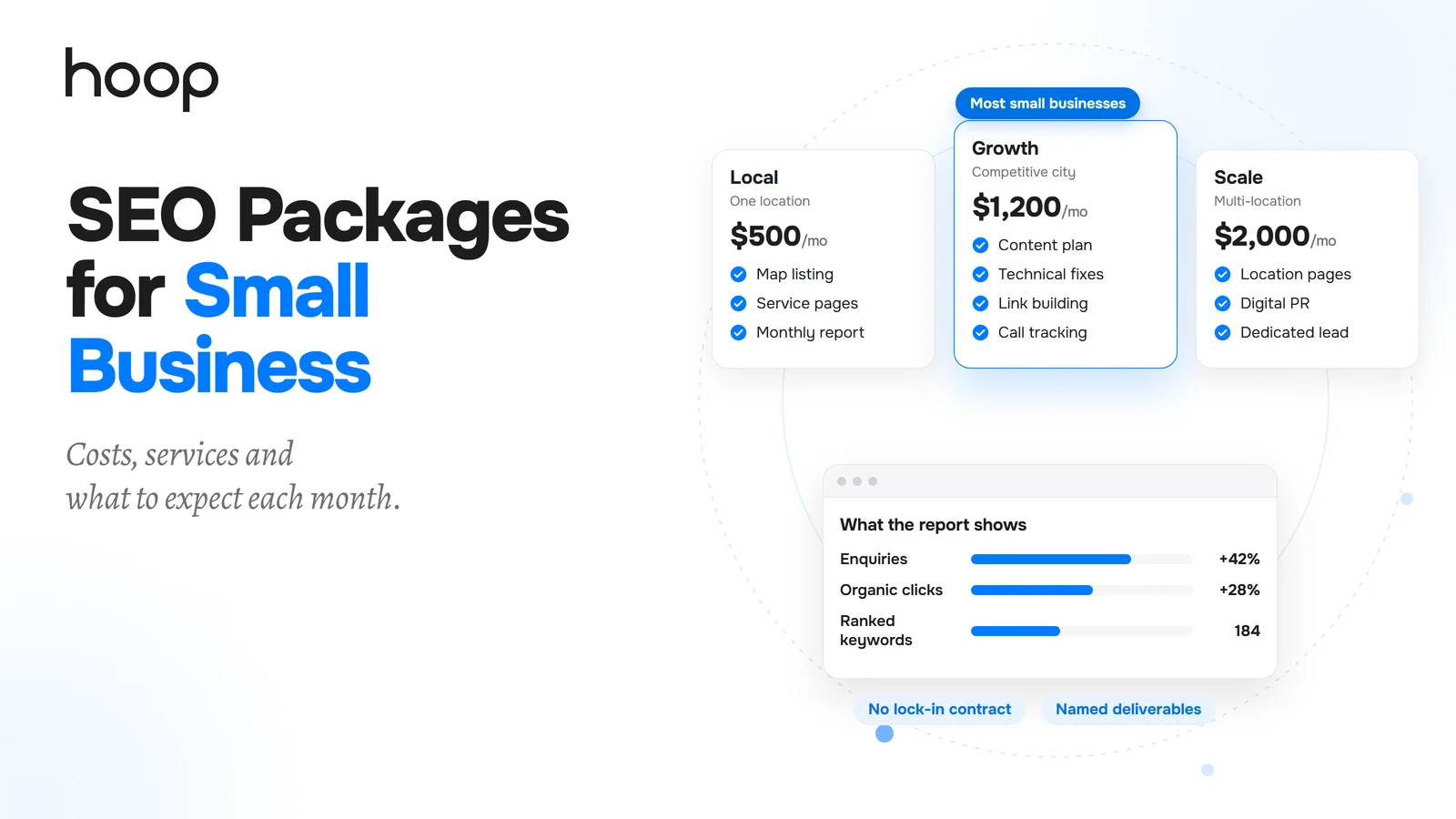
SEO Packages for Small Business: Costs, Services, and What to Expect
Nov 23, 2026 · 10 min read
What Is Local SEO? A Practical Guide to Local Search
Sep 22, 2026 · 10 min read