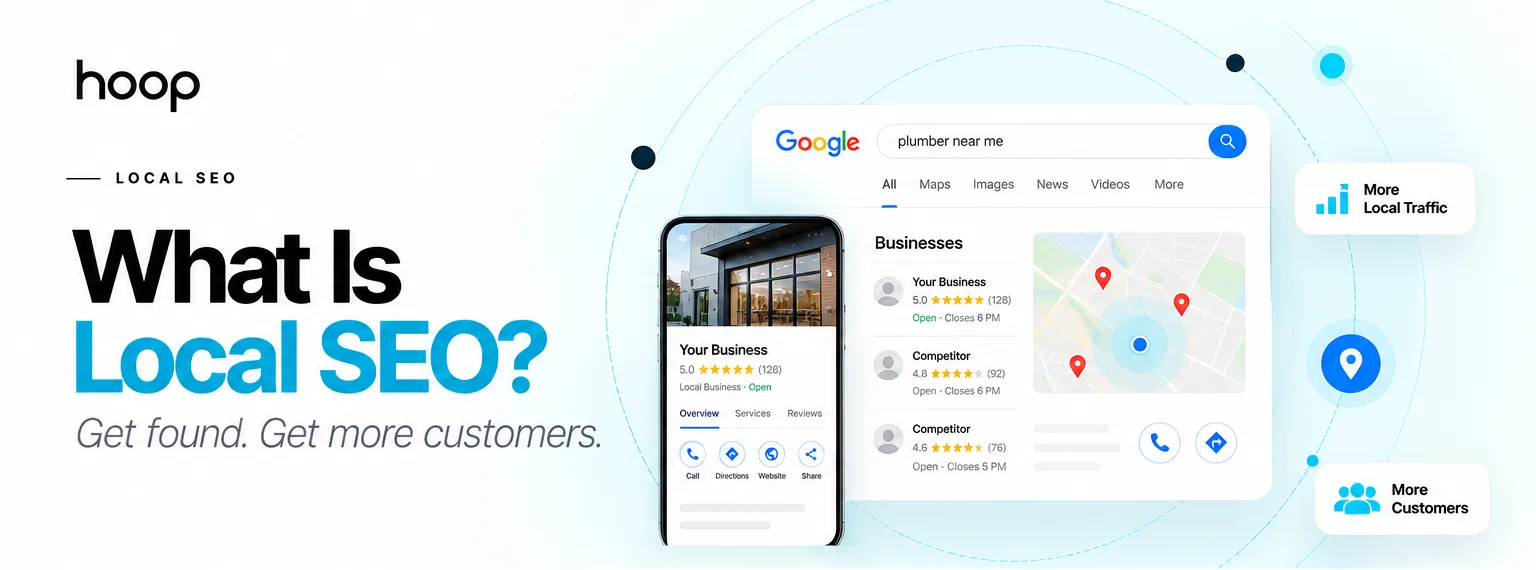
What Is Local SEO? A Practical Guide to Local Search
Local SEO helps nearby customers find your business in Search and Maps. Profiles, websites, reviews, citations, and local signals together drive calls, visits, bookings, and leads.
Sahar
Content Writer
What is local SEO? Local SEO helps your business appear when nearby customers search for products or services you offer. Google also improves local discovery through Maps and local results.
A strong local presence connects your Google Business Profile, website, reviews, citations, and local authority signals. Each part supports a different stage of discovery. Customers can find your business, judge your reputation, confirm details, and contact you quickly.
Local search optimization matters most for businesses that serve defined areas. Dentists, restaurants, plumbers, lawyers, salons, clinics, retailers, and home service companies all depend on local demand. Service-area businesses also benefit, even without a public storefront.
What Is Local SEO and How Does It Work?
Local SEO is the process of improving visibility for searches with local intent. Local intent means the searcher wants a nearby business, service, or place.
A person can show local intent without typing a city. Google can use location signals to interpret searches such as “dentist,” “coffee shop,” or “roof repair.” Searchers can also state location directly. Examples include “dentist in Chicago,” “coffee shop near me,” and “roof repair Brooklyn.”
The strategy works across 2 connected surfaces. Google can show business listings in a local pack. Google can also show localized website pages in organic results.
Your Google Business Profile supports Maps and local pack visibility. Your website supports organic visibility, service detail, trust, and conversions. Strong campaigns connect both assets instead of choosing one.
Where Do Local SEO Results Appear?
Local SEO results usually appear in Google Maps, the local pack, and localized organic results. Each placement gives searchers different information.
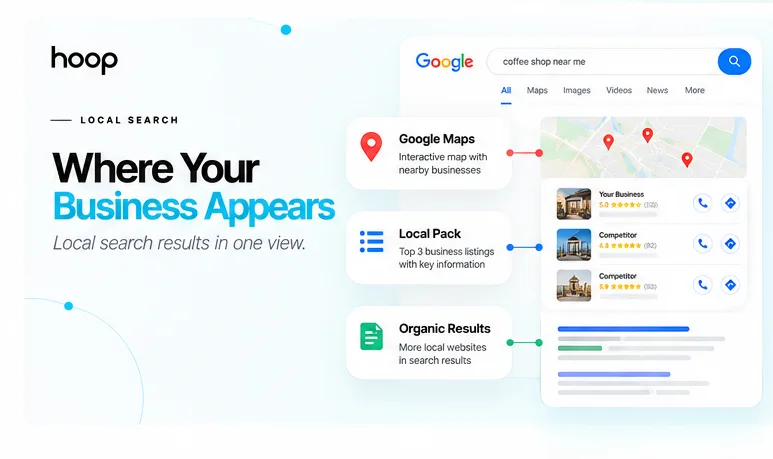
Google Maps results
Google Maps shows nearby businesses that match a search. A listing can show categories, reviews, photos, hours, directions, phone details, and website links.
Searchers often use Maps when proximity matters. Examples include emergency plumbers, restaurants, pharmacies, repair shops, and salons.
Local Pack results
The local pack places a map beside a small group of business listings. Google often places the local pack above standard organic links.
The local pack helps customers compare nearby options quickly. Searchers can review ratings, opening hours, locations, and business categories before visiting a website.
Local organic results
Localized organic results are standard website links influenced by local intent. Service pages, location pages, homepages, and useful guides can rank here.
A business can rank well organically without ranking equally well in Maps. Google evaluates local listings and webpages through overlapping, but different, signals.
How Does Google Rank Businesses for Local Search?
Google says local rankings depend mainly on relevance, distance, and prominence. Relevance, distance, and prominence shape which businesses appear for local searches.
Relevance matches the business to the search
Relevance measures how closely a business matches the searcher’s need. Clear categories, services, website content, and business details help Google understand that match.
Choose the most accurate primary Google Business Profile category. Add relevant secondary categories only when each category represents a real service.
Describe services with specific language. A dental clinic can list teeth whitening, dental implants, emergency dentistry, and routine examinations.
Distance connects results with the searcher’s location
Distance measures how far each business sits from the searcher or stated location. Businesses cannot optimize away physical distance.
Local rankings can change across neighborhoods within the same city. A business can rank strongly near its address and lower farther away.
That variation explains why one manual search never shows your complete local visibility. Grid-based rank tracking gives a better location-by-location view.
Prominence reflects reputation and authority
Prominence reflects how well known and trusted a business appears. Google uses information from reviews, links, articles, directories, and other sources.
Strong prominence comes from genuine business activity. Earn customer reviews, local coverage, relevant links, and consistent mentions across trusted platforms.
Google’s local ranking guidance also confirms that review count and positive ratings support local ranking.
What Is Local SEO vs Traditional SEO?
Local SEO targets location-based demand, while traditional SEO can target broader regional, national, or global demand. Both disciplines share important foundations.
Traditional SEO focuses heavily on crawlability, content quality, search intent, internal links, backlinks, and technical performance. Local search adds location-specific signals.
Local signals include Google Business Profile data, proximity, reviews, citations, service areas, local links, and location pages. The local strategy also measures Maps visibility.
For example, “how to fix a leaking tap” has informational intent. “Plumber near me” has local service intent. The second query needs stronger local signals.
Your website still needs sound technical and on-page work. Hoop’s professional SEO services cover technical, content, authority, and search intent foundations.
Is Local SEO Just Google Business Profile Optimization?
No. Local SEO includes Google Business Profile optimization and website optimization. Reviews, citations, links, and local content also support visibility.
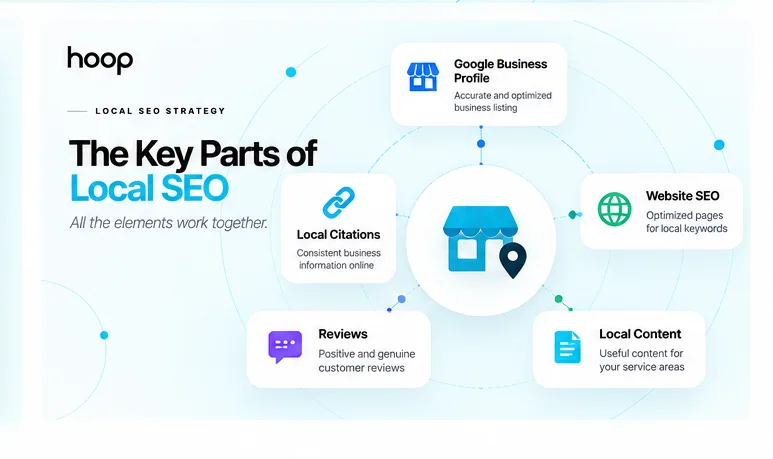
Google Business Profile gives Google structured information about your business. Your website gives search engines deeper information about services, locations, expertise, and proof.
A complete profile cannot replace weak website content for every query. A strong website cannot enter the local pack without an eligible Google Business Profile.
What the Google Business Profile should do
Your profile should make the business easy to understand and contact. Complete the business name, category, address, service area, hours, phone number, and website.
Add useful photos that reflect the real business. Examples include storefronts, team members, completed work, treatment rooms, menus, products, and vehicles.
Request genuine reviews after real customer experiences. Reply to positive and negative reviews with useful, specific responses.
What the website should do
Your website should explain each service and each service area. Build clear service pages for distinct services with separate search intent.
Create location pages for real offices, stores, clinics, or meaningful service areas. Give each page unique local information and useful proof.
Add clear contact information and conversion paths. Phone links, enquiry forms, booking buttons, directions, and opening hours reduce friction.
Use LocalBusiness structured data for real business details. Mark up addresses, opening hours, phone numbers, and eligible location information.
What supporting local signals should do
Citations should keep your business details consistent across trusted platforms. Examples include Apple Maps, Bing Places, Yelp, industry directories, and local chambers.
Local backlinks should show genuine community or industry relevance. Examples include local newspapers, trade associations, sponsorship partners, and business organizations.
What Makes Up a Strong Local SEO Strategy?
A strong local SEO strategy combines 7 core activities in a clear sequence. The sequence prevents scattered work and protects limited budgets.
1. Research local search demand
Start with services customers actually search for. Map each service to location-based queries and real pages.
Examples include “emergency dentist,” “family dentist Manchester,” “roof repair near me,” and “wedding photographer Bristol.” Check whether Google shows local results.
2. Optimize the Google Business Profile
Complete every relevant profile field. Choose accurate categories, add services, maintain hours, upload useful photos, and keep contact details current.
3. Build service and location pages
Give important services dedicated pages when search intent differs. Give real locations dedicated pages when customers need location-specific information.
Avoid mass-produced city pages with only place names changed. Unique pages should include services, proof, directions, local context, and conversion details.
4. Keep NAP data consistent
Name, address, and phone number (NAP) should match across major platforms. Fix old phone numbers, previous addresses, duplicates, and conflicting business names.
5. Build a review system
Ask real customers for honest reviews after completed work, purchases, appointments, or visits. Make the request easy with a direct review link.
Never buy reviews or reward only positive feedback. Google prohibits review manipulation and selective review practices.
6. Earn relevant local authority
Build links and mentions through real relationships. Sponsor local events, join trade groups, contribute expertise, and earn local media coverage.
7. Track visibility and conversions
Track rankings, calls, enquiries, bookings, direction requests, website clicks, and revenue. The strategy should create business outcomes, not ranking screenshots.
How Do “Near Me” Searches Work?
Google can infer “near me” intent from the searcher’s location, query, and available business data. You do not need unnatural “near me” repetition.
Write pages around actual services and actual locations. A plumber should explain boiler repair, drain clearing, emergency plumbing, and service areas clearly.
Google can connect that information with location signals from the searcher. Accurate profile data and relevant website pages strengthen the connection.
Avoid headings such as “best plumber near me” across every page. Searchers do not need awkward wording, and keyword stuffing weakens readability.
Use natural location phrases where location adds value. Examples include “emergency plumber in Leeds” and “dental implants in Austin.”
Do You Need a Website for Local SEO?
A business can appear in Google Maps without a strong website, but a website expands local search opportunities. The website also improves conversion control.
Google Business Profile can generate calls, directions, messages, and website visits. Some customers can choose a business without leaving Google.
A website answers questions that a listing cannot cover well. Customers can compare services, pricing approaches, credentials, case studies, policies, and detailed locations.
Website pages also compete in localized organic results. That creates a second path to visibility beyond Maps and the local pack.
A website gives you stronger measurement and conversion options. You can track form submissions, calls, bookings, landing pages, and revenue sources.
How to Start Local SEO Without Wasting Effort
To start local SEO, fix business information first, then improve pages, reviews, authority, and measurement. Use evidence to set priorities.
Begin with a local visibility audit. Check profile completeness, categories, duplicate listings, citations, reviews, website pages, technical health, and competitors.
Use Hoop’s SEO audit guide to structure the website review before changing content.
Then follow a simple execution order. The table gives a practical starting sequence for a single-location business.
| Task | Timing | Method | Difficulty |
|---|---|---|---|
| Verify business profile | Week 1 | Confirm ownership, category, hours, services, and contact details | Easy |
| Map local keywords | Weeks 1–2 | Match services and locations to search intent | Moderate |
| Fix citations | Weeks 2–4 | Correct major directories and remove conflicting information | Moderate |
| Improve local pages | Month 1 | Build useful service and location pages | Moderate |
| Start review requests | Ongoing | Ask customers after completed transactions or appointments | Easy |
| Build local authority | Monthly | Earn local links, mentions, partnerships, and coverage | Hard |
| Measure performance | Weekly and monthly | Track Maps visibility, organic traffic, calls, leads, and revenue | Moderate |
Do not treat every task as equally urgent. A wrong primary category can matter more than another blog post.
Do not chase citation volume without quality. Focus on accurate listings where customers and search engines expect to find your business.
How Do You Measure Local SEO Results?
Measure visibility and conversions together. Rankings show discoverability, while conversions show business value.
Track Google Business Profile interactions, including calls, website clicks, direction requests, bookings, and messages. Compare trends across meaningful periods.
Track website performance with Google Search Console and analytics. Review local queries, landing pages, organic clicks, forms, calls, and booked appointments.
Track Maps rankings from multiple points around your service area. A single rank number hides geographic variation caused by distance.
Track review growth and quality. Measure review volume, average rating, response rate, and recurring customer themes.
Track leads and revenue where systems allow attribution. Connect form submissions, call tracking, CRM records, and booked sales to organic sources.
Who Needs Local SEO Most?
Local search optimization fits businesses that serve customers in specific physical areas. The strongest fit includes storefronts and service-area businesses.
Storefront businesses include restaurants, dentists, pharmacies, gyms, salons, retailers, and medical clinics. Customers usually visit a physical location.
Service-area businesses include plumbers, electricians, roofers, cleaners, landscapers, locksmiths, and mobile mechanics. Teams travel to customers within defined areas.
Professional service businesses also benefit from local demand. Examples include lawyers, accountants, estate agents, architects, consultants, and private healthcare providers.
Purely online businesses need local optimization only when geography affects demand. A national software product usually needs broader organic SEO instead.
What Common Mistakes Hurt Local Visibility?
The most damaging mistakes create inaccurate signals, weak relevance, or poor customer trust. Fix foundational problems before adding more content.
Avoid keyword-stuffed business names. Use the real-world business name that follows Google Business Profile guidelines.
Avoid inconsistent contact details. Old addresses, disconnected numbers, duplicate listings, and conflicting names create confusion.
Avoid thin location pages. Each location page should help a customer understand services, proof, access, contact options, and local relevance.
Avoid fake reviews. Review manipulation risks policy problems and damages customer trust.
Avoid measuring success from your own device only. Local rankings change with searcher location, query wording, competition, and personalization.
Avoid treating Google Business Profile as the entire strategy. Maps visibility and website visibility support different search journeys.
Connect Visibility With an Easy Next Action
Local customers should find accurate information across every search surface. Strong local search optimization connects visibility with trust and an easy next action.
If you want a structured plan, explore Hoop’s local SEO services and start with the highest-impact gaps. Our guide to local SEO pricing covers what each budget level realistically buys.
“A wrong primary category can matter more than another blog post.”
Key takeaways
- 01Google weighs relevance, distance, and prominence — you cannot optimise away distance.
- 02Rankings change block by block, so one search from your own desk proves nothing.
- 03A complete profile cannot replace website content, and vice versa — you need both.
- 04“Near me” needs accurate services and locations, not the phrase stuffed into headings.
Written by
Sahar
Content Writer
Frequently Asked
Questions
Everything you need to know before booking a strategy call. Can't find your answer? Contact us directly.
Yes, you can perform many local search tasks without paid software. Google Business Profile and Google Search Console are free tools. You still invest time in research, content, reviews, citations, technical work, and reporting.
Yes, a Google Business Profile can appear without a strong website. A website gives you more ranking, trust, content, and conversion opportunities.
Yes. Google confirms that review count and positive ratings can support local rankings. Reviews also influence customer trust and choice.
Local search performance has no universal timeline. Competition, distance, business history, website quality, reviews, and existing authority change the pace.
Local SEO covers Maps, the local pack, localized organic results, websites, reviews, citations, and local authority. Google Maps SEO focuses mainly on Maps visibility.