
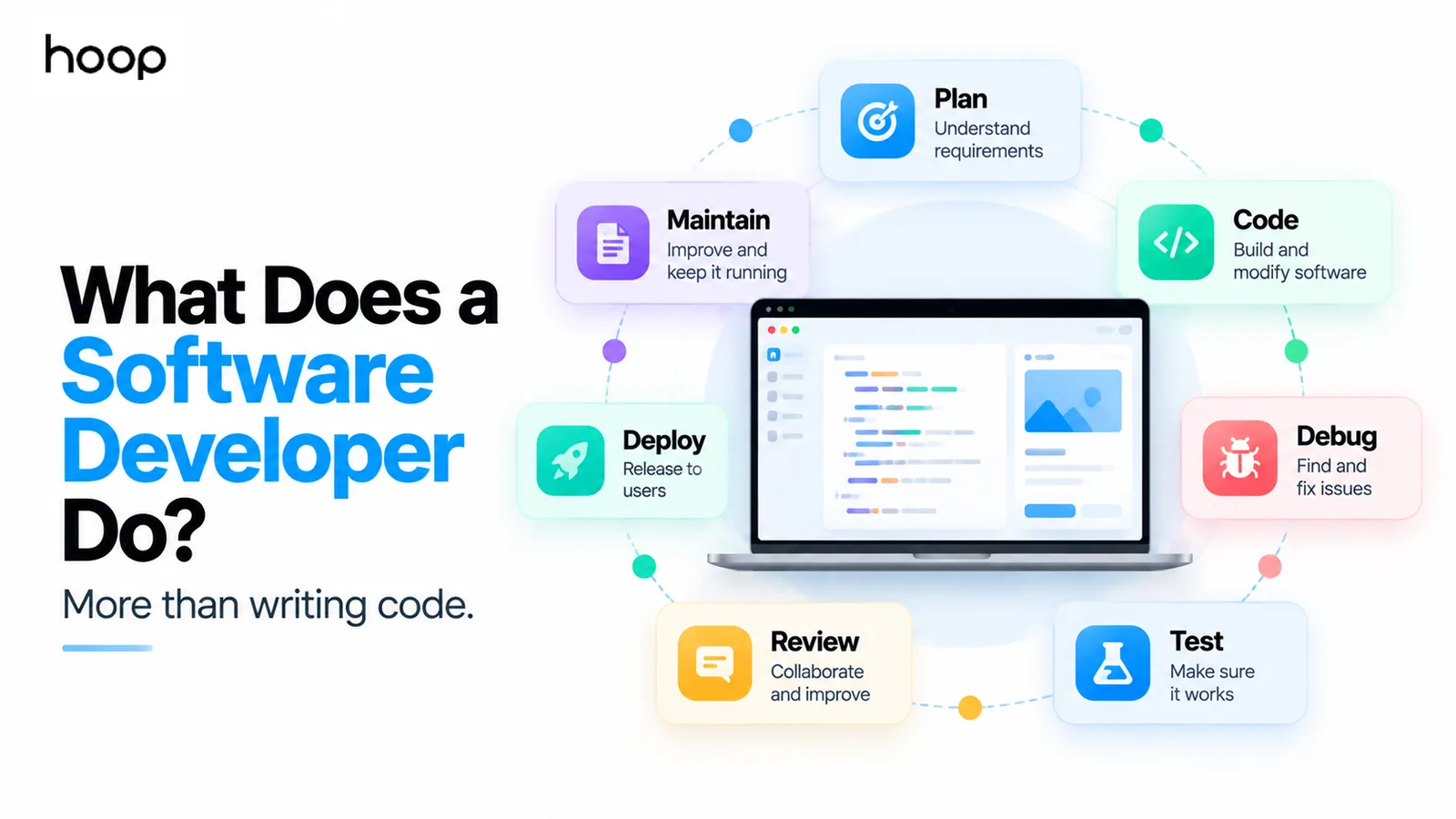
What Does a Software Developer Do? Roles, Tasks and Skills
Software developers do much more than write code. They translate business and user needs into working software, then test, review, release, maintain and improve that software as requirements change.
Sahar
Content Writer
A software developer turns user or business needs into working software, then tests, maintains and improves that software over time. Writing code is a core responsibility, but professional development also includes requirements analysis, system design, debugging, testing, code review, deployment and collaboration.
The exact job changes by company, product and seniority. A developer at a startup may work across the full product. A developer at a larger company may own one service, application layer or technical domain.
What Does a Software Developer Actually Do?
A software developer solves problems by designing and changing software. The work starts before code and continues after release.
The U.S. Bureau of Labor Statistics lists analyzing user needs, designing software, maintenance, testing and documentation among typical developer duties. Developers also work with other people who contribute to a product, including quality assurance teams and stakeholders.
A developer might spend one day adding an account-export feature. The next day may involve investigating a production bug, reviewing a teammate’s code and updating an API integration.
The job therefore combines technical execution with analysis and communication. Code turns the plan into software, but code alone does not define the role.
What Do Software Developers Do All Day?
Software developer daily tasks usually shift between understanding work, building changes and checking that those changes behave correctly.
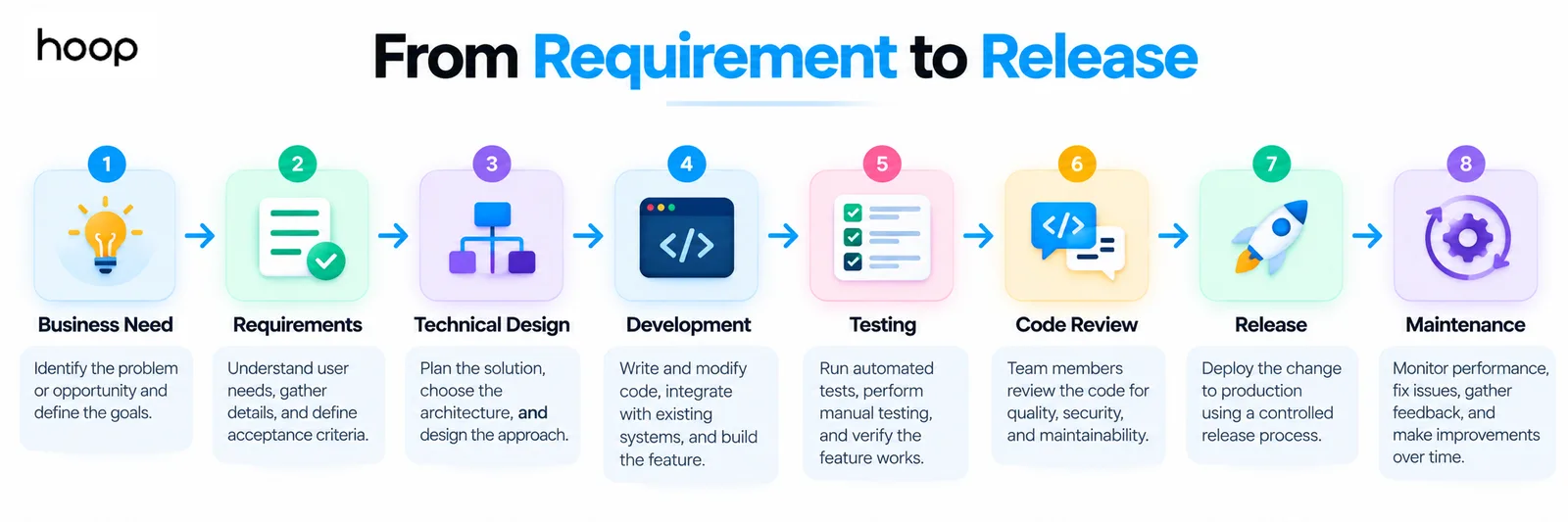
Understand requirements
Developers first clarify the problem. A ticket saying “add export” leaves many unanswered questions.
A developer needs to know which data users can export, who has permission, which file format the system needs and what happens when the export fails.
Good requirements reduce rework because the team agrees on expected behavior before implementation.
Design technical solutions
Developers decide how a feature fits the existing system. A small change may require a database update, API endpoint, permission rule and new user-interface state.
Developers also consider security, performance, error handling and maintainability. Senior team members often handle broader architecture decisions, while other developers design individual components.
Write and modify code
Developers implement features using programming languages, frameworks, libraries and existing system components. Professional work usually means modifying an established codebase rather than starting from an empty project.
Developers also connect external systems through Application Programming Interfaces (APIs), update database logic and add error handling.
Debug problems
Debugging means finding why software behaves differently from the expected result. Developers reproduce the issue, inspect logs, trace data and examine the relevant code path.
A useful fix addresses the root cause instead of hiding the visible symptom.
Test and review work
Developers test their changes before release. Testing can include unit tests, integration tests, end-to-end tests and manual checks.
A teammate often reviews the proposed code through a pull request. The review can catch logic errors, security concerns and maintainability problems before the code reaches users.
Deploy and maintain software
Approved changes move through a release process. Many teams use Continuous Integration and Continuous Delivery (CI/CD) pipelines to run tests and deploy code consistently.
After release, developers monitor software, fix defects and respond to new requirements. Maintenance can continue for years after the first version launches.
What Does a Real Development Task Look Like?
Consider a company that asks for a new CSV export button inside its customer dashboard.
The request sounds simple, but the developer must answer several questions. Which customers can export data? Which records belong in the file? Should the system generate the file instantly or process large exports in the background?
The developer then checks the existing application. The work may require a backend endpoint, database query, permission check and frontend button.
Next, the developer writes the code and tests normal cases and failure cases. A teammate reviews the change. Quality Assurance (QA) may test the complete workflow before release.
The team then deploys the feature. Monitoring continues after release because real production data can expose issues that did not appear during development.
This workflow explains why a software task involves more than typing the requested feature. For companies that need systems built around unique processes, custom software development can cover discovery, architecture, implementation and ongoing support.
Do Software Developers Code All Day?
No. Professional software developers do not spend the entire workday writing new code. The balance depends on the role and the stage of the project.
A developer may spend several uninterrupted hours coding during implementation. Another day may contain requirement discussions, debugging, code reviews and release work.
Senior developers often spend more time on architecture, design decisions, mentoring and coordination. Junior developers usually spend more time implementing defined tasks and learning the codebase.
Coding remains central to many developer roles. The professional job, however, also requires understanding what to build and proving that the change works safely.
Do Developers Build New Software or Maintain Existing Systems?
Most developers spend significant time changing software that already exists. Completely new products represent only one part of software development.
Existing systems need new features because products and businesses change. Teams also fix defects, improve performance, replace outdated dependencies and update integrations.
Developers may refactor older code as part of that work. Refactoring improves the internal structure of software without intentionally changing its user-facing behavior.
Maintenance also protects business continuity. A mature system can support revenue, operations or customer service, so keeping that system reliable matters as much as adding new features.
Why Do Companies Need Developers After Software Is Built?
Software does not become permanently finished after launch. Users discover new needs, external systems change and operating environments evolve.
Developers continue working because companies need to:
- add features based on customer or operational needs;
- fix bugs discovered in production;
- update security controls and dependencies;
- improve speed, scalability and reliability;
- connect new services and APIs;
- support new devices, browsers or operating systems;
- modernize old components before they become expensive to maintain.
A successful product can create more development work because growth introduces larger data volumes, more users and more complex workflows.
What Types of Software Developers Are There?
“Software developer” describes a broad profession. The daily responsibilities change significantly across specializations.
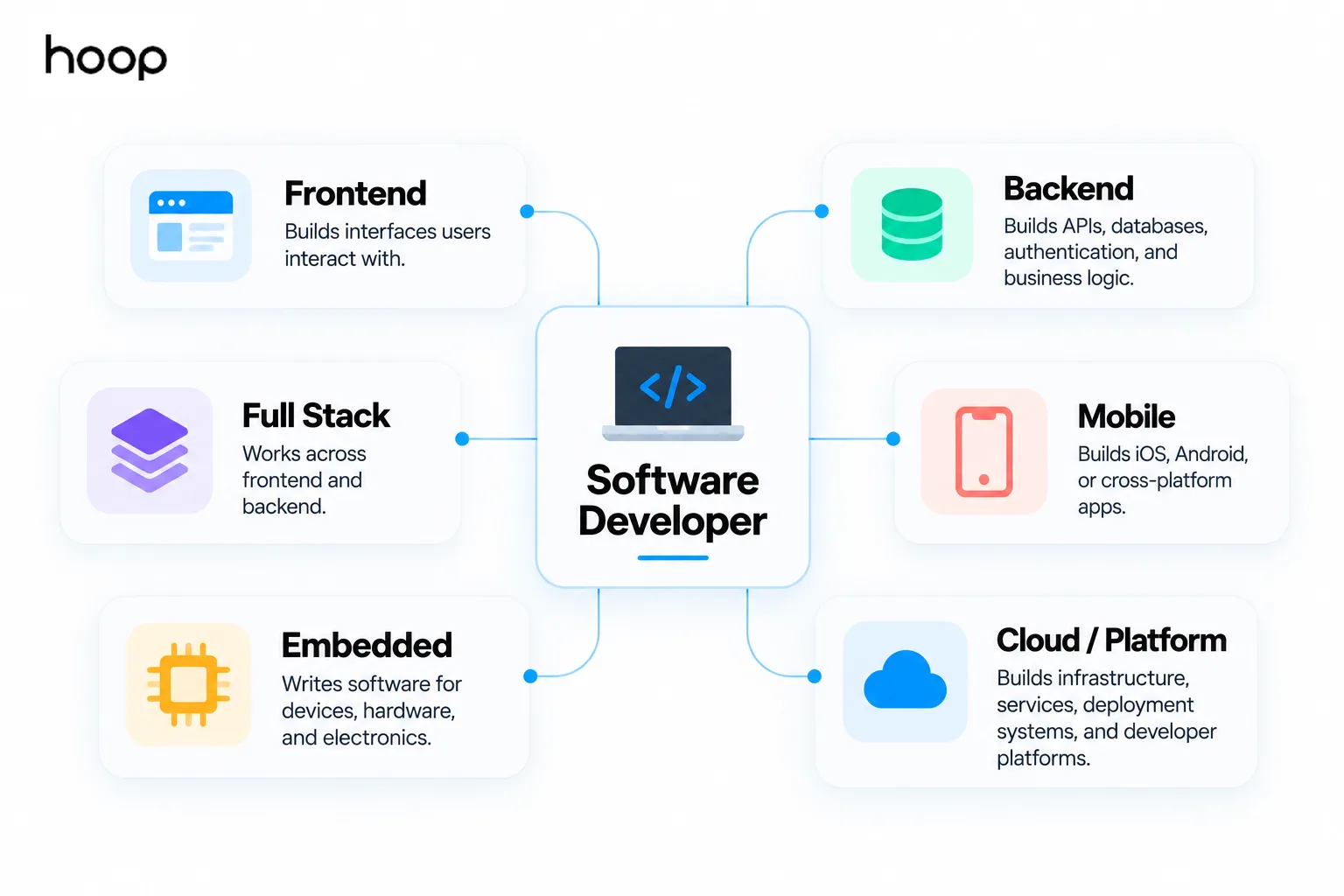
Frontend developers
Frontend developers build the parts of web applications that users see and interact with. Work includes forms, navigation, dashboards, state management and responsive interfaces.
Backend developers
Backend developers build server-side systems. Common responsibilities include APIs, databases, authentication, permissions, business logic and background processing.
Full-stack developers
Full-stack developers work across frontend and backend layers. The role is common in smaller teams where one developer needs to understand the complete application flow.
Mobile developers
Mobile developers build applications for iOS, Android or both. They work with mobile frameworks, device APIs, app permissions and platform-specific release requirements.
Embedded developers
Embedded developers write software that runs inside hardware such as industrial equipment, consumer electronics, vehicles and connected devices.
Cloud and platform developers
Cloud and platform developers build infrastructure, internal services, deployment systems and tools that help other development teams deliver software reliably.
A browser-based product often combines several of these specializations. Hoop’s web application development work, for example, can involve frontend interfaces, backend services, data storage and cloud deployment within one product.
Software Developer vs Software Engineer: What’s the Difference?
Many companies use “software developer” and “software engineer” as interchangeable titles. There is no universal industry boundary that applies to every employer.
Some organizations use “software engineer” for roles with broader architecture, systems thinking or engineering responsibility. Other companies use both titles for almost identical jobs.
Job title alone therefore tells you less than the actual responsibilities. A developer can own complex architecture, while an engineer can spend most of the day implementing application features.
The safer comparison is the job description. Look at ownership, system scope, design expectations, mentoring duties and technical decision-making.
What Is the Difference Between Junior and Senior Developers?
Junior developers usually work on well-defined tasks with guidance. Common responsibilities include implementing features, fixing smaller bugs, writing tests and learning established patterns.
Mid-level developers handle larger features with less supervision. They can investigate ambiguous problems, estimate work and make local design decisions.
Senior developers often influence architecture and team direction. They review complex changes, mentor teammates, clarify requirements and make decisions that affect multiple systems.
Seniority does not mean a developer stops coding. Senior developers often still write code, but the percentage of hands-on implementation usually decreases as system and team responsibility grows.
How Do Software Developers Debug and Test Software?
Debugging, testing and review protect software from avoidable failures.
Debugging
To debug an issue, developers first reproduce the problem. They then inspect logs, requests, database values, application state or stack traces.
A debugger can pause running code so the developer can inspect values step by step. Production monitoring tools can also show errors, latency or failed requests.
Testing
Unit tests check small units of behavior. Integration tests check whether components work together. End-to-end tests verify complete user workflows.
Developers also perform manual tests when visual behavior, device differences or unusual edge cases require direct inspection.
Code review
Code review gives another developer a chance to inspect a proposed change before it merges into the main codebase.
Reviewers check logic, readability, security, test coverage and compatibility with existing architecture. Reviews also spread knowledge across the team.
Who Do Software Developers Work With?
Software development is usually collaborative. Developers work with people who define the product, design the experience and operate the software.
Common collaborators include product managers, UI/UX designers, QA engineers, DevOps engineers, data specialists, security teams and business stakeholders.
A product manager may define what outcome a feature needs. A designer specifies the user experience. A developer implements the behavior. QA tests the result. DevOps supports release infrastructure.
Smaller teams often combine these responsibilities. Larger organizations usually divide them across specialists.
What Tools Do Software Developers Use?
Developers use tools that help them write, understand, test and ship software.
Common tool categories include:
- Integrated Development Environments (IDEs) and code editors for writing and navigating code;
- Git and version control platforms for tracking changes and collaborating safely;
- issue trackers for requirements, bugs and project work;
- terminals and command-line tools for running applications and development tasks;
- database tools for inspecting and changing stored data;
- API tools for testing requests and integrations;
- CI/CD systems for automated tests, builds and deployments;
- monitoring tools for errors, logs, performance and production behavior.
The exact products change between companies. The underlying jobs remain similar.
What Skills Does a Software Developer Need?
Strong developers combine technical ability with reasoning and communication.
Technical skills
Developers need programming fundamentals, data structures, version control, testing and familiarity with the systems they build.
A frontend role may prioritize JavaScript and browser behavior. A backend role may require databases, networking and API design.
Problem-solving skills
Many tasks arrive as symptoms rather than complete solutions. Developers need to break complex problems into smaller parts and test possible causes.
Communication skills
Developers need to ask precise questions, explain technical tradeoffs and document decisions. Communication reduces misunderstandings between technical and nontechnical teams.
Learning and research skills
Software changes constantly. Developers regularly read documentation, investigate unfamiliar code and learn new libraries, platforms or tools.
The ability to learn reliably often matters more than memorizing one technology stack. If you are starting out, our guide on how to become a software developer maps the sequence.
What Does a Typical Developer Day Look Like?
There is no universal schedule, but a realistic day could look like this:
- 9:00 — Check messages, monitoring alerts and current work.
- 9:30 — Join a short team stand-up.
- 10:00 — Investigate a production bug or continue a feature.
- 11:30 — Write code and automated tests.
- 1:30 — Review another developer’s pull request.
- 2:00 — Meet with product or design to clarify upcoming work.
- 3:00 — Finish implementation and test edge cases.
- 4:30 — Respond to review comments and prepare the change for release.
Some developers have fewer meetings and longer coding blocks. Senior or leadership roles can spend much more time on planning and technical decisions.
Software Developer Work at a Glance
| Task | When It Happens | Method | Difficulty |
|---|---|---|---|
| Requirements | Before development and when scope changes | Tickets, workshops, prototypes and acceptance criteria | Medium |
| Technical design | Before complex implementation | Architecture notes, diagrams and interface decisions | Medium to high |
| Development | Throughout an iteration | IDE, frameworks, APIs, databases and Git | Varies |
| Debugging | When software behaves incorrectly | Logs, reproduction, tracing and debuggers | Medium to high |
| Testing | Before review and release | Unit, integration, end-to-end and manual tests | Medium |
| Code review | Before changes merge | Pull requests and peer review | Medium |
| Release | After approval | CI/CD pipelines and controlled deployment | High for critical systems |
| Maintenance | After launch | Monitoring, fixes, upgrades and refactoring | Varies |
How Does Development Continue After Launch?
Launch starts a new stage of software development rather than ending the work.
Teams monitor errors and performance. Developers investigate production incidents, improve slow areas and respond to customer feedback.
They also update dependencies and infrastructure as technology changes. Security fixes can require immediate releases, while larger improvements may enter the normal product roadmap.
Long-term maintenance also includes removing outdated code and simplifying systems. These changes reduce technical debt and make future development safer.
The Role in One View
A software developer does much more than produce source code. The role turns requirements into reliable software through design, implementation, testing, review, deployment and maintenance.
The strongest developers understand the problem before choosing the solution. They also work effectively with product, design, QA and infrastructure teams because modern software rarely succeeds through isolated coding.
If your business needs a product built, modernized or scaled, Hoop Interactive’s software development services cover the full path from discovery and architecture through engineering, QA, deployment and ongoing support.
“A useful fix addresses the root cause instead of hiding the visible symptom.”
Key takeaways
- 01Most developers spend more time changing existing systems than building new ones.
- 02A “simple” export button touches permissions, queries, background jobs, and failure states.
- 03“Developer” and “engineer” are used interchangeably by most employers — read the job description.
- 04Seniority shifts the mix toward architecture and mentoring; it does not end the coding.
Written by
Sahar
Content Writer
Frequently Asked
Questions
Everything you need to know before booking a strategy call. Can't find your answer? Contact us directly.
A software developer designs, builds, tests and maintains software that solves user or business problems. The role includes coding, debugging, collaboration and ongoing improvements.
No. Developers also analyze requirements, design solutions, test software, review code, debug issues, attend project discussions and maintain existing systems.
There is no universal difference. Many employers use the titles interchangeably, while some reserve “engineer” for broader architecture or systems responsibility.
Software developers need programming, debugging, testing, problem-solving, communication and continuous learning skills. Specific technical requirements depend on the role.
A typical day mixes coding with problem-solving and collaboration. A developer may build features, investigate bugs, write tests, review code and discuss requirements in the same day.
Keep reading
All articles →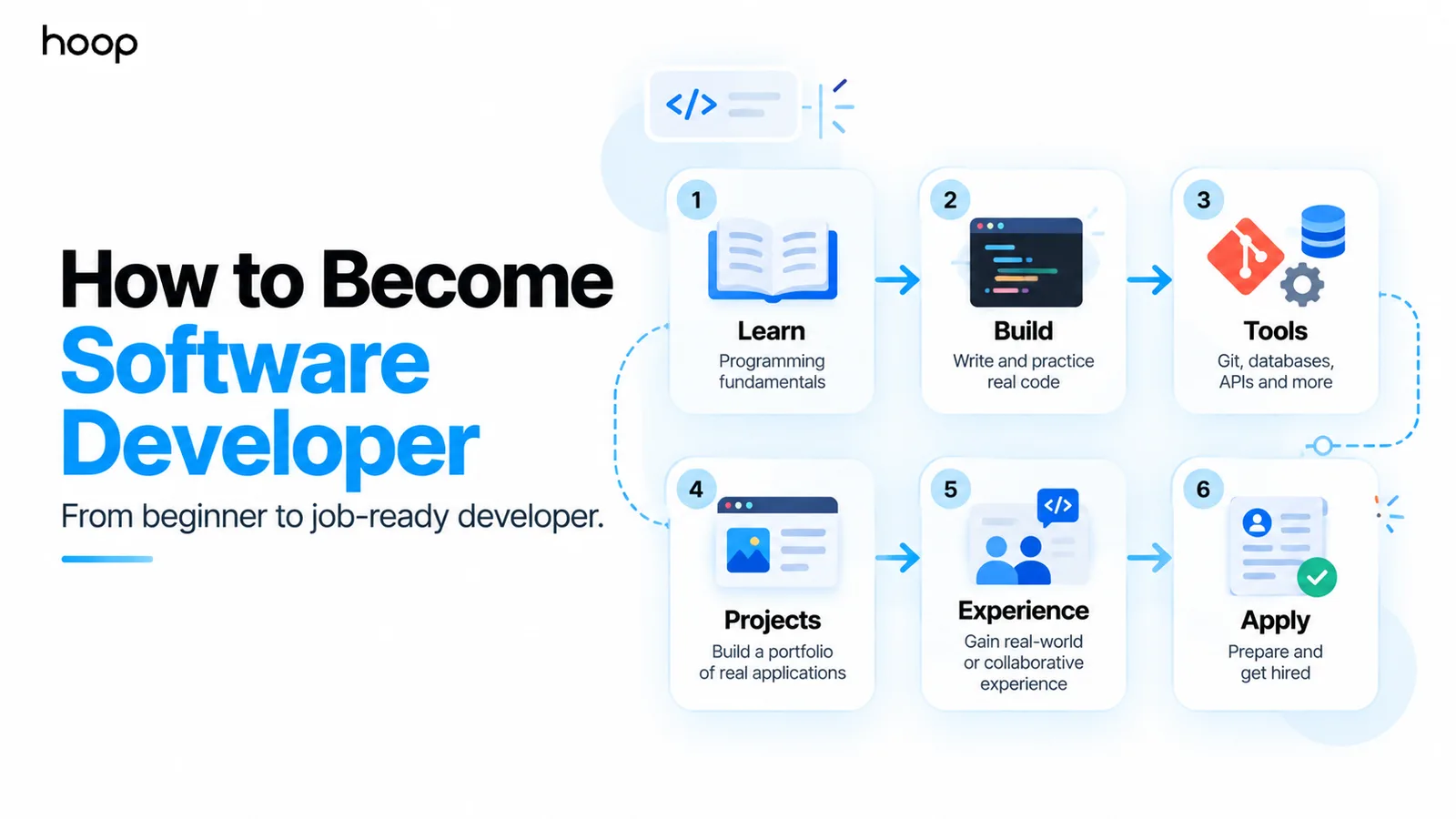
How to Become a Software Developer: A Practical Career Roadmap
Sep 19, 2026 · 10 min read
Agile Methodology in Software Development: How It Actually Works
Sep 17, 2026 · 10 min read