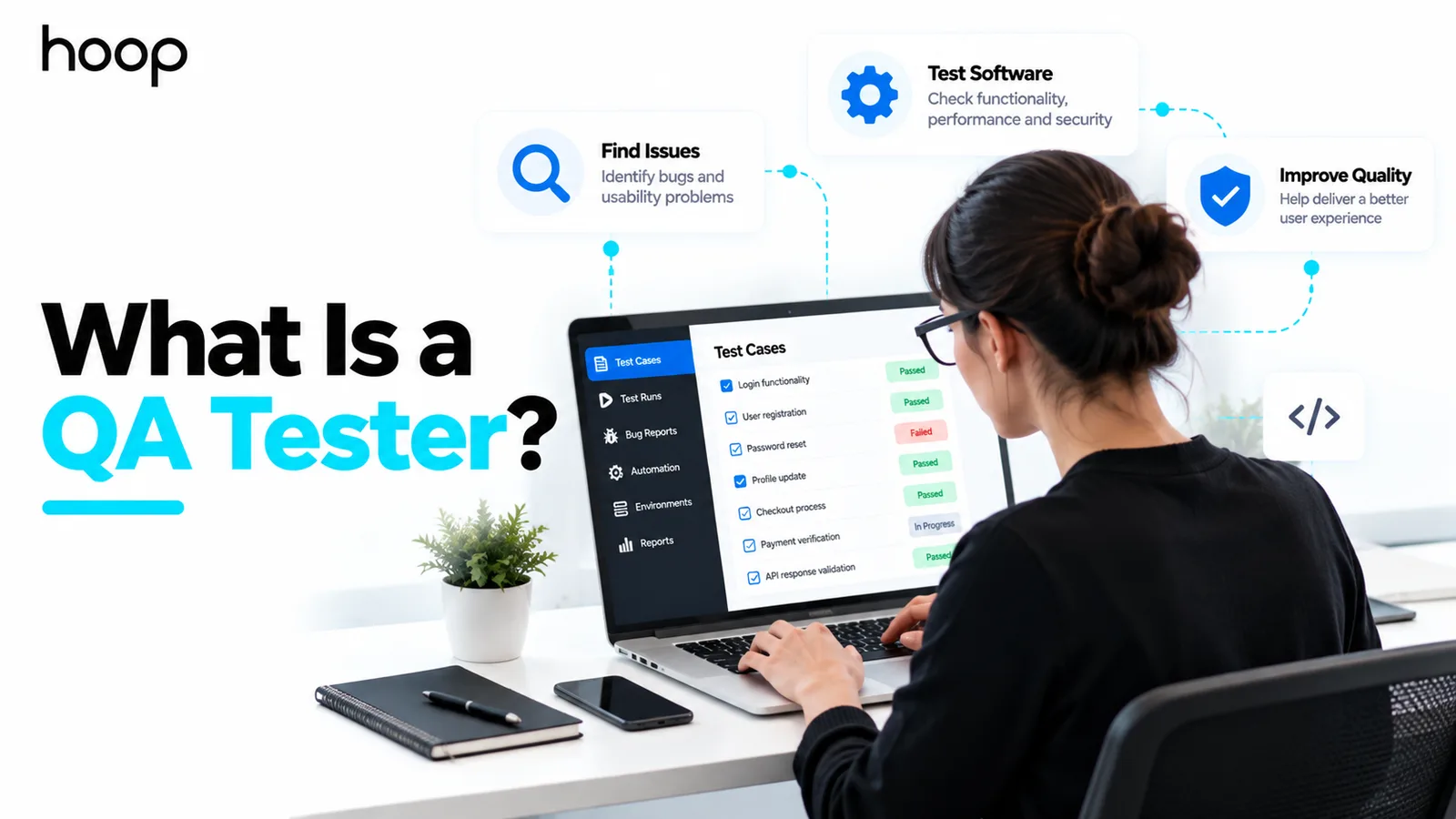
What Is a QA Tester? Role, Responsibilities and Skills Explained
A QA tester evaluates software against expected behavior, investigates the cases where it breaks, and gives the team evidence about release risk. The job is judgment about what to test, not clicking through screens.
Sahar
Content Writer
What is a QA tester? A QA tester checks whether applications behave as expected and identifies risks before users encounter them.
Testers investigate edge cases, reproduce failures, document defects, verify fixes, and provide evidence about release quality.
The role is not limited to clicking through screens. Effective testers study requirements, challenge assumptions, and explore how real users may behave.
Depending on the company, the role may involve manual testing, automation, or a combination of both approaches.
Need this done right?
Hoop builds the strategy, design and development behind sites like this one — talk to us about yours.
What Is a QA Tester and What Do They Do?
A tester evaluates software against expected behavior and looks for situations where that behavior breaks down.
The tester studies requirements, prepares meaningful scenarios, executes tests, investigates failures, and communicates results to the product team.
A good tester also looks beyond the written requirement. They consider unusual data, unexpected workflows, permissions, integrations, and previous defect patterns.
The goal is not simply to find many bugs. The goal is to find important problems and explain their impact clearly.
What Does QA Mean?
QA stands for quality assurance. In software teams, the term often describes the people and activities used to evaluate product quality.
Formally, quality assurance is broader than testing. It can also include process improvement, requirement reviews, standards, and release controls.
In real companies, however, the title QA tester often refers to a professional whose primary responsibility is software testing.
What Is a QA Tester Responsible for Day to Day?
Daily work changes with the product, release cycle, and team structure. A tester may review a story before coding begins.
Later, the tester may prepare data, execute feature tests, inspect browser behavior, check an API, reproduce defects, and verify fixes.
Before a release, the same tester may run regression coverage and summarize known risks for product and engineering leads.
Some days involve structured test cases. Other days involve exploratory investigation after an unexpected failure or customer report.
What Does a QA Tester Actually Test?
The tester compares actual software behavior with expected product behavior. That expectation can come from several sources.
Requirements, user stories, designs, acceptance criteria, API specifications, business rules, and existing product behavior can all define expected results.
Testing may cover functionality, usability, compatibility, accessibility, performance, data handling, permissions, integrations, and error behavior.
The exact mix depends on the product risk and the tester role.
How Does a QA Tester Test Software?
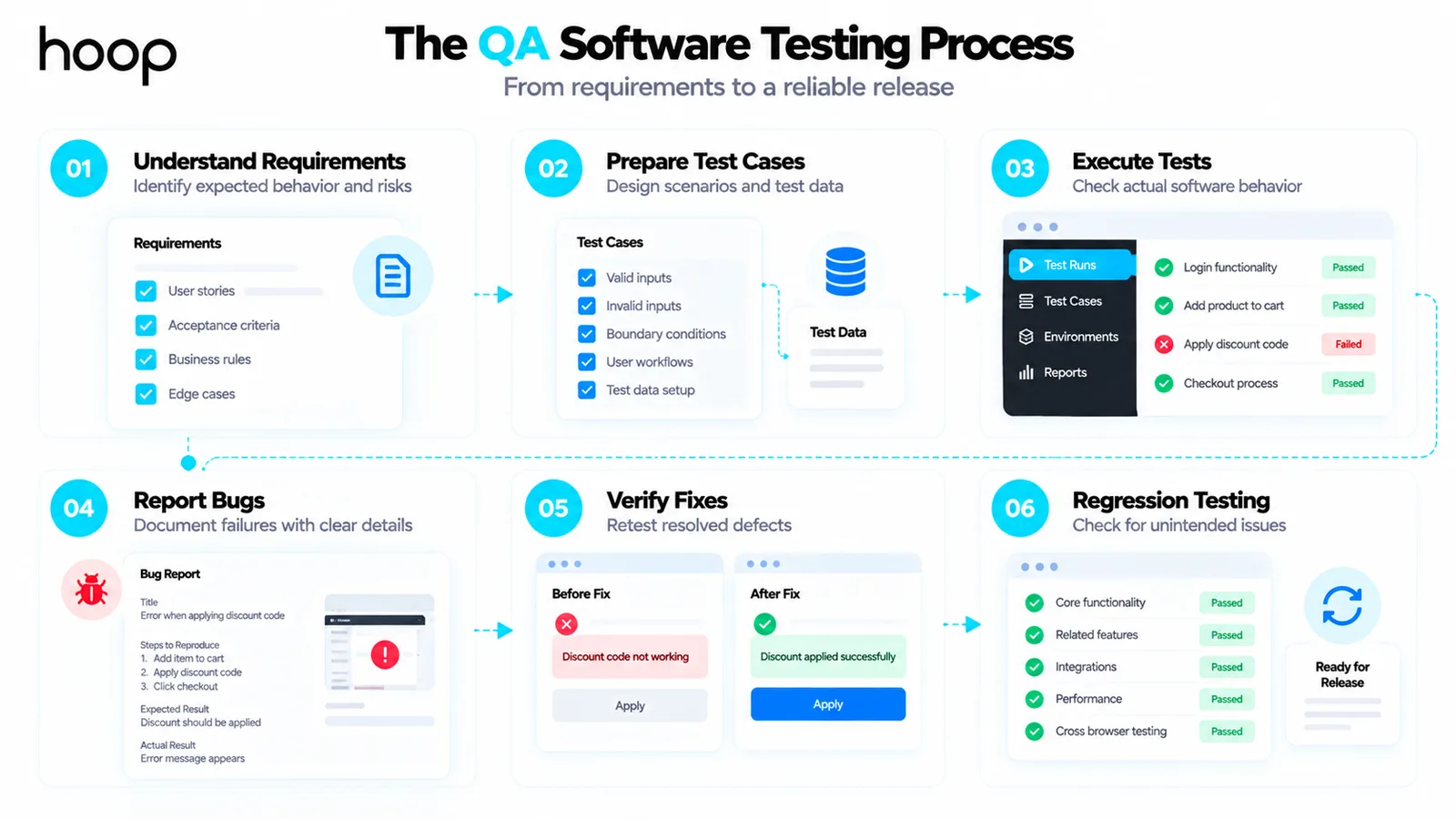
A typical workflow starts with understanding the feature, its users, and its risks. The tester then decides what evidence is needed.
Next, the tester prepares scenarios and test data. They execute expected workflows and deliberately challenge assumptions around those workflows.
When something fails, the tester reproduces the issue and gathers evidence. The defect is then documented for the development team.
After a fix arrives, the tester confirms the original problem is resolved. Related regression checks may follow before release.
What Is Manual QA Testing?
Manual QA testing means a person executes and evaluates test scenarios without relying on an automated script for each check.
Manual testing is especially useful for new features, visual behavior, usability, exploratory work, and situations where requirements remain uncertain.
Professional QA testing services often combine manual exploration with automated regression, API, performance, and accessibility coverage.
Manual testing is not simply a lower-skill version of automation. It relies heavily on observation, product knowledge, curiosity, and judgment.
What Is Exploratory Testing for a QA Tester?
Exploratory testing combines learning, test design, and execution at the same time. The tester follows evidence instead of only following a script.
For example, checkout may work during the standard path. An exploratory tester may refresh during payment or change quantities in another tab.
The tester may also try expired coupons, stale sessions, interrupted networks, unusual navigation, or conflicting account states.
Exploratory testing is valuable because users do not always follow the workflow imagined during development.
Why Do QA Testers Test Failure Paths?
Successful workflows show that the product can work under expected conditions. Failure paths reveal whether it behaves safely when conditions change.
A tester may try missing fields, invalid formats, unsupported values, expired sessions, denied permissions, or unavailable external services.
Boundary conditions also matter. If a field accepts 100 characters, the tester may check 99, 100, 101, zero, and unexpected character types.
These scenarios reveal validation problems, unclear messages, unsafe states, and business rules that normal happy-path testing may miss.
What Makes a Good Bug Report?
A good bug report makes the problem easy to understand and easier to reproduce. The title should describe the visible failure clearly.
The report should explain what happened, what should have happened, and which steps reproduce the problem.
Useful evidence may include environment details, test data, screenshots, videos, console output, logs, or network information.
A strong report also gives impact context. Developers can investigate faster when they understand who is affected and how serious the failure is.
What Happens After a QA Tester Finds a Bug?
First, the tester confirms that the failure can be reproduced. They may narrow the conditions that trigger it before creating the defect.
The developer then investigates and changes the software. When the fix becomes available, the tester checks the original failing scenario again.
That confirmation is often called retesting. The tester may then check related functionality for accidental side effects.
Those broader checks are regression testing. They help confirm that fixing one problem did not create another problem elsewhere.
How Does a QA Tester Decide What to Test First?
Testers cannot test every possible combination. They need to prioritize based on risk and the value of fast feedback.
Critical business workflows usually deserve attention first. Recent changes, fragile integrations, high-severity defect areas, and frequently used features also matter.
A payment failure may deserve more attention than a minor alignment issue. A permissions defect may matter more than a cosmetic admin-page bug.
Risk-based thinking helps testers spend limited testing time where failure would cause the greatest damage.
Do QA Testers Write Test Cases?
Yes, many testers create test cases, but the role is broader than following written scripts.
A test case usually records a condition, actions, expected result, and sometimes required data. It helps make important checks repeatable.
However, a mature tester also recognizes when the product needs investigation outside the documented steps.
Test cases preserve coverage. Tester judgment discovers risks that nobody thought to document yet.
Do QA Testers Need Coding Skills?
Not every QA role requires programming. Manual positions can focus heavily on product behavior, test design, and defect investigation.
Coding knowledge becomes more valuable as the role expands into automated tests, test utilities, data setup, or pipeline integration.
Basic technical literacy is useful even without full programming. Understanding browser tools, HTTP requests, logs, and data formats improves investigation.
A tester who can read simple code or scripts can often collaborate more effectively with developers and automation engineers.
Do QA Testers Use Automation?
Many do, although the amount varies by company. Automation is useful for checks that are stable, repeatable, and needed frequently.
Regression suites, API checks, and repetitive browser workflows are common automation candidates. Automated tests can run on every build or release.
Automation does not decide what quality means. A person still chooses the scenarios, expected outcomes, priorities, and failure conditions.
Strong QA teams use automation to remove repetitive effort while keeping human attention available for exploration and new risks.
Do QA Testers Test APIs and Databases?
Many modern QA roles include API and database work, especially when important behavior cannot be understood from the interface alone.
API testing can verify backend data, permissions, errors, integrations, and business rules without depending on browser screens.
Database queries can confirm whether records were created correctly, statuses changed, or duplicate data appeared after a workflow.
These skills are not required in every role, but they make a tester more effective on complex applications.
QA Tester vs QA Engineer
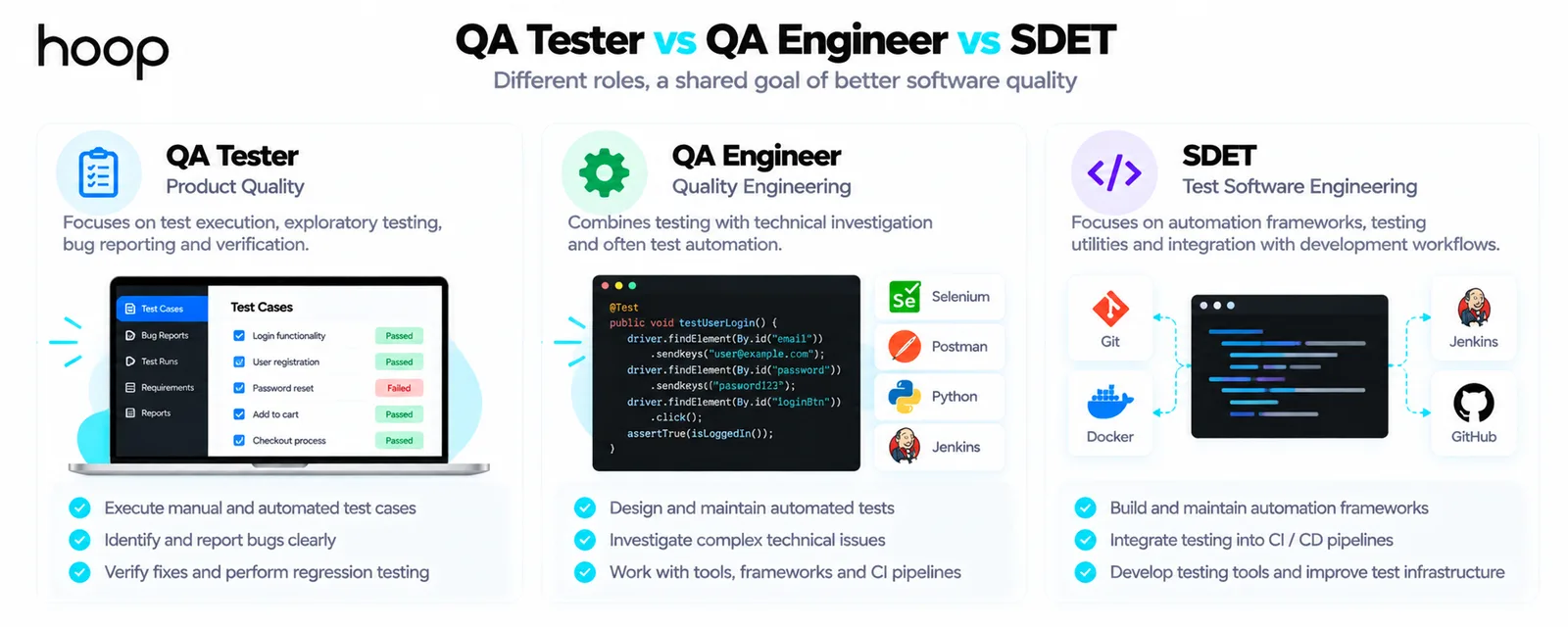
There is no industry-wide rule separating a QA tester from a QA engineer. Companies use both titles in different ways.
Some employers use QA tester for manual execution and QA engineer for automation or broader technical work.
Other organizations give both titles nearly identical responsibilities. Some QA engineers spend most of their time on manual product testing.
The safest approach is to read the responsibilities, tools, and expected ownership rather than relying on the title alone.
QA Tester vs SDET
SDET means Software Development Engineer in Test. The role usually places more emphasis on software engineering applied to testing.
An SDET may build automation frameworks, test utilities, infrastructure, pipeline integrations, and other systems that make testing scalable.
A tester usually spends more time evaluating the product directly, although many people in testing roles also write automation code.
The roles can overlap, but SDET positions generally expect stronger programming and test-engineering depth.
QA Tester vs Developer
Developers primarily build and maintain software. QA testers primarily evaluate product behavior and provide independent evidence about risk.
Both roles test software. Developers commonly write unit tests and implementation-level checks around the code they change.
QA testers often add broader user, business, cross-feature, and failure perspectives that are harder to see from implementation alone.
In strong custom software development teams, QA works inside the development cycle instead of waiting until all coding is complete.
QA Tester vs Software Tester
In many companies, QA tester and software tester mean nearly the same thing. Both titles can describe people who evaluate software behavior.
Some organizations reserve QA for broader process responsibilities, while software tester refers more narrowly to product testing activities.
The distinction is inconsistent across employers. Job descriptions usually reveal more than the label.
What Skills Make a Good QA Tester?
Strong QA work combines testing knowledge with product understanding and communication. The most useful skills reinforce one another.
- Analytical thinking helps testers break features into rules, states, inputs, dependencies, and failure conditions.
- Curiosity encourages investigation beyond the obvious workflow and exposes unexpected product behavior.
- Product knowledge helps testers recognize which failures matter most to users and the business.
- Risk awareness helps prioritize high-impact flows when time and environments are limited.
- Communication helps testers describe defects, questions, and release concerns without ambiguity.
- Defect investigation helps narrow reproduction conditions and provide useful technical evidence.
- Test design helps turn requirements into meaningful scenarios instead of repetitive checklists.
- Technical literacy helps with APIs, databases, browser tools, logs, automation, and delivery pipelines.
What Tools Do QA Testers Use?
The toolset depends on the product. Issue trackers such as Jira are commonly used to manage defects and testing work.
Browser developer tools help inspect network requests, console errors, storage, and page behavior. Postman or similar tools support API investigation.
SQL clients can help verify backend data. Automation work may involve Playwright, Cypress, Selenium, or comparable testing frameworks.
QA testers may also use device platforms, accessibility tools, performance tools, test-management systems, and CI platforms.
Knowing why a tool is useful matters more than collecting a long list of tools without strong testing judgment.
How Do QA Testers Work in Agile Teams?
Agile teams usually involve QA throughout each iteration instead of sending a finished product to a separate test phase.
A QA tester may review stories during refinement, challenge acceptance criteria, prepare data, test during implementation, and automate repeatable checks.
The same person may support defect triage, sprint regression, release readiness, and production follow-up.
Modern software development services often integrate product, development, QA, deployment, and support as one continuous delivery process.
Who Is Responsible for Software Quality?
The whole product team is responsible for quality. A tester provides specialized testing skill, but cannot create quality alone.
Developers influence reliability through design, code, tests, and reviews. Product teams influence quality through clear priorities and requirements.
Designers influence usability and accessibility. Operations teams influence deployment quality, monitoring, resilience, and incident response.
The QA tester brings an independent, risk-focused perspective that helps these responsibilities work together.
Does a QA Tester Approve a Release?
A QA tester can provide evidence about release readiness, but the final release decision usually belongs to the wider organization.
QA may report critical tests, known defects, regression status, environment concerns, and areas that remain unverified.
Product and engineering leaders then consider that evidence alongside deadlines, customer commitments, operational risk, and business priorities.
A mature tester explains the remaining risk clearly rather than claiming that software is completely bug-free.
How Is AI Changing the QA Tester Role?
AI can speed up parts of a QA tester workflow. It can draft test ideas, create sample data, summarize failures, or assist automation.
AI can also help analyze logs and suggest likely relationships between failures. These capabilities can reduce repetitive investigation time.
However, faster test generation does not guarantee better testing. Someone still needs to understand the product, risk, and expected behavior.
QA testers remain valuable when they decide which questions matter and recognize when generated checks miss the real problem.
Common Misconceptions About QA Testers
Several misconceptions make the role look simpler or more isolated than it actually is.
- QA testers only click buttons. The real work is deciding what behavior and risk deserve investigation.
- QA owns every bug. Quality is created by the whole product and engineering process.
- Manual testing requires no technical skill. Strong manual testers use product knowledge, analysis, and investigative tools.
- Developers do not test. Developers commonly test code directly and write automated checks around implementation.
- Automation removes the need for manual testing. Automation covers known repeatable scenarios, while people explore new uncertainty.
- QA tester and SDET always mean the same thing. SDET roles usually place much more emphasis on software engineering.
- Finding more bugs always means better QA. Severity, timing, coverage, and user impact matter more than raw counts.
- QA begins after development finishes. Strong teams involve testing and quality thinking much earlier.
Building Better Software With Strong QA
A skilled tester gives software teams a disciplined way to challenge assumptions before users discover the consequences.
The role combines product knowledge, risk thinking, test design, investigation, communication, and increasingly technical skills.
Strong QA testers do not chase bug counts. They help teams understand where software can fail and which failures matter most.
That evidence supports better fixes, safer releases, and a development process that learns from defects instead of repeating them.
“The goal is not simply to find many bugs. The goal is to find important problems and explain their impact clearly.”
Key takeaways
- 01Risk-based prioritisation matters more than coverage counts — testers cannot test every combination.
- 02Failure paths, boundary values, and permissions reveal more than happy-path checks.
- 03Coding is optional for manual roles but becomes valuable for automation, APIs, and pipelines.
- 04QA provides release evidence; the release decision belongs to product and engineering leadership.
Written by
Sahar
Content Writer
Frequently Asked
Questions
Everything you need to know before booking a strategy call. Can't find your answer? Contact us directly.
Often, yes. Many companies use the terms interchangeably, although some use QA for broader quality responsibilities.
No, not for every role. Programming becomes more valuable when the position includes automation, test utilities, or technical integration work.
Yes. Manual roles still exist, especially where exploratory testing, usability, visual checks, and changing requirements need strong human judgment.
There is no universal distinction. Some companies expect more automation from QA engineers, while others use both titles for similar work.
No tool can automatically understand every product risk or business expectation. AI can assist execution, but human testing judgment still matters.
Keep reading
All articles →
What Is Software Quality Assurance? QA Explained
Oct 12, 2026 · 11 min read
What Is Software Testing? Types, Methods and How It Works
Oct 12, 2026 · 9 min read