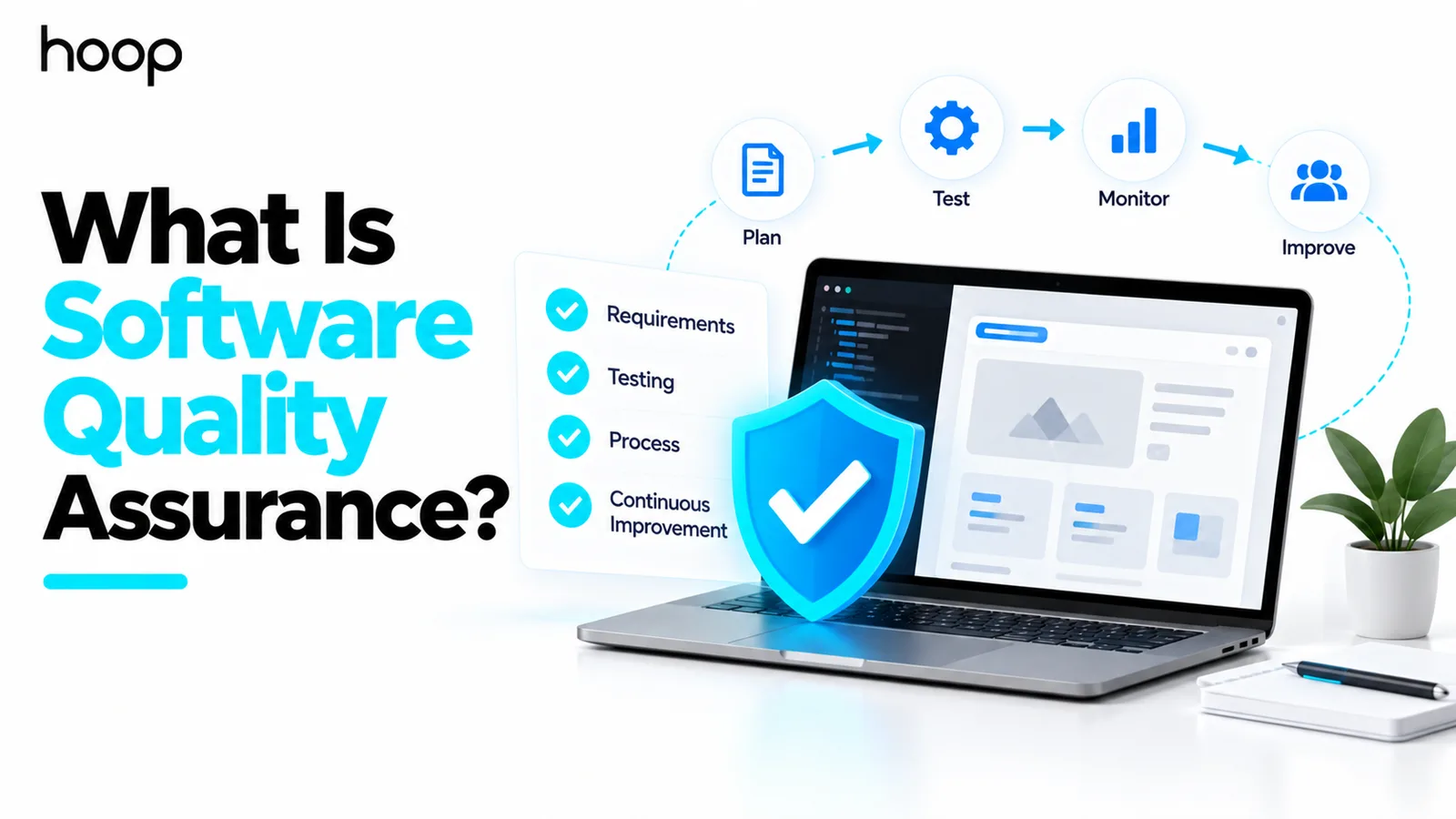
What Is Software Quality Assurance? QA Explained
QA is broader than testing. Testing finds defects in the product; quality assurance improves the process that let those defects exist, from requirements through release and production feedback.
Sahar
Content Writer
Software quality assurance is the practice of building quality into software development through planned reviews, testing, standards, and process improvement.
Its goal is not only to find defects. SQA also reduces the conditions that allow defects to reach users.
Software testing is one part of software quality assurance. QA also examines requirements, workflows, release controls, defect patterns, and production feedback.
Need this done right?
Hoop builds the strategy, design and development behind sites like this one — talk to us about yours.
What Does Software Quality Assurance Mean?
Software Quality Assurance, or SQA, is a structured approach for creating confidence in software quality throughout the development lifecycle.
Teams use SQA to define expectations, identify risks, review work, test behavior, analyze defects, and improve how software is built.
The word assurance matters. The team gathers evidence that its processes and product are likely to meet agreed quality expectations.
That evidence never proves perfection. It helps teams understand remaining risk and make better release decisions.
What Does Software Quality Actually Mean?
Software quality means more than correct buttons, calculations, or screens. A feature can work and still create serious quality problems.
For example, checkout may calculate totals correctly but take 12 seconds. Login may work while exposing another customer’s information.
Quality can include functionality, performance, reliability, security, usability, compatibility, maintainability, and other product characteristics.
The relevant mix depends on the product. A banking system and a marketing website do not carry the same risks.
Why Is Software Quality Assurance Important?
Software defects become more expensive when teams discover them late. A vague requirement is cheaper to fix before development than after release.
SQA moves quality conversations earlier and keeps them active throughout delivery. That reduces avoidable rework and improves release confidence.
A strong QA process also helps teams learn from failures. Repeated defects should trigger questions about requirements, design, reviews, automation, or architecture.
The aim is not simply to close more bug tickets. The aim is to improve the system that produces the software.
Is Software Quality Assurance the Same as Software Testing?
No. Software testing evaluates software behavior and related work products to discover defects and provide information about quality.
Software quality assurance is broader. It also examines the development processes that influence whether good software is produced consistently.
Testing may reveal that users can bypass a permission rule. QA should also ask why that weakness reached testing in the first place.
In real companies, the terms often overlap. Many organizations call their testing function QA even when the daily work focuses mainly on testing.
Software Quality Assurance vs Quality Control
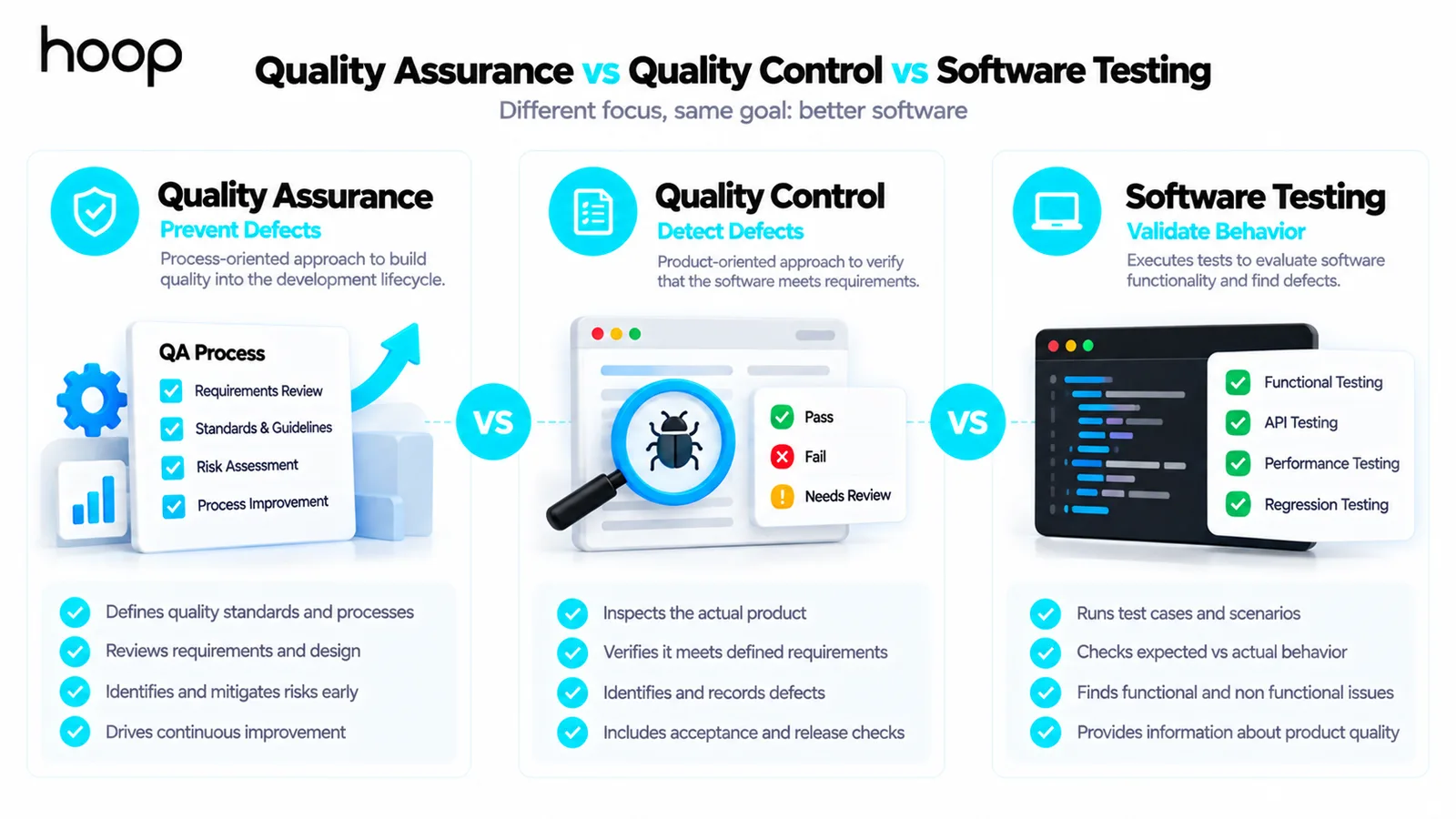
Quality assurance is mainly process-oriented. It asks whether the team uses practices that make acceptable outcomes more likely.
Quality control is mainly product-oriented. It asks whether the actual software meets defined requirements and quality expectations.
Reviews, process standards, and defect-prevention activities fit naturally under QA. Product testing and defect inspection fit more closely under quality control.
Software teams often blend these activities. The distinction is still useful because prevention and detection solve different quality problems.
Software Quality Assurance vs Quality Engineering
Quality Engineering, or QE, usually pushes quality deeper into engineering systems, architecture, automation, pipelines, reliability, and observability.
Traditional QA language places more emphasis on assurance processes, standards, reviews, and validation. Modern software teams often combine both perspectives.
Job titles are not standardized. One QA engineer may focus on manual testing, while another builds automation and CI quality gates.
The responsibilities matter more than the title. Mature teams distribute quality work across engineering, product, testing, and operations.
What Does a Software QA Engineer Do?
A software QA engineer investigates product risk and helps the team gather evidence about quality. The role can be highly technical.
Daily work may include requirement reviews, exploratory testing, API testing, database checks, automation, defect analysis, and release verification.
QA engineers may also inspect logs, browser tools, test data, accessibility behavior, performance results, or CI pipeline failures.
The exact mix depends on the product and team. A mobile app, payment platform, and enterprise system need different QA skills.
When Does Software Quality Assurance Start?
Software quality assurance should start while requirements and risks are being defined. Waiting for a finished feature removes many prevention opportunities.
Before coding, QA can challenge unclear acceptance criteria, missing error behavior, permission rules, data assumptions, and unsupported edge cases.
During development, QA can review changes, prepare data, test unfinished work, and improve automated coverage.
In custom software development, quality works best when it is built into delivery rather than added as a final checkpoint.
How Does the Software QA Process Work?
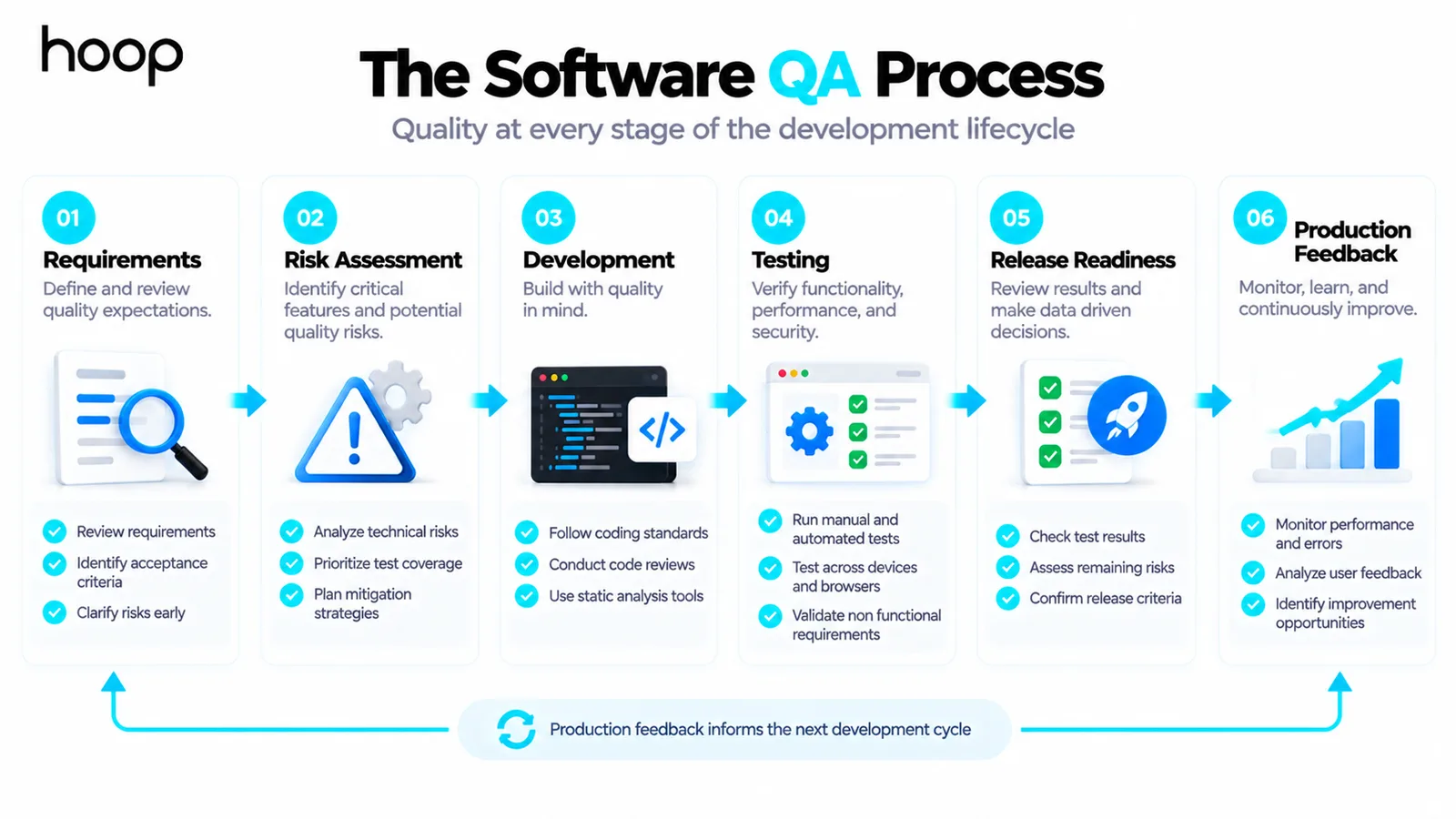
A practical software QA process follows the product from idea to production. The exact workflow changes with product risk and delivery speed.
The team first clarifies requirements and quality expectations. It then identifies risks, chooses suitable checks, and prepares the needed test environments and data.
During implementation, developers and QA run appropriate tests and reviews. Defects are documented with evidence, severity, and enough context for investigation.
Before release, teams review remaining risks and critical checks. After release, production signals feed lessons back into future development and testing.
How Does QA Improve Software Requirements?
Poor requirements create defects before anyone writes code. QA can reduce that risk by challenging language that is vague, incomplete, or untestable.
Consider the requirement, “The dashboard should load quickly.” That statement does not define a measurable expectation.
QA can ask about response time, data volume, device class, network conditions, and expected failure behavior.
Those questions turn assumptions into testable decisions. They also help developers design the right solution before implementation becomes expensive to change.
What Does Software QA Test?
Software QA checks whether important product behavior and quality characteristics meet agreed expectations. Functional correctness is only one part of that work.
A team may examine user flows, APIs, integrations, security rules, performance, accessibility, compatibility, reliability, data handling, and recovery behavior.
The selected coverage should reflect actual product risk. A payment system deserves deeper transaction and authorization checks than a simple brochure site.
Professional QA testing services often combine exploratory work with automated regression, API, performance, accessibility, and cross-platform testing.
What Is a Software QA Strategy?
A QA strategy explains how the team will create enough quality evidence for the product and its risks. It should guide decisions, not create paperwork.
The strategy may define critical user journeys, quality priorities, test levels, environments, automation goals, ownership, release gates, and production feedback.
A small product may need a lightweight strategy. A regulated or high-risk system may need stronger traceability and formal evidence.
The best strategy connects testing effort to business and technical risk instead of treating every feature as equally important.
Why Do Test Environments and Test Data Matter in SQA?
Software quality assurance depends on realistic, controlled conditions for testing. Poor environments can hide defects or create false failures.
A staging system should resemble production closely enough for important risks. Differences in services, permissions, versions, or configuration can change behavior.
Test data matters for the same reason. Teams need valid, invalid, boundary, permission-based, and high-volume data for meaningful quality evidence.
Sensitive production data should not be copied carelessly into test systems. Teams can use masked, synthetic, or purpose-built data instead.
Environment and data problems can make reliable testing impossible. SQA should treat them as quality infrastructure, not as minor setup details.
What Is Risk-Based QA?
Risk-based QA prioritizes quality work based on the likelihood and impact of failure. Teams spend more effort where defects would hurt most.
An ecommerce team may prioritize checkout, payments, pricing, inventory, and account security over minor internal settings.
A healthcare platform may prioritize patient data, access controls, calculations, and auditability. A SaaS product may prioritize tenant isolation and billing.
This approach does not mean ignoring low-risk areas. It means using limited time where additional evidence provides the greatest value.
What Is Root Cause Analysis in Software QA?
Root cause analysis looks beyond the immediate defect and asks what underlying condition allowed it to happen or escape.
Suppose every sprint produces permission bugs. Logging each defect treats the symptom but may not improve the system.
The team could examine unclear requirements, duplicated authorization logic, missing code review checks, or gaps in automated tests.
Fixing the underlying cause can prevent entire classes of future defects. That makes QA a learning process rather than a bug-counting function.
Who Is Responsible for Software Quality?
Software quality is a whole-team responsibility. A QA engineer can guide quality work but cannot create quality alone after development ends.
Developers contribute through unit tests, code reviews, secure coding, and maintainable design. Product teams contribute clear rules and acceptance criteria.
QA contributes risk thinking, testing depth, investigation, and quality feedback. Operations contributes monitoring, reliability data, and incident learning.
Quality improves when those responsibilities connect. Handing a finished product to QA at the end weakens that feedback loop.
How Does Software QA Work in Agile?
Agile moves QA activities inside each iteration instead of saving them for one large testing phase near the end.
QA can join refinement, clarify acceptance criteria, identify risks, prepare scenarios, test during implementation, and support release decisions.
Developers receive feedback while the change is still fresh. Product owners can resolve unclear behavior before the sprint closes.
The approach supports shorter feedback loops without lowering quality expectations. It simply changes when quality work happens.
How Does Software QA Work in DevOps?
DevOps extends quality work across build, integration, delivery, deployment, and production feedback. Automated evidence becomes part of the delivery system.
A Cloud and DevOps workflow can run unit, integration, security, API, and regression checks before a change moves toward production.
Teams can also validate deployments, monitor production behavior, and use incidents to improve future tests and release controls.
This creates continuous quality feedback instead of a separate QA stage that begins only after development finishes.
Does QA Include Test Automation?
Yes, test automation can support software quality assurance, but automation does not equal QA. Automation executes repeatable checks efficiently.
Teams can automate unit tests, API checks, regression suites, static analysis, security scans, performance checks, and deployment verification.
Humans still decide what quality means, which risks matter, whether requirements are sensible, and whether failures deserve investigation.
Automation is most valuable when it removes repetitive work while preserving meaningful human judgment for uncertain or exploratory problems.
What Are Quality Gates?
Quality gates are conditions a change must satisfy before it can move to another delivery stage. They turn known expectations into enforceable checks.
A team might block a merge when unit tests fail, a critical security finding appears, or required review is missing.
Other gates may check regression results, performance thresholds, build health, or release acceptance criteria.
Quality gates work best when each gate protects a meaningful risk. Too many noisy gates can slow delivery without improving confidence.
How Does QA Support Release Readiness?
QA supports release readiness by summarizing what was tested, what failed, what remains unknown, and which risks still exist.
A release decision should consider defect severity, critical-flow results, recent changes, environment differences, monitoring plans, and rollback options.
QA should not act as the only person who approves release. Product, engineering, operations, security, and business owners may share that decision.
Good release evidence makes tradeoffs visible. The team can release with known limitations when the remaining risk is understood and accepted.
This turns software quality assurance into a decision-support function rather than a simple pass-or-fail checkpoint.
How Do Teams Measure Software Quality?
Software quality cannot be reduced to one number. Useful metrics should help teams understand product risk, process health, and release outcomes.
Examples include escaped defects, severity patterns, regression frequency, failed releases, detection time, resolution time, flaky tests, and critical-flow coverage.
Raw bug counts can be misleading. Forty cosmetic defects may matter less than one authorization flaw exposing customer data.
Metrics should support decisions and improvement. They should not reward teams for creating larger test counts or reporting more defects.
Does QA Guarantee Bug-Free Software?
No. Software quality assurance cannot prove that a product contains zero defects. Modern software has too many possible states and interactions.
QA reduces uncertainty by gathering evidence about important risks. Teams then decide whether the remaining risk is acceptable for release.
That is a stronger goal than claiming perfection. It encourages transparent decisions about known limitations, unresolved defects, and coverage gaps.
Does Software QA Continue After Release?
Yes. Production reveals conditions that test environments cannot reproduce perfectly. Real traffic and user behavior provide important quality evidence.
Teams can monitor crashes, errors, latency, failed transactions, support tickets, incidents, and unexpected usage patterns.
That information should influence future requirements, tests, automation, and risk priorities. Production feedback closes the quality loop.
A release is therefore not the end of QA. It is another source of evidence about how the software behaves in reality.
How Is AI Changing Software Quality Assurance?
AI can speed up test drafting, data generation, defect analysis, log review, automation maintenance, and coverage suggestions.
Those capabilities can reduce repetitive work and help teams explore more scenarios. They do not remove the need for quality judgment.
People still need to decide whether a requirement is correct and which risks matter. They also judge whether AI-generated tests check meaningful behavior.
AI changes the speed of QA work. It does not define what acceptable product quality should mean.
What Are the Benefits of Software Quality Assurance?
Software quality assurance creates value when it improves both product evidence and the process used to create that product.
- Earlier detection of unclear requirements, risky assumptions, and design problems.
- Lower rework by finding problems before they spread across implementation and release stages.
- Better release confidence through evidence tied to real product and business risks.
- More consistent testing, review, automation, and defect-handling practices across the team.
- Fewer repeated defects when root causes lead to process or engineering improvements.
- Stronger feedback between development, testing, operations, and production behavior.
Common Software QA Mistakes
- Treating QA as a final testing phase after development is already complete.
- Making one QA engineer responsible for quality while other roles ignore quality risks.
- Testing only happy paths and overlooking failures, permissions, boundaries, and unusual states.
- Equating automation volume with product quality or meaningful test coverage.
- Accepting vague requirements that cannot be measured or tested consistently.
- Judging QA success only by the number of bugs or test cases created.
- Ignoring production incidents instead of using them to improve future quality work.
- Fixing recurring defects without investigating the process or design conditions behind them.
Build Quality Into the Software Lifecycle
Software quality assurance works best when quality decisions begin before coding and continue after release. Testing remains essential but is not the whole discipline.
Strong software quality assurance connects requirements, engineering practices, reviews, automation, risk analysis, release controls, and production feedback.
The result is not bug-free software. The result is better evidence, earlier learning, and a repeatable process for managing software quality.
“Testing may reveal that users can bypass a permission rule. QA should also ask why that weakness reached testing in the first place.”
Key takeaways
- 01QA is process-oriented and preventive; quality control is product-oriented and detective.
- 02Vague requirements produce defects before any code is written — challenging them is QA work.
- 03Risk-based prioritisation beats uniform coverage: forty cosmetic bugs matter less than one authorization flaw.
- 04QA cannot guarantee bug-free software. It produces evidence so release risk is understood, not hidden.
Written by
Sahar
Content Writer
Frequently Asked
Questions
Everything you need to know before booking a strategy call. Can't find your answer? Contact us directly.
No. Testing evaluates software behavior, while software quality assurance also improves the processes used to create and maintain the product.
The main goal is confidence that software meets important quality expectations. QA also reduces preventable defects and unmanaged release risk.
Quality is a whole-team responsibility. QA specialists lead many activities, while developers, product teams, security, and operations also contribute.
No. Job titles vary widely. Some companies separate QA and quality engineering, while others combine testing, automation, and engineering responsibilities.
No. AI can accelerate many QA tasks, but people still need domain knowledge, risk judgment, investigation skills, and product context.
Keep reading
All articles →
What Is Software Testing? Types, Methods and How It Works
Oct 12, 2026 · 9 min read
What Is Regression Testing? How It Prevents Old Features From Breaking
Oct 12, 2026 · 10 min read