What Is DevOps? How Development and Operations Work Together
DevOps removes the wall between the people who write software and the people who run it. Shared ownership, automation, CI/CD, infrastructure as code, and monitoring turn delivery into one continuous feedback loop.
Sahar
Content Writer
DevOps is an approach to software delivery where development and operations work together across the entire lifecycle. Teams use shared ownership, automation, CI/CD, Infrastructure as Code, and monitoring to release changes faster without sacrificing reliability.
DevOps is not one tool, one job title, or another name for cloud computing. It is a way to connect planning, coding, testing, deployment, operations, and feedback into one continuous system.
Need this done right?
Hoop builds the strategy, design and development behind sites like this one — talk to us about yours.
What Does DevOps Mean?
DevOps combines development and operations. The name is simple, but the idea goes beyond putting two teams in the same meeting.
A DevOps model reduces handoffs between people who write software and people who run it. Developers gain more awareness of production. Operations teams become involved earlier in delivery decisions.
The result is a shorter feedback loop. A change can move from code to testing, deployment, monitoring, and improvement through repeatable processes.
Why Was DevOps Created?
Traditional software teams often separated development from operations. Developers built features, then handed releases to another team for deployment and production support.
That separation created friction. A release might work in development but fail after deployment. Operations could receive changes without enough context. Developers might discover production problems too late.
DevOps reduces that wall. It encourages shared responsibility for how software behaves after release, not only how it behaves during development.
The goal is not to remove specialists. The goal is to make delivery, infrastructure, and production feedback part of the same engineering process.
How Does DevOps Work?
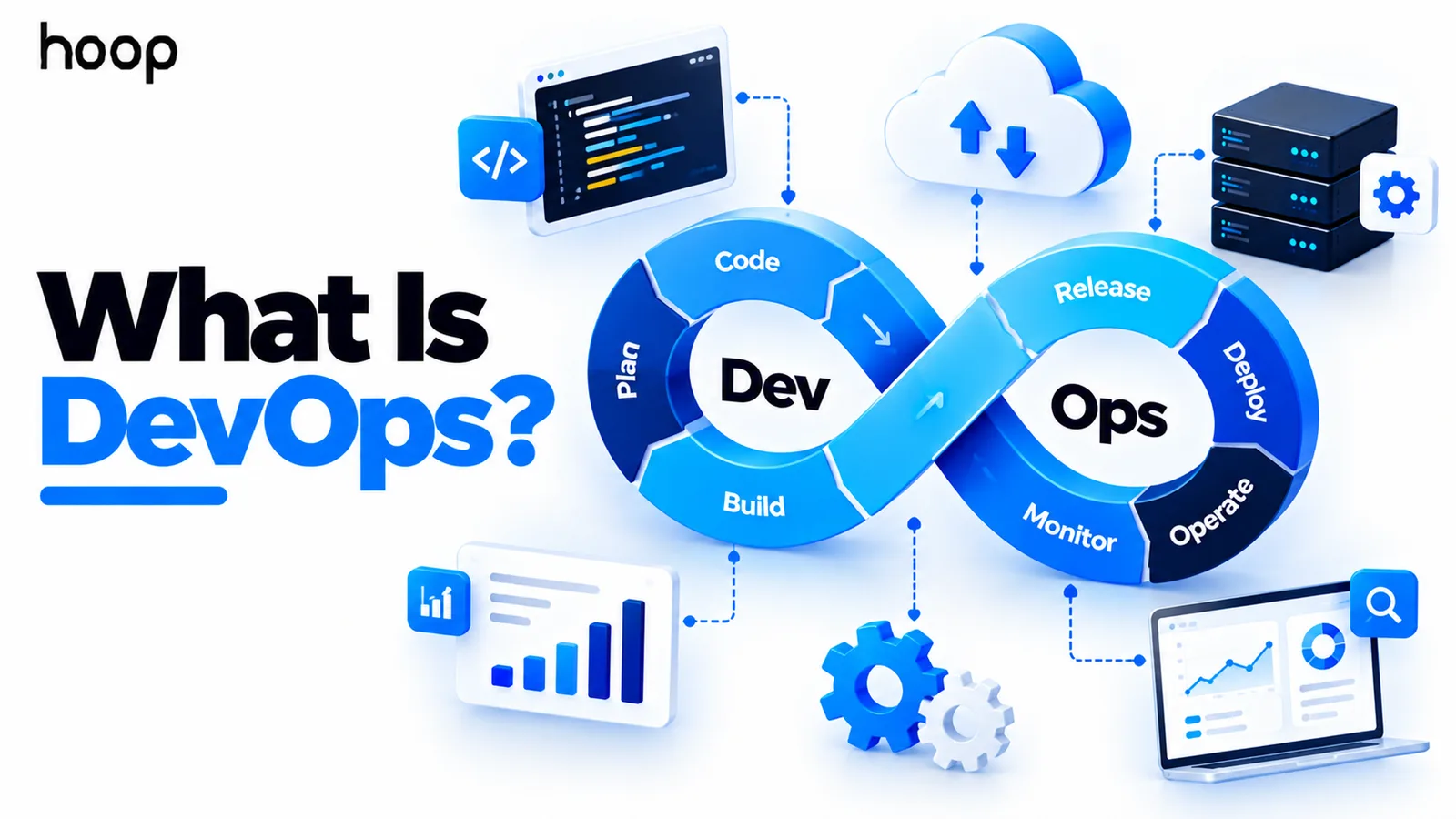
A DevOps workflow is continuous rather than a one-time release event. Teams plan work, write code, test changes, deploy them, operate systems, and learn from production behavior.
A typical cycle looks like this: Plan, Code, Build, Test, Release, Deploy, Operate, Monitor, and Improve. Each stage produces information for the next one.
Automation helps reduce slow manual steps. Version control records changes. CI/CD pipelines test and move code. Monitoring shows what happens after release.
The cycle then repeats. Production becomes a source of engineering feedback instead of a separate environment that developers rarely see.
What Is DevOps in a Simple Real-World Example?
Imagine a team adding a new checkout feature to an online product. The change should move through one repeatable delivery path.
A developer writes the feature and opens a code change. Automated checks build the application, run tests, and flag obvious security or quality problems.
After approval, the same pipeline can deploy the change to a staging environment. The team tests it with production-like settings before release.
Production deployment then uses the same controlled process. Monitoring watches errors, response times, resource usage, and customer behavior after the release.
If something fails, the team can roll back, diagnose the problem, and improve the pipeline. That loop explains DevOps better than any tool list.
What Does a DevOps Engineer Actually Do?
A DevOps engineer usually builds and maintains the systems that help software move safely from development to production. Exact responsibilities vary between companies.
One team may focus on CI/CD pipelines and cloud infrastructure. Another may spend more time on containers, observability, security controls, release automation, or developer tooling.
DevOps engineers often write scripts and configuration code. They also debug failed deployments, improve infrastructure, reduce repetitive work, and help teams recover from incidents.
At Hoop Interactive, our Cloud and DevOps services connect delivery pipelines, infrastructure automation, monitoring, security, and deployment engineering.
Is DevOps a Job, Team, or Culture?
DevOps is primarily an operating approach, but companies also use DevOps as a job title and team name. That creates understandable confusion.
A DevOps culture emphasizes collaboration, shared ownership, fast feedback, and continuous improvement. A DevOps engineer implements technical practices that support those goals.
Some organizations create dedicated DevOps teams. Others distribute responsibilities across development, platform, operations, security, and site reliability teams.
There is no universal organization chart. What matters is whether software can move from idea to production through a reliable, measurable process.
What Is DevOps Culture?
DevOps culture is the set of working habits that supports shared ownership, fast feedback, learning, and reliable delivery across technical teams.
Culture does not mean removing accountability. It means teams avoid throwing problems across a wall after code, infrastructure, security, or deployment changes.
Blameless incident reviews are one example. The team studies how the system failed, improves safeguards, and avoids treating one person as the entire explanation.
Documentation, visible metrics, shared runbooks, and clear ownership also support DevOps culture. They make operational knowledge easier to use during normal work and incidents.
What Are the Main DevOps Practices?
DevOps practices are the repeatable techniques that turn collaboration into an operating system for software delivery. Most mature workflows combine several practices rather than relying on one.
Continuous Integration and Delivery
Continuous Integration helps teams merge code frequently and test it automatically. Continuous Delivery moves tested changes through a repeatable release process.
Infrastructure as Code
Infrastructure as Code defines infrastructure through version-controlled files instead of relying only on manual setup. This makes environments easier to reproduce and review.
Automation
Automation removes repetitive work from builds, tests, deployments, environment setup, and routine operational tasks. It also reduces inconsistency between people and environments.
Monitoring and Observability
Monitoring shows whether services are healthy. Observability helps teams understand why a complex system behaves a certain way when problems appear.
Shared Responsibility
Developers and operations specialists share more context about releases and production behavior. Ownership does not stop when code is merged.
What Is CI/CD in DevOps?
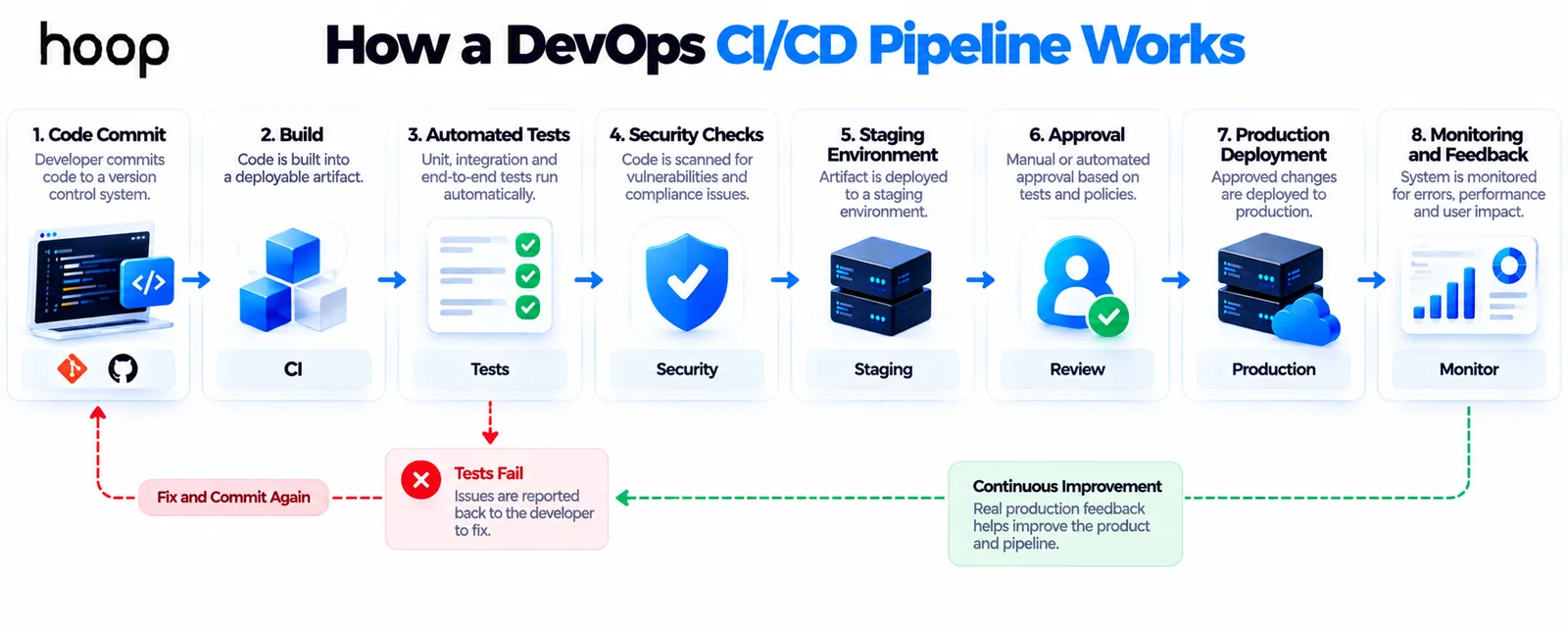
CI/CD stands for Continuous Integration and Continuous Delivery or Continuous Deployment. It is one of the most visible DevOps practices.
Continuous Integration answers a basic question quickly: did this code change break something? Each change can trigger builds, automated tests, static checks, or security checks.
Continuous Delivery prepares validated changes for release through a repeatable pipeline. Continuous Deployment can push qualifying changes into production automatically.
The point is not to deploy constantly for its own sake. The point is to make releases smaller, safer, easier to repeat, and easier to reverse.
What Is Infrastructure as Code in DevOps?
Infrastructure as Code, or IaC, means defining infrastructure in machine-readable configuration rather than configuring every resource manually.
Teams can describe networks, servers, load balancers, databases, permissions, and other resources in files stored with version history.
That makes infrastructure changes easier to review, test, reproduce, and rebuild. It also reduces configuration drift between development, staging, and production.
A well-designed cloud infrastructure setup can use IaC to make environments repeatable while improving security, resilience, and recovery planning.
What Tools Do DevOps Teams Use?
DevOps teams use many tools, but the tools do not define DevOps. The right toolset depends on application architecture, team size, deployment model, and operational needs.
Common categories include source control, CI/CD platforms, Infrastructure as Code, containers, cloud services, secrets management, monitoring, and incident tools.
A small product may use GitHub Actions, managed cloud services, and basic monitoring. A larger platform may add Terraform, Kubernetes, centralized observability, and policy automation.
Good teams choose the simplest toolchain that produces dependable delivery. Adding more tools without a clear problem can create another layer of operational work.
Does DevOps Require Cloud Computing?
No. DevOps can work with public cloud, private cloud, hybrid systems, or on-premises infrastructure.
Cloud platforms make automation easier because infrastructure can be created through APIs and code. That is why modern DevOps and cloud engineering often appear together.
The underlying DevOps ideas still apply without public cloud. Teams can automate testing, deployment, configuration, monitoring, and feedback on their own infrastructure.
Does DevOps Require Docker or Kubernetes?
No. Containers and Kubernetes can support DevOps workflows, but neither technology is a requirement.
A small application may deploy reliably without containers. A larger distributed system may benefit from container orchestration because it has more services and scaling demands.
The architecture should determine the tools. Choosing Kubernetes first and inventing a problem later usually adds complexity without improving delivery.
DevOps vs System Administration
System administration and DevOps overlap, but they usually emphasize different work. Traditional system administration focuses heavily on keeping infrastructure and operating systems healthy.
DevOps engineering applies more software-engineering and automation practices to infrastructure, releases, environments, and operational workflows.
The boundary is not universal. Many experienced system administrators already automate infrastructure, while many DevOps roles include familiar systems work.
The clearest distinction is the delivery context. DevOps connects infrastructure work directly to how software is built, released, measured, and improved.
DevOps vs Agile
Agile and DevOps solve related problems at different parts of the lifecycle. Agile mainly improves how teams plan, build, review, and adapt software work.
DevOps extends that feedback mindset through delivery and production operations. It asks how changes move safely into real environments and stay reliable after release.
Teams can use Agile and DevOps together. Agile can improve development flow while DevOps improves the path from development to production.
DevOps vs SRE
Site Reliability Engineering, or SRE, focuses on operating reliable services through engineering methods. It often uses service objectives, incident processes, automation, and reliability metrics.
DevOps is broader. It describes collaboration and continuous software delivery across development and operations.
SRE can be one practical way to implement the reliability side of DevOps. Many organizations use both approaches together.
DevOps vs Platform Engineering
Platform engineering builds reusable internal platforms that make software delivery easier for development teams. It has become an important companion to DevOps.
For example, a platform team might provide approved deployment templates, environments, service catalogs, observability defaults, or self-service infrastructure.
DevOps describes the desired delivery model. Platform engineering creates internal products that make that model easier to use consistently at scale.
What Is DevSecOps?
DevSecOps brings security into the same software delivery lifecycle. Security checks should not wait until the final stage before release.
Teams can add dependency scanning, secret detection, access controls, infrastructure policies, code checks, and security testing inside delivery workflows.
The objective is shared security responsibility. Developers, security specialists, and operations teams receive earlier feedback instead of relying on a late handoff.
What Are the Benefits of DevOps?
DevOps is valuable when it improves both delivery speed and production confidence. The benefits come from better systems and feedback, not from adopting a fashionable toolchain.
- Faster, smaller releases that are easier to test and recover.
- More repeatable deployments with fewer manual differences between environments.
- Earlier detection of defects through automated checks and production monitoring.
- Clearer collaboration between development, operations, security, and platform teams.
- Faster recovery because teams have better logs, metrics, runbooks, and ownership.
What Are the Challenges of DevOps?
DevOps can fail when an organization changes tools without changing incentives, ownership, or workflow. Automation cannot repair unclear responsibilities by itself.
- Tool overload can create complexity instead of reducing it.
- Legacy systems may be difficult to automate or deploy frequently.
- Teams can resist shared ownership when responsibilities are unclear.
- Weak testing can make faster deployment produce failures faster.
- Poor monitoring leaves teams unable to understand production behavior.
- Security and compliance requirements may require stronger controls around automation.
How Do You Measure DevOps Performance?
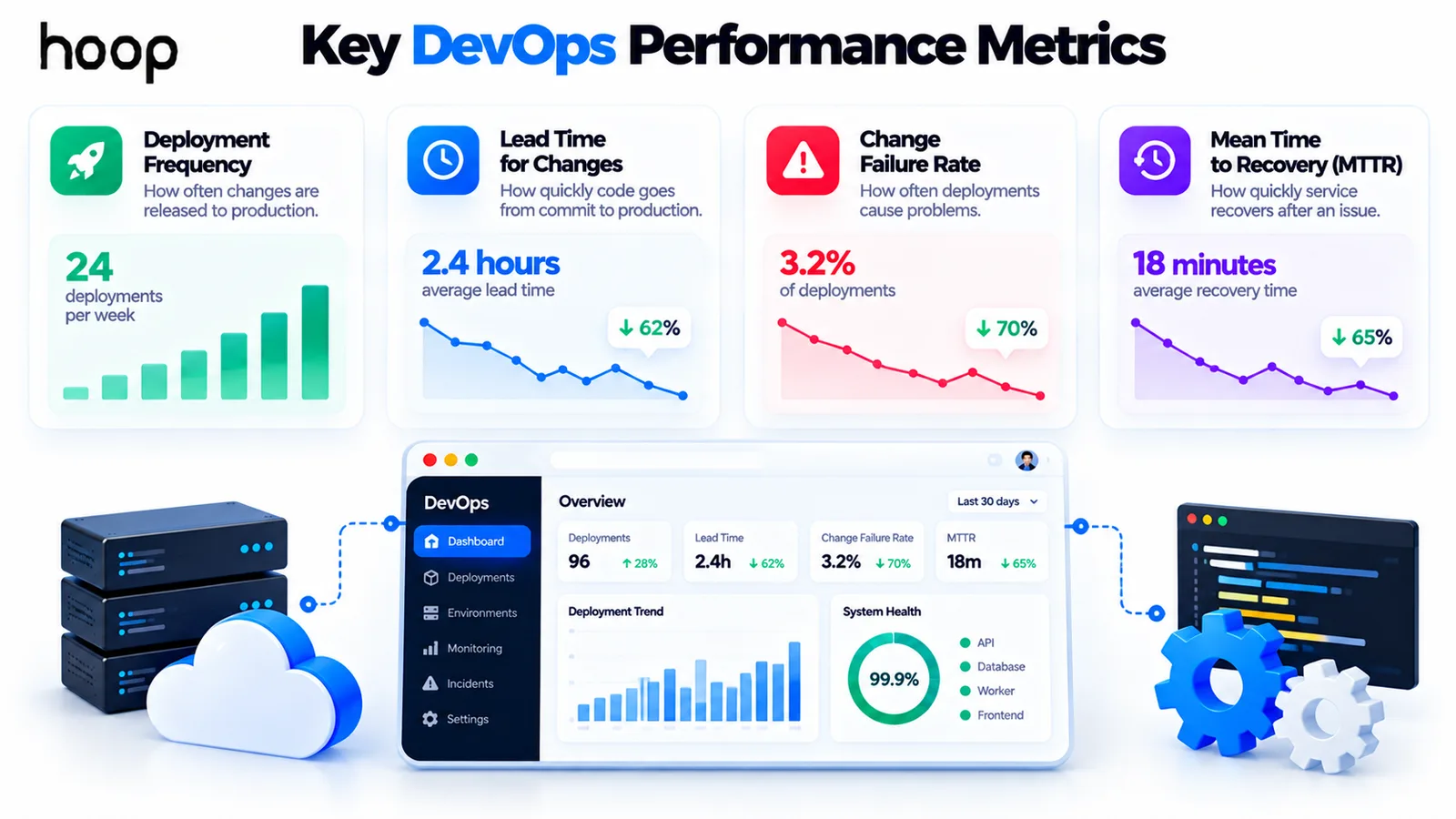
Teams need metrics that reflect both speed and stability. Measuring only deployment volume can reward risky behavior.
DORA metrics are commonly used to evaluate software delivery. Deployment frequency measures release cadence. Lead time measures how quickly changes reach production.
Change failure rate measures how often releases create production problems. Recovery time measures how quickly service returns after a failure.
Useful teams combine these delivery metrics with product, reliability, cost, and customer measures. The objective is better outcomes, not better dashboards.
How Is AI Changing DevOps?
AI can assist with code review, test generation, configuration, incident analysis, documentation, and troubleshooting. It can also increase the volume of software changes teams produce.
That makes delivery discipline more important, not less important. Faster code generation still needs testing, security checks, reliable deployment, and production visibility.
AI works best inside a strong delivery system. Weak processes can simply create mistakes faster when automated intelligence is added.
What Is DevOps for a Small Team?
For a startup or small product team it usually means a simple delivery system with fewer manual steps and clearer production ownership.
A small team may need only version control, automated tests, one deployment pipeline, infrastructure backups, error tracking, and basic monitoring.
The team does not need an expensive platform or a dedicated DevOps department. One engineer may own the initial setup while developers share operational awareness.
As the product grows, the team can add observability, Infrastructure as Code, release controls, incident processes, and platform expertise.
When Does a Business Need DevOps?
A business benefits from DevOps when software releases become frequent enough that manual delivery creates delays, mistakes, or operational risk.
The need becomes clearer with multiple environments, cloud resources, frequent releases, growing traffic, or several developers working on one product.
DevOps also becomes valuable when incidents take too long to diagnose. It also helps when deployments depend on undocumented steps.
For teams building modern services, cloud application development works best when application delivery and infrastructure are designed together.
Build a Delivery System, Not Just a Toolchain
DevOps works when software delivery becomes a shared engineering system rather than a chain of disconnected handoffs. The goal is faster feedback with reliable production outcomes.
Start with the bottleneck that hurts delivery most. That might be manual deployment, inconsistent infrastructure, weak testing, poor monitoring, or unclear ownership.
Then improve the workflow step by step. The tools can change over time. The core objective remains the same: ship useful software safely and learn from production quickly.
“Start with the bottleneck that hurts delivery most. That might be manual deployment, inconsistent infrastructure, weak testing, poor monitoring, or unclear ownership.”
Key takeaways
- 01It is an operating approach first; the job title and the team name came later.
- 02No cloud, Docker, or Kubernetes is required — architecture should pick the tools, not fashion.
- 03Measure with DORA: deployment frequency, lead time, change failure rate, and recovery time.
- 04Faster delivery on top of weak testing and monitoring just produces failures faster.
Written by
Sahar
Content Writer
Frequently Asked
Questions
Everything you need to know before booking a strategy call. Can't find your answer? Contact us directly.
No. DevOps engineers may write scripts and configuration code, but the work also includes infrastructure, deployment, monitoring, security, and operational design.
Yes. Developers can move into DevOps by learning Linux, networking, cloud infrastructure, CI/CD, automation, observability, and production operations.
No. Kubernetes is useful for some systems, but many DevOps roles work with simpler managed infrastructure or different deployment platforms.
No. Small teams also benefit from automated tests, repeatable deployments, monitoring, backups, and clear release processes. The implementation can stay simple.
No. Cloud engineering focuses on cloud infrastructure and services. DevOps focuses on the broader process of building, delivering, running, and improving software.
Keep reading
All articles →
What Is CI/CD? Continuous Integration and Delivery Explained
Oct 12, 2026 · 10 min read
What Is Azure DevOps? Microsoft’s DevOps Platform Explained
Oct 12, 2026 · 10 min read