

What Is SRE? Site Reliability Engineering Explained
SRE applies software engineering to running production. Reliability becomes a measured target through SLIs, SLOs, and error budgets, and repetitive operational work becomes something to automate away.
Sahar
Content Writer
Site Reliability Engineering, or SRE, is an engineering approach to keeping production software reliable, scalable, and performant. SRE teams measure reliability, automate operations, and improve systems after failures.
An SRE is not simply someone who watches dashboards or responds to outages. Healthy SRE work reduces recurring operational problems through software, automation, and better system design.
Need this done right?
Hoop builds the strategy, design and development behind sites like this one — talk to us about yours.
What Does SRE Mean?
SRE stands for Site Reliability Engineering. The discipline applies software engineering methods to the work of running production systems.
Traditional operations can depend heavily on manual procedures. SRE asks whether code, automation, or better architecture can perform that work more safely.
The goal is reliable service without turning growth into endless manual operations. Reliability must remain measurable as traffic, teams, and product complexity increase.
Why Was Site Reliability Engineering Created?
Large online services create operational work faster than people can handle manually. More servers, deployments, incidents, and dependencies create more chances for failure.
Hiring more operators can help for a while. It does not solve the deeper scaling problem when repetitive work grows with every new service.
SRE addresses that problem by treating production operations as an engineering system. Repetitive work becomes a candidate for automation, redesign, or removal.
What Does an SRE Actually Do?
An SRE studies how production behaves and then improves the systems around that behavior. Daily work varies because companies organize reliability differently.
An SRE may investigate unusual latency, improve alerts, automate recovery, review capacity, support releases, or design safer infrastructure. The common goal is dependable production.
When an incident happens, an SRE helps restore service quickly. After recovery, the SRE looks for engineering changes that reduce repeat failures.
This work often overlaps with broader Cloud and DevOps services, especially around deployment automation, observability, infrastructure, and production operations.
What Is Reliability in SRE?
Reliability means users receive the service quality the business intends to provide. It can include availability, latency, correctness, freshness, or another user-visible outcome.
SRE does not assume every service needs 100% availability. Perfect reliability can be extremely expensive and may slow useful product change.
Teams instead define a reliability target that matches user needs and business risk. They then measure whether the service is meeting that target.
What Are SLIs, SLOs, and SLAs?
SLI: What Actually Happened
A Service Level Indicator measures real service behavior. An SLI might track successful requests, latency, availability, freshness, or another meaningful signal.
For example, a service might record 99.96% successful requests during the last 30 days. That percentage is an observed result.
SLO: What You Want
A Service Level Objective defines the target for an SLI. The team might require 99.9% of requests to succeed during each 30-day period.
SLOs turn reliability into a measurable engineering target. Teams can then discuss reliability using evidence instead of vague statements about system health.
SLA: What You Promise
A Service Level Agreement is a formal service commitment, usually made to customers. An SLA may include remedies when promised service levels are missed.
A simple memory rule works well. SLI is what happened. SLO is what you wanted. SLA is what you promised.
What Is an Error Budget?
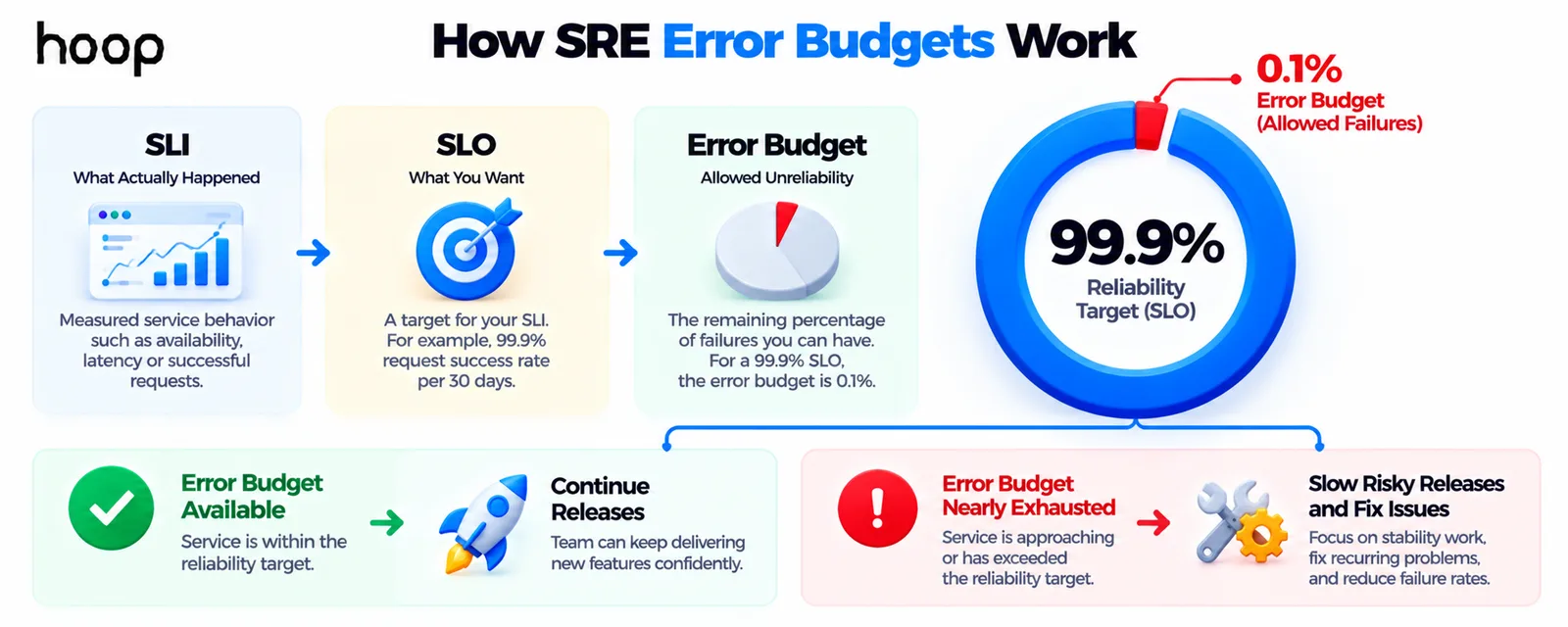
An error budget translates an SLO into an allowed amount of unreliability. A 99.9% availability objective leaves 0.1% as the error budget.
The budget helps teams balance product change against reliability. If the service stays within budget, the team can usually continue releasing changes confidently.
If reliability consumes too much budget, stability work can take priority. Teams may slow risky releases, fix recurring incidents, or strengthen testing and recovery.
Error budgets reduce arguments between speed and stability. Product and reliability teams can make decisions against the same measurable threshold.
What Is Toil in SRE?
Toil is repetitive operational work that scales with the system but creates little lasting engineering value. It is often manual, predictable, and interrupt-driven.
Examples include restarting the same service, repeating identical deployment fixes, or responding to noisy alerts. These tasks may be necessary temporarily.
SRE asks how those tasks can be automated or removed. The objective is not avoiding operations work. The objective is preventing repeated work from dominating engineering time.
Do SREs Write Code?
Yes. SREs often write code, but the code may support reliability rather than customer-facing features. Typical work includes automation, tooling, integrations, and recovery systems.
An SRE might build a deployment safeguard, automate capacity checks, or improve alert routing. Another project might repair a known failure automatically.
The exact balance depends on the company. Some SRE roles are strongly software-focused, while others sit closer to infrastructure engineering and operations.
Are SREs Always On Call?
Many SRE teams participate in on-call rotations because they help own production reliability. On-call engineers respond when important services need urgent attention.
Constant firefighting should not be treated as successful SRE. Repeated pages create signals that the system, alerting, staffing, or ownership model needs improvement.
A healthy rotation keeps alerts actionable and workload sustainable. Engineers need enough non-incident time to remove the causes of repeated pages.
How Does SRE Handle Incidents?
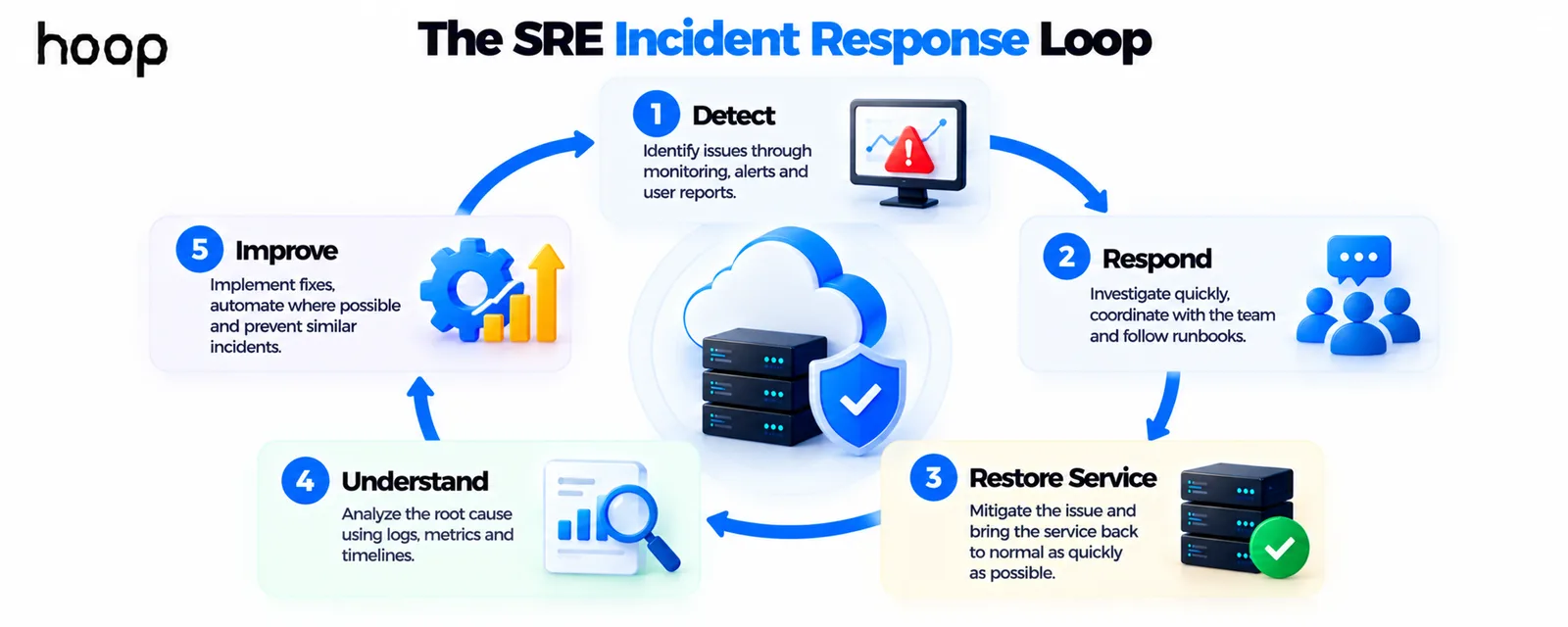
Incident response begins by reducing user impact. Teams identify the problem, stabilize the service, communicate clearly, and restore normal operation.
After recovery, the work continues. Engineers investigate what failed, why detection took a certain amount of time, and which controls made recovery harder.
The full loop is simple: detect, respond, restore, understand, and improve. The final step is what turns an outage into future reliability work.
What Is a Blameless Postmortem?
A postmortem documents a significant incident and the lessons from it. A blameless postmortem focuses on system conditions instead of finding one person to punish.
Teams examine contributing factors, missed signals, recovery delays, and useful responses. They then define actions that make similar failures less likely or less damaging.
The goal is not to pretend mistakes never happen. The goal is to make the system safer even when people make normal human mistakes.
What Is Observability in SRE?
Observability helps engineers understand what a system is doing from the signals it produces. Common signals include metrics, logs, and distributed traces.
Monitoring usually answers known questions. For example, an alert can tell the team that error rates exceeded a defined threshold.
Observability helps investigate unexpected questions. Engineers can trace a slow request through services and identify where time or failures are accumulating.
What Do SRE Teams Monitor?
SRE teams choose indicators that reflect user experience and system limits. Four useful signals are latency, traffic, errors, and saturation.
Latency measures response time. Traffic measures demand. Errors track unsuccessful work. Saturation shows how close a constrained resource is to its limit.
Good alerts focus on conditions that need action. Alerting on every unusual metric can create fatigue and make genuine incidents harder to recognize.
How Does SRE Improve Deployments?
Software changes are a common source of production incidents. SRE therefore cares about how new versions move into production and how quickly they can be reversed.
Teams may use canary releases, progressive rollouts, feature flags, automated health checks, or rapid rollback. These controls reduce the blast radius of bad changes.
Reliability signals can also influence release decisions. A team that has exhausted its error budget may postpone risky changes until service health improves.
SRE vs DevOps: What Is the Difference?
DevOps is the broader approach to collaboration, delivery, automation, and shared ownership between development and operations. SRE is a specific reliability discipline.
SRE gives teams concrete practices for production reliability. These practices include SLOs, error budgets, toil reduction, incident response, and reliability engineering.
The disciplines often work together rather than compete. A DevOps-oriented organization can use SRE methods to make reliability decisions more measurable.
SRE vs Software Engineer
Product software engineers primarily build application features and customer-facing behavior. SREs primarily engineer the systems that keep those applications dependable in production.
Both roles can write production code. The difference is usually the problem being solved rather than whether coding is part of the job.
An SRE may still contribute to application code when reliability requires it. A product engineer may also own operational work for the service they build.
SRE vs System Administrator
System administration often focuses on configuring and operating servers, networks, accounts, and production environments. Modern sysadmin work can also include extensive automation.
SRE places stronger emphasis on engineering away repetitive operations. The goal is for service growth to avoid proportional growth in manual operational effort.
The boundary is not universal. Many infrastructure roles share skills with SRE, especially in cloud environments, automation, Linux, networking, and incident response.
SRE vs Platform Engineering
Platform engineering builds reusable internal infrastructure and developer experiences. It may provide deployment platforms, service templates, environments, and self-service tooling.
SRE focuses on production reliability outcomes. SRE requirements can influence what a platform provides, including observability, rollout controls, and reliability defaults.
The teams often collaborate closely. In some organizations, their responsibilities overlap significantly.
Does SRE Require Kubernetes?
No. SRE principles apply to virtual machines, bare metal, containers, serverless systems, managed services, and hybrid environments.
Kubernetes can create reliability challenges involving scheduling, networking, scaling, and service health. SRE methods can help manage those challenges, but Kubernetes is not required.
Does SRE Require Cloud Computing?
No. Site reliability engineering is about production reliability rather than one hosting model. The same principles can support public cloud, private infrastructure, or hybrid systems.
Reliable environments still depend on sound architecture. Hoop’s cloud infrastructure setup work covers redundancy, monitoring, backups, recovery, access controls, and infrastructure automation that often support reliability goals.
How Does SRE Handle Capacity Planning?
Reliability can fail even when the software is correct. A service may simply run out of database connections, memory, storage, network capacity, or compute.
Capacity planning estimates how much demand a system can support and when important limits may be reached. SRE teams compare current usage with expected growth.
The work can include load testing, traffic forecasting, resource limits, scaling policies, and regional capacity reviews. The purpose is to find constraints before customers do.
Good capacity planning also prevents waste. Reliability does not require buying unlimited infrastructure when measured scaling policies can handle demand safely.
A Simple SRE Example
Imagine a checkout service that becomes slow during busy periods. The problem appears every week, and engineers repeatedly increase resources by hand.
An SRE first studies latency, traffic, errors, and resource saturation. The investigation shows a database connection limit causing requests to queue.
The immediate fix restores service. The engineering response then changes connection handling, adds capacity alerts, and automates scaling before the next peak.
The team also updates its SLO and incident runbook. The same failure becomes easier to detect, easier to recover from, and less likely to recur.
That example captures the SRE mindset. Restore the service first, then change the system so the same operational pain creates less future work.
How Do Teams Measure Whether SRE Is Working?
SRE success should not be measured by the number of dashboards, alerts, or incidents handled. Those numbers can rise even when reliability work is ineffective.
Teams should look at user-facing reliability, SLO performance, error-budget use, incident frequency, and recovery time. Repetitive operational work matters too.
A healthy trend usually means fewer recurring incidents, better alert quality, and faster recovery. Engineers should also gain more time for preventive work.
Deployment confidence can improve as well. Safer rollouts and clearer reliability signals let teams release changes without turning every deployment into a high-risk event.
How Can SRE Improve Developer Productivity?
Reliability work can make product development easier as well as safer. Developers lose less time when production systems provide clear logs, useful alerts, and repeatable deployment paths.
SRE teams may build service templates, standard dashboards, rollback tooling, or automated recovery. These systems reduce the amount of operational knowledge each developer must recreate.
Better reliability tooling also shortens debugging. Engineers can move from an alert to the relevant request, dependency, deployment, or infrastructure signal more quickly.
The result is not only higher uptime. Product teams can spend more time building useful features instead of repeatedly diagnosing the same operational failures.
What Are the Benefits of SRE?
- Reliability becomes measurable through service indicators, objectives, and error budgets.
- Automation reduces repetitive operational work and gives engineers more time for lasting improvements.
- Incident response becomes structured, with clearer ownership, communication, and recovery processes.
- Safer deployment practices reduce the impact of failed releases and speed recovery when changes go wrong.
- Production insights can improve both system design and developer workflows.
What Are the Challenges of SRE?
- Poorly designed on-call rotations can create burnout and constant firefighting.
- Noisy alerts can hide important incidents and reduce trust in monitoring systems.
- Unclear ownership can turn SRE into a ticket queue instead of an engineering function.
- Bad SLOs can measure infrastructure health without reflecting real user experience.
- Tool complexity can grow quickly when teams add monitoring, deployment, cloud, and incident platforms without clear goals.
When Does a Business Need SRE?
A business may benefit from SRE when production reliability starts affecting revenue, customer trust, contracts, or engineering speed. The need depends on service criticality.
Warning signs include frequent outages, repeated manual recovery, noisy on-call rotations, difficult deployments, unclear reliability targets, and recurring capacity problems.
A small product does not necessarily need a dedicated SRE team. It can still adopt SRE practices before reliability problems justify specialized roles.
Customer-facing platforms often need scaling and resilient production architecture. Cloud SaaS application development can connect application design with availability, scaling, and recovery requirements.
How Can a Team Start Applying SRE?
Start with one important service and define what reliability means for its users. Choose a small number of indicators that represent that experience.
Set an initial SLO, then measure current performance against it. Use incidents and error-budget consumption to identify the reliability work with the highest value.
Review operational toil and automate the most repetitive work. Improve alert quality, document incident response, and run postmortems after meaningful failures.
SRE maturity grows through repeated measurement and learning. Teams do not need every advanced reliability practice on the first day.
Build Reliability as an Engineering Discipline
SRE turns reliability from a vague expectation into an engineering system. Teams define reliability, measure it, respond to failures, and improve the service afterward.
The strongest SRE teams do more than keep production running. They make production easier to operate as the product, traffic, and organization grow.
“Restore the service first, then change the system so the same operational pain creates less future work.”
Key takeaways
- 01SLI is what happened, SLO is what you wanted, SLA is what you promised.
- 02An error budget turns a 99.9% target into 0.1% of allowed failure — and into a release decision.
- 03Toil is repetitive work that scales with the system; reducing it is the core engineering job.
- 04Constant firefighting is a symptom of failing SRE, not evidence of it working.
Written by
Sahar
Content Writer
Frequently Asked
Questions
Everything you need to know before booking a strategy call. Can't find your answer? Contact us directly.
No. DevOps is a broader software-delivery approach. SRE is a reliability discipline that provides specific practices for operating production services.
Daily work can include automation, incident response, monitoring, capacity planning, and deployment safety. Reliability projects also reduce recurring operational work.
Yes, programming is important in many SRE roles. SREs use code to automate operations, build reliability tooling, and solve production problems at scale.
No. Small teams can use SLOs, better monitoring, incident reviews, and toil reduction without creating a dedicated SRE organization.
It can be stressful when on-call load and incident frequency are poorly managed. Healthy SRE organizations design sustainable rotations and reduce repeated operational pain.
Keep reading
All articles →
What Is CI/CD? Continuous Integration and Delivery Explained
Oct 12, 2026 · 10 min read
What Is DevSecOps? How Security Fits Into DevOps
Oct 12, 2026 · 10 min read