
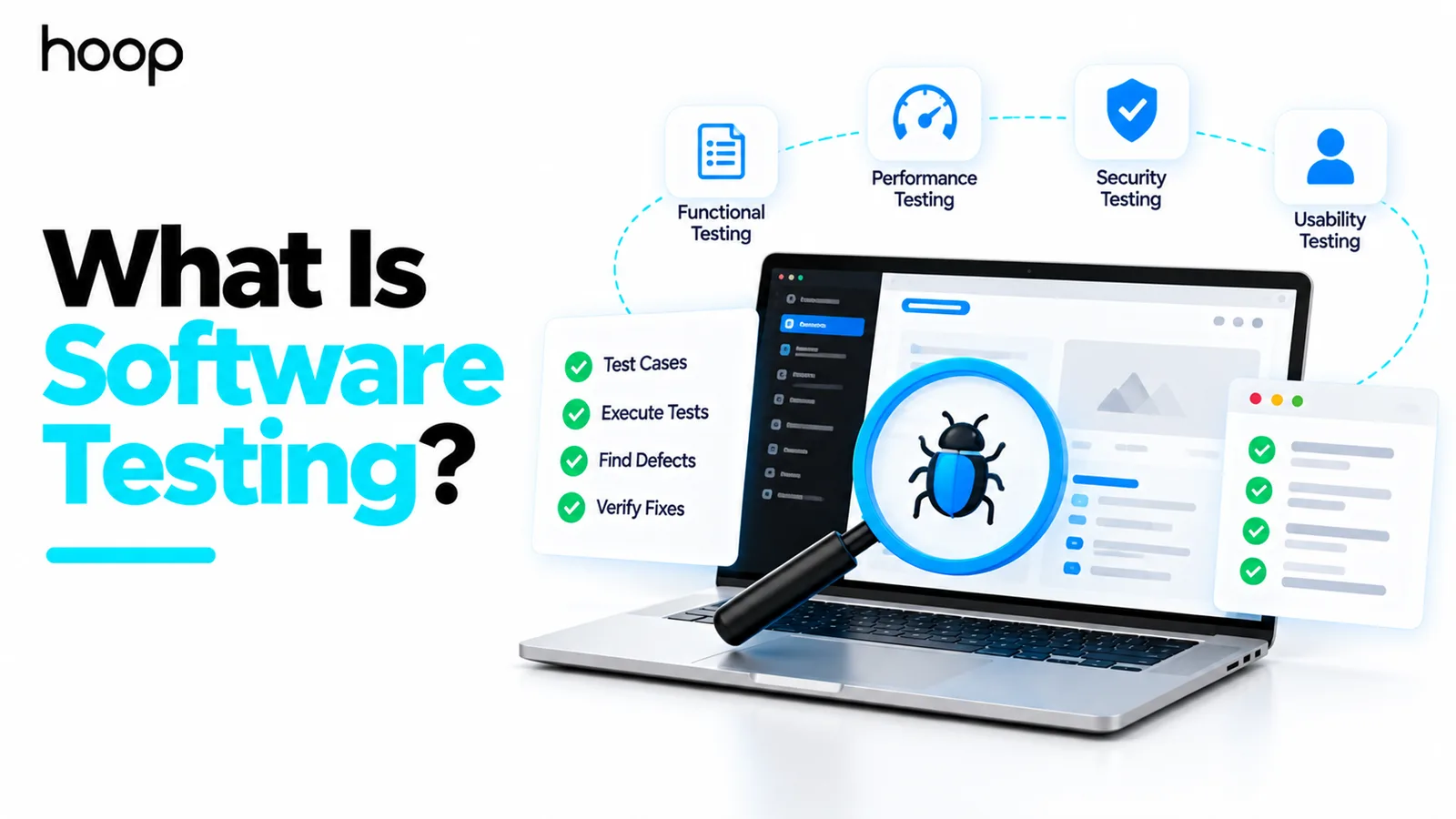
What Is Software Testing? Types, Methods and How It Works
Testing is structured investigation, not bug-hunting. It gathers evidence about how software behaves under chosen conditions so teams can judge release risk honestly.
Sahar
Content Writer
Software testing is the process of evaluating software to learn whether it behaves as expected and where important risks remain.
Software testing helps teams identify defects, compare actual behavior with expected behavior, and make better release decisions.
Testing does not prove that software has zero bugs. It reduces uncertainty by showing how the product behaves under the conditions that were tested.
Need this done right?
Hoop builds the strategy, design and development behind sites like this one — talk to us about yours.
What Does Software Testing Mean?
Testing is a structured investigation of software behavior.
A tester asks questions, creates conditions, observes results, and compares those results with expectations.
Some checks confirm that a feature works. Other checks explore failure paths, performance, security, accessibility, compatibility, or unusual user behavior.
The purpose goes beyond reporting defects. Testing also provides evidence about quality, product risk, and release readiness.
Why Is Software Testing Important?
Software can appear correct while still failing under specific conditions.
A checkout may work for one card but fail on retries. A dashboard may load quickly for one user but slow down under heavy traffic.
Testing exposes those differences before they become expensive customer problems. It can also protect existing behavior while teams continue adding features.
Good testing supports safer releases, clearer product decisions, and faster diagnosis when something goes wrong.
Is Software Testing Only About Finding Bugs?
No. Testing has a wider purpose than finding defects.
A tester may confirm requirements, investigate edge cases, evaluate risk, question unclear behavior, or collect evidence for release decisions. A test can also pass and still provide useful information.
For example, a performance test may show that response time stays within the target. That result increases confidence even though no defect was found.
How Does Software Testing Work?
A simple cycle starts with a requirement or risk.
The team decides what behavior matters, creates a test condition, defines the expected result, and runs the check.
The actual result is then compared with the expectation. Unexpected behavior may become a defect, investigation, or product discussion.
After a fix, the team retests the original problem. It may also run regression tests to check that the change did not damage other features.
What Is Risk-Based Software Testing?
Risk-based testing focuses effort where failure would create the greatest business or user impact.
Teams cannot test every possible combination, so priorities matter.
Payments, authentication, permissions, data deletion, and financial calculations often deserve deeper coverage than low-impact cosmetic behavior.
Risk can also change over time. A feature serving 10 users may need much stronger testing after it becomes central to thousands of customers.
Why Do Test Data and Test Environments Matter?
A test can pass while still giving weak evidence if its data or environment does not resemble real use.
Teams need representative accounts, permissions, devices, integrations, and data volumes. Sensitive production data should not be copied carelessly into test systems.
Stable test environments also matter. If environments change unpredictably, teams cannot tell whether failures come from the product or the setup.
How Does a Software Defect Move From Discovery to Fix?
The tester records the behavior, expected result, reproduction steps, evidence, environment, and severity. The team then reviews priority and assigns the issue.
A developer investigates and fixes the cause. The tester retests the original problem and checks nearby behavior for regression risk.
What Is a Test Case?
A test case is a specific check with known conditions, actions, and expected results. It turns a requirement into something that can be verified consistently.
Suppose users should be able to reset a password. A test case might request the reset and open the email. It can then create a new password and reject the old one.
Test cases are useful for repeatability and coverage. They should not prevent testers from exploring behavior that a script did not predict.
Manual Testing vs Automated Testing
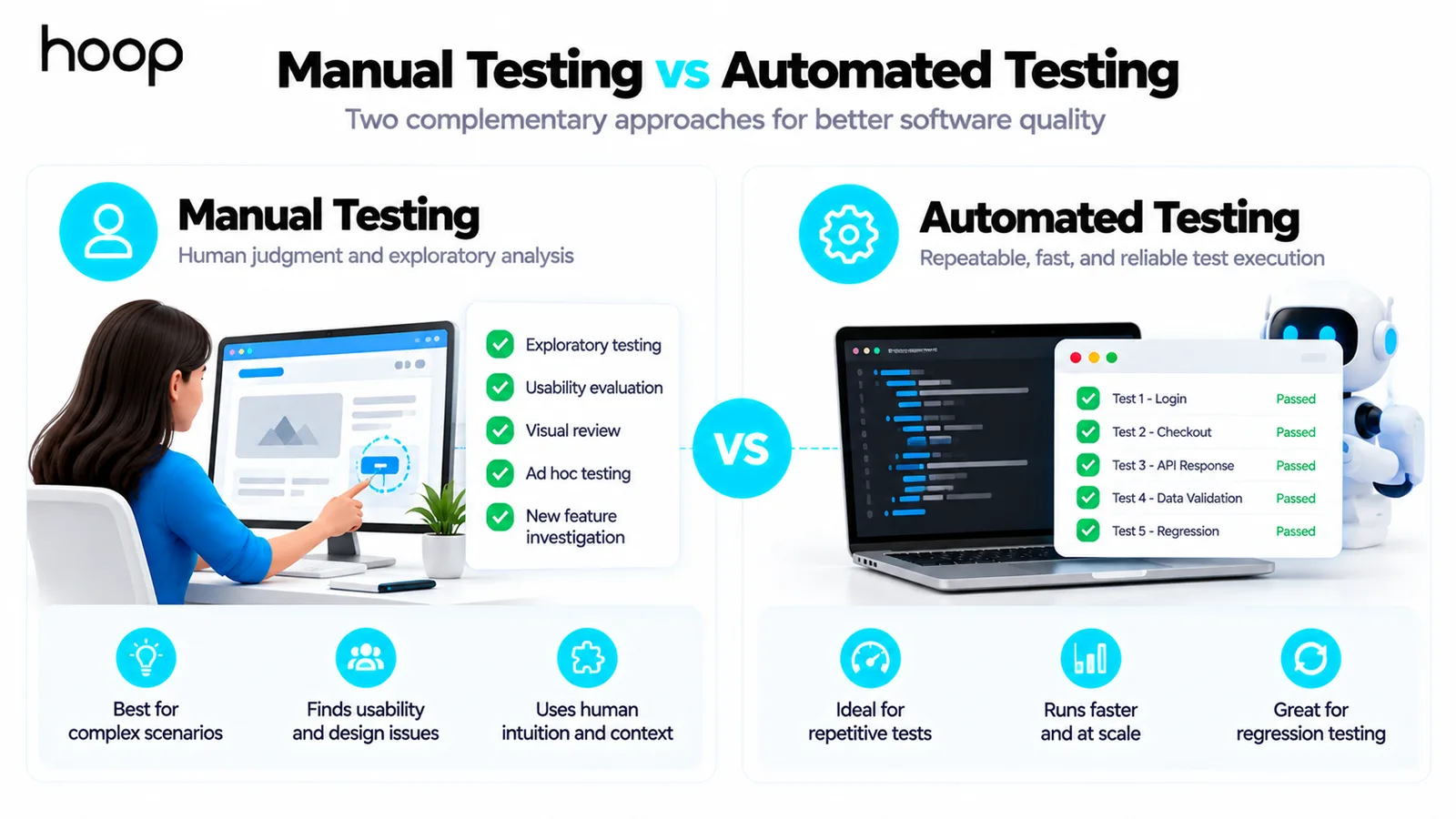
Manual and automated testing describe execution methods. They do not describe the quality characteristic being tested.
Manual testing is useful when human judgment matters. Exploratory testing, usability checks, visual review, and new feature investigation often benefit from a person observing the product directly.
Automated testing is useful when the same check should run repeatedly. Login, checkout, APIs, permissions, and critical workflows are common automation targets.
Strong testing strategies usually combine both methods. Automation handles repeatable checks, while people investigate new risks and ambiguous behavior.
What Are the 4 Main Levels of Software Testing?
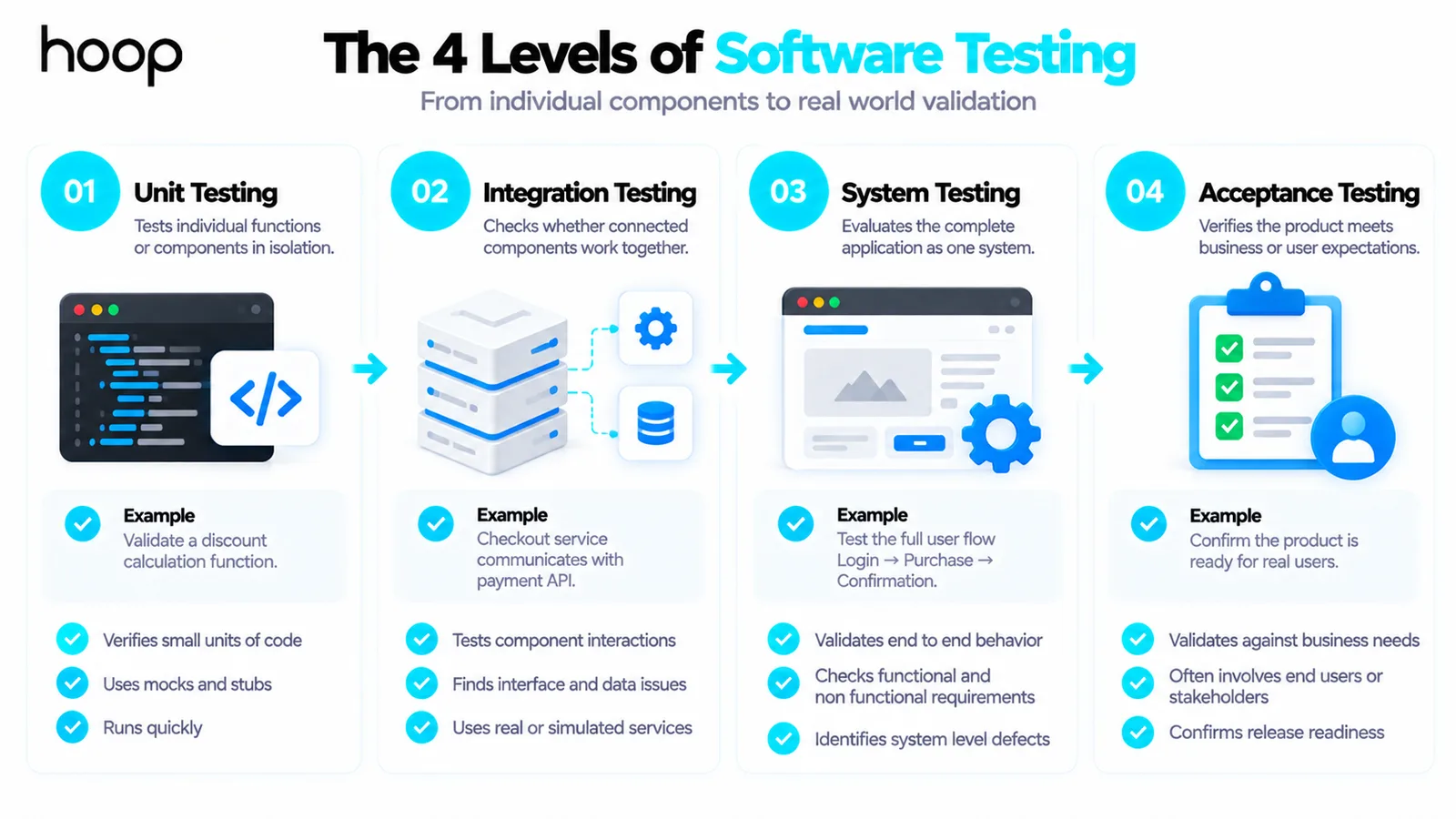
Unit Testing
Unit testing checks a small piece of code in isolation. A developer might test whether a pricing function returns the correct discount.
Integration Testing
Integration testing checks whether components work together. A payment test might verify that checkout sends the correct request to the payment provider.
System Testing
System testing checks the complete application as a working system. It may cover a full journey from login through purchase and confirmation.
Acceptance Testing
Acceptance testing checks whether the product satisfies business or user expectations. It helps decide whether the system is ready for its intended use.
Functional vs Non-Functional Testing
Functional testing asks whether a feature behaves correctly. Non-functional testing asks how well the software performs under important conditions.
A functional test might confirm that one user can log in. A non-functional test might check whether thousands of users can log in within acceptable response times.
Performance, security, accessibility, usability, compatibility, and scalability are common non-functional quality concerns.
What Is Regression Testing?
Regression testing checks whether new work broke behavior that previously worked.
For example, a developer may update checkout to support a new payment method. Regression tests can verify that existing cards, refunds, receipts, and order history still work.
Hoop uses repeatable regression coverage within its QA testing services so important workflows can be checked after meaningful changes.
Retesting vs Regression Testing
Retesting checks whether a specific defect was fixed. Regression testing checks whether the fix caused unexpected problems elsewhere.
Suppose a coupon bug produced the wrong total. Retesting checks that coupon again. Regression testing also checks related pricing, checkout, invoices, and refunds.
Both matter because a correct fix can still create a new problem in connected code.
What Is Smoke Testing?
Smoke testing checks whether the most critical parts of a new build work well enough for deeper testing to continue.
A smoke test may confirm that the application opens and users can log in. It may also check critical pages and APIs.
If those basics fail, running a large test suite may waste time. The build should usually be repaired first.
What Is Exploratory Testing?
Exploratory testing combines learning, test design, and execution. The tester uses observations from one action to decide what to investigate next.
This approach is useful when requirements are incomplete, behavior is new, or the product contains complex user interactions.
Exploratory testing can reveal problems that scripted test cases miss because the tester is not limited to a fixed sequence.
What Other Types of Software Testing Are Used?
Different testing methods answer different questions about quality. Performance testing asks whether the system stays responsive under load. API testing checks service behavior and data exchange.
Security testing looks for weaknesses that could expose systems or data. Accessibility testing checks whether people with different abilities can use the product effectively.
Compatibility testing checks supported browsers, devices, operating systems, or configurations. Usability testing evaluates whether real users can understand and complete important tasks.
Software Testing vs Quality Assurance
The two overlap, but they are not identical.
Testing evaluates the product and provides information about its behavior. Quality assurance also examines the processes that help teams create consistent quality.
QA may improve requirements, review workflows, release criteria, defect processes, and team practices. Testing is one important source of evidence inside that broader quality effort.
Software Testing vs Debugging
Testing identifies unexpected behavior, while debugging investigates and removes the technical cause.
A tester may report that checkout duplicates an order after a timeout. A developer may then trace the request flow, find the cause, and fix the logic.
The same person can perform both activities, but the goals are different.
When Should Software Testing Start?
Testing should start before development is complete, because early feedback can expose unclear requirements and risky assumptions.
A tester can review a proposed feature before code exists. That review may expose questions that would otherwise become expensive defects later.
This approach also fits modern custom software development where testing is built into delivery from the start.
How Does Software Testing Work in Agile Teams?
In Agile teams, testing becomes continuous rather than a separate final phase. Testers work alongside developers, designers, and product owners throughout each iteration.
Testing can start while a story is being refined. The team may clarify acceptance criteria, identify risky edge cases, and decide which checks should be automated.
During development, testing provides fast feedback on new behavior. After release, production findings can shape the next iteration.
This model keeps quality discussions close to the work. It also makes testing part of shared delivery responsibility instead of a late handoff.
What Is Shift-Left Testing?
Shift-left testing means moving testing closer to the point where a decision or code change is created. The goal is faster feedback and less rework.
Examples include reviewing requirements early and running unit tests during development. Teams can also check APIs and scan code before merge.
Shift left does not mean testing ends early. Production monitoring and post-release learning still matter after deployment.
How Does Testing Work in CI/CD?
In modern delivery, testing becomes part of CI/CD. Pipelines can run repeatable checks whenever code changes, and stop unsafe changes before they move toward production.
Unit tests, integration tests, API checks, security scans, smoke tests, and selected regression suites can all become automated gates.
That testing becomes more useful when paired with reliable Cloud and DevOps services that make builds, environments, and releases repeatable.
A failed pipeline is not wasted work. It is early feedback that a change needs attention before users receive it.
Can Developers Test Their Own Software?
Yes. Developers should test the code they create, especially through unit tests, integration checks, and local validation.
However, independent perspectives still add value. People who did not build the feature may notice assumptions, confusing behavior, or risks the original developer overlooked.
The best model is shared quality ownership. Developers, testers, product teams, and operations all contribute different forms of evidence.
Can Software Ever Be Fully Tested?
No practical process can exercise every possible condition in a complex product.
Real systems contain too many combinations of users, data, devices, timing, permissions, and dependencies.
Testing therefore prioritizes risk. Critical areas such as payments, authentication, data deletion, permissions, and financial calculations deserve deeper coverage.
The goal is enough evidence to make a responsible decision, not an impossible promise of perfect software.
What Are the Benefits of Software Testing?
- Reveals defects and unexpected behavior before they reach more users.
- Protects existing functionality while new features are added.
- Provides evidence for release and risk decisions.
- Improves confidence in critical workflows and integrations.
- Reduces repeated manual checking through targeted automation.
- Helps teams learn how software behaves under real conditions.
Common Software Testing Mistakes
- Testing only successful paths while ignoring invalid input and failure states.
- Automating every test even when human judgment would be more useful.
- Running tests too late and discovering basic requirement problems near release.
- Keeping weak regression coverage around critical customer workflows.
- Using unrealistic test data that hides real production risks.
- Treating a passing test suite as proof that no defects remain.
How Is AI Changing Software Testing?
AI can generate test ideas, draft automation scripts, create test data, and summarize failures.
It can also help teams review large test suites and prioritize checks after code changes.
Human judgment still matters. Teams must decide which risks matter, whether behavior is acceptable, and whether generated tests reflect real business needs.
Build Quality Into the Product, Not Just the Release
Software testing is at its best when quality work is built into product development from the beginning.
Early review, thoughtful manual testing, targeted automation, and regression coverage all contribute different evidence.
A mature testing process does not promise perfect software. It makes product risk more visible and gives teams faster feedback before problems become expensive.
Hoop Interactive helps teams combine development, QA, automation, and delivery practices. That approach helps software evolve while protecting critical user journeys.
“Testing does not prove that software has zero bugs. It reduces uncertainty by showing how the product behaves under the conditions that were tested.”
Key takeaways
- 01Four levels build on each other: unit, integration, system, and acceptance.
- 02Manual and automated describe how a test runs, not what quality it checks — most products need both.
- 03Unrealistic test data and unstable environments make passing tests meaningless.
- 04Exhaustive testing is impossible, so coverage follows risk: payments, auth, permissions, and deletion first.
Written by
Sahar
Content Writer
Frequently Asked
Questions
Everything you need to know before booking a strategy call. Can't find your answer? Contact us directly.
The main purpose is to gather evidence about product behavior, defects, and risk. That evidence supports safer release decisions.
No. Testing evaluates the product directly. QA also covers the processes and practices used to build quality consistently.
No single method is always better. Automation suits repeatable checks, while manual testing is valuable for exploration, usability, and human judgment.
No. Passing tests show that the tested conditions behaved as expected. Untested conditions can still contain defects or unexpected behavior.
Start with stable, repeatable, high-value workflows. Login, checkout, critical APIs, permissions, and core regression paths are common candidates.
Keep reading
All articles →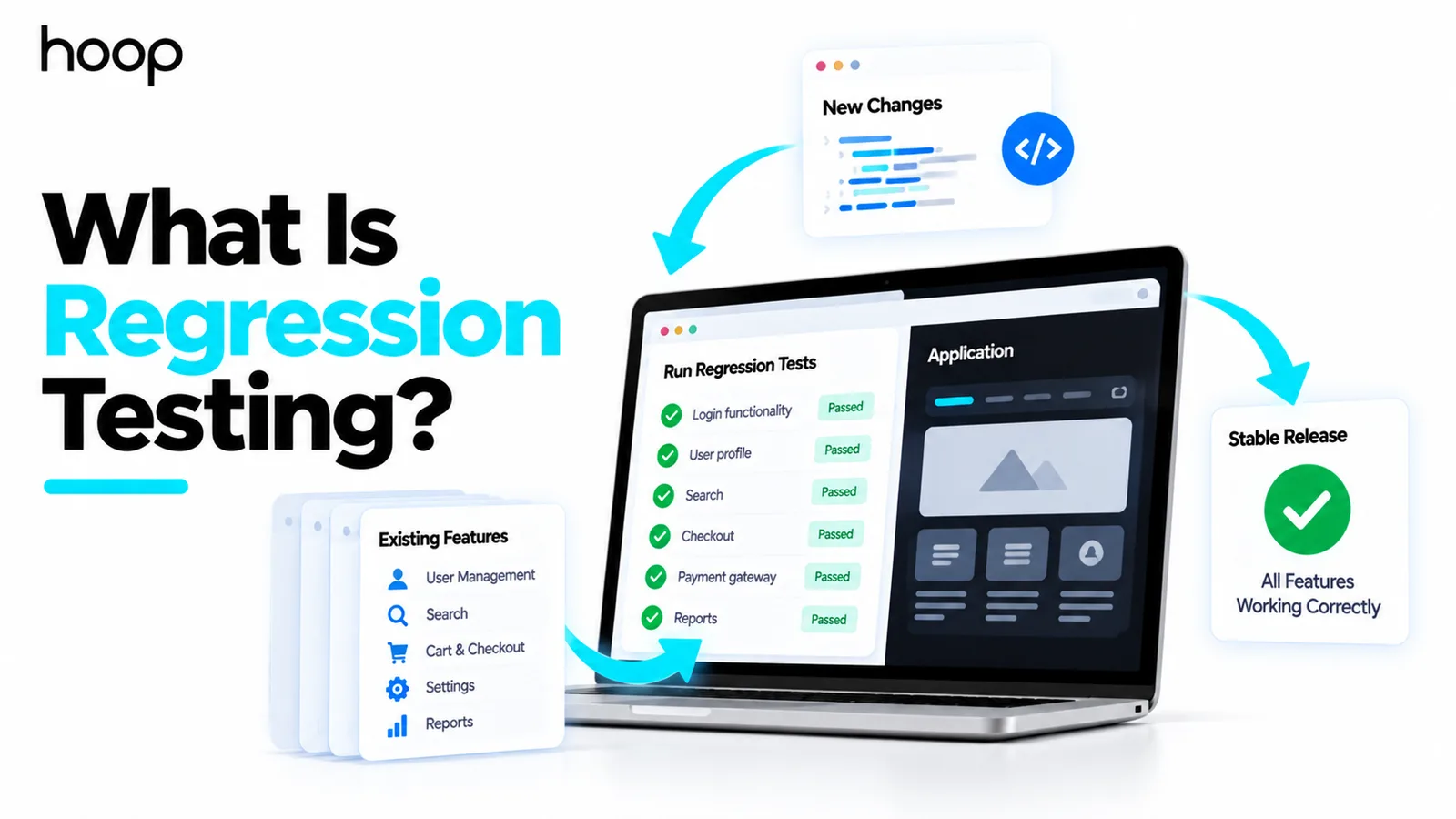
What Is Regression Testing? How It Prevents Old Features From Breaking
Oct 12, 2026 · 10 min read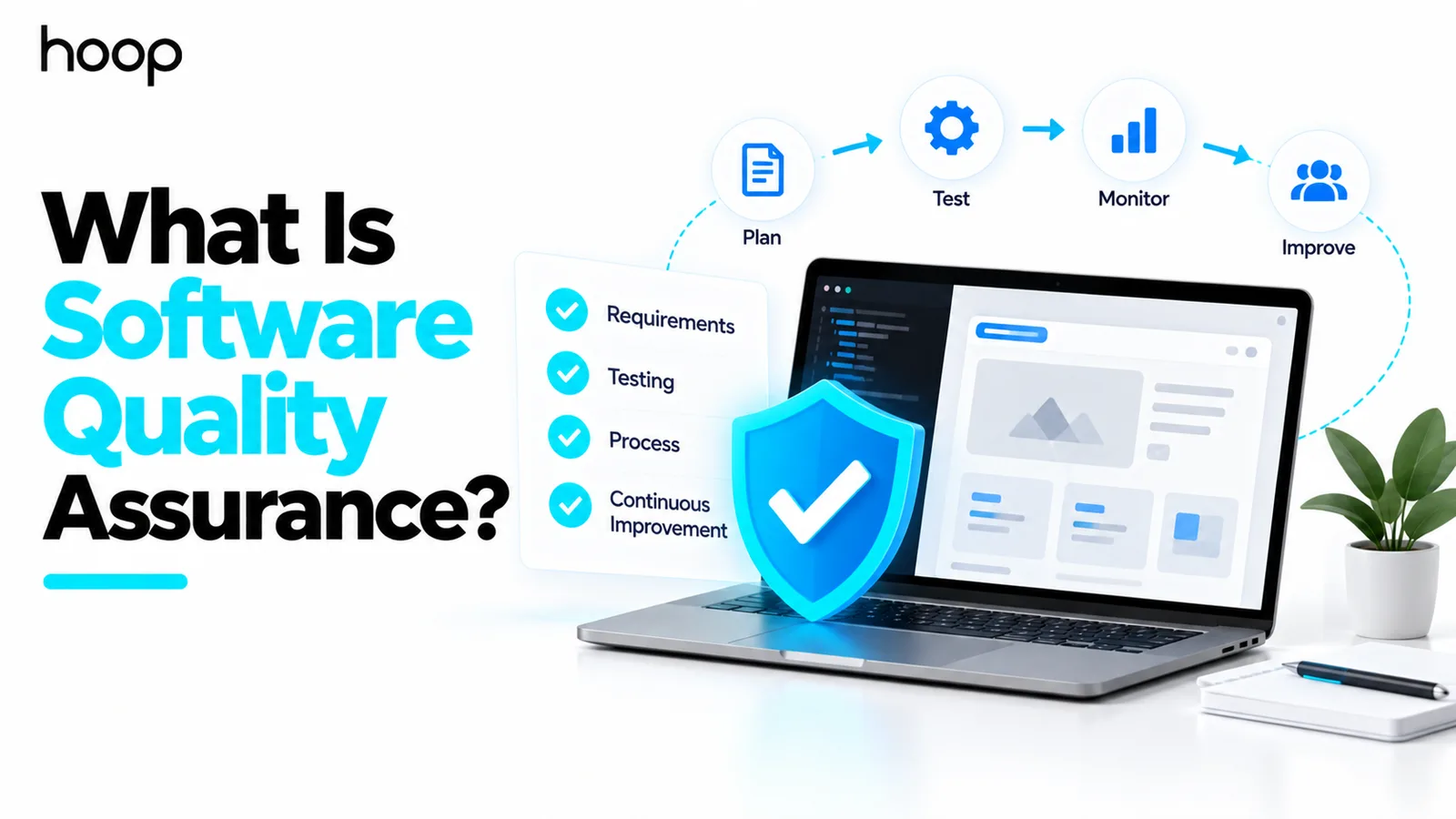
What Is Software Quality Assurance? QA Explained
Oct 12, 2026 · 11 min read