What Is API Testing? How to Test APIs Properly
API testing calls endpoints directly and checks data, schema, permissions, errors, and state changes. A 200 response proves almost nothing on its own — the assertions are where the value is.
Sahar
Content Writer
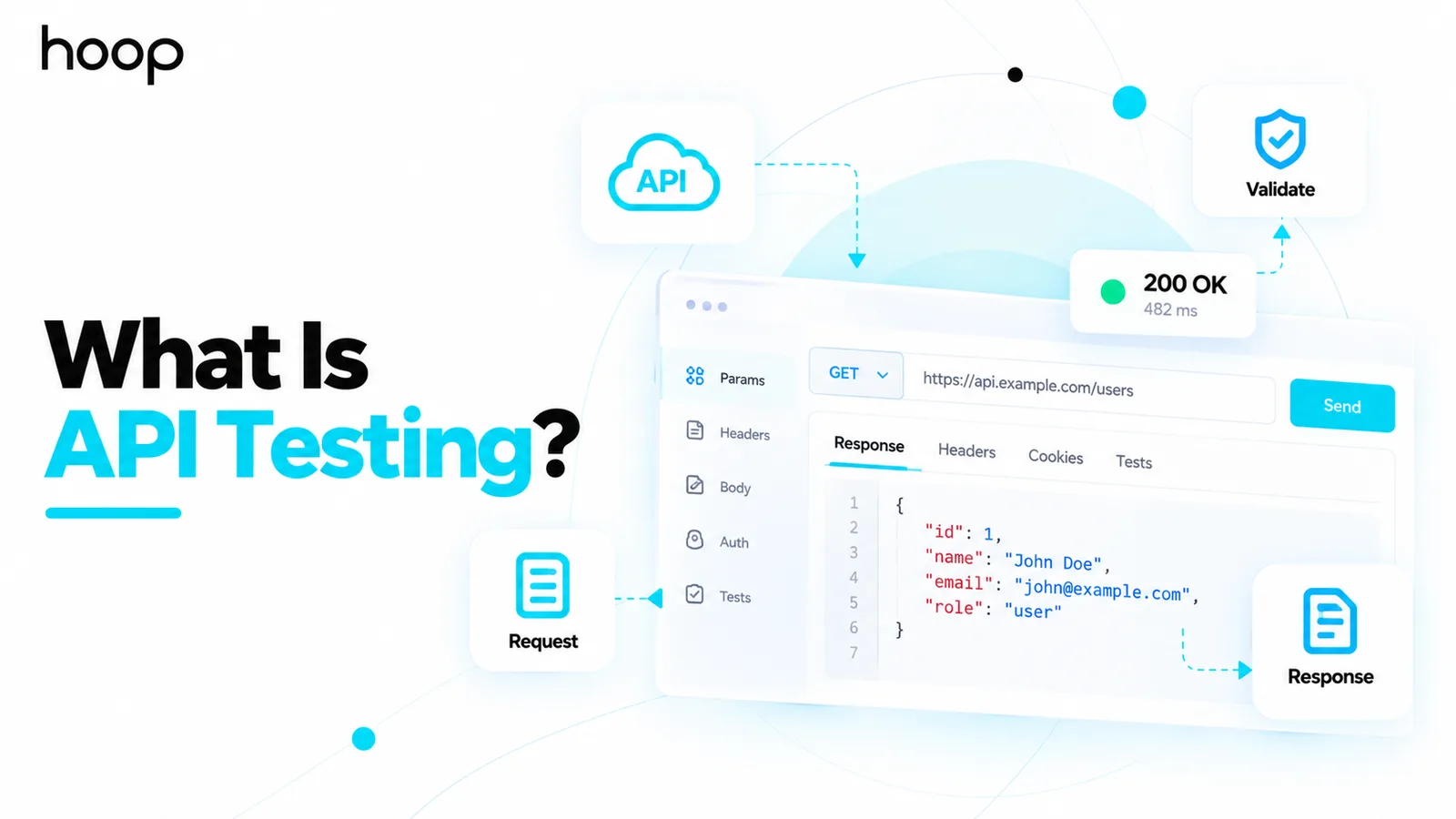
API testing sends requests directly to an application programming interface and checks whether the results match expectations. It validates data, rules, errors, permissions, integrations, and performance without relying on a browser interface.
A successful status code does not prove an API works correctly. Testers also need to verify the returned data, schema, business logic, access controls, and state changes.
Need this done right?
Hoop builds the strategy, design and development behind sites like this one — talk to us about yours.
What Is an API?
An API is a defined way for software systems to request data or actions from each other. One application sends a structured request, and another application returns a structured response.
For example, a mobile banking app might request an account balance through an API endpoint. The customer sees the balance on screen, but the API handles the software-to-software exchange behind that screen.
What Does API Testing Mean?
API testing deliberately calls an API and checks whether its behavior matches the agreed requirements. The tester controls the request, observes the response, and compares actual behavior with the expected result.
The goal is not only to confirm that an endpoint responds. Good API testing also checks valid requests, bad requests, protected data, and the final business action.
How Does API Testing Work?
A typical test starts with an endpoint, method, request data, and expected behavior. The tester sends the request, captures the response, and evaluates several conditions.
A login test might send valid credentials and expect an access token. Another test might send the wrong password and expect a safe failure with no token.
The same endpoint can therefore support many test scenarios. Each scenario explores a different rule, boundary, permission, or failure condition.
What Is API Testing Checking in a Response?
A useful API test checks more than one signal. Status codes show the response category, while the response body reveals whether the correct data returned.
Headers can expose content type, caching, authentication, or version information. Schema checks confirm that fields, types, and structures still match the documented contract.
Business assertions matter too. A payment endpoint may return success, yet the order could remain unpaid in the database. That result still represents a failed API test.
What Are HTTP Methods in API Testing?
HTTP methods describe the requested action. GET normally retrieves data, while POST commonly creates new data. PUT and PATCH update data, and DELETE removes it.
A simple CRUD workflow can test all four business actions. Create a customer, retrieve the record, update a field, then delete the customer.
The final step should verify the deleted record is unavailable. That confirms the state changed, rather than trusting the earlier response alone.
Positive vs Negative API Testing
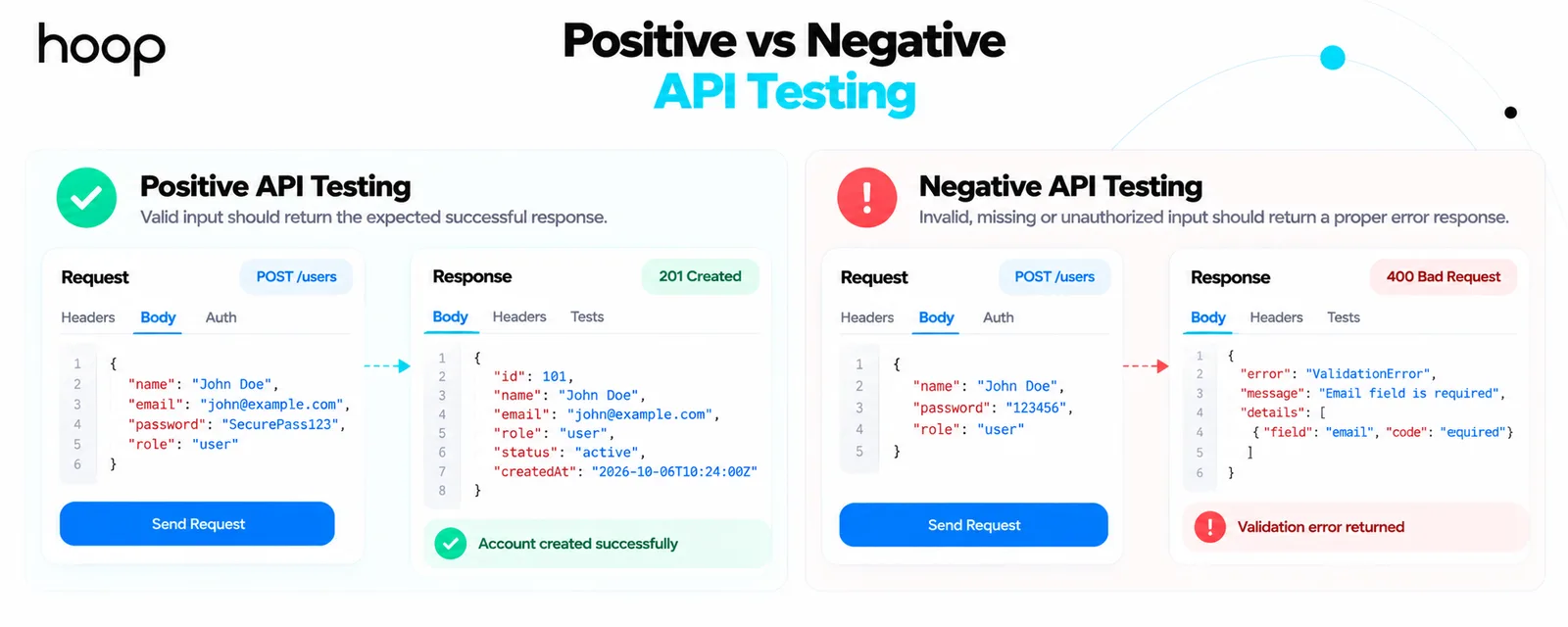
Positive API testing uses valid requests and confirms the expected successful behavior. Negative testing deliberately sends invalid, missing, malformed, or unauthorized input.
Suppose an endpoint creates a user account. A positive test uses valid values and confirms that the account is created correctly.
Negative tests can omit the email, use an invalid format, exceed field limits, repeat an existing address, or remove authorization. Each case should fail predictably and safely.
What Is Boundary Testing for APIs?
Boundary testing focuses on values around allowed limits because defects often appear at those edges. If quantity allows 1 through 100, test 1, 100, 0, and 101.
Type boundaries matter too. A numeric field should not silently accept text, arrays, or unsupported null values unless the contract allows them.
Boundary tests are especially useful for prices, pagination, upload sizes, date ranges, password rules, and rate limits.
What Is Schema Validation?
Schema validation checks whether an API response still follows the expected structure. It can verify field names, required properties, nested objects, arrays, and data types.
A response may still return 200 while breaking consumers. For example, changing an integer ID into a string can break code that expects a number.
Schema checks detect those compatibility problems before they spread into mobile apps, web frontends, integrations, or customer systems.
What Is API Contract Testing?
Contract testing checks whether an API still accepts and returns the structures its consumers expect. The contract can describe endpoints, fields, formats, errors, and authentication rules.
OpenAPI specifications can serve as a machine-readable reference for those expectations. Teams can compare implementation behavior against the published contract during development.
Hoop Interactive builds APIs around defined contracts, documentation, and validation through its API development services. That same discipline makes API tests easier to design and maintain.
What Is API Testing for Authentication and Authorization?
Authentication asks who the caller is. Authorization asks what that authenticated caller is allowed to do.
Authentication tests should cover valid, missing, invalid, and expired credentials. Authorization tests should try actions that different roles are not permitted to perform.
A strong authorization test also checks ownership boundaries. Customer A should not gain Customer B’s record simply by changing an object ID.
What Is API Testing for Error Handling?
Bad requests should fail in a predictable way. The API should return an appropriate status code and a response body that follows the documented error format.
Tests should cover missing fields, unsupported methods, unavailable resources, invalid credentials, forbidden actions, server failures, and downstream timeouts.
Useful error behavior helps both users and developers. It also prevents consumers from building unreliable workarounds around inconsistent responses.
What Is API Integration Testing?
API integration testing checks whether connected components use interfaces correctly together. A single endpoint can pass isolated tests while the complete workflow still fails.
A checkout service might send the wrong amount to a payment provider. Another integration might accept payment but fail to update inventory afterward.
Hoop handles third-party workflows, retries, failure paths, and connected services through its API integration services. Those same dependencies need focused integration tests.
API Testing vs UI Testing
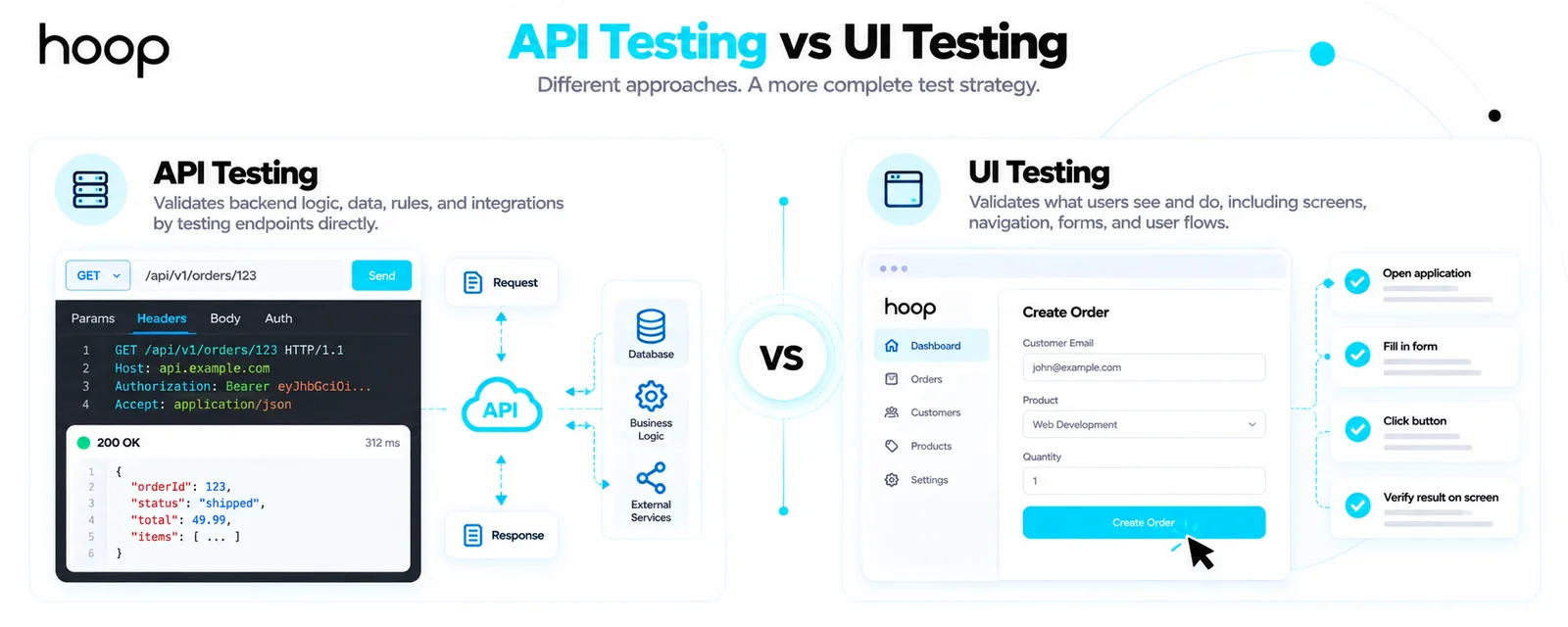
API testing checks the service layer directly. UI testing checks the interface that customers actually see and use.
API tests are often faster because they skip browser rendering, page navigation, and visual interaction. They can also create test data without clicking through several setup screens.
UI testing still matters. API tests cannot reveal hidden buttons, broken layouts, confusing navigation, keyboard problems, or other user-interface failures.
The two approaches complement each other. Test business rules deeply at the API layer, then test user experience where customers actually interact.
API Testing vs Interface Testing
API testing is one form of interface testing. Interface testing can also cover other boundaries between components, services, files, middleware, or external systems.
The key idea stays the same: verify that both sides exchange information correctly and handle failures under shared rules.
API Testing vs Consuming an API
Consuming an API means using it as part of a normal product workflow. Testing an API means deliberately challenging that interface and checking specific expectations.
A weather application consumes a forecast API to show temperatures. A test sends controlled inputs and checks whether the forecast service behaves correctly under defined conditions.
What Do You Need Before API Testing?
First identify the contract, environment, credentials, test data, and expected behavior. Those inputs determine whether a result can be judged accurately.
Useful documentation should describe endpoints, methods, parameters, authentication, required fields, response formats, errors, and rate limits. OpenAPI or Swagger files can make those rules easier to review.
The test environment also matters. A production-like staging environment can reveal integration and configuration problems that a local mock may not expose.
How Do You Design an API Test Case?
A useful test case starts with one clear risk or rule. Define the request, setup data, expected status, expected body, expected state change, and cleanup step.
For example, a refund test can create an order and capture payment. It can then verify refund and order states.
This structure keeps testing focused on observable behavior. It also makes failed tests easier to diagnose because every assertion has a clear purpose.
How Do You Test Pagination, Filtering, and Sorting?
Collection endpoints often support pagination, filtering, or sorting. These features need direct testing because small logic errors can return missing, duplicated, or incorrectly ordered records.
Pagination tests should check the first page, last page, empty pages, invalid limits, and repeated records. Filtering tests should combine valid and unsupported filter values.
Sorting tests should verify ascending and descending order across realistic data. These checks are especially useful for dashboards, search tools, catalogs, and reporting APIs.
What Is Idempotency in API Testing?
Idempotency means repeating the same request should not accidentally repeat a business action when the contract promises safe retries. Payment and order APIs often depend on this behavior.
A test can send the same idempotency key twice and confirm that only one charge or order is created. This protects users from duplicate actions during retries.
Why Test Complete API Workflows?
Endpoint tests are useful, but customers experience workflows rather than isolated URLs. A complete workflow can expose data handoff problems that single-endpoint tests miss.
A subscription workflow might create a customer, start a plan, record payment, change entitlement, cancel service, and confirm access removal.
That is API testing at the business level: checking whether connected API actions produce the correct end-to-end outcome.
Manual vs Automated API Testing
Manual API testing is useful when exploring a new endpoint, understanding a response, reproducing a defect, or designing initial scenarios. It provides fast feedback while the tester learns the interface.
Automation becomes more valuable when stable scenarios repeat across builds, environments, and releases. Automated suites can execute regression checks without relying on someone to repeat every request manually.
A balanced QA strategy often starts with exploration, then automates the cases that are stable, important, and repeated frequently.
Hoop combines manual investigation with repeatable automated coverage through its QA testing services. API checks can then become part of the wider release process.
Is Postman Enough for API Testing?
Postman is a useful API client and automation platform, but the tool does not decide what matters. Good testing still depends on scenario design, expected results, risk analysis, and useful assertions.
A tester who only sends requests manually may miss authorization gaps, schema drift, state problems, and workflow failures. Tool familiarity should support testing skill, not replace it.
What Is API Regression Testing?
API regression testing checks whether existing endpoint behavior still works after code or configuration changes. It protects consumers from accidental changes to responses, errors, rules, or permissions. The same principle applies across the product in regression testing.
Stable API regression tests are strong automation candidates because they can run quickly after merges or before deployment.
What Is API Performance Testing?
API performance testing measures how the service behaves under demand. A functionally correct endpoint can still be unacceptable if it becomes slow or unstable under normal traffic.
Tests may measure response time, throughput, timeouts, error rates, concurrency, and behavior near rate limits. High-traffic workflows deserve special attention.
What Is API Security Testing?
API security testing asks whether someone can abuse the interface rather than merely use it correctly. It explores access control, authentication, sensitive data, resource limits, and unsafe inputs.
For example, a functional test confirms an account endpoint returns the correct record. A security test asks whether another customer can access that record without permission.
Automated API checks can cover known security conditions, but deeper security assessment may require dedicated security expertise.
What Are Mocks and Stubs in API Testing?
Mocks and stubs simulate dependencies when the real service is unavailable, expensive, unstable, or still being built. They let teams test expected interactions under controlled conditions.
A payment mock can return success, decline, timeout, and malformed responses on demand. Those controlled responses make failure-path testing much easier.
What Is API Testing in CI/CD?
Automated API tests can run after code changes, pull requests, merges, staging deployments, or scheduled builds. Fast checks can stop faulty changes before they reach production, which is a core reason teams adopt CI/CD.
Teams can run smaller suites frequently and broader workflows before important releases. That keeps feedback fast while still protecting important business behavior.
How Do You Maintain an API Test Suite?
API suites need regular maintenance as contracts, data models, authentication, and business rules change. Old tests can become misleading when expected behavior has legitimately changed.
Remove duplicate checks, repair flaky setup, refresh test data, and keep reusable helpers simple. Slow or noisy tests should be investigated before teams begin ignoring failures.
A healthy suite keeps testing measurable and trustworthy. Teams should know which failures indicate product risk and which failures come from unstable test design.
What Are the Benefits of API Testing?
- Find backend defects before a user interface is complete.
- Test business rules and failure paths directly at the service layer.
- Get faster automated feedback than many browser-based workflows.
- Protect integrations with schema, contract, and regression checks.
- Validate permissions, errors, performance, and state changes earlier.
These benefits make API testing especially valuable for SaaS products, mobile applications, payment systems, enterprise integrations, and distributed services.
Common API Testing Mistakes
- Checking only 200 responses without validating the returned data.
- Testing only valid requests and ignoring negative scenarios.
- Skipping authorization tests between users, roles, or customers.
- Ignoring schema changes that can break existing consumers.
- Testing endpoints independently but never testing complete workflows.
- Using Postman collections without clear expected business outcomes.
- Ignoring performance, rate limits, cleanup, and test-data strategy.
The best API suites stay focused on risk. They verify the behaviors that would cause real product or customer impact if they failed.
Build Confidence at the Service Layer
API testing gives teams direct evidence about the software layer that connects applications, databases, and external services. That visibility makes backend failures easier to find before customers encounter them.
The strongest strategy checks valid behavior, invalid behavior, permissions, contracts, integrations, and performance. It then automates the stable coverage that needs to run repeatedly.
Hoop Interactive can help teams design that testing approach alongside the APIs and applications it protects.
“A payment endpoint may return success, yet the order could remain unpaid in the database. That result still represents a failed API test.”
Key takeaways
- 01Check the body, headers, schema, and the resulting state change, not just the status code.
- 02Negative and boundary cases catch more defects than valid-input tests.
- 03Authorization tests must cross ownership boundaries — changing an object ID should not expose another customer.
- 04Schema and contract checks protect consumers from breaking changes that still return 200.
Written by
Sahar
Content Writer
Frequently Asked
Questions
Everything you need to know before booking a strategy call. Can't find your answer? Contact us directly.
Yes. API testing is commonly considered backend testing because it validates application behavior without relying on the visual interface.
Not always for basic manual checks. Automation, data handling, custom assertions, and complex workflows become easier with scripting or programming skills.
No. API testing validates service behavior, while UI testing validates the customer-facing interface and visual interaction. Strong products usually need both layers.
No. Prioritize stable, repeated, high-risk, and business-critical scenarios. Exploratory or rapidly changing endpoints may still benefit from manual investigation first.
Start as soon as the API contract, mock, or working endpoint is available. Early testing can catch design problems before frontend development depends on them.
Keep reading
All articles →
What Is Regression Testing? How It Prevents Old Features From Breaking
Oct 12, 2026 · 10 min read
What Is Black Box Testing? Techniques, Examples and Benefits
Oct 12, 2026 · 11 min read