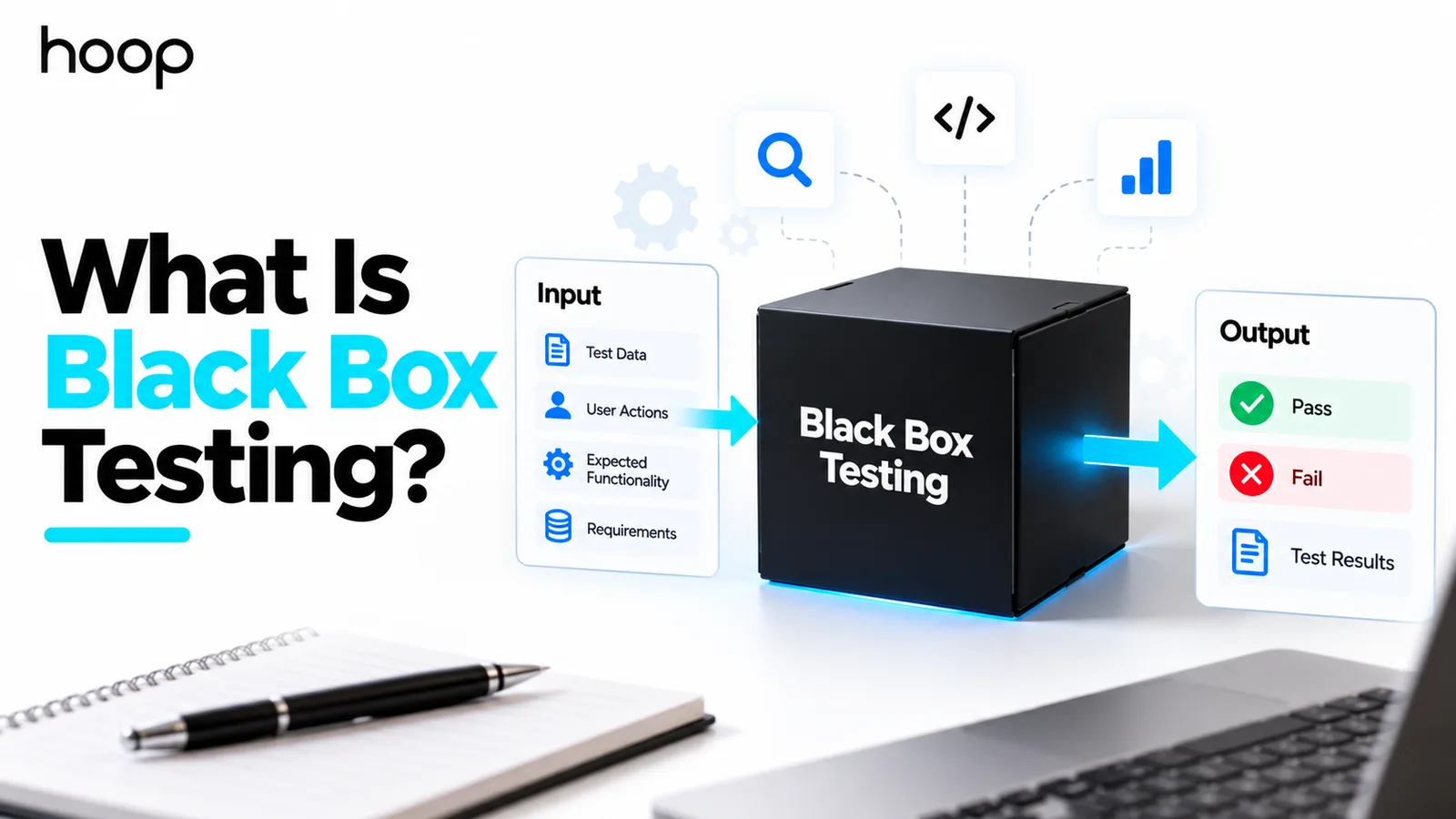
What Is Black Box Testing? Techniques, Examples and Benefits
Black box testing designs tests from the specification, not the code. Inputs go in, observable behavior comes out, and the expected result comes from an independent source of truth — never from what the software currently does.
Sahar
Content Writer
Black box testing checks software through externally observable behavior rather than internal code structure.
Testers provide inputs or actions, compare the resulting outputs with requirements, and decide whether the system behaves correctly.
The tester does not need complete ignorance of the implementation. The test design simply avoids depending on internal code paths.
This approach treats software as a behavioral contract between expected inputs, expected outcomes, and user-visible rules.
Need this done right?
Hoop builds the strategy, design and development behind sites like this one — talk to us about yours.
What Does Black Box Testing Mean?
Black box testing is a specification-based approach to software testing. Tests come from requirements, business rules, interfaces, and expected behavior.
The tester focuses on what the system should do. Internal methods, branches, classes, and algorithms do not define the test cases.
This distinction matters because someone may know the technology stack and still design a black-box test.
The deciding question is simple: did the expected result come from the external contract or from the internal implementation?
Why Is It Called a Black Box?
The name comes from treating the system like a closed box. You can interact with the outside without opening the box.
Imagine a vending machine. You insert money, select a drink, and observe what the machine returns.
You can test correct change, unavailable items, invalid coins, and canceled purchases without inspecting its internal mechanisms.
Software works the same way. The test observes requests, actions, messages, screens, files, or responses that cross the system boundary.
How Does Black Box Testing Work?
To perform black box testing, start with the expected behavior rather than the implementation.
A tester identifies a rule, chooses meaningful inputs, and predicts the correct result. The tester then executes the scenario and compares the result.
Consider a checkout rule stating that orders above $100 receive free standard shipping.
The tester can try $99.99, $100, and $100.01, then compare the displayed shipping charge with the stated rule.
No knowledge of the shipping calculation function is required to design those scenarios.
Where Do Expected Results Come From?
Expected results should come from an independent source of truth. The current implementation should not define its own correct answer.
Useful sources include requirements, acceptance criteria, business rules, API contracts, standards, approved designs, and previously validated behavior.
Suppose a tax rule says an eligible purchase should produce an $8 charge. The current application incorrectly returns $7.
A good test expects $8 because the rule defines correctness. Recording $7 would protect the existing defect instead.
Testers sometimes call the source used to judge correctness a test oracle. The oracle must be trustworthy enough to support the decision.
Does a Black Box Tester Need Access to Source Code?
No. Source-code access is not required for black-box test design.
However, having access does not automatically turn the activity into white-box testing.
A tester may know that the product uses a particular database, framework, or authentication service.
The test remains black box when scenarios come from observable requirements instead of internal statements, branches, or code structure.
This is why the method works well for closed-source tools, third-party services, and external integrations.
How Are Black Box Test Cases Written?
Good test cases begin with a rule that has a clear expected outcome.
The tester then chooses representative conditions that challenge the rule instead of repeating many similar values.
A login test might cover valid credentials, invalid credentials, missing credentials, a locked account, and an expired password.
The same thinking applies to APIs, forms, payment flows, permissions, calculations, and stateful workflows.
Test design becomes stronger when the tester deliberately includes valid, invalid, boundary, and unusual conditions.
What Is Equivalence Partitioning?
Equivalence partitioning divides a large input space into groups expected to behave similarly.
Suppose a quantity field accepts values from 1 through 100. Three useful partitions are below 1, 1 through 100, and above 100.
The tester can select one representative value from each partition, such as 0, 50, and 101.
This reduces repetitive testing while still checking meaningfully different behavior.
The technique works best when values inside each partition are expected to follow the same rule.
What Is Boundary Value Analysis?
Boundary value analysis focuses on the points where a rule changes.
For a valid range of 1 through 100, important values include 0, 1, 2, 99, 100, and 101.
These values matter because defects often appear around minimums, maximums, thresholds, and off-by-one calculations.
This technique is useful for ages, quantities, dates, character limits, balances, pagination limits, and many other numeric rules.
What Is Decision Table Testing?
Decision table testing helps when several conditions combine to determine one outcome.
Imagine a shipping rule that depends on membership status, order value, destination, and promotional eligibility.
Testing each condition alone may miss a problematic combination.
A decision table maps important combinations of conditions to the result each combination should produce.
The technique is especially useful for pricing, eligibility, permissions, approvals, discounts, and insurance rules.
What Is State Transition Testing?
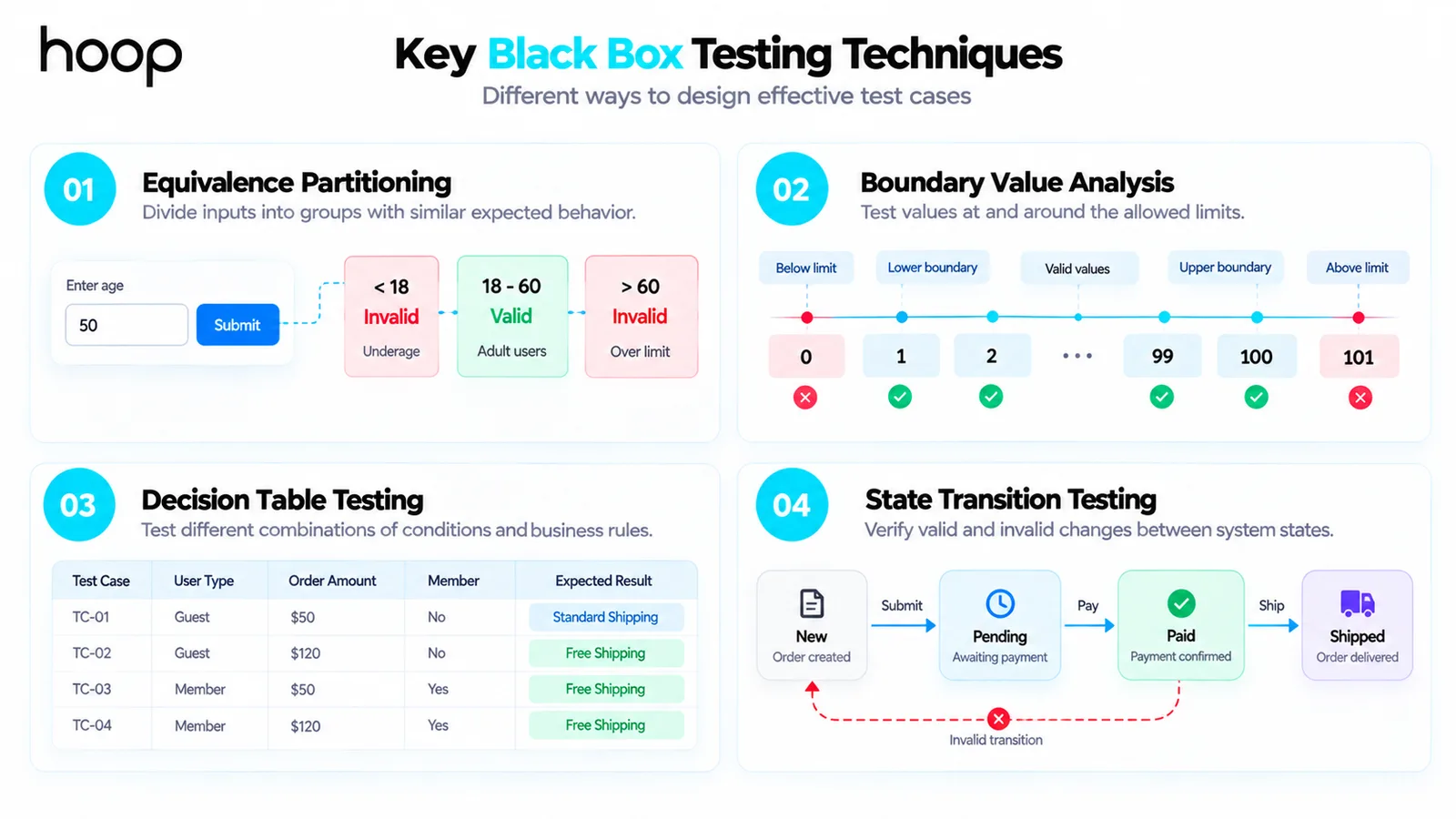
State transition testing checks behavior that changes with the system’s current state.
An order may move from pending to paid, shipped, delivered, canceled, or refunded.
Actions that are valid in one state may be invalid in another.
A tester can verify both allowed transitions and blocked transitions without examining how the state machine is implemented.
This approach is useful for subscriptions, account status, workflows, payment states, and device modes.
Black Box Testing vs White Box Testing
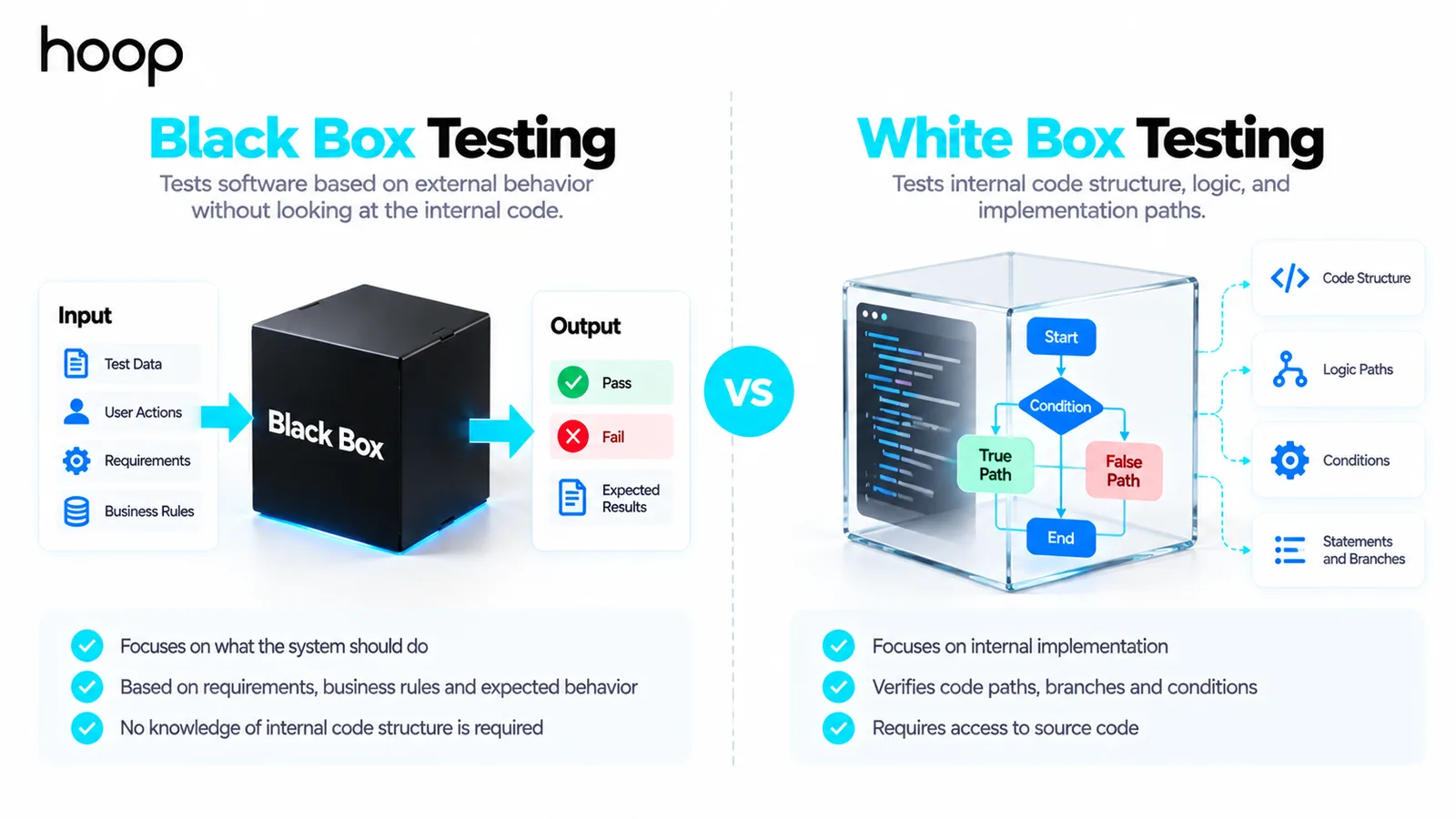
Black-box tests are designed from externally specified behavior. White-box tests are designed from internal code structure and processing.
A black-box test might verify that an expired coupon is rejected. A white-box test might target every branch inside the coupon validation logic.
The first asks whether the product behaves correctly. The second asks whether relevant internal paths received structural coverage.
Neither perspective replaces the other. Combining them gives the team evidence about both external behavior and internal implementation.
Black Box vs Grey Box Testing
Grey-box testing sits between external-only and fully structural approaches.
A grey-box tester may know database structure, architecture, API design, or selected implementation details.
That knowledge can guide scenario selection without requiring complete source-code analysis.
The boundary is not perfectly standardized across companies. The terms mainly communicate how much internal knowledge influences the testing approach.
Is This the Same as Functional Testing?
No. Functional testing describes what quality aspect is being checked, while black box describes how the test is designed.
Many functional tests use a black-box perspective because requirements define the expected behavior.
However, a team can also test usability, security behavior, performance thresholds, and compatibility from an external perspective.
The terms overlap often, but they describe different dimensions of software testing.
Is This the Same as System Testing?
No. System testing is a test level, while black box is a test-design approach.
System testing often uses external behavior because the complete application is being evaluated as one integrated product.
The same external approach can also appear in component, API, acceptance, and integration tests.
Test level describes the scope. Test-design approach describes the information used to choose scenarios and expected results.
Can Unit Testing Use a Black Box Approach?
Yes. A unit test can focus only on the public contract of a small component.
For example, a pricing function may accept a subtotal and membership type, then return a final price.
A test can validate documented inputs and outputs without depending on private helper functions or internal branches.
That test has black-box characteristics even though the test level is unit testing.
Can API Testing Use a Black Box Approach?
Yes. API tests frequently validate externally documented requests and responses without examining endpoint implementation.
For example, an API contract may define a successful response, an authorization failure, and validation errors.
The tester sends each request and checks whether the returned status, data, and error behavior match the contract.
Hoop applies the same contract-focused thinking in its API development services when defining and validating endpoint behavior.
Can This Testing Approach Be Automated?
Yes. Automation changes how tests execute, not the perspective used to design them.
A person can manually enter an invalid date and inspect the error. A script can perform the same action and assert the same message.
The test remains black box when the expected result comes from observable behavior rather than internal implementation.
This makes the approach suitable for browser automation, API regression checks, command-line tests, and other repeatable workflows.
What Interfaces Can Be Tested From the Outside?
Black-box tests are not limited to graphical interfaces. Any observable boundary can become the test surface.
A web application may expose screens and forms. A service may expose HTTP endpoints, events, files, or command-line responses.
A hardware product may expose buttons, lights, sounds, sensors, or network messages.
The tester focuses on the contract visible at that boundary and asks whether each interaction produces the promised behavior.
This makes the approach useful across web, mobile, backend, desktop, embedded, and integration testing.
How Do You Choose the Right Black Box Technique?
Choose the technique that matches the rule you need to challenge.
Use equivalence partitioning when many inputs should behave similarly. Use boundary analysis when limits or thresholds create the main risk.
Use decision tables when several conditions combine to produce different outcomes.
Use state transition testing when the result depends on what happened earlier or which state the system currently holds.
Real features often need more than one technique. A subscription flow may require boundaries for trial dates and states for active, canceled, or expired accounts.
The goal is not to apply every technique mechanically. Select the method that exposes the most important risk with the fewest redundant tests.
How Does the Black Box Approach Support Regression Testing?
Behavioral tests can remain valuable long after the original feature is released.
If a team rewrites an internal service but keeps the same public contract, many external tests can run unchanged.
That stability makes them useful for regression coverage during refactoring, platform migrations, backend replacements, and routine product updates.
The tests still need maintenance when requirements change. Stable automation should protect behavior that users and connected systems continue to depend on.
What Makes a Good Black Box Test?
A good external test starts with a rule that can be judged clearly.
The expected outcome should come from an independent requirement, contract, calculation, or approved business rule.
The scenario should use data chosen for a reason, such as a boundary, invalid condition, permission difference, or important workflow.
Good tests also make failures easy to understand. A failed result should point to the broken behavior instead of producing vague evidence.
Tests become more valuable when they stay stable through internal refactoring and change only when the external contract changes.
That keeps the suite focused on behavior customers and connected systems actually depend on.
Can This Approach Test Performance, Security, and Usability?
Black box testing can evaluate more than functional correctness.
A team can measure response times against an external performance target without inspecting the algorithm that produced them.
Security testers can send malicious or unexpected requests and observe whether authentication, authorization, and error handling resist abuse.
Usability testing can also evaluate what users see and experience without reference to source code.
These tests still need clear expectations. Performance thresholds, security rules, and usability goals should be defined before results are judged.
Internal profiling, code analysis, and structural testing can then explain problems that external evidence reveals.
What Are the Benefits of This Approach?
- It checks behavior from the user or consumer perspective.
- It can work without source-code access or implementation details.
- It stays useful when internal code changes but the external contract remains stable.
- It helps validate business rules, workflows, permissions, inputs, and outputs.
- It works well for third-party systems, APIs, vendor software, and complete applications.
- It supports both manual exploration and automated regression coverage.
What Are the Limitations of This Approach?
An external test cannot prove that every statement, branch, exception path, or internal condition was exercised.
Correct outputs can also hide inefficient algorithms, dead code, unreachable paths, or unsafe implementation patterns.
Fault localization can be harder because a failed external scenario may involve several internal components.
Weak requirements create another problem. A tester cannot confidently judge behavior when the expected result is vague or contradictory.
Input spaces can also become enormous. Structured techniques help select representative scenarios, but exhaustive testing remains unrealistic.
How Is the Black Box Model Used in Security?
Security teams can evaluate a running application from an outside perspective without relying on source code.
The tester may discover entry points, manipulate requests, test authentication boundaries, probe error behavior, and observe the system’s responses.
This outside-in model resembles what an external attacker can see, which makes it valuable for realistic security assessment.
However, limited internal visibility can hide vulnerable code paths. Security programs often combine external testing with code review and other techniques.
When Should You Use This Approach?
This approach is especially useful when the team needs confidence in externally visible behavior.
It fits user workflows, business rules, acceptance criteria, APIs, third-party integrations, and complete system behavior.
It also works well during refactoring or rewrites because tests can remain stable while the implementation changes underneath.
Teams can strengthen this coverage through QA testing services that combine requirements-based scenarios with exploratory, automated, regression, and performance checks.
Common Mistakes With Black Box Tests
- Copying current application outputs and treating them as automatically correct.
- Testing only happy paths while ignoring invalid data and failure conditions.
- Confusing black-box testing with random testing or unstructured clicking.
- Assuming the method must be manual or limited to graphical interfaces.
- Ignoring boundaries, rule combinations, and state transitions.
- Assuming passing external tests prove every internal path is healthy.
- Using black-box coverage as the only testing perspective for the product.
How Should Black Box and White Box Testing Work Together?
Use both perspectives when the risk justifies them.
External tests show whether the product fulfills its observable contract. Structural tests show whether important internal paths received coverage.
Code review, exploratory testing, performance testing, and security analysis add further evidence that neither perspective provides alone.
Hoop integrates these layers across its software development services so quality work happens throughout implementation instead of only before release.
Use External Behavior as One Quality Lens
Black box testing gives teams a disciplined way to verify software from the outside.
It starts with independently defined expectations, then challenges those expectations with representative inputs, boundaries, rules, and state changes.
That perspective is valuable because users and external systems experience behavior rather than source code.
Its limits matter just as much. Passing external tests cannot prove that the internal implementation is complete, efficient, secure, or fully exercised.
The strongest quality strategy combines behavioral tests with structural, exploratory, performance, and security evidence based on product risk.
“Suppose a tax rule says an eligible purchase should produce an $8 charge. The current application incorrectly returns $7. A good test expects $8 because the rule defines correctness.”
Key takeaways
- 01Four core techniques: equivalence partitioning, boundary value analysis, decision tables, and state transitions.
- 02Source-code access does not make a test white box; the design basis does.
- 03Copying current application output as the expected result just locks in the existing defect.
- 04External tests survive refactoring, but cannot prove internal branches were ever exercised.
Written by
Sahar
Content Writer
Frequently Asked
Questions
Everything you need to know before booking a strategy call. Can't find your answer? Contact us directly.
No. It can be manual or automated. Manual versus automated describes execution, while black box describes the basis used for test design.
Yes. Developers can write tests against public behavior without using internal implementation details to design those tests.
No. The observable interface can be a GUI, API, command line, file output, service endpoint, protocol, or hardware interface.
Its strongest advantage is implementation independence. Tests can validate required behavior even when the internal design changes or remains unavailable.
It cannot show whether every important internal branch or code path was exercised. Structural techniques are needed for that evidence.
Keep reading
All articles →
What Is API Testing? How to Test APIs Properly
Oct 12, 2026 · 10 min read
What Is Regression Testing? How It Prevents Old Features From Breaking
Oct 12, 2026 · 10 min read