

What Is Unit Testing? How Developers Test Code in Isolation
A unit test checks one small behavior in isolation and fails for one clear reason. Arrange, act, assert gives it structure; mocks give it isolation; and speed is what makes it worth running constantly.
Sahar
Content Writer
Unit testing checks a small piece of software behavior independently from the rest of the application. Developers provide controlled inputs and verify the expected result.
A unit does not always mean one function. It can be the smallest useful behavior a team can test independently and quickly.
Unit tests give developers a fast feedback loop while they build and change software. They complement integration, API, system, and end-to-end testing.
Need this done right?
Hoop builds the strategy, design and development behind sites like this one — talk to us about yours.
What Does Unit Testing Mean?
Unit testing checks a small, focused piece of software behavior independently from the rest of the application. Developers provide controlled inputs and compare the actual result with the expected result.
A useful unit test should answer one narrow question. It should also fail for a clear reason when that behavior changes unexpectedly.
The goal is fast feedback. Developers can run unit tests repeatedly while coding, refactoring, and reviewing changes.
What Counts as a Unit in Unit Testing?
A unit does not always mean one function. It can be the smallest useful behavior a team can test independently.
That unit might be a function, method, class, module, or small rule. The exact boundary depends on the design and language.
The important point is isolation. The test should focus on one behavior without depending on the entire application.
What Does a Simple Unit Test Look Like?
Imagine an ecommerce function that applies a 20 percent discount to a $100 order. The expected total is $80.
A unit test supplies those inputs, runs the calculation, and checks whether the result equals $80. If the code later returns $75, the test fails.
That failure gives the developer immediate evidence that the expected behavior changed. The test also identifies the affected area quickly.
How Does Arrange, Act, Assert Work?
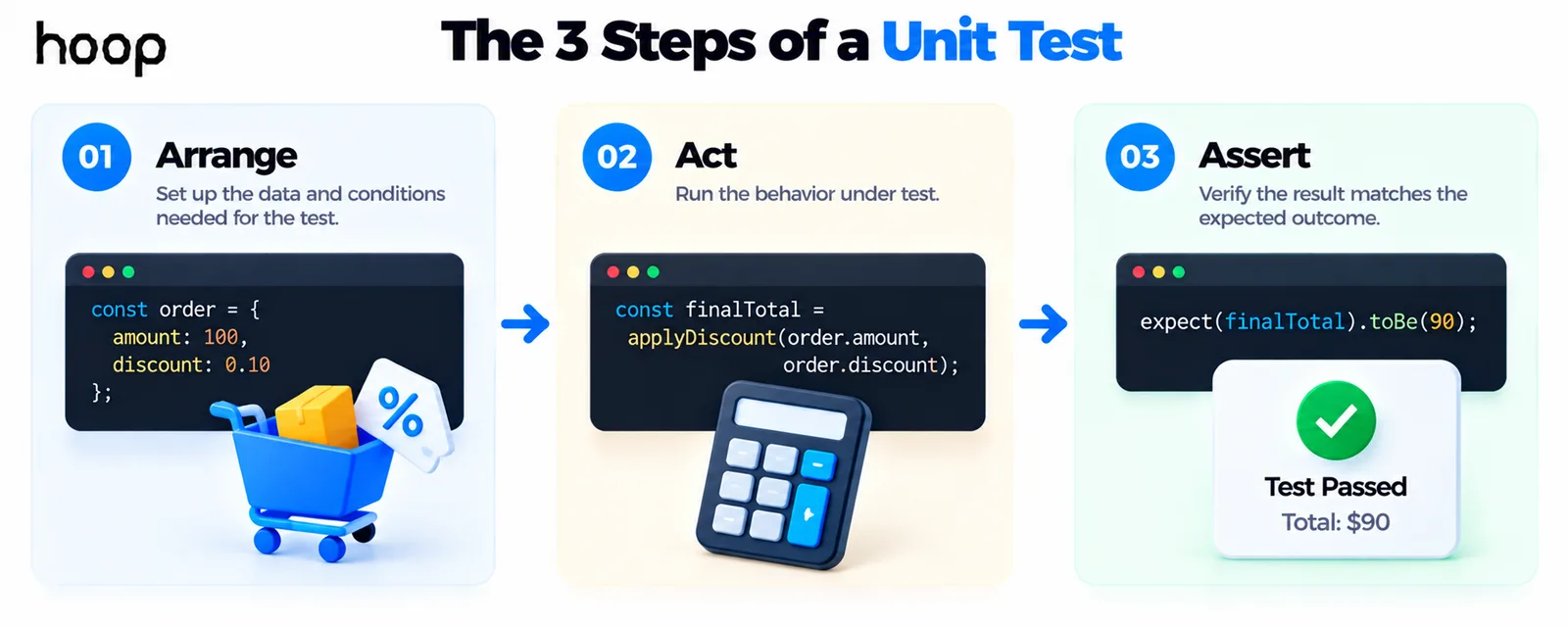
Many unit tests follow the Arrange, Act, Assert pattern. It gives tests a simple structure and makes their purpose easier to read.
Arrange
Arrange the data and conditions needed for the test. For example, create an order worth $100 and define a 10 percent discount.
Act
Act by running the behavior under test. In this example, call the discount calculation once.
Assert
Assert that the result matches the expected outcome. The final order total should equal $90.
Why Does Isolation Matter in Unit Testing?
Isolation keeps failures easy to understand. A test should ideally fail because the unit is wrong, not because another service failed.
Real databases, live APIs, filesystems, and network calls introduce extra failure points. They can also make tests slower and less predictable.
A unit test usually replaces those outside dependencies with controlled alternatives. This keeps the feedback focused on the behavior being tested.
What Makes a Good Unit Test?
A good unit test is fast, repeatable, readable, and independent. It should produce the same result when the relevant code has not changed.
The test should describe expected behavior clearly. A developer should understand the scenario and failure without reading the entire implementation.
Tests should also run in any order. One test should not depend on another test preparing hidden state first.
What Should You Unit Test?
Prioritize behavior where mistakes would matter or where the correct outcome is not obvious. Business rules are often strong candidates.
Useful examples include pricing rules, permissions, validation, data conversion, date calculations, state changes, and error handling.
Simple getters or framework-generated code may offer little value when their behavior is already obvious. Testing effort should follow risk and complexity.
Why Should Unit Tests Cover Edge Cases?
A happy-path test proves only one expected scenario. Real defects often appear around boundaries, invalid inputs, and unusual conditions.
Consider a withdrawal function. Testing a $20 withdrawal from a $100 balance checks only the normal path.
Stronger coverage also checks zero, negative values, insufficient funds, large values, and invalid input. These cases expose hidden assumptions.
Unit Testing vs Integration Testing
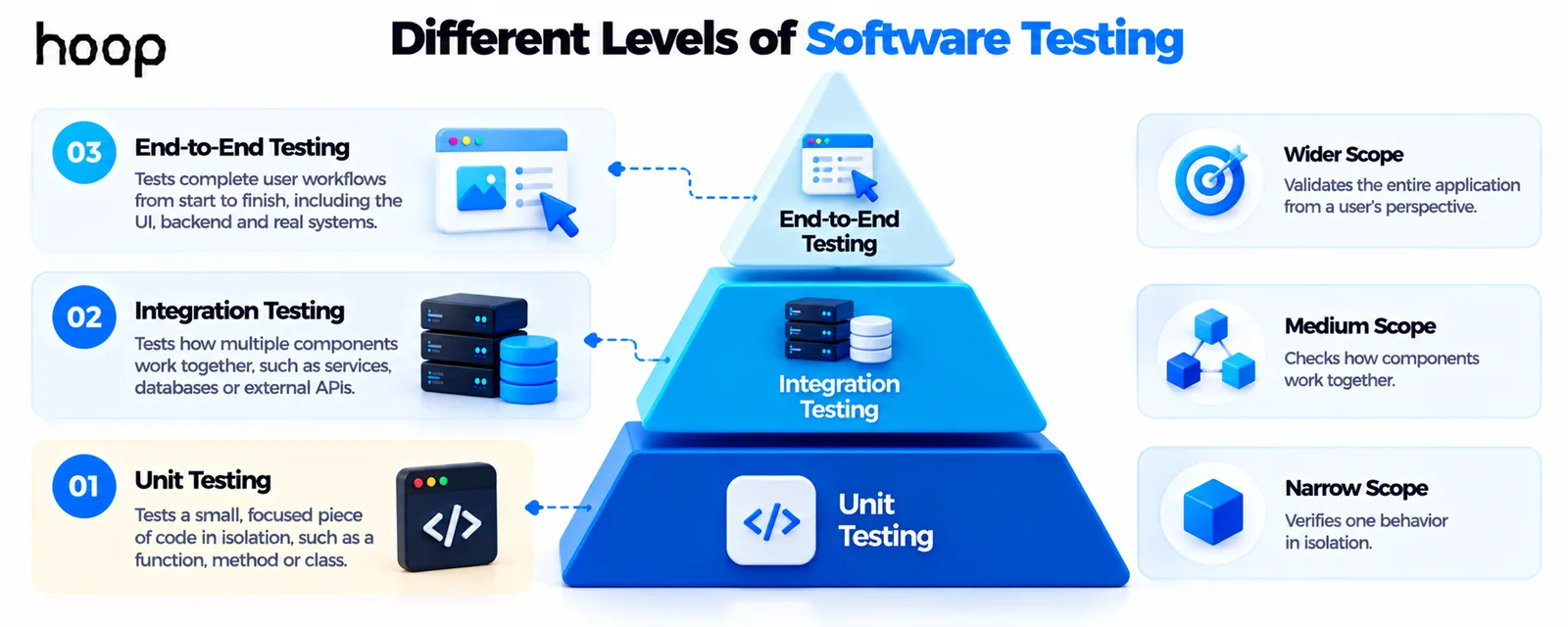
Unit testing asks whether one focused behavior works correctly by itself. Integration testing asks whether multiple components work correctly together.
A unit test may replace a payment provider with a controlled response. An integration test may call the real payment sandbox.
Both test levels are useful. Unit tests give fast, precise feedback, while integration tests expose problems between components.
Unit Testing vs End-to-End Testing
End-to-end testing checks a complete user workflow across many parts of the system. Unit testing stays much smaller and more isolated.
An end-to-end test might open checkout, place an order, process payment, and confirm the receipt. A unit test may only check tax logic.
End-to-end tests provide broad confidence but usually cost more time to run and maintain. Unit tests are better for frequent developer feedback.
Unit Testing vs Regression Testing
Unit testing describes the level or scope of a test. Regression testing describes the purpose of rerunning tests after software changes.
A unit test can become regression protection once it guards behavior that already works. The same test may serve both purposes.
This distinction matters because regression testing can also happen at integration, API, system, or user-interface levels.
What Are Mocks, Stubs, and Fakes?
Mocks, stubs, and fakes are test doubles. They replace dependencies so the unit can be tested under controlled conditions.
A stub may return a prepared value from a dependency. A fake may provide a lightweight working implementation for tests.
A mock can also verify an expected interaction. For example, it may confirm that checkout requested one payment authorization.
When Can Mocking Make Unit Tests Worse?
Mocking becomes harmful when tests know too much about internal implementation. Small refactors can then break tests without changing real behavior.
That creates maintenance work and reduces trust in the suite. Developers may start fixing tests instead of improving the product.
Use mocks where dependencies need control or isolation. Avoid mocking every internal method simply because the testing framework allows it.
Why Should Unit Tests Focus on Behavior?
Behavior-focused tests check what the code promises to do. Implementation-focused tests check exactly how the code currently performs that work.
The first approach usually survives refactoring better. Private helper methods can change while the public result remains correct.
A useful rule is simple. Test the contract that matters to callers, not every internal step used to produce it.
Should Unit Tests Access a Real Database?
Usually, a test that depends on a real database is closer to an integration test. The database adds external state and infrastructure behavior.
A focused unit test can replace data access with a fake repository or controlled interface. That keeps the test fast and deterministic.
Database behavior still needs testing. It simply belongs in a different layer where the real integration is intentionally part of the test.
What Is Code Coverage in Unit Testing?
Code coverage measures how much code executes while tests run. It can expose areas that receive little or no automated exercise.
Coverage does not measure test quality. A test can execute a line without checking whether the outcome is correct.
Treat coverage as a diagnostic signal, not a score to maximize blindly. Important behavior matters more than impressive percentages.
Does 100 Percent Coverage Mean There Are No Bugs?
No. Complete line coverage does not prove that every meaningful input, interaction, or business rule has been tested.
Unit coverage also cannot prove that databases, APIs, interfaces, deployment settings, and complete user workflows work together correctly.
High coverage can support confidence, but it cannot replace thoughtful test design or other testing levels.
How Should Unit Tests Handle Time and Randomness?
Time and randomness can make tests unpredictable when they are read directly from the environment. A passing test may fail later without code changes.
Developers can inject a fixed clock, seeded random source, or prepared identifier generator. That keeps the scenario controlled and repeatable.
The same principle applies to environment variables and machine-specific settings. Unit tests should control inputs that affect the behavior being checked.
What Is a Flaky Unit Test?
A flaky test sometimes passes and sometimes fails without a relevant code change. That behavior weakens confidence in the entire test suite.
Common causes include shared state, timing assumptions, uncontrolled randomness, race conditions, and hidden external dependencies. These problems should be investigated quickly.
Repeatedly rerunning a flaky test until it passes is not a reliable fix. The test should become deterministic or move to a better test layer.
How Should Unit Tests Be Named?
A good test name should communicate the scenario and expected result. Clear names make failures easier to understand during development and review.
For example, a name can describe that an expired coupon returns no discount. That is clearer than a vague name such as testCouponTwo.
Consistent naming also improves tests as documentation. Teams can scan the suite and understand which business rules already have automated coverage.
Which Unit Testing Frameworks Do Developers Use?
Most programming ecosystems provide mature unit testing frameworks. The framework supplies test discovery, assertions, setup tools, and reporting.
JavaScript teams may use Jest or Vitest. Python projects often use pytest, while .NET teams commonly use xUnit, NUnit, or MSTest.
Framework choice matters less than test quality. A well-designed test should remain focused, fast, readable, and useful regardless of the chosen tool.
How Does Unit Testing Make Refactoring Safer?
Refactoring changes the internal structure of code without intentionally changing its visible behavior. Good unit tests protect that expected behavior.
Developers can restructure logic, improve names, or split classes, then rerun the suite immediately. Unexpected behavior changes appear quickly.
This feedback reduces fear around modifying older code. It also makes gradual cleanup more practical during normal development.
Can Unit Tests Act as Documentation?
Yes. Clear tests can show future developers exactly how a piece of behavior is expected to work.
A cancellation-fee test may show the expected percentage for different notice periods. That example can be clearer than a long comment.
Tests only work as documentation when names and scenarios remain readable. Cryptic tests provide much less value.
Who Usually Writes Unit Tests?
Developers usually write unit tests because they understand the code boundary and can run the tests while making changes.
Quality Assurance teams may review risk, improve scenarios, or contribute automation. Responsibilities still vary between organizations.
Unit testing works best when developers treat it as part of implementation, not as a separate cleanup task before release.
Is Test-Driven Development the Same as Unit Testing?
No. Unit testing is a testing approach, while Test-Driven Development is a development workflow.
Test-Driven Development usually starts with a failing test. The developer writes enough code to pass it, then improves the design.
Teams can write unit tests without using Test-Driven Development. Test-Driven Development simply uses fast tests as part of its feedback cycle.
How Can Unit Testing Improve Software Design?
Unit testing can expose tightly coupled code because hidden dependencies make isolated testing difficult. That friction can reveal unclear boundaries.
Developers may respond by separating responsibilities and making dependencies explicit. These choices also support custom software development that remains easier to maintain and extend.
Testing difficulty does not automatically prove that design is poor. Some software legitimately depends on complex platform or infrastructure behavior.
How Do Unit Tests Work in CI/CD?
Unit tests fit naturally into continuous integration because they are usually fast. Cloud and DevOps services can automate these checks whenever code changes.
A failed unit test can stop a build before slower integration or deployment stages begin. That prevents obvious defects from moving downstream.
When Does Unit Testing Provide Less Value?
Some behaviors are difficult to isolate without replacing nearly everything around them. In those cases, a broader test may provide clearer confidence.
Thin wrappers around frameworks can also produce low-value tests when the only assertion repeats the framework’s own documented behavior.
The right question is not whether every line has a dedicated test. Ask which test level gives useful evidence with reasonable maintenance cost.
Teams should still protect risky logic inside these areas. They can choose integration or system tests when those layers match the real behavior better.
Benefits of Unit Testing
- Fast feedback helps developers catch mistakes while the changed code is still fresh.
- Focused failures make defects easier to locate than broad end-to-end failures.
- Regression protection helps preserve expected behavior during future changes.
- Repeatable checks support safer refactoring and routine code cleanup.
- Readable tests can document important business rules and edge cases.
Common Unit Testing Mistakes
- Testing private implementation details instead of stable behavior.
- Mocking every dependency until tests no longer resemble real usage.
- Chasing code coverage percentages instead of meaningful scenarios.
- Ignoring edge cases and testing only normal successful inputs.
- Allowing tests to depend on execution order, live services, or shared state.
- Writing slow tests that developers stop running during normal development.
How Does Unit Testing Fit Into a Broader QA Strategy?
Unit testing provides fast developer feedback, but it cannot prove the complete product works. Broader testing must cover connected systems and users.
API, integration, regression, accessibility, performance, and exploratory testing answer different questions. A healthy testing strategy combines the right layers.
Professional QA testing services can add those wider checks while developers continue protecting small code behaviors with unit tests.
Fast Feedback at the Smallest Scale
Unit testing gives developers a fast way to check small pieces of behavior under controlled conditions. It makes failures easier to localize and fix.
The strongest unit tests focus on behavior, avoid unnecessary dependencies, and cover important edge cases. They also remain readable during refactoring.
Unit testing is only one layer of software quality. Combine it with broader testing so the complete product remains dependable as it changes.
“A test can execute a line without checking whether the outcome is correct. Treat coverage as a diagnostic signal, not a score to maximize blindly.”
Key takeaways
- 01A "unit" is the smallest behavior you can test independently — not necessarily one function.
- 02Test the contract callers depend on, not internal steps, or refactors will break tests that should pass.
- 03Code coverage shows what executed, not what was verified. It is a diagnostic, not a target.
- 04Flaky tests are worse than missing ones: they teach the team to ignore red.
Written by
Sahar
Content Writer
Frequently Asked
Questions
Everything you need to know before booking a strategy call. Can't find your answer? Contact us directly.
Yes. Unit tests are normally automated because developers need fast, repeatable feedback after code changes.
No. Unit tests find defects inside tested units, but they cannot prove that the complete system works correctly.
A strict unit test usually replaces live API calls with controlled test doubles. Real API calls move the test toward integration testing.
There is no universal target. Teams should cover important behavior, edge cases, and risky logic without creating low-value maintenance work.
No. Test meaningful behavior and risk. Trivial generated code or obvious pass-through methods may not justify dedicated tests.
Keep reading
All articles →
What Is Regression Testing? How It Prevents Old Features From Breaking
Oct 12, 2026 · 10 min read
What Is Software Testing? Types, Methods and How It Works
Oct 12, 2026 · 9 min read