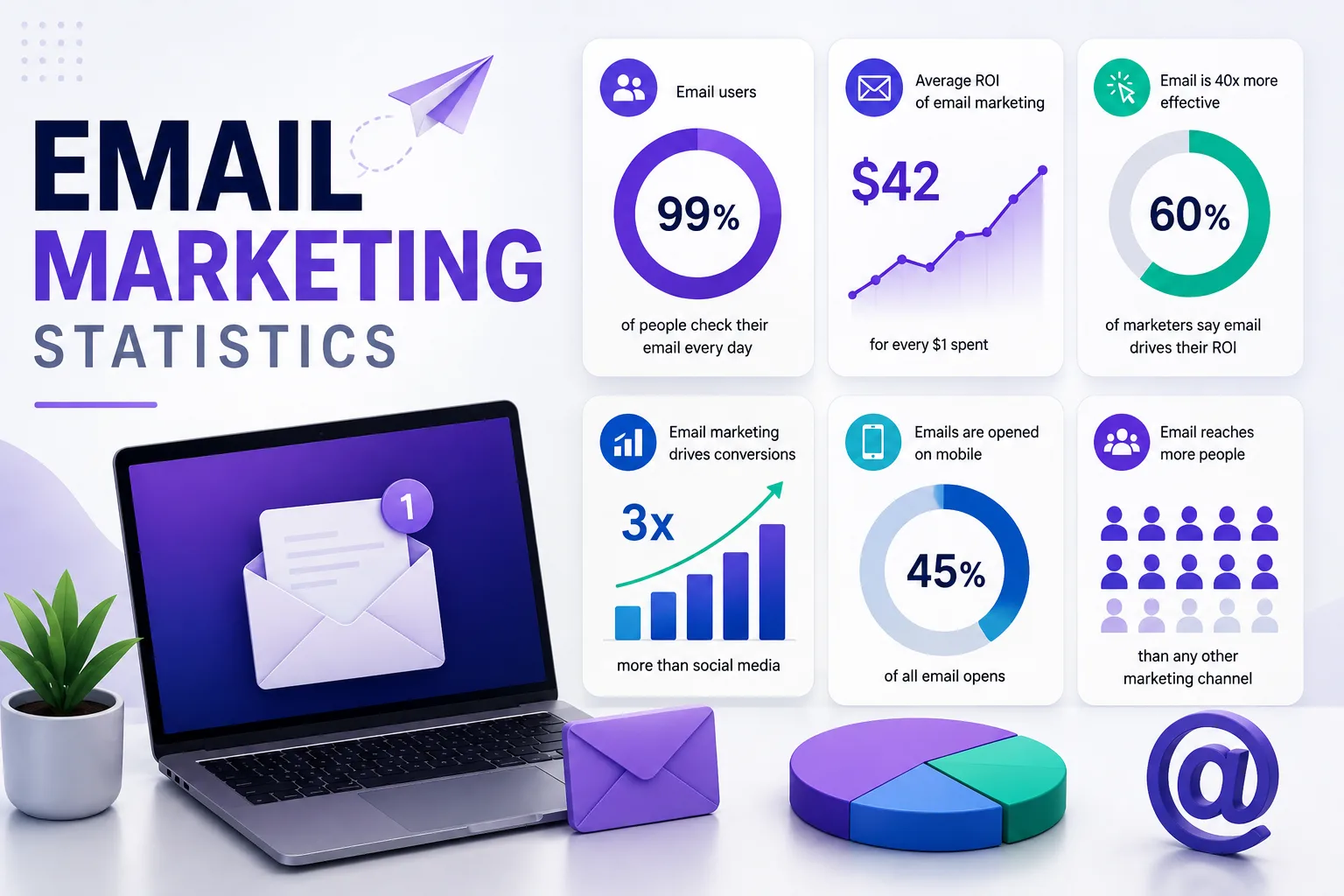
Email Marketing Statistics 2026: Open Rates, ROI & More
Email still earns its budget because it is owned, direct, and measurable — but privacy changes have broken open rates as a standalone metric. Judge campaigns on clicks, conversions, revenue per recipient, and deliverability, and treat list quality as more valuable than list size.
Sahar
Content Writer
Looking for the latest email marketing statistics to improve your campaigns? This guide explores the most important trends, including email open rates, ROI, click-through rates, automation, and customer engagement. Whether you’re a business owner or marketer, these insights will help you build smarter email strategies and achieve better results in 2026.
Why Email Marketing Still Matters in 2026
With the rise of artificial intelligence, social media platforms, short-form videos, and instant messaging apps, many marketers are asking the same question: is email marketing still worth investing in?
The latest email marketing statistics provide a clear answer. Email remains one of the most effective digital marketing channels because it allows businesses to communicate directly with their audience without relying on changing social media algorithms or expensive advertising campaigns. Unlike platforms where visibility depends on paid promotions, email gives brands complete control over how and when they connect with subscribers.
Businesses also value email because it supports the entire customer journey. From welcoming new subscribers and nurturing leads to recovering abandoned baskets and encouraging repeat purchases, email marketing helps brands build stronger relationships over time. Instead of focusing on one-time sales, businesses can use email to create long-term customer loyalty.
Another reason email marketing continues to deliver strong results is personalisation. Modern email platforms allow businesses to send highly relevant messages based on customer behaviour, interests, and purchase history. This creates a better experience for subscribers while improving engagement and conversions.
As competition continues to grow across digital channels, email remains one of the few marketing strategies that combines affordability, scalability, and measurable performance. Businesses that invest in building quality subscriber lists and delivering valuable content continue to see consistent returns.
The Current State of Email Marketing
Email marketing has changed significantly over the last few years. Sending the same newsletter to every subscriber is no longer enough. Today’s customers expect personalised experiences that match their interests and stage of the buying journey.
This shift has encouraged businesses to focus more on segmentation and automation. Rather than treating every subscriber the same, marketers now group audiences based on demographics, behaviour, previous purchases, or engagement levels. This allows them to deliver more relevant content, increasing both customer satisfaction and campaign performance.
Artificial intelligence is also influencing how businesses create email campaigns. AI-powered tools can generate subject line ideas, recommend sending times, personalise content, and analyse campaign performance. However, successful campaigns still depend on human creativity and understanding of customer needs.
Privacy has become another important consideration. Changes in email tracking and growing consumer awareness around data protection mean marketers can no longer rely solely on open rates to measure success. Instead, businesses increasingly evaluate campaign performance using multiple metrics, including click-through rates, conversions, revenue, and customer retention.
Despite these changes, email marketing continues to evolve rather than decline. Businesses that adapt to new technologies while maintaining a customer-first approach are achieving stronger results than ever before.
Key Email Marketing Statistics Every Marketer Should Know
The latest email marketing statistics reveal several important trends shaping digital marketing strategies worldwide.
Email continues to deliver one of the highest returns on investment among all digital marketing channels. Businesses consistently choose email because it combines relatively low costs with the ability to reach highly targeted audiences.
Mobile usage remains a major factor influencing campaign performance. Most subscribers now open emails on smartphones before switching to other devices. This makes responsive email design essential for improving engagement and reducing bounce rates.
Automation is becoming standard practice rather than a competitive advantage. Businesses increasingly use automated email sequences to welcome subscribers, nurture leads, remind customers about abandoned baskets, and encourage repeat purchases. These campaigns save time while delivering more consistent communication.
Personalisation also continues to influence results. Subscribers are far more likely to engage with emails that reflect their interests, previous interactions, or purchasing behaviour than generic promotional messages.
Another important trend is audience quality. Growing subscriber lists is valuable, but maintaining an engaged audience is even more important. Businesses that regularly remove inactive subscribers often experience better deliverability and stronger campaign performance.
These developments highlight an important lesson: successful email marketing depends less on sending more emails and more on sending the right message to the right audience at the right time.
Email Marketing ROI Statistics
One of the biggest reasons businesses continue investing in email marketing is its impressive return on investment. Unlike many other marketing channels, email supports both customer acquisition and customer retention, making it valuable throughout the entire sales funnel.
A single email campaign can introduce a new product, educate potential customers, recover abandoned purchases, promote seasonal offers, and encourage repeat business. Few marketing channels provide this level of flexibility while remaining cost-effective.
However, achieving strong ROI requires more than simply sending promotional emails. Businesses seeing the best results focus on delivering consistent value. Educational newsletters, helpful resources, exclusive offers, and personalised recommendations often outperform constant sales messages because they strengthen customer relationships. Creating high-quality educational content through a well-planned content marketing strategy gives businesses valuable resources to share in email campaigns and keeps subscribers engaged over time.
Another factor influencing ROI is automation. Automated workflows allow businesses to communicate with customers based on their actions rather than fixed schedules. Welcome emails, follow-up sequences, birthday offers, and post-purchase campaigns continue generating results with minimal ongoing effort.
The latest email marketing statistics also show that businesses measuring revenue instead of vanity metrics make better marketing decisions. Open rates remain useful, but revenue per campaign, customer lifetime value, and conversion rates provide a more complete picture of success.
Email Open Rate Statistics
Open rates remain one of the most discussed email marketing metrics, but their role has evolved. While marketers still use open rates to understand audience engagement, privacy updates have made them less reliable as a standalone performance indicator.
Instead of asking, “What is a good open rate?” businesses should ask whether subscribers are interacting with content and completing desired actions. Several factors continue to influence email open rates.
The subject line remains one of the biggest drivers of engagement. Clear, relevant, and curiosity-driven subject lines encourage more people to open emails than generic promotional headlines.
Sender reputation is equally important. Subscribers are more likely to open emails from brands they recognise and trust. Consistency in branding and communication helps build that trust over time.
Timing also affects campaign performance. While there is no universal best time to send emails, analysing audience behaviour helps businesses identify when subscribers are most likely to engage.
Finally, list quality has a direct impact on open rates. Businesses that regularly clean inactive subscribers and focus on permission-based marketing generally achieve stronger engagement than those prioritising subscriber numbers alone.
Rather than chasing higher open rates for their own sake, marketers should focus on delivering relevant content that encourages meaningful customer interaction.
Why Email Performance Is Changing

Many marketers have noticed changes in campaign performance over the past few years and wonder whether email marketing has become less effective. In reality, the channel itself remains strong, but audience expectations have changed.
Subscribers now receive dozens of marketing emails every week. As a result, they have become more selective about which messages they open and engage with. Generic promotions, repetitive content, and excessive email frequency often lead to lower engagement or increased unsubscribe rates.
Successful businesses respond by prioritising relevance over volume. They use customer data to personalise campaigns, segment audiences, and deliver content that aligns with subscriber interests.
Deliverability also plays an increasingly important role. Even the best-designed email cannot generate results if it never reaches the inbox. Maintaining a healthy sender reputation, avoiding spam-triggering practices, and following permission-based marketing principles all contribute to better campaign performance.
Ultimately, the latest email marketing statistics reinforce a simple principle: businesses that focus on customer value rather than simply increasing email volume consistently achieve stronger engagement, better ROI, and long-term marketing success.
Email Click-Through and Conversion Statistics
While open rates often receive the most attention, they only tell part of the story. The latest email marketing statistics show that clicks, conversions, and revenue provide a much clearer picture of campaign success. An email that generates purchases or enquiries is far more valuable than one that is simply opened.
Click-through rates continue to reflect how relevant and engaging an email is. Subscribers are more likely to click when the content solves a problem, introduces something useful, or presents a compelling offer. A clear call to action, concise copy, and an easy-to-follow layout all contribute to stronger engagement.
Conversions are even more important because they measure the action that matters most to the business. Depending on the campaign, this could include making a purchase, booking a consultation, downloading a guide, or signing up for a webinar. Businesses that optimise every stage of the customer journey, from email content to landing page experience, consistently achieve better conversion rates.
Another noticeable trend is the growing importance of testing. Marketers who regularly test subject lines, layouts, images, and calls to action gain valuable insights into what resonates with their audience. Small improvements across multiple campaigns often lead to significant long-term growth.
Instead of measuring success through a single metric, businesses should evaluate the complete customer journey. Looking at clicks, conversions, and revenue together provides a more accurate understanding of campaign performance.
The Role of AI in Email Marketing
Artificial intelligence is transforming how businesses create, manage, and optimise email campaigns. However, the latest email marketing statistics suggest that AI works best as a tool to support marketers rather than replace them.
AI can analyse customer behaviour, recommend the best time to send emails, personalise product recommendations, and generate subject line ideas. These features help marketers save time while improving campaign relevance.
Personalisation has become one of AI’s biggest strengths. Instead of sending identical emails to every subscriber, businesses can tailor content based on browsing history, previous purchases, engagement levels, or customer preferences. This creates a more personalised experience that encourages higher engagement.
AI is also improving campaign optimisation. Marketers can quickly identify which emails perform best, understand audience behaviour, and refine future campaigns using performance insights. This allows businesses to make smarter decisions without relying on guesswork.
Although AI offers many advantages, it cannot replace genuine brand voice or human creativity. Subscribers still respond best to authentic communication that reflects the values and personality of a business. The most successful brands combine AI-powered efficiency with thoughtful, customer-focused content.
Email Automation Statistics
Automation has become one of the most valuable features of modern email marketing. Businesses no longer need to manually send every message because automated workflows allow communication to happen at the right moment.
Welcome emails remain one of the most effective automated campaigns because they reach subscribers when interest is highest. A strong welcome sequence introduces the brand, builds trust, and encourages early engagement.
Abandoned basket emails also continue to perform well. Many online shoppers leave products in their basket before completing a purchase. Automated reminders help recover a significant number of these potential sales by encouraging customers to return and finish the checkout process.
Post-purchase emails strengthen customer relationships after a sale. Businesses use these campaigns to share helpful product information, request reviews, recommend related products, or encourage repeat purchases.
Re-engagement campaigns are equally valuable. Instead of allowing inactive subscribers to remain on an email list indefinitely, businesses can automatically identify disengaged contacts and encourage them to reconnect before removing them if necessary.
Automation not only saves time but also ensures customers receive timely, relevant communication throughout their relationship with a business.
Personalisation and Customer Engagement

Personalisation has evolved far beyond including a subscriber’s first name in the subject line. Today’s customers expect businesses to understand their interests and provide content that feels relevant.
The latest email marketing statistics highlight that personalised campaigns generally achieve stronger engagement than generic broadcasts. Customers are more likely to interact with recommendations based on previous purchases, browsing behaviour, or demonstrated interests.
Segmentation plays a crucial role in achieving this. By dividing subscribers into meaningful groups, businesses can create targeted campaigns that address specific needs rather than sending the same message to everyone.
Behaviour-based emails are particularly effective because they respond to customer actions. Whether someone downloads a guide, visits a pricing page, or abandons a purchase, timely follow-up emails help maintain momentum and improve conversion opportunities.
Personalisation also strengthens customer loyalty. When subscribers consistently receive useful and relevant content, they are more likely to remain engaged and view the brand as trustworthy.
What These Statistics Mean for Businesses
The latest email marketing statistics show that email remains one of the most reliable ways to build customer relationships and generate consistent business growth. However, success depends on strategy rather than volume.
Businesses achieving the strongest results prioritise relevance, personalisation, automation, and continuous optimisation. They understand their audience, monitor performance, and adapt campaigns based on real customer behaviour instead of assumptions.
Email marketing also works best when integrated with the wider digital marketing strategy. Combining email with SEO, content marketing, social media, and paid advertising creates a more consistent customer experience while strengthening overall campaign performance.
As customer expectations continue to evolve, businesses that focus on delivering helpful, timely, and valuable communication will remain ahead of competitors. Rather than asking whether email marketing still works, marketers should focus on how they can use it more effectively to build lasting relationships and drive measurable results.
Email Marketing Trends to Watch in 2026
The latest email marketing statistics show that the future of email marketing is not about sending more emails — it’s about sending smarter ones. Businesses that understand changing customer expectations and adopt modern strategies will continue to outperform competitors.
One of the biggest trends is the increasing use of first-party data. As privacy regulations become stricter and third-party cookies continue to disappear, businesses are placing greater value on information collected directly from their subscribers. This allows marketers to create more personalised campaigns while respecting customer privacy.
Interactive emails are also becoming more popular. Features such as polls, quizzes, product carousels, appointment booking, and interactive buttons encourage subscribers to engage without leaving their inbox. This creates a smoother customer experience and often leads to higher engagement.
Another important trend is predictive personalisation. Instead of reacting to customer behaviour, businesses are beginning to anticipate what subscribers are likely to need next. By analysing browsing habits, previous purchases, and engagement history, marketers can send highly relevant recommendations that improve both customer satisfaction and conversions.
Accessibility is another area receiving increased attention. Businesses are designing emails that are easy to read for everyone by using clear fonts, descriptive image text, logical layouts, and sufficient colour contrast. Accessible emails improve the user experience while expanding audience reach.
The most successful brands are also focusing on relationship building rather than constant promotion. Educational newsletters, industry updates, exclusive insights, and useful resources help businesses remain valuable even when subscribers are not ready to buy immediately.
What Every Marketer Should Measure
Modern email marketing success cannot be measured using a single number. While open rates remain useful, they should always be considered alongside other key performance indicators.
Marketers should regularly monitor click-through rates to understand whether subscribers find email content engaging enough to take action. Conversion rates provide an even clearer picture because they show how many recipients complete the desired goal after clicking.
Revenue generated from email campaigns remains one of the most important business metrics. Tracking income instead of focusing only on engagement helps marketers understand which campaigns contribute most to business growth.
Subscriber growth also deserves attention, but quality should always take priority over quantity. A smaller list of engaged subscribers usually delivers stronger results than a large database filled with inactive contacts.
Unsubscribe rates and spam complaints provide valuable insights into audience satisfaction. If these metrics increase, businesses should review email frequency, content relevance, and audience segmentation to identify possible issues.
Deliverability is another essential metric. Even the best-designed email campaign cannot perform well if messages fail to reach subscribers’ inboxes. Maintaining a strong sender reputation should remain a priority for every business.
By monitoring these metrics together, marketers gain a complete understanding of campaign performance and can make informed decisions that improve future results.
Conclusion
The latest email marketing statistics confirm that email remains one of the most effective and reliable digital marketing channels for businesses of all sizes. As customer expectations continue to evolve, brands that prioritise personalisation, automation, relevance, and valuable content consistently achieve higher engagement, stronger customer relationships, and better long-term results.
Rather than focusing only on open rates, successful marketers measure the complete customer journey through clicks, conversions, revenue, and customer retention. These insights help businesses optimise their campaigns, improve decision-making, and maximise the return on every email they send.
Email marketing has become much more than a promotional tool. It plays a vital role in lead nurturing, customer education, retention, and sustainable business growth. When combined with a strategic digital marketing approach, email can become one of your most valuable channels for driving measurable results.
If you’re looking to build high-performing email campaigns that increase engagement, generate more conversions, and deliver measurable ROI, contact Hoop Interactive today. Our team creates data-driven email marketing strategies tailored to your business goals, helping you connect with your audience and achieve long-term growth.
“Successful email marketing depends less on sending more emails and more on sending the right message to the right audience at the right time.”
Key takeaways
- 01Most subscribers open on mobile first, so responsive design is a baseline requirement.
- 02Segmentation and behaviour-triggered sends consistently outperform generic broadcasts.
- 03Automation — welcome, abandoned basket, post-purchase, re-engagement — carries most of the return.
- 04Cleaning inactive subscribers improves deliverability more than chasing list growth.
Written by
Sahar
Content Writer
Frequently Asked
Questions
Everything you need to know before booking a strategy call. Can't find your answer? Contact us directly.
Yes. Email remains one of the highest-performing digital marketing channels. It helps businesses generate leads, nurture customer relationships, improve retention, and achieve excellent long-term ROI.
A good open rate varies depending on the industry, audience, and campaign type. Rather than comparing numbers with competitors, monitor your own performance and aim for continuous improvement while focusing on clicks and conversions as well.
AI helps marketers personalise campaigns, automate workflows, optimise subject lines, and analyse campaign performance. However, the best results come from combining AI-powered tools with authentic, human-written content.
There is no universal schedule. The ideal frequency depends on your audience and industry. Consistency and relevance are far more important than sending emails as often as possible.
Sending generic emails to every subscriber is one of the most common mistakes. Audience segmentation, personalisation, and valuable content consistently produce better engagement and stronger customer relationships.
Keep reading
All articles →
AI in Digital Marketing in 2026: What Small Businesses Need to Know
Aug 6, 2026 · 11 min read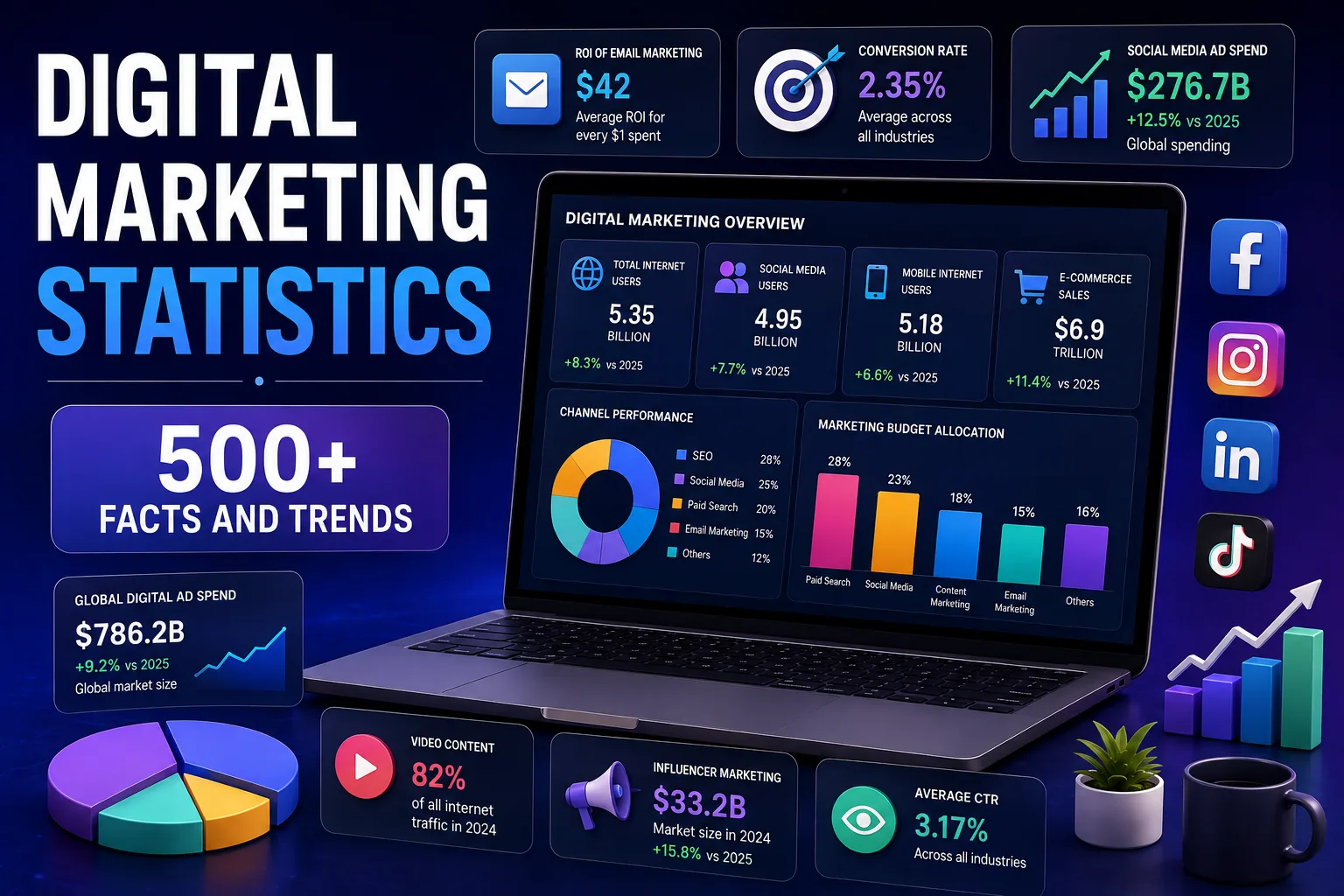
Digital Marketing Statistics 2026: 500+ Facts and Trends
Aug 6, 2026 · 10 min read