What Is CRM in Marketing? Meaning, Examples, and Benefits
CRM in marketing means using customer records and interaction history to decide who hears which message and when. The data makes the segmentation possible; the process makes it useful.
Sahar
Content Writer
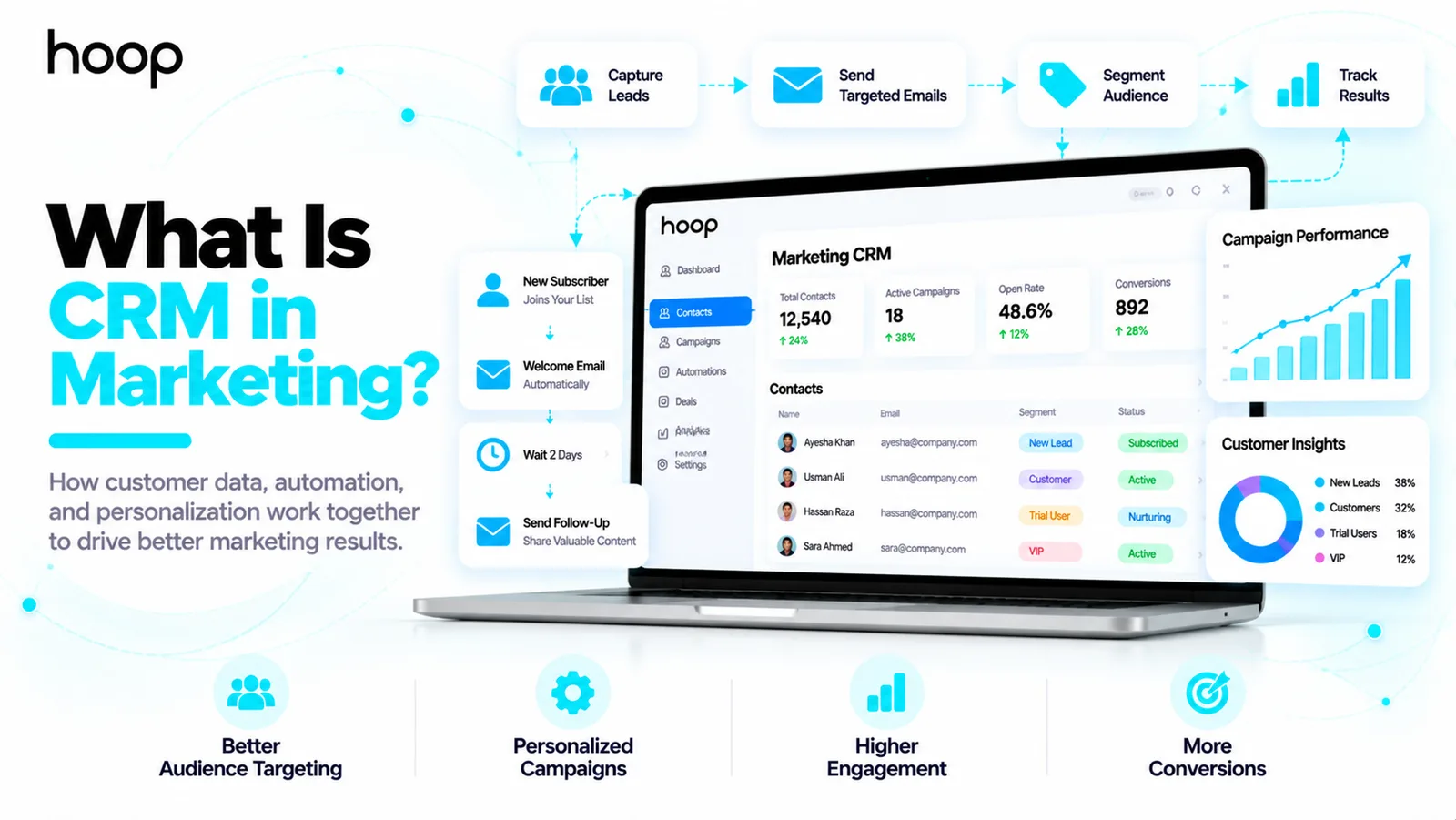
What is CRM in marketing? Customer relationship management (CRM) in marketing uses customer information and interaction history to create relevant campaigns, nurture leads, and build lasting relationships. Marketing teams use CRM data to understand who customers are, what customers need, and when to contact them.
A CRM helps you move beyond sending identical messages to every contact. You can organize audiences, track inquiries, and connect marketing activity with customer outcomes. The underlying strategy matters as much as the software. A platform cannot fix inconsistent follow-up or poor customer information on its own.
Need this done right?
Hoop builds the strategy, design and development behind sites like this one — talk to us about yours.
What Does CRM Mean in Marketing?
In marketing, CRM means using customer relationship management practices and software to communicate with prospects and existing customers more effectively. A CRM system stores information such as contact details, inquiry sources, purchase history, preferences, and previous conversations.
Marketing teams turn that information into decisions. For example, a skincare retailer can separate first-time buyers from returning customers. A software agency can distinguish demo requests from newsletter subscribers. Each group receives information that matches its needs.
What does a marketing CRM actually store?
A useful customer record includes identity, consent status, acquisition source, and engagement history. Your team can also record product interests, purchase dates, and sales stages. Start with fields that help you make real decisions. Avoid collecting personal information without a defined purpose.
A B2B agency might capture industry, company size, requested service, estimated project scope, and assigned account owner. An online store might capture order frequency, product categories, and email preferences. Both examples support targeted communication without creating unnecessary fields.
Is CRM a strategy or a software tool?
CRM is both a relationship strategy and a category of software. The strategy defines how you attract, serve, and retain customers. Software records the information and helps staff perform those actions consistently.
A spreadsheet can support a simple contact process. A dedicated CRM system becomes more useful when you need shared records, automatic reminders, controlled access, and reports. Choose technology after mapping the communication process your business needs.
How Does CRM Work in Marketing?
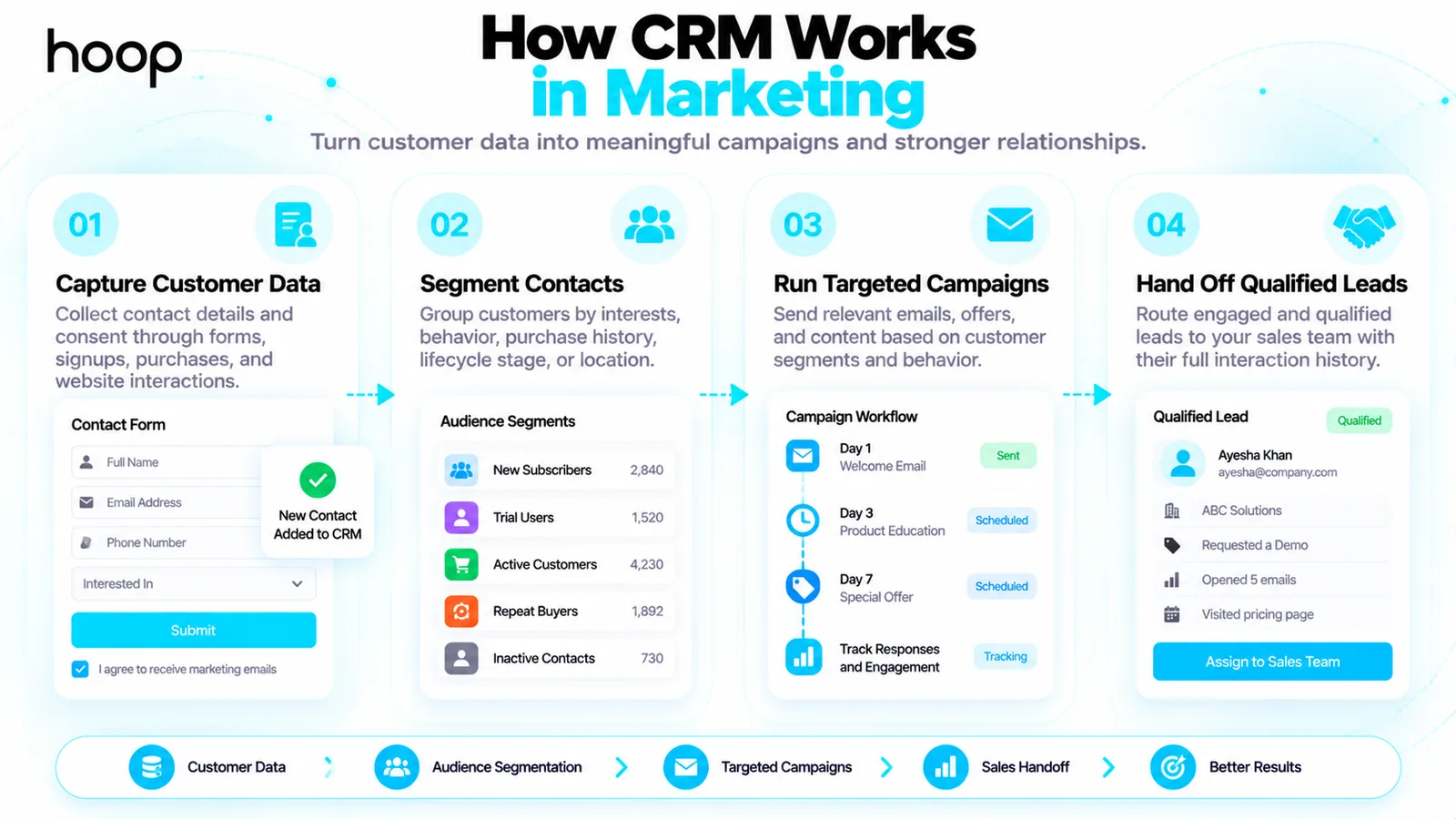
CRM marketing works by connecting customer data with decisions about audiences, messages, timing, and follow-up. A common workflow starts when someone submits a form and continues through purchases, support, and repeat engagement.
Step 1: Capture contact details with permission
To capture useful contact details, collect information through inquiry forms, email signups, bookings, and purchases. Record where each contact entered your business. Separate service inquiries from people requesting educational content.
Explain how you will use personal information and honor relevant consent requirements. A downloaded guide does not automatically grant permission for every type of promotional message. Reliable permission records support trust and better list quality.
Step 2: Organize contacts into relevant groups
To organize contacts, create segments based on meaningful differences such as product interest, customer status, or purchase history. A first-time buyer needs different information from a customer awaiting a renewal.
A marketing team can group trial users, active subscribers, and cancelled subscribers separately. Segments should remain understandable to sales staff. Review categories regularly to remove duplicates and outdated labels.
Step 3: Send relevant campaigns and track responses
To send relevant campaigns, match one specific message to each audience and goal. Invite new inquiries to a consultation. Send product instructions after a purchase. Offer renewal guidance to customers nearing an agreed end date.
Record meaningful responses such as consultations booked, qualified inquiries, and purchases. Email opens alone cannot prove buying interest. Focus on actions that move the customer relationship forward.
Step 4: Share qualified leads with sales
To share qualified leads, define when marketing should hand an opportunity to a salesperson. A demo request with a stated business problem often deserves faster action than a general newsletter signup.
A shared record shows the salesperson what the prospect requested and which content the prospect already received. Clear ownership prevents duplicate outreach and unanswered inquiries.
What Are Practical Examples of CRM in Marketing?
CRM marketing appears in everyday workflows, not only large enterprise campaigns. The best examples connect a customer need to one useful action.
Example 1: An agency nurtures a new service inquiry
A visitor requests a website redesign consultation. The CRM records the request, selected service, company name, and source page. The marketing team sends a relevant project checklist and assigns follow-up to the right salesperson.
The salesperson sees the original request before contacting the visitor. The prospect avoids repeating basic information. The agency can measure how many website redesign inquiries become qualified projects.
Example 2: An online store encourages repeat purchases
A customer buys a moisturizer and agrees to receive promotional emails. The CRM records the product category and purchase date. The store later sends relevant care information or a related product offer.
The store should not assume every buyer wants daily promotions. Purchase history provides context, while consent and preferences determine appropriate contact. Repeat purchases and customer retention provide stronger results than message volume.
Example 3: A SaaS business supports trial users
A software company tracks trial registrations, onboarding milestones, and requests for assistance. The marketing team sends setup guidance when users struggle to complete a useful action. Sales staff receive notifications when qualified accounts request a demo.
The software company measures activated accounts and paid conversions. The CRM helps connect messages to customer progress, rather than treating every registration as a sales opportunity.
What Are the Main Benefits of CRM in Marketing?
CRM marketing helps teams build relevant communication, coordinate outreach, and connect campaigns with results. Benefits depend on clean data, thoughtful processes, and staff adoption.
Improve audience segmentation and personalization
Customer segments let you tailor messages to known needs. A retailer can separate existing buyers from prospects who have never purchased. A business service provider can separate owners seeking consulting from employees researching general topics.
Personalization should improve usefulness. Adding a first name to an irrelevant offer does not make the message valuable. Relevant customer context and clear next steps matter more.
Reduce missed follow-ups and duplicate messages
Shared records help staff see previous conversations and planned next steps. A lead can have an assigned owner and a documented response deadline. Marketing can exclude customers from acquisition offers that no longer apply.
Automated reminders can support consistency, but teams still need clear responsibility. Review workflows for outdated messages, overlapping campaigns, and unnecessary notifications.
Connect marketing spend with customer outcomes
A CRM can record where leads originated and whether the leads became paying customers. Marketing teams can compare search, advertising, referrals, and email campaigns using qualified opportunities and revenue.
Attribution remains imperfect because customers interact with several channels before buying. Use consistent tracking and explain any gaps. Avoid assigning full credit to one campaign without supporting evidence.
Support retention after the first purchase
Marketing continues after acquisition. Customer information supports onboarding, useful updates, renewal reminders, and appropriate cross-selling. A helpful retention message responds to a real customer need.
Measure repeat purchase rate, retention, and customer satisfaction alongside acquisition metrics. Long-term relationships depend on product quality and service delivery, not messages alone.
What Is the Difference Between CRM and Marketing Automation?
CRM manages customer relationships and information; marketing automation executes repeatable communication workflows. Many platforms include both capabilities, but the functions remain distinct.
A CRM record might show that a customer purchased a product. An automation workflow can use that event to send an onboarding email, provided the messaging is appropriate and permitted.
Marketing automation needs trustworthy inputs. Wrong contact data or unclear customer stages produce poorly targeted messages faster. Define your journey and data fields before building complex workflows.
For a closer look at practical campaigns, see Hoop Interactive’s email marketing automation guide, which covers common lifecycle sequences and performance measures.
How Does CRM Marketing Differ From Sales CRM?
Marketing CRM and sales CRM share customer information but answer different operational questions. Marketing asks which audience needs which message. Sales asks which opportunity requires a conversation and what action comes next.
A marketing team might use CRM data for newsletters, audience groups, and lead nurturing. A sales team uses opportunities, meeting records, proposals, and pipeline stages. Both teams need consistent definitions of qualified leads.
Customer support can also benefit from the same record. Support staff can see relevant purchases and reported issues without accessing unrelated marketing data. Grant each department access based on its work.
Which CRM Marketing Features Matter Most?
Choose features based on the customer journey your team actually manages. Most beginners benefit from accurate contact records before advanced scoring or artificial intelligence features.
| Marketing task | CRM feature | Suggested review timing | Setup difficulty |
|---|---|---|---|
| Capture inquiries | Connected forms and source tracking | Daily | Low |
| Segment audiences | Tags, lists, and custom fields | Monthly | Low |
| Nurture leads | Triggers and email workflows | Weekly | Medium |
| Coordinate follow-up | Ownership and activity reminders | Daily | Medium |
| Measure outcomes | Campaign and pipeline reporting | Monthly | Medium |
Contact management and segmentation
Contact records should show accurate names, companies, communication preferences, and engagement context. Deduplication avoids sending the same promotion to one person multiple times. Keep the number of mandatory fields manageable.
Workflow automation and lead scoring
A workflow can assign new inquiries, notify staff, or send requested information. Lead scoring adds points based on agreed fit and engagement criteria. Scores are prioritization aids rather than proof of purchase intent.
Reporting and integrations
Useful reports connect campaigns with meetings, orders, renewals, and revenue. Integrations can connect web forms, ecommerce software, and customer service tools. Evaluate security, cost, and data accuracy before connecting systems.
If your team needs connected workflows, Hoop Interactive provides marketing automation setup services for campaign processes, integrations, and lead nurturing.
How Can a Small Business Start CRM Marketing?
Start with one customer journey and one measurable problem. A small company does not need dozens of automated sequences to improve follow-up.
Map the customer journey before buying tools
Write down how customers find your business, inquire, purchase, and return. Identify who owns each step and what information staff need. Look for forgotten inquiries, inconsistent responses, and duplicated work.
For example, a service company can map website form submission, qualification call, proposal, decision, and follow-up. A retailer can map first order, delivery, support, and repeat purchase.
Clean existing customer data
Remove duplicate contacts and correct invalid information before importing records. Confirm permission settings and record sources where available. Avoid importing old lists whose marketing permissions you cannot establish.
Decide how your team will enter new data. A clean launch becomes unreliable if employees use different labels or skip required updates after the first week.
Launch one campaign with one clear goal
Begin with a useful welcome sequence or a follow-up reminder. Set a single goal, such as booked consultations or completed onboarding. Test every trigger and exit rule before activating the workflow.
Review contact experiences from the recipient’s perspective. Check message frequency, unsubscribe handling, and handoff to staff. Expand only after the first workflow produces reliable information.
Train staff and review results
Show sales and marketing teams how to update records and find ownership information. Assign responsibility for contact quality, campaigns, and reporting. Schedule monthly reviews to fix missing fields and outdated workflows.
Business growth often requires changes beyond software. Hoop Interactive’s growth marketing strategy guide explains how acquisition, retention, and measurement work together.
How Do You Measure CRM Marketing Performance?
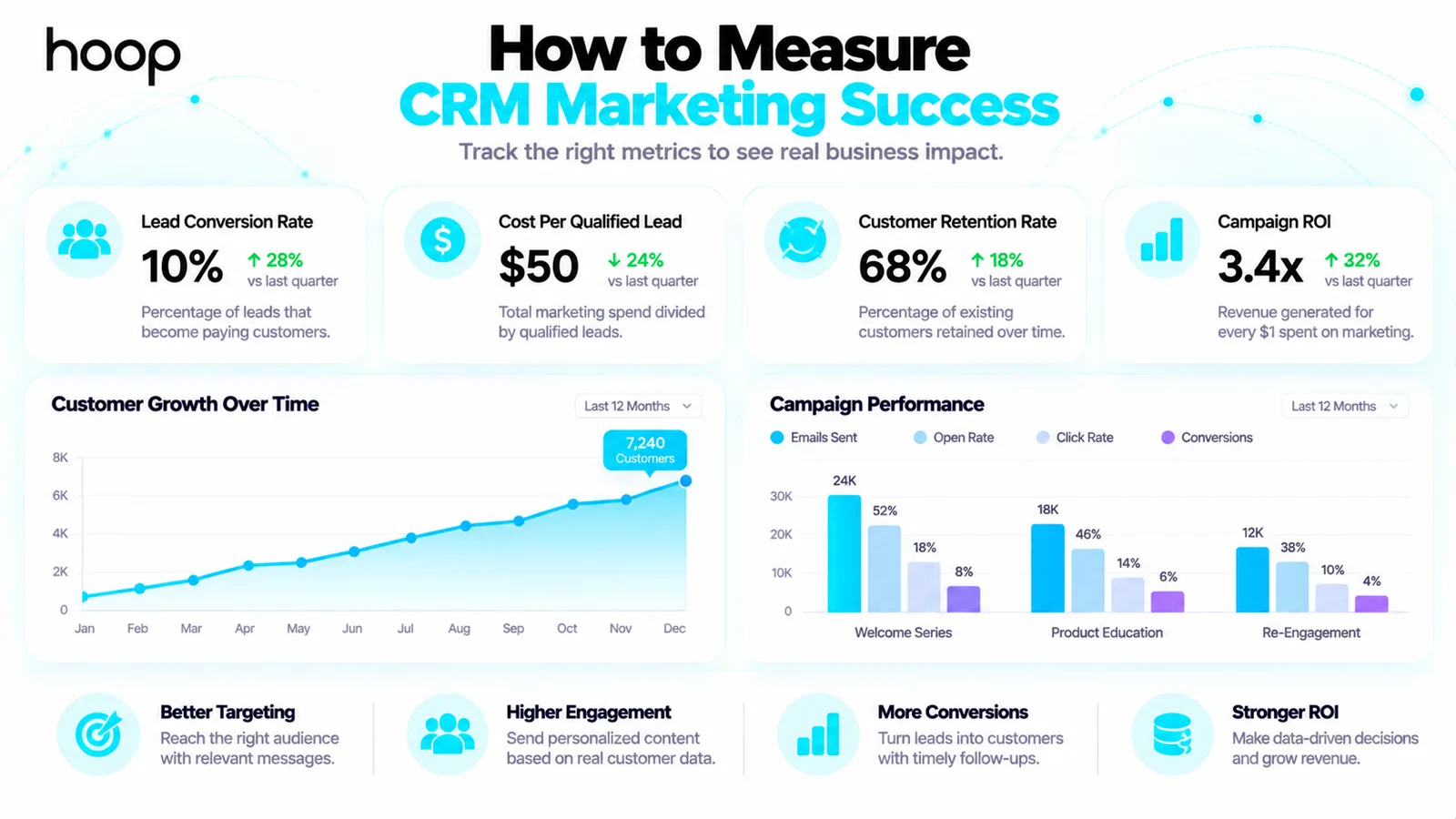
Measure CRM marketing using customer outcomes, not only email activity. Track lead quality, conversion rates, acquisition cost, retention, and campaign revenue when reliable data exists.
Lead-to-customer conversion rate equals new customers divided by leads, multiplied by 100. For example, 12 customers from 120 leads produce a 10% conversion rate. Define what counts as a lead before comparing periods.
Cost per qualified lead equals relevant marketing spend divided by qualified leads generated. If a campaign costs $2,000 and produces 40 qualified leads, the cost is $50 per qualified lead. Include relevant costs consistently across campaigns.
Customer retention rate measures the share of starting customers who remain during a period, excluding new customers acquired during that period. Choose a consistent period and customer definition. Subscription businesses can also track churn and renewal rates.
Watch for misleading metrics. A large contact database does not prove stronger relationships. High open rates do not guarantee revenue. Better data and clearer processes improve the reliability of your decisions.
What CRM Marketing Mistakes Should You Avoid?
Avoid treating CRM adoption as a software purchase alone. The most common operational problems involve unclear ownership, low-quality data, excessive automation, and unfocused reporting.
First, do not collect fields simply because the platform supports them. Ask which decision each field will improve. Second, do not create complex scoring rules before your team agrees on a qualified lead.
Third, do not send every campaign to the full database. Match content to relevant segments and consent. Fourth, do not assume a CRM reveals the complete customer journey automatically. Tracking depends on the data and integrations you configure.
Finally, keep human judgment involved. Sales staff should review valuable opportunities. Support teams should respond personally to sensitive complaints. Automation supports relationships but does not replace responsibility.
Build Better Marketing Around Customer Relationships
CRM marketing connects useful customer data with relevant communication and clear accountability. Start with accurate records, a defined customer journey, and one measurable campaign. Improve the process before expanding automation.
For help connecting customer records with purposeful marketing workflows, review Hoop Interactive’s CRM services and build a system your team can maintain.
“Adding a first name to an irrelevant offer does not make the message valuable. Relevant customer context and clear next steps matter more.”
Key takeaways
- 01Four steps: capture with permission, segment, send relevant campaigns, hand qualified leads to sales.
- 02CRM stores the relationship; marketing automation runs the workflow. Bad data just automates the wrong message faster.
- 03Measure conversion, cost per qualified lead, and retention — not open rates.
- 04Start with one journey and one goal before building complex sequences.
Written by
Sahar
Content Writer
Frequently Asked
Questions
Everything you need to know before booking a strategy call. Can't find your answer? Contact us directly.
No. Small businesses can use simple CRM processes to organize leads, follow-ups, and customer history. Choose features based on your actual workflow and budget.
Yes. CRM data can support audience segmentation, relevant email content, follow-up timing, and campaign reporting. Send promotional messages only under appropriate permissions.
No. A CRM manages customer records and relationships. An email marketing tool primarily creates, sends, and measures campaigns. Some platforms combine both.
No. A CRM organizes and manages leads. Search, advertisements, referrals, and other acquisition channels bring prospects into the business. CRM workflows can improve follow-up and conversion.
Start with inquiry follow-up. Capture the lead source, assign an owner, and send a timely response. Measure completed conversations before adding complex campaigns.
Keep reading
All articles →
What Is Marketing Automation? How It Works and Real Examples
Oct 22, 2026 · 9 min read
What Is Lead Generation? Meaning, Process, and Examples
Oct 22, 2026 · 10 min read