
What Is Growth Marketing? Definition, Strategies, and Business Benefits
Growth marketing uses data, experimentation, and automation across the entire customer journey — acquisition, activation, retention, and revenue — to drive sustainable, compounding growth.
Sahar
Content Writer
If you are searching for what is growth marketing, you want a simple answer and a practical guide. Growth marketing is a data-driven approach that focuses on customer acquisition, user retention, revenue growth, and ongoing optimization across the full customer journey. It combines testing, analysis, automation, and smart channel strategy to drive sustainable growth.
Need this done right?
Hoop builds the strategy, design and development behind sites like this one — talk to us about yours.
Growth Marketing Definition in Simple Words
Let us start with a simple growth marketing definition.
Growth marketing is a form of digital marketing that focuses on more than just getting attention. It works across the full customer journey. That means it does not stop at traffic, clicks, or leads. Instead, it looks at the whole system: acquisition, activation, retention, revenue, and referral.
In simple words, growth marketing means using experiments, data, and smart marketing strategy to grow a business faster and more efficiently.
A traditional campaign might ask, “How do we get more people to see this ad?”<br /> A growth marketer asks, “How do we attract the right people, help them take action, keep them engaged, and increase customer lifetime value?”
That is the big difference.
So when someone asks what is growth marketing, the answer is this:
Growth marketing is a full-funnel, data-driven marketing approach focused on customer acquisition, user retention, experimentation, and long-term business growth.
Why Growth Marketing Matters Today
Modern businesses need more than visibility. They need systems that create measurable results. That is why growth marketing matters so much.
In crowded markets, brands cannot rely only on one campaign, one platform, or one message. They need to understand how each part of the funnel works. They need to know what drives leads, what improves conversion, what reduces churn, and what increases revenue.
Growth marketing matters because it helps businesses:
- Improve customer acquisition
- Increase user retention
- Support revenue growth
- Reduce wasted budget
- Improve marketing ROI
- Use data-driven marketing instead of guesswork
- Create a stronger customer journey
- Build sustainable long-term growth
This is why growth marketing is especially important for startups, SaaS companies, ecommerce brands, and fast-moving businesses that want to scale with more precision.
How Growth Marketing Works
To understand what is growth marketing, you need to understand how it works in practice.
Growth marketing works by improving the full journey instead of focusing on only one stage.
A growth marketer studies:
- How people first discover the brand
- What makes them sign up or buy
- What keeps them engaged
- What causes them to leave
- What increases repeat purchases or revenue
- What turns customers into promoters
That means growth marketing sits across multiple parts of the business, not just one ad channel.
The basic growth marketing process
A simple growth marketing process often looks like this:
- Research the market and users
- Identify opportunities in the funnel
- Launch experiments
- Measure results
- Improve what works
- Repeat and scale
This cycle of marketing experimentation, analysis, and improvement is at the heart of growth marketing.
It is not static. It is active, flexible, and always looking for better results.
Growth Marketing vs Traditional Marketing
A lot of people understand regular marketing, but growth marketing sounds newer. So it helps to compare the two.
Traditional marketing
Traditional marketing often focuses on:
- Awareness
- Campaign reach
- Brand visibility
- Big launches
- Broad promotion
It can be effective, but it may stop at the top of the funnel.
Growth marketing
Growth marketing focuses on:
- Customer acquisition
- Activation
- User retention
- Conversion rate optimization
- Repeat revenue
- Referral and expansion
- Full-funnel analysis
- Ongoing improvement
Traditional marketing asks how to get people in the door.<br /> Growth marketing asks how to get the right people in, help them stay, and turn them into loyal customers.
That is why growth marketing is often described as more agile, measurable, and experimental.
The Full Funnel in Growth Marketing
A strong article on what is growth marketing should explain the funnel clearly.
Growth marketing usually works across these stages:
- Awareness
- Acquisition
- Activation
- Retention
- Revenue
- Referral
Awareness
This is where people first discover the brand. Channels may include SEO, content marketing, social media marketing, paid advertising, or partnerships.
Acquisition
This stage is about getting users to take the first meaningful step. That could be signing up, starting a free trial, subscribing, or making a first purchase.
Activation
Activation means helping people experience value quickly. This is where onboarding, product messaging, and clear next steps matter.
Retention
User retention is one of the biggest parts of growth marketing. It is often cheaper to keep a good customer than to constantly replace lost ones.
Revenue
This stage focuses on increasing spending, repeat purchases, upgrades, and overall customer lifetime value.
Referral
This is where happy users bring in new users. Referral systems, word of mouth, reviews, and viral loops can all support this stage.
Growth marketing works because it studies every stage instead of treating growth like a one-time campaign.
Core Growth Marketing Strategies
There are many growth marketing strategies, but most strong systems are built on a few core ideas.
Customer acquisition strategy
A clear customer acquisition plan is essential. Businesses need to know which marketing channels bring in the right people, not just the most traffic.
This may include:
- SEO
- Paid advertising
- Email capture
- Social media campaigns
- Partnerships
- Referral systems
- Content-driven lead generation
User retention strategy
User retention is a major part of sustainable growth marketing. It is not enough to acquire users if they leave quickly.
Retention strategies may include:
- Better onboarding
- Personalized messaging
- Lifecycle emails
- Product reminders
- Customer support
- Loyalty programs
- Ongoing education
Conversion rate optimization
Conversion rate optimization or CRO helps businesses improve what happens after a user lands on a page, opens an email, or signs up.
This may include:
- Better headlines
- Clearer calls to action
- Stronger forms
- Faster landing pages
- Better product pages
- More trust signals
- Fewer steps in checkout
Marketing automation
Marketing automation helps growth teams scale communication and improve timing. Automation can support onboarding, lead nurturing, re-engagement, and lifecycle campaigns.
A/B testing
A/B testing is one of the most important tools in growth marketing. It allows marketers to compare versions of pages, ads, emails, or headlines to see which performs better.
Funnel analysis
Funnel analysis helps identify where people drop off. If users sign up but never activate, that is a growth problem. If they buy once but never return, that is also a growth problem.
Growth marketing improves the whole system by studying these gaps.
Data-Driven Marketing and Growth Decisions
One of the biggest strengths of growth marketing is data-driven marketing.
Instead of making decisions from guesswork, growth teams rely on:
- Analytics
- User behavior
- Funnel data
- Campaign performance
- Retention trends
- Revenue metrics
- Cohort analysis
- Experiment results
This does not mean creativity disappears. It means creativity is tested and improved through real evidence.
Data-driven growth helps businesses answer questions like:
- Which channel brings the best leads?
- Which message increases signups?
- Which users are most likely to stay?
- Where are users dropping off?
- Which changes improve marketing ROI?
This is how growth marketing becomes practical and scalable.
Growth Marketing Channels
Growth marketing is not tied to one channel. It uses whatever channels help move the business forward.
SEO
SEO supports long-term traffic and demand capture. It helps businesses reach users already searching for answers or solutions.
Content marketing
Content marketing supports awareness, authority, and lead generation. It also supports SEO and onboarding.
Social media marketing
Social media marketing helps with reach, engagement, community, and brand visibility.
Email marketing
Email marketing is one of the most useful tools for retention, nurturing, and customer lifecycle communication.
Paid advertising
Paid advertising supports faster acquisition, testing, and campaign scaling.
Inbound marketing
Inbound marketing attracts users through useful content, search visibility, and trust-building.
Outbound marketing
Outbound marketing includes direct outreach and proactive audience targeting. In B2B or high-ticket offers, it may still play an important role.
The best growth marketing systems use a mix of channels based on audience, budget, and growth stage.
Product-Led Growth and Growth Marketing
Product-led growth is closely connected to growth marketing.
In product-led growth, the product itself helps drive acquisition, activation, and retention. Users experience value early, and that value supports growth.
Examples include:
- Free trials
- Freemium plans
- Easy onboarding
- In-product prompts
- Referral loops
- Self-serve upgrades
Growth marketing often supports product-led growth by improving:
- Sign-up flows
- Activation steps
- User education
- Upgrade paths
- Retention campaigns
This makes product-led growth especially important for SaaS and software products.
Startup Marketing and Growth Marketing
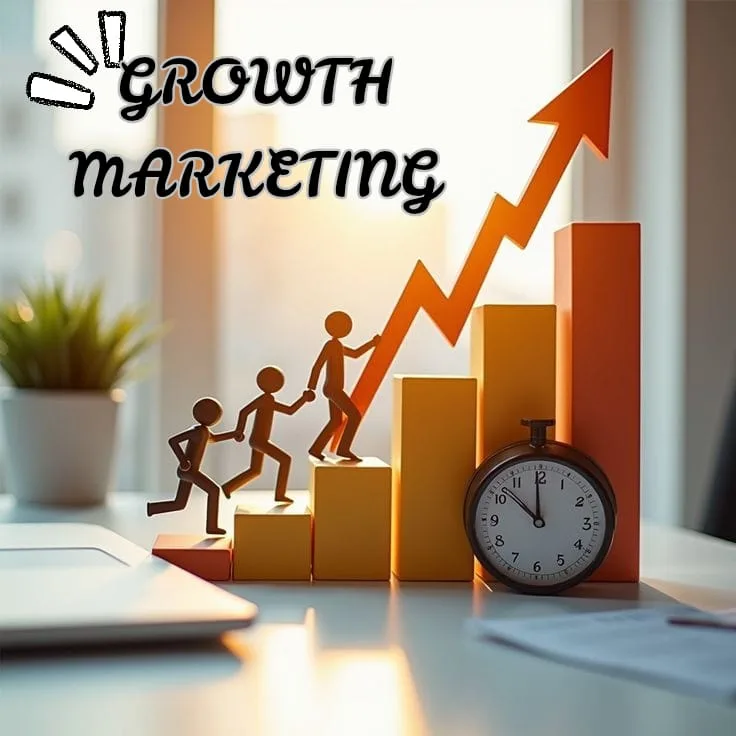
Startup marketing often overlaps strongly with growth marketing.
Startups usually work with:
- Smaller budgets
- Faster testing cycles
- Strong pressure for traction
- Need for clear ROI
- Need for scalable systems
That is why startups often rely on:
- Growth hacking
- A/B testing
- Agile experiments
- Funnel optimization
- Product-led growth
- Fast learning loops
In many cases, growth marketing gives startups a smarter way to learn what works before they scale harder.
Growth Hacking vs Growth Marketing
People often use growth hacking and growth marketing in similar ways, but they are not exactly the same.
Growth hacking
Growth hacking usually refers to creative, rapid, and often experimental techniques focused on fast growth.
Growth marketing
Growth marketing is broader and more sustainable. It includes acquisition, retention, customer lifecycle, experimentation, and long-term revenue optimization.
So growth hacking may be part of growth marketing, but growth marketing is the bigger system.
The Role of Customer Journey and Customer Lifecycle
Two ideas are very important in growth marketing:
- Customer journey
- Customer lifecycle
The customer journey is the path a person takes from first awareness to conversion and beyond.
The customer lifecycle looks at the customer relationship over time: new user, active user, loyal customer, repeat buyer, advocate, or churned user.
Growth marketing improves both.
For example:
- Awareness content helps users discover the brand
- Onboarding improves activation
- Email campaigns support engagement
- Product messages support upgrades
- Re-engagement campaigns reduce churn
This is why growth marketing does not stop after the first conversion. It continues throughout the relationship.
Marketing Automation and Growth Systems
Marketing automation plays a major role in growth marketing because it allows businesses to scale communication without losing timing or relevance.
Automation can support:
- Welcome emails
- Trial onboarding
- Abandoned cart emails
- Lead nurturing
- Customer education
- Retention reminders
- Renewal campaigns
- Upsell flows
When used well, automation improves efficiency and reduces manual work.
However, automation must still feel relevant. A poor automated sequence can feel cold or spammy. A strong one feels timely and useful.
Key Growth Marketing Metrics
A growth strategy needs strong measurement. Otherwise, the team cannot know what is improving and what is failing.
Important growth metrics include:
- Customer acquisition cost
- Activation rate
- Conversion rate
- Retention rate
- Churn rate
- Revenue per user
- Customer lifetime value
- Lead-to-customer rate
- Referral rate
- Marketing ROI
Customer lifetime value
Customer lifetime value is especially important. It helps businesses understand how much value a customer brings over time, not just from one purchase.
Marketing ROI
Marketing ROI shows whether marketing investment is creating business value.
Funnel metrics
These help identify where users drop off and where growth opportunities exist.
Growth marketing depends on metrics because growth without measurement is not reliable.
Growth Marketing and Revenue Growth
At the center of growth marketing is one big goal: revenue growth.
Not just more traffic.<br /> Not just more impressions.<br /> Not just more clicks.
Real growth marketing focuses on revenue, retention, and system-wide improvement.
It asks:
- Which users turn into real customers?
- Which campaigns bring profitable growth?
- Which channels are sustainable?
- What increases repeat revenue?
- What improves long-term customer value?
That is why growth marketing connects so strongly to business performance.
Agile Marketing and Experimentation
Agile marketing is another important part of growth marketing.
It means teams move in smaller, faster cycles. They test, learn, adjust, and repeat.
This is where marketing experimentation becomes valuable.
Examples of experiments include:
- Testing landing page headlines
- Comparing two email subject lines
- Trying different calls to action
- Testing paid ad audiences
- Changing onboarding steps
- Comparing content formats
These small tests help teams learn faster and reduce guesswork.
Go-To-Market Strategy and Growth
A go-to-market strategy explains how a business introduces or scales a product in the market.
Growth marketing often supports GTM by helping answer:
- Who is the audience?
- What is the value proposition?
- Which channels should be used?
- What message works best?
- How should acquisition and activation be measured?
This is especially important for new products, startup launches, and market expansion.
Common Growth Marketing Mistakes
Many businesses say they want growth, but they make avoidable mistakes.
Focusing only on acquisition
Getting new users matters, but ignoring user retention creates a weak system.
Skipping experimentation
Without A/B testing and funnel analysis, businesses often repeat bad assumptions.
Using too many channels at once
Trying everything at once can waste marketing budget and reduce focus.
Ignoring the customer lifecycle
A first conversion is not the end of the journey.
Measuring vanity metrics
Traffic, likes, and clicks matter less if they do not support revenue or retention.
Weak market research
Without market research, teams may target the wrong audience or build the wrong message.
Poor alignment between marketing and product
In product-led businesses, weak alignment can hurt activation and growth.
How to Build a Growth Marketing Strategy
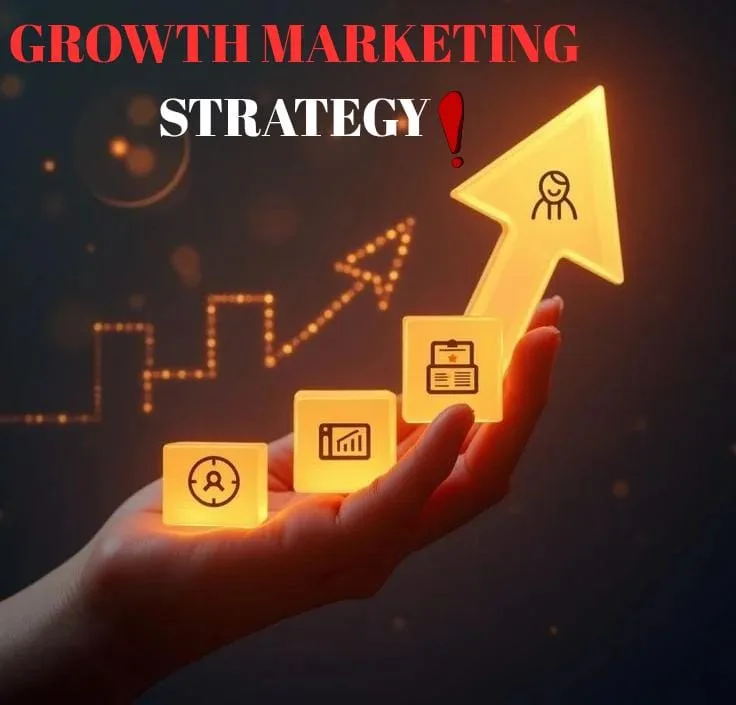
If you want to build a real growth system, use this structure.
Step 1: Define business goals
Know what growth means for the business. Is it more users, more leads, higher retention, or better revenue?
Step 2: Understand the market and customer
Use market research and customer data to identify needs, behavior, and opportunities.
Step 3: Map the funnel
Understand where users enter, where they drop off, and where improvement is possible.
Step 4: Choose growth channels
Select the channels that support your audience and goals. These may include SEO, email, paid ads, content, and social.
Step 5: Build experiments
Use A/B testing and other experiments to improve performance.
Step 6: Measure results
Track growth metrics, retention, conversion, and ROI.
Step 7: Scale what works
Growth marketing becomes powerful when businesses improve winning systems instead of starting from zero each time.
Growth Marketing for Different Business Types
Different businesses use growth marketing in different ways.
SaaS businesses
They often focus on product-led growth, activation, retention, and upgrades.
Ecommerce brands
They may focus on acquisition, repeat purchases, lifecycle emails, and customer lifetime value.
Startups
They often use agile experiments, growth hacking, and limited-budget scaling.
Service businesses
They may use SEO, paid ads, content, and conversion optimization to drive high-quality leads.
That is why growth marketing is flexible. The core system stays the same, but the tactics change by business model.
Why Growth Marketing Fits Modern Businesses
Growth marketing fits the modern business world because it is practical.
It connects:
- Strategy
- Channels
- Testing
- Data
- Customer journey
- Retention
- Revenue
This makes it more useful than isolated campaigns that do not connect to the full system.
It also helps businesses become more disciplined. Instead of hoping a campaign works, they build a process that can be improved again and again.
Conclusion
Now you have a clear answer to what is growth marketing. It is not just promotion or lead generation. It is a full-funnel, data-driven approach that improves customer acquisition, user retention, conversion rate optimization, and long-term revenue growth through testing, automation, and continuous learning.
If your business wants a smarter marketing strategy, stronger growth metrics, better customer lifecycle performance, and a system built for real results, Hoop can help. Contact Hoop today to build a growth marketing strategy that creates sustainable business growth.
“Growth marketing is a data-driven approach that focuses on the full customer journey — acquisition, retention, revenue, and constant optimization.”
Key takeaways
- 01It's data-driven and full-funnel, not just acquisition
- 02Continuous testing and iteration beat one-off campaigns
- 03It spans acquisition, retention, and revenue across the customer lifecycle
- 04Growth marketing is broader and more sustainable than growth hacking
Written by
Sahar
Content Writer
Frequently Asked
Questions
Everything you need to know before booking a strategy call. Can't find your answer? Contact us directly.
Growth marketing is a data-driven way to grow a business by improving customer acquisition, retention, conversion, and revenue across the full funnel.
Not exactly. Growth hacking is usually faster and more experimental. Growth marketing is broader and more focused on sustainable full-funnel growth.
It helps businesses improve results across the customer journey, not just at the awareness stage.
The main parts include customer acquisition, activation, user retention, revenue growth, referral, experimentation, and analytics.
Common channels include SEO, content marketing, email marketing, paid advertising, social media marketing, and product-led growth systems.
Important metrics include conversion rate, customer acquisition cost, retention rate, churn, customer lifetime value, and marketing ROI.
Yes. It is especially useful for startups because it supports testing, learning, and scaling with limited resources.
A/B testing helps businesses compare options and improve decisions based on real results instead of assumptions.
Keep reading
All articles →
Why Hire a Digital Marketing Agency? When It Makes Sense
Sep 26, 2026 · 10 min read
How to Create a Social Media Marketing Campaign That Gets Results
Sep 27, 2026 · 10 min read