
What Is Content Marketing? A Complete Guide for Modern Businesses
Content marketing creates useful, consistent content that attracts the right audience, builds trust, and supports lead generation — powering SEO, email, and social at the same time.
Sahar
Content Writer
If you are searching for what is content marketing, you are looking for a simple answer and a practical guide. Content marketing is the process of creating and sharing useful, relevant, and consistent content to attract a target audience, build trust, improve brand awareness, support lead generation, and drive business growth over time.
Need this done right?
Hoop builds the strategy, design and development behind sites like this one — talk to us about yours.
Content Marketing Definition in Simple Words
Let us begin with a clear content marketing definition.
Content marketing is a type of digital marketing and online marketing that focuses on creating valuable content instead of pushing direct sales messages all the time. The goal is to inform, help, educate, and guide people. As a result, the business earns attention, trust, and customer action.
In simple words, content marketing means giving people something useful before asking them to buy.
That content can be:
- Blog posts
- Videos
- Ebooks
- Infographics
- Case studies
- Email newsletters
- Social media posts
- Guides
- Checklists
- Landing page resources
So, when people ask what is content marketing, the real answer is this: it is a long-term way to connect with your audience by solving problems and sharing value.
Instead of saying, “Buy from us now,” a business says, “Here is something helpful.” That shift is what makes inbound marketing powerful.
Why Content Marketing Matters Today
Today, people do not trust every ad they see. They search, compare, read, scroll, and think before they act. That is why content marketing strategy has become so important.
People want answers. They want clarity. They want useful information. If your business gives them that information, they are more likely to remember your brand.
This is why content marketing matters:
- It improves audience engagement
- It builds brand awareness
- It supports lead generation
- It attracts people through search and social channels
- It moves readers through the marketing funnel
- It improves long-term trust
- It supports customer retention as well as customer acquisition
In short, strong content helps businesses become more visible, more useful, and more trusted.
A paid ad can bring attention for a moment. A useful blog post or guide can keep bringing traffic and trust for months or years. That is one reason content marketing often creates stronger long-term value.
How Content Marketing Works
To understand what is content marketing, you also need to understand how it works in real business terms.
A business starts by understanding its target audience. Then it creates content based on their needs, questions, pain points, and goals. After that, it shares the content across the right channels. Finally, it tracks content performance and improves results over time.
Here is the basic process:
1. Understand the audience
Good content starts with the audience, not with the business itself. You need to know:
- Who they are
- What they need
- What questions they ask
- What problems they face
- Where they spend time online
- What type of content they prefer
This is where an audience persona becomes useful. An audience persona is a simple profile of your ideal reader or buyer. It helps you create more relevant content.
2. Set a clear value proposition
Your content should offer something useful. That is your value proposition. It answers the question: why should someone read, watch, or download this content?
If the answer is weak, the content will struggle.
3. Create the right content
This step is content creation. You choose formats and topics that match your audience and goals. Some content is made for awareness. Some is made for trust. Some is made for conversions.
4. Publish and promote
Content does not work if nobody sees it. That is why content distribution matters. A great article, video, or ebook must reach the right people through the right channels.
5. Measure performance
You need to study content performance and content marketing ROI. If a piece performs well, improve and reuse it. If it underperforms, update it or change your approach.
That is how content marketing becomes a real system rather than random posting.
Types of Content Marketing
There are many types of content marketing, and each one serves a different purpose. The best strategy often uses a mix of formats.
Blog Posts
Blog posts are one of the most common forms of content marketing. They help answer questions, target keywords, improve seo content, and drive search traffic.
A good blog post is clear, useful, and focused on what the reader wants.
Ebooks
Ebooks give deeper information on a topic. They are useful for lead generation because businesses often offer them in exchange for email sign-ups.
Infographics
Infographics turn useful information into a visual format. They work well for sharing statistics, processes, and summaries.
Case Studies
Case studies show how a product or service helped a customer. They are powerful for trust and conversion because they give real examples.
Videos
Video content is highly engaging. It can explain ideas quickly and build a stronger emotional connection. That is why video marketing often supports a broader content marketing strategy.
Email Newsletters
Email content helps maintain relationships over time. It supports nurturing, loyalty, and repeat visits.
Social Media Content
Short-form posts, carousels, short videos, and captions can all support content marketing by increasing visibility and engagement.
Guides and Tutorials
Guides help readers understand a topic in detail. They are excellent for search visibility, authority, and trust.
These different formats support different stages of the buyer journey. That is why understanding types of content marketing is important when building your plan.
The Role of Content in the Marketing Funnel
Content marketing works best when it supports the marketing funnel.
The marketing funnel usually has three main stages:
- Top of funnel
- Middle of funnel
- Bottom of funnel
Top of Funnel Content
This content is for awareness. People at this stage may not know your brand yet. They are looking for answers, ideas, or education.
Examples:
- Blog posts
- Educational videos
- Introductory guides
- Social posts
- Infographics
This stage builds brand awareness and attracts new visitors.
Middle of Funnel Content
This content is for consideration. People know they have a problem and are comparing options.
Examples:
- Case studies
- Webinars
- Ebooks
- Email sequences
- Detailed comparison posts
This stage builds trust and deeper audience engagement.
Bottom of Funnel Content
This content helps with decisions. People are close to acting.
Examples:
- Product pages
- Sales pages
- Testimonials
- Demo pages
- Consultation landing pages
This stage supports customer acquisition and conversion.
A smart content marketing plan uses content across the full funnel, not just at the awareness stage.
Benefits of Content Marketing
There are many benefits of content marketing, especially for businesses that want long-term growth.
Builds Brand Awareness
Useful content helps more people discover your brand. Over time, this increases visibility and recognition.
Improves Audience Engagement
When your content is clear, useful, and relevant, people spend more time with your brand. They read, share, comment, and return.
Supports Lead Generation
High-value content can encourage people to sign up, download, subscribe, or contact you. This is why content marketing is one of the strongest channels for lead generation.
Helps SEO
Strong seo content can improve visibility in search engines. Blog posts, guides, and landing pages can all bring in organic traffic when they target the right keywords.
Strengthens Trust
People trust brands that teach, help, and explain. Content builds authority over time.
Improves Customer Acquisition
By educating and nurturing readers, content makes future conversion easier. This supports customer acquisition more naturally.
Delivers Long-Term Value
A social post may fade quickly. A strong blog article or guide can keep delivering results for a long time. That is one reason content marketing can create strong content marketing ROI.
Content Marketing and SEO
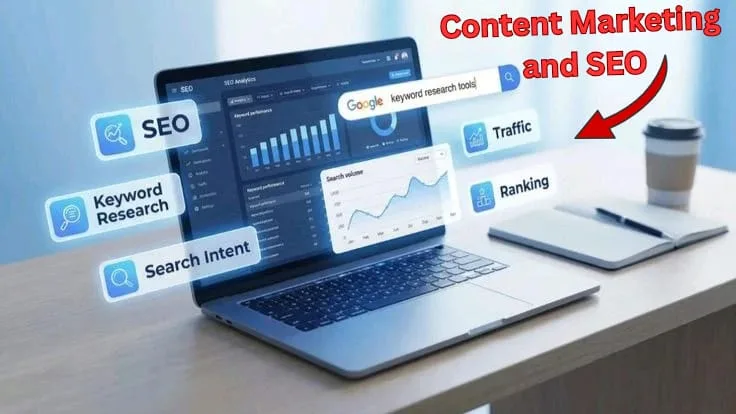
Content marketing and SEO work together very closely.
Without good content, SEO has very little to rank. Without SEO, good content may stay hidden.
That is why seo content is so important. It combines useful writing with keyword research, clear structure, search intent, and good readability.
For example, if your target keyword is what is content marketing, your article should include:
- The keyword in the title
- The keyword in the introduction
- Related terms in headings
- Useful subtopics readers expect
- Clear answers to common questions
- Strong readability and structure
This is how search engine optimization and content marketing support each other.
Content Marketing Strategy: How to Build One
A strong content marketing strategy does not happen by accident. It is planned.
Here is a simple step-by-step process.
Define your goals
Know what you want content to do. Do you want:
- More traffic
- More leads
- Better brand awareness
- More sign-ups
- Better engagement
- Higher conversions
Your goals shape your full marketing strategy.
Identify your target audience
Know who you are trying to reach. Create an audience persona if needed. The clearer your audience, the stronger your content will be.
Understand the buyer’s journey
The buyer’s journey helps you understand what readers need at different stages. Someone new to a topic needs different content than someone ready to buy.
Choose content types
Pick the formats that fit your goals. Blog posts may help SEO. Ebooks may help lead generation. Videos may improve engagement.
Build a content marketing plan
Your content marketing plan should include:
- Main goals
- Audience
- Key topics
- Target keywords
- Formats
- Distribution channels
- Measurement plan
Use a content calendar
A content calendar helps you stay consistent. Consistency is one of the biggest strengths of content marketing.
Create an editorial calendar
An editorial calendar is more detailed. It may include deadlines, titles, topics, keywords, owners, and publication dates.
Promote the content
Do not just publish and hope. Share the content through email, SEO, social media, and internal links.
Measure and improve
Study what works. Then update, improve, and scale it.
Content Strategy Examples
Here are a few simple content strategy examples to show how this works in practice.
Example 1: Service business
A web agency wants more qualified leads.
Its content strategy might include:
- Blog posts about web design and SEO
- Case studies showing client results
- Landing pages for services
- An ebook for lead capture
- Email follow-up sequence
This supports awareness, trust, and lead generation.
Example 2: E-commerce brand
An online store wants more organic traffic and repeat customers.
Its strategy might include:
- Buying guides
- Product comparison posts
- Tutorials
- Email newsletters
- Video demonstrations
This supports SEO, engagement, and conversions.
Example 3: SaaS business
A software company wants to build thought leadership and demo requests.
Its strategy might include:
- Educational blog articles
- Industry reports
- Webinars
- Product tutorials
- Case studies
This strengthens trust and authority.
These content strategy examples show that content marketing should match business goals, not just trends.
Content Distribution Matters
Great content alone is not enough. You need content distribution.
Content distribution means sharing your content through the right channels so the right audience sees it.
Common channels include:
- Organic search
- Social media
- Email marketing
- Paid promotion
- Internal links
- Communities and forums
- Partnerships
- Repurposed formats
For example, one blog post can become:
- A LinkedIn post
- A short email
- A carousel
- A video script
- An infographic summary
That is how one piece of content creates more value.
Content Marketing ROI and Performance
A lot of people ask whether content marketing is worth it. The answer depends on strategy, quality, and consistency.
To measure content marketing ROI, you need to track:
- Traffic
- Time on page
- Leads
- Email sign-ups
- Downloads
- Demo requests
- Conversions
- Assisted revenue
You should also monitor content performance by asking:
- Which topics bring traffic?
- Which pages convert best?
- Which content gets shared most?
- Which formats keep people engaged?
- Which pieces support customer acquisition?
Tools like Google Analytics, Semrush, Ahrefs, and HubSpot can help with this.
Strong measurement turns content marketing into a business asset.
Content Marketing Tools
Many tools support better planning, writing, promotion, and measurement.
Useful content marketing tools include:
- Google Analytics for traffic and behavior data
- Semrush for keyword research and content opportunities
- Ahrefs for SEO insights and competitor analysis
- HubSpot for CRM, forms, email, and automation
- Buffer for social media scheduling
These tools make planning and execution easier, but tools alone are not enough. Strategy still matters most.
Thought Leadership and Brand Storytelling
Two important parts of content marketing are thought leadership and brand storytelling.
Thought Leadership
Thought leadership means publishing content that shows expertise, insight, and original thinking. It helps people see your brand as informed and credible.
Brand Storytelling
Brand storytelling means using content to communicate who you are, what you believe, and why your work matters.
These two ideas help turn content into something more powerful than simple publishing. They create emotional and strategic connection.
Common Content Marketing Mistakes
Many businesses publish content but still do not get strong results. Here are some common mistakes.
No clear strategy
Without a strong content marketing strategy, content becomes random and weak.
Writing only for the brand
If all content talks only about the business, readers lose interest. Good content should focus on the audience.
Ignoring SEO
Without seo content, your best articles may never be discovered.
Inconsistent publishing
Content marketing works better when it is regular and planned. That is why a content calendar matters.
No measurement
If you do not measure content performance, you cannot improve content marketing ROI.
Weak value proposition
If the content does not offer real value, readers will not stay.
How Content Marketing Supports Digital Marketing

Content marketing does not work alone. It strengthens the whole digital marketing system.
It supports:
- SEO
- Email marketing
- Social media marketing
- Lead generation
- Brand awareness
- Marketing automation
- Customer nurturing
That is why content often acts as the foundation of broader online marketing efforts.
For example:
- SEO needs content to rank
- Email needs content to share
- Social media needs content to post
- Lead magnets are content
- Case studies are content
- Webinars are content
So when people ask what is content marketing, they should also understand this: it often powers many other marketing channels too.
Conclusion
Now you have a clear answer to what is content marketing. It is not just writing blog posts. It is a strategic way to use useful content to attract the right audience, improve audience engagement, support brand awareness, drive lead generation, and create long-term business growth.
If your business wants a smarter content marketing plan, stronger seo content, better content performance, and clearer content marketing ROI, Hoop can help. Contact Hoop today and build a content strategy that brings traffic, trust, and real results.
“A paid ad can bring attention for a moment. A useful guide can keep bringing traffic and trust for years.”
Key takeaways
- 01It earns attention by solving problems first, rather than pushing a sales message
- 02Strong content maps to the funnel: awareness at the top, consideration in the middle, decision at the bottom
- 03Publishing isn't enough — distribution and repurposing are what get content seen
- 04Measure traffic, leads, engagement, and conversions to prove content marketing ROI
Written by
Sahar
Content Writer
Frequently Asked
Questions
Everything you need to know before booking a strategy call. Can't find your answer? Contact us directly.
Content marketing means creating useful and relevant content to attract, engage, and build trust with a target audience.
The main goal is to build relationships, improve brand awareness, support lead generation, and guide people toward action over time.
Yes. Content marketing is one of the most important parts of digital marketing and online marketing.
Common examples include blog posts, ebooks, case studies, videos, infographics, newsletters, and guides.
It helps SEO by creating useful keyword-focused pages that can rank in search engines and bring organic traffic.
Advertising usually pushes a direct message quickly. Content marketing builds trust by offering value first.
A content calendar helps businesses stay organized, consistent, and strategic with publishing.
You measure success through traffic, engagement, leads, conversions, and content marketing ROI.
A content marketing strategy is a plan for creating, publishing, distributing, and measuring content based on business goals and audience needs.
Keep reading
All articles →
Content Creation Ideas: How to Never Run Out of Things to Create
Sep 17, 2026 · 9 min read
B2B SaaS Content Marketing: Complete Strategy Guide (2026)
Aug 20, 2026 · 14 min read