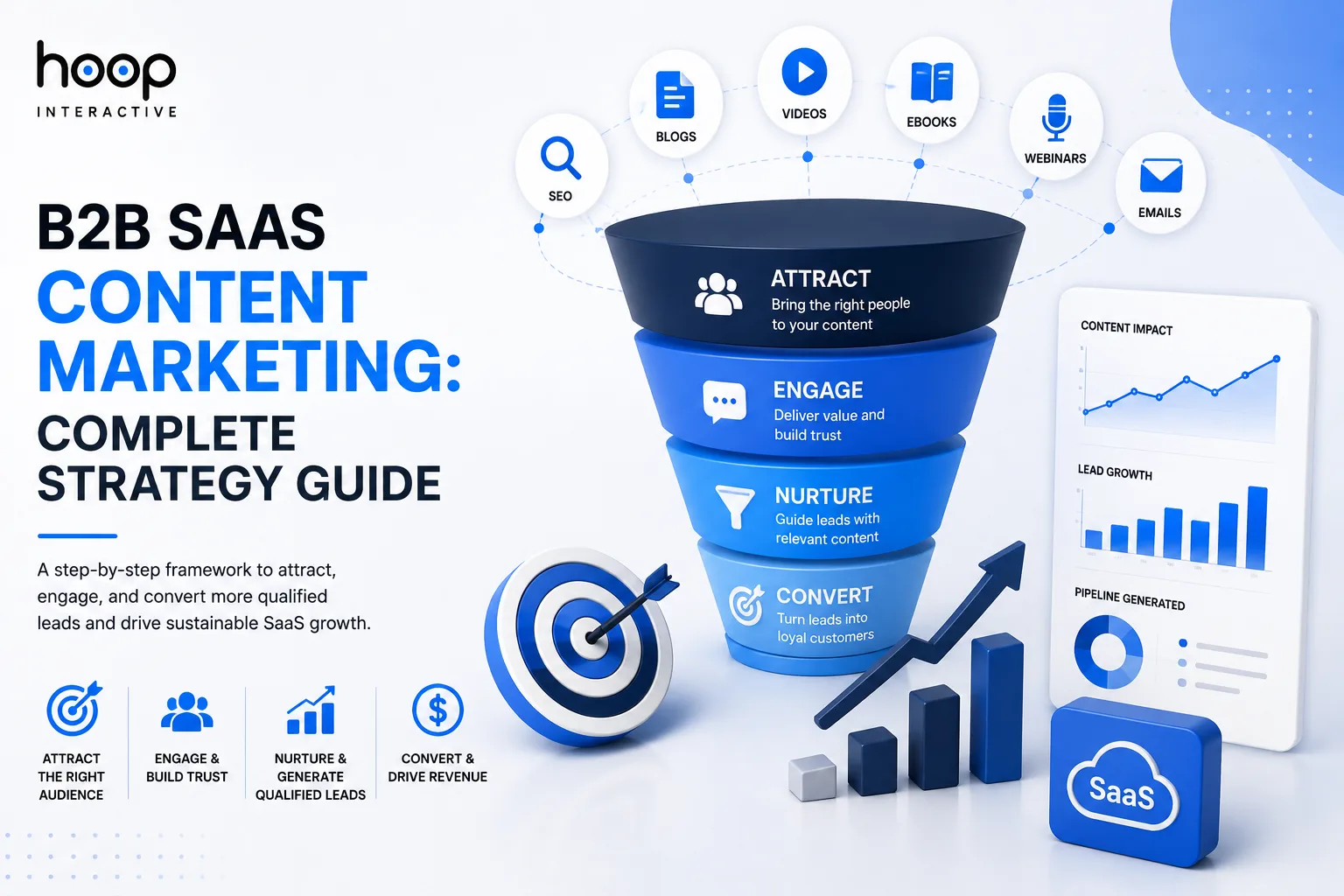
B2B SaaS Content Marketing: Complete Strategy Guide (2026)
SaaS content usually fails because it is written from assumptions rather than buyer intent, and measured on traffic rather than pipeline. Map content to awareness, consideration, and decision stages, target keywords with commercial intent, and lead with the customer problem before the product.
Sahar
Content Writer
Looking for the best B2B SaaS content marketing strategy in 2026? This guide explains how SaaS companies can attract qualified leads, increase free trial sign-ups, generate demo requests, and build sustainable organic growth through SEO, product-led content, AI, and a well-planned content marketing strategy.
Why B2B SaaS Content Marketing Matters More Than Ever
The B2B SaaS industry has never been more competitive. Every day, new software companies enter the market, making it increasingly difficult to stand out. At the same time, buyers have become more informed and spend more time researching solutions before speaking with a sales representative.
Today’s decision-makers compare products, read reviews, explore feature pages, evaluate case studies, and search for educational content long before requesting a demo. If your business fails to appear during this research phase, potential customers may never discover your solution.
This is why B2B SaaS content marketing has become one of the most valuable growth strategies. Instead of interrupting prospects with advertisements, content marketing attracts them by answering questions, solving problems, and demonstrating expertise.
Unlike paid campaigns that stop producing results once the budget ends, high-quality content continues generating organic traffic, qualified leads, and recurring opportunities for months or even years.
For SaaS companies focused on long-term growth, content marketing is no longer optional. It has become a fundamental part of customer acquisition, brand authority, and sustainable revenue generation.
Why Many SaaS Companies Struggle With Content Marketing
Despite investing time and resources, many SaaS businesses fail to see meaningful results from their content marketing efforts. In most cases, the problem is not publishing too little content — it is publishing the wrong content.
Many companies create articles based on assumptions instead of customer intent. They write about broad industry topics without considering what potential buyers actually search for during different stages of the buying journey.
Others focus only on traffic while ignoring conversions. A blog may attract thousands of visitors each month, but if none of those readers become qualified leads, demo requests, or paying customers, the content is not supporting business growth.
Another common mistake is producing generic articles that offer little original value. As artificial intelligence becomes more accessible, search engines increasingly reward content that demonstrates genuine expertise, practical experience, and unique insights.
Successful B2B SaaS content marketing combines strategic planning, customer research, SEO, and product knowledge to create content that educates readers while naturally guiding them toward your solution.
Build a Content Strategy Before You Create Content
One of the biggest reasons SaaS content fails is the absence of a clear strategy. Publishing articles consistently is important, but consistency alone does not guarantee results.
Every successful content marketing strategy begins with understanding your audience. Identify who makes the buying decision, what challenges they face, and what questions they ask throughout the purchasing process. Marketing managers, IT leaders, founders, finance teams, and operations professionals often have different priorities, so your content should address each audience appropriately.
Once your audience is defined, organize your content around specific business objectives. Some articles should increase brand awareness, while others should nurture prospects or encourage demo requests.
Building topic clusters around your core products also improves SEO performance. Instead of creating unrelated blog posts, develop comprehensive content that supports broader subject areas relevant to your software.
A structured editorial calendar ensures consistent publishing while helping your team prioritize high-impact topics that align with customer needs and business goals.
The strongest content strategies balance educational value with commercial intent, allowing readers to learn first while naturally discovering how your product solves their problems.
Map Content to the Buyer’s Journey
Not every visitor is ready to purchase software immediately. Some are only beginning to research a problem, while others are comparing vendors or evaluating pricing. Understanding this journey helps you create content that supports prospects at every stage.
During the awareness stage, potential customers are trying to understand their challenges. Educational blog posts, industry reports, beginner guides, and thought leadership articles perform well because they introduce valuable information without being overly promotional.
As prospects move into the consideration stage, they begin comparing solutions. This is the ideal time to publish comparison articles, product alternatives, implementation guides, feature explanations, webinars, and customer success stories.
When buyers reach the decision stage, they need confidence before committing to a purchase. Detailed case studies, pricing information, product demonstrations, ROI calculators, onboarding resources, and customer testimonials help reduce uncertainty and encourage conversions.
Aligning content with the buyer’s journey creates a smoother experience while improving lead quality and shortening the sales cycle.
SEO Remains the Foundation of SaaS Growth
Search engine optimization continues to be one of the highest-return marketing investments for SaaS companies. Unlike short-term advertising campaigns, SEO helps your business build lasting visibility in search results, attracting prospects who are actively looking for solutions.
Effective SaaS SEO begins with understanding search intent rather than simply targeting high-volume keywords. Some users search for educational information, while others compare software providers or look for pricing details. Creating content that matches these different intentions significantly improves both rankings and conversions.
Topical authority has become another important ranking factor. Rather than publishing isolated articles, successful SaaS businesses develop comprehensive content ecosystems that thoroughly cover every aspect of their industry.
Internal linking strengthens this approach by connecting related guides, feature pages, use cases, comparison articles, and customer success stories. This not only improves navigation but also helps search engines understand the relationship between your content.
Technical SEO also contributes to long-term performance. Fast loading speeds, mobile responsiveness, secure browsing, clean site architecture, and structured metadata all support better rankings while improving the user experience.
Businesses that invest consistently in SEO build a reliable source of qualified organic traffic that continues growing over time.
Target Keywords That Drive Business Results
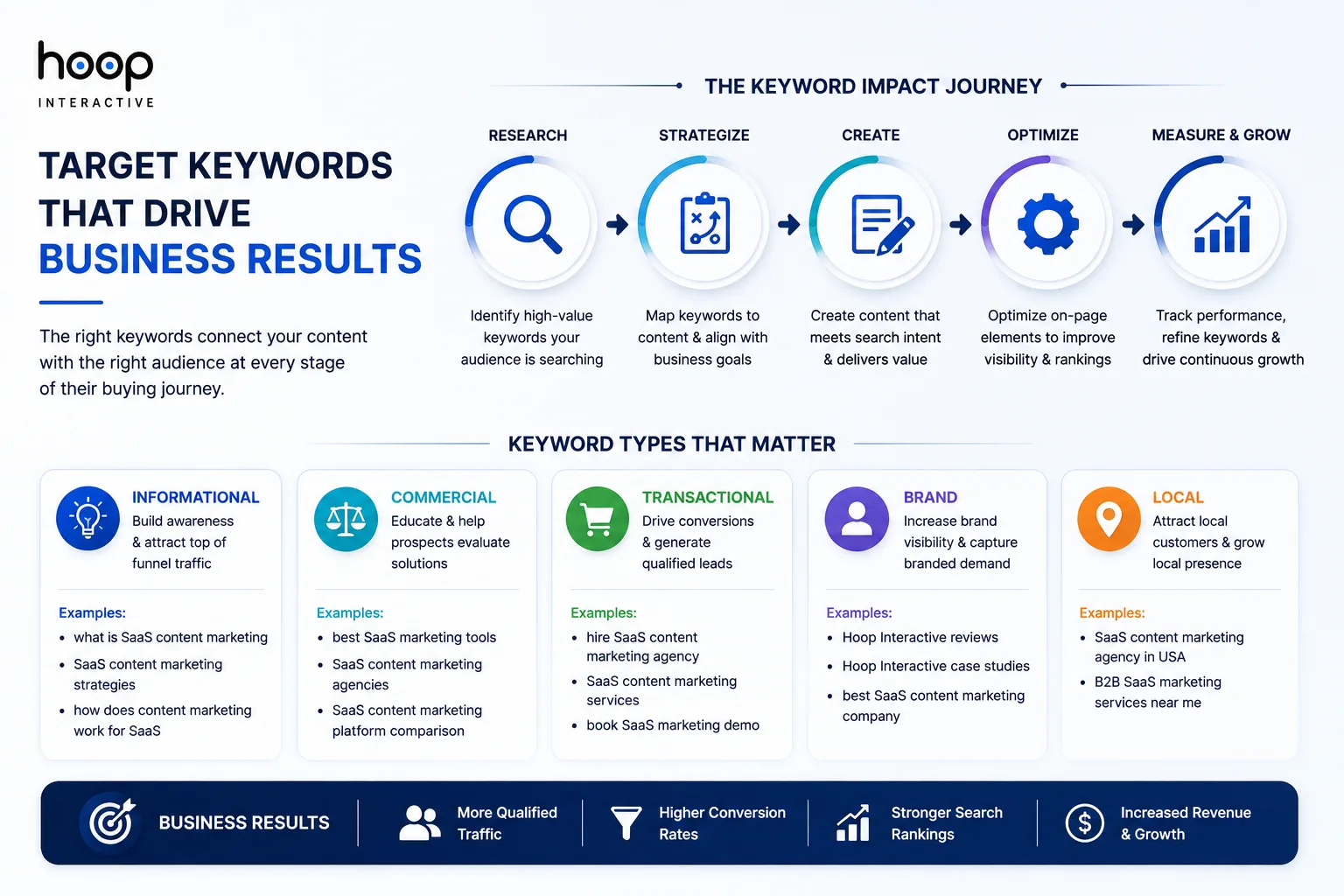
Many SaaS companies focus on high-volume keywords because they appear attractive in keyword research tools. However, search volume alone rarely predicts business value.
The most profitable keywords often indicate strong commercial intent. Searches involving software comparisons, product alternatives, pricing, integrations, implementation, and solution-specific questions typically attract users who are much closer to making a purchase.
Long-tail keywords also play an important role. Although they usually generate lower search volume, they often produce higher conversion rates because they reflect highly specific customer needs.
Instead of targeting one broad keyword, build content clusters around related search terms that address different aspects of the same topic. This approach increases topical authority while creating multiple entry points for potential customers.
Regularly updating existing content is equally important. Refreshing statistics, improving examples, expanding sections, and optimizing for evolving search intent helps maintain strong rankings while keeping information relevant.
A well-planned keyword strategy supports every stage of the customer journey and creates a stronger foundation for long-term organic growth.
Create Product-Led Content That Educates First
One of the biggest challenges in B2B SaaS content marketing is promoting your software without making every article sound like a sales pitch.
The most successful SaaS development teams solve this by adopting a product-led content approach.
Instead of starting with product features, begin by addressing a real customer problem. Explain the challenge, provide practical solutions, and share actionable advice that readers can apply immediately.
Once the problem has been clearly explained, introduce your software naturally as one possible solution. Demonstrating how specific features simplify workflows or solve common pain points makes product recommendations feel helpful rather than promotional.
Use real examples, screenshots, customer stories, implementation tips, and practical use cases whenever possible. This helps readers visualize how the software fits into their daily work while building trust in your expertise.
Educational-first content not only improves user engagement but also increases the likelihood that prospects will request a demo or start a free trial because they already understand the value your solution provides.
Content Distribution Is Just as Important as Content Creation
Publishing a high-quality article is only the first step. Without a strong distribution strategy, even the best content may struggle to reach the right audience.
Successful B2B SaaS content marketing focuses on getting content in front of potential customers wherever they spend time online. Instead of relying only on search engines, SaaS companies should distribute content across multiple channels to maximize visibility and engagement.
LinkedIn remains one of the most effective platforms for B2B SaaS marketing. Decision-makers, executives, and professionals regularly use LinkedIn to discover industry insights, making it an ideal place to share blog posts, thought leadership articles, customer success stories, and product updates.
Email marketing is another powerful distribution channel. Rather than sending only promotional emails, businesses should share educational resources, product tips, industry news, and valuable guides that keep subscribers engaged throughout the buyer’s journey.
Webinars, podcasts, newsletters, online communities, and strategic partnerships also expand your content’s reach while positioning your brand as a trusted industry authority.
Content repurposing further increases efficiency. A single in-depth guide can become several LinkedIn posts, short videos, infographics, newsletters, podcast discussions, and downloadable resources, allowing you to reach different audiences without constantly creating new material.
The most successful SaaS companies treat content distribution as an ongoing strategy rather than an afterthought.
AI Is Transforming SaaS Content Marketing
Artificial intelligence has changed how marketing teams research, write, optimize, and analyze content. However, AI works best when it enhances human expertise rather than replacing it.
AI tools can help marketers identify keyword opportunities, generate content outlines, summarize research, improve readability, optimize headlines, and analyze search trends. These capabilities save valuable time and allow teams to focus on strategy, creativity, and customer insights.
AI is also improving personalization. By analyzing customer behavior, businesses can recommend relevant content, deliver targeted email campaigns, and create personalized user experiences that improve engagement and conversions.
Despite these advantages, relying entirely on AI-generated content creates risks. Generic articles often lack original insights, practical experience, and unique perspectives that both readers and search engines value.
Google continues rewarding content that demonstrates expertise, experience, authority, and trustworthiness. This means human editing remains essential.
The strongest B2B SaaS content marketing strategies combine AI-powered efficiency with subject matter expertise, customer knowledge, and authentic storytelling.
Measure Content Marketing ROI
Creating content without measuring results makes it difficult to understand whether your strategy supports business growth. While page views and impressions provide useful information, they should never be the only metrics you monitor.
Organic traffic remains one of the first indicators of SEO success. Increasing search visibility shows that your content is reaching more potential customers through search engines. However, traffic should also translate into meaningful business outcomes.
Monitor demo requests, free trial sign-ups, consultation bookings, newsletter subscriptions, and contact form submissions to understand how content contributes to lead generation.
Marketing-qualified leads and sales-qualified leads provide additional insight into lead quality. If your content attracts visitors who match your ideal customer profile, your sales team will have a stronger pipeline of qualified opportunities.
Conversion rate is another critical metric. Small improvements to landing pages, calls to action, or product pages can significantly increase the number of visitors who become customers.
Businesses should also evaluate customer acquisition cost, customer lifetime value, and revenue influenced by content marketing. These metrics provide a clearer picture of long-term return on investment than traffic alone.
Regular performance reviews help identify which topics, keywords, and content formats generate the greatest business impact.
Content Marketing Supports Every Stage of the Sales Funnel
Many businesses mistakenly believe content marketing only creates awareness. In reality, effective content influences every stage of the customer journey.
At the top of the funnel, educational articles introduce potential customers to your brand by solving common problems and answering industry questions. This builds trust before buyers actively begin evaluating software solutions.
During the middle of the funnel, comparison articles, implementation guides, webinars, and case studies help prospects understand how different solutions address their needs. This is where product-led content becomes especially valuable because it connects customer challenges with practical solutions.
At the bottom of the funnel, decision-focused content removes uncertainty. Pricing pages, feature comparisons, customer testimonials, ROI calculators, onboarding resources, and detailed product demonstrations help prospects feel confident about moving forward.
After a customer converts, content continues providing value. Knowledge bases, training resources, product updates, and educational newsletters improve customer retention while encouraging product adoption and long-term loyalty.
A complete content strategy supports the entire customer lifecycle rather than focusing solely on attracting new visitors.
Common B2B SaaS Content Marketing Mistakes
Many SaaS companies invest significant resources into content marketing but fail to achieve consistent results because they repeat the same avoidable mistakes.
One of the biggest mistakes is publishing content without conducting proper keyword research. Articles that do not align with customer search intent rarely generate meaningful organic traffic.
Another common issue is creating content for search engines instead of people. While SEO is essential, readers ultimately determine whether your content provides value. Helpful, engaging, and practical articles consistently outperform generic keyword-focused content.
Some businesses also overlook internal linking. Every guide, feature page, comparison article, and case study should connect naturally to related resources, improving navigation while strengthening topical authority.
Publishing inconsistent content is another challenge. Building authority requires ongoing effort rather than occasional blog posts.
Many companies also ignore content updates. Refreshing older articles with current information, improved examples, and new insights helps maintain rankings while keeping content relevant.
Finally, weak calls to action often reduce conversions. Every article should guide readers toward a logical next step, whether that means downloading a resource, booking a demo, starting a free trial, or contacting your sales team.
Future Trends Shaping B2B SaaS Content Marketing
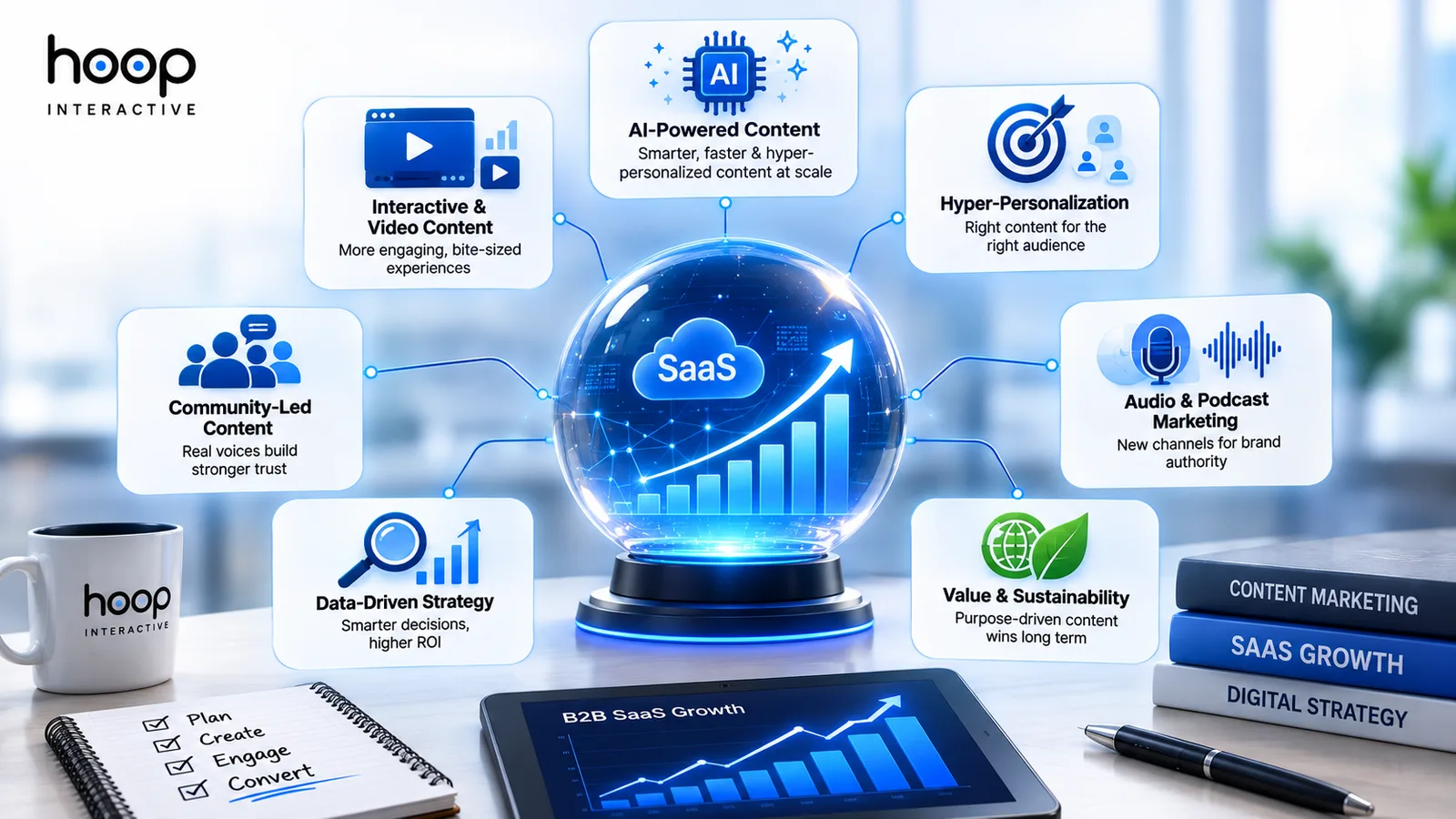
The future of B2B SaaS content marketing will focus on creating highly relevant, personalized, and experience-driven content. As competition continues to grow, businesses that publish generic articles will find it increasingly difficult to stand out.
One of the biggest trends is the rise of first-party data. As privacy regulations evolve and third-party cookies continue to disappear, SaaS companies will rely more on information collected directly from prospects through newsletters, webinars, product sign-ups, and gated resources. This data allows marketers to create more personalized content experiences while building stronger customer relationships.
Interactive content is also becoming more popular. ROI calculators, product assessment tools, quizzes, interactive demos, and self-service product tours help prospects engage with software before speaking with a sales representative. These experiences often increase engagement while shortening the buying journey.
Video content will continue to grow in importance. Product walkthroughs, feature demonstrations, customer interviews, educational webinars, and short tutorial videos help explain complex software more effectively than text alone. Combining written content with video creates a richer learning experience for potential customers.
AI-assisted personalization will become increasingly sophisticated. Instead of delivering identical content to every visitor, SaaS businesses will recommend articles, product resources, and case studies based on user behavior, industry, company size, and stage in the buying journey.
Another growing trend is content optimization rather than content expansion. Instead of publishing hundreds of new blog posts, successful SaaS companies will improve existing content by updating statistics, expanding topic coverage, enhancing user experience, and strengthening internal links.
Businesses that combine SEO, valuable educational content, product expertise, and outstanding customer experience will continue building long-term competitive advantages.
Key Metrics Every SaaS Marketing Team Should Track
Publishing content consistently is important, but measuring its impact is what drives continuous improvement.
Organic traffic remains a valuable indicator because it reflects how well your content performs in search engines. However, traffic should always be evaluated alongside business outcomes.
Demo requests and free trial sign-ups provide a much clearer picture of content effectiveness. These metrics show whether visitors are moving beyond information gathering and taking meaningful action.
Conversion rate helps identify how effectively landing pages, product pages, and blog posts encourage users to continue through the sales funnel.
Marketing-qualified leads and sales-qualified leads help determine whether your content is attracting the right audience rather than simply increasing website visits.
Customer acquisition cost should also be monitored regularly. As organic visibility grows, content marketing often reduces dependence on paid advertising, lowering overall acquisition costs.
Customer lifetime value provides another important perspective. High-quality content not only attracts new customers but also improves onboarding, product adoption, customer retention, and long-term revenue.
Businesses should also track keyword rankings, backlink growth, engagement time, bounce rate, internal link performance, email subscriptions, and pipeline influenced by content.
Reviewing these metrics regularly enables marketing teams to refine their strategies, improve performance, and demonstrate measurable business value.
Build a Content Engine, Not a Publishing Schedule
A successful B2B SaaS content marketing strategy is about much more than publishing blog posts. It requires a clear understanding of your audience, strong SEO foundations, product-led storytelling, consistent content distribution, and continuous optimization based on measurable results.
Businesses that focus on educating prospects, answering real customer questions, and creating valuable content for every stage of the buyer’s journey build stronger trust, generate more qualified leads, and create sustainable long-term growth. Instead of chasing short-term traffic, they develop a content ecosystem that continually attracts, nurtures, and converts potential customers.
As AI, personalization, and search behavior continue to evolve, companies that combine technology with authentic expertise will remain ahead of the competition. High-quality content will continue to play a central role in customer acquisition, retention, and revenue growth.
If you are ready to build a scalable strategy that drives organic traffic, increases demo requests, and supports long-term business growth, Hoop Interactive develops data-driven content marketing services designed to improve search visibility, generate qualified leads, and deliver measurable results for SaaS businesses.
“The problem is rarely publishing too little. It is publishing the wrong thing, then measuring it with the wrong number.”
Key takeaways
- 01Search volume rarely predicts business value — comparison, pricing, and integration queries convert.
- 02Product-led content explains the problem first and introduces the software as one answer.
- 03Distribution deserves as much planning as creation; LinkedIn and email carry B2B reach.
- 04Measure demo requests, trial sign-ups, MQLs, SQLs, CAC, and CLV — not pageviews.
Written by
Sahar
Content Writer
Frequently Asked
Questions
Everything you need to know before booking a strategy call. Can't find your answer? Contact us directly.
It is the process of creating valuable content that educates potential customers, builds trust, improves search visibility, and generates qualified leads for software companies. It includes blog articles, SEO content, case studies, comparison pages, webinars, product guides, and email marketing.
Yes. It remains one of the highest-ROI marketing strategies for SaaS businesses. High-quality, SEO-focused content attracts organic traffic, supports lead generation, nurtures prospects, and helps reduce acquisition costs over the long term.
Educational blog posts, comparison pages, product-led guides, case studies, customer success stories, feature pages, implementation tutorials, webinars, and industry reports consistently generate qualified traffic and encourage demo requests.
AI is an excellent tool for research, outlining, optimization, and productivity. However, successful SaaS companies combine AI with human expertise, original insights, and industry experience to produce content that is accurate, engaging, and trustworthy.
Track organic traffic, keyword rankings, demo requests, free trial sign-ups, MQLs, SQLs, conversion rates, customer acquisition cost, customer lifetime value, and revenue influenced by content.
Keep reading
All articles →
How to Write a Blog Post That Ranks on Google (2026)
Aug 6, 2026 · 14 min read
What Is SEO? A Complete Guide to Search Engine Optimization
Jul 13, 2026 · 11 min read