
Content Creation Ideas: How to Never Run Out of Things to Create
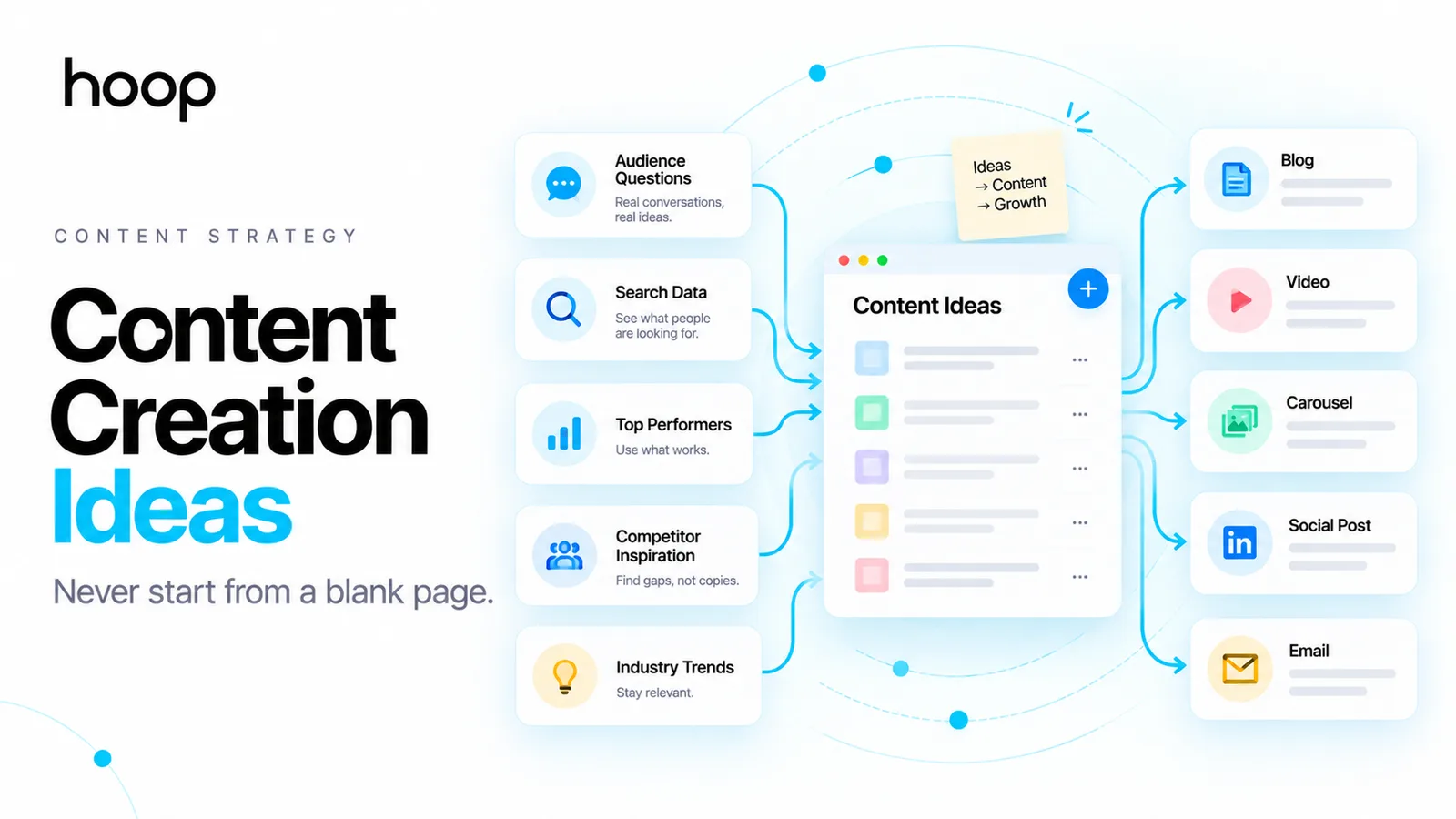
Strong content ideas come from audience questions, search behavior, customer conversations, performance data, competitor gaps, and reusable systems. Build an idea bank, filter weak topics, repurpose one idea across formats, and keep the pipeline full without relying on inspiration.
Sahar
Content Writer
The best content creation ideas come from real audience problems, search behavior, customer conversations, performance data, and proven themes you can reuse. You do not need constant inspiration. You need a system that captures useful signals, turns those signals into angles, and keeps strong ideas available before production starts.
Most teams struggle because they mix ideation with writing, recording, design, and publishing. The blank page becomes stressful because every post starts from zero. A better process separates idea collection from content production.
That shift gives you a working backlog for blogs, videos, carousels, emails, podcasts, and social posts. It also makes your content more relevant because the ideas come from evidence instead of guesses.
What Are Content Creation Ideas and Where Do They Come From?
Content creation ideas are topics, questions, angles, stories, examples, or formats that can become useful content for a specific audience. Strong ideas connect audience interest with a clear business or communication goal.
A useful idea usually starts with a signal. A customer asks the same question on 3 sales calls. A search query keeps appearing in Google Search Console. A LinkedIn post earns 4 times your normal saves. A competitor covers a topic but leaves an obvious gap. An industry change creates a new question.
These signals are more reliable than random brainstorming because they show existing interest. Your job is to capture the signal and shape the angle.
Audience questions reveal active problems
Questions from comments, direct messages, support tickets, reviews, and sales calls give you exact audience language. Turn repeated questions into how-to guides, FAQs, comparison posts, videos, or objection-handling content.
Search behavior reveals existing demand
Search suggestions, keyword tools, Google Trends, and Search Console show what people actively look for. Search-led ideas work especially well for blogs, YouTube videos, product education, and evergreen guides.
If search-led publishing is a major goal, Hoop’s blog writing services connect topic research with keyword mapping and publication-ready content.
Performance data reveals proven themes
Review posts with strong saves, shares, watch time, clicks, leads, or organic traffic. High-performing topics deserve follow-ups, deeper explanations, updated versions, and new formats.
30 Content Creation Ideas You Can Use
Use these 30 content creation ideas as starting formats, then connect each format to a real audience problem. A format alone does not create relevance. The audience question inside the format creates value.
Educational content ideas
- Answer a common question. Turn one repeated customer question into a clear direct answer.
- Create a step-by-step guide. Show the exact process for completing one useful task.
- Explain a confusing term. Define industry language in plain English with a real example.
- List common mistakes. Explain what people get wrong and what to do instead.
- Build a checklist. Give readers a sequence they can use before starting or publishing.
Authority-building content ideas
- Share a strong opinion. Explain a position and support the position with evidence or experience.
- Publish a prediction. Identify a change you expect and explain the signals behind it.
- Break down a lesson learned. Show what changed after a project, test, launch, or mistake.
- Explain your process. Walk through how your team handles research, planning, production, or quality control.
- Create a case study. Show the problem, action, result, and lesson from a real project.
Product and service content ideas
- Demonstrate one feature. Show one feature solving one specific user problem.
- Explain a use case. Connect the product or service to a real scenario.
- Compare 2 options. Help the audience decide between 2 products, methods, or approaches.
- Answer a buying objection. Address concerns about price, complexity, time, risk, or fit.
- Show before and after. Compare the old state with the improved result.
Audience-led content ideas
- Turn a comment into a post. Expand a useful question from a comment thread.
- Run a poll. Ask the audience to choose between 2–4 options and explain the result later.
- Correct a myth. Address one belief that causes confusion or poor decisions.
- Share customer language. Build a post around phrases customers use during real conversations.
- Create an FAQ series. Turn recurring questions into a weekly or monthly format.
Behind-the-scenes content ideas
- Show work in progress. Share a safe part of the creation or delivery process.
- Explain a decision. Show why your team chose one approach over another.
- Introduce a team workflow. Explain how research, review, design, or approvals happen.
- Share a failed experiment. Explain what failed and what the team changed next.
- Document a milestone. Connect a launch, result, anniversary, or release to a useful lesson.
Repurposing content ideas
- Update an older winner. Add new examples, evidence, screenshots, or lessons.
- Turn a blog into a carousel. Extract the strongest 5–7 points and redesign the explanation.
- Turn a video into short clips. Pull specific answers, examples, or moments into shorter pieces.
- Turn customer questions into email content. Send one focused answer with a clear next step.
- Combine several posts into a guide. Merge related ideas into a deeper resource.
How to Find Content Creation Ideas From Your Audience
To find content creation ideas from your audience, collect the questions, objections, goals, and repeated phrases people already use. Start with direct conversations before searching for abstract trends.
Sales calls are rich research because prospects explain what blocks a decision. Support conversations show what confuses existing customers. Reviews reveal expectations and frustrations. Comments and direct messages show what deserves a deeper answer.
Create a simple capture habit. Save each useful question exactly as the person asked it. Then add 3 fields: audience, problem, and possible format.
For example, the question “How often should a small business post on LinkedIn?” can become a short post, carousel, blog section, email, or video. One question can support several useful assets.
Social content needs platform context. Hoop’s social media marketing approach combines audience research, content pillars, format planning, publishing, and performance measurement.
How to Build a Content Idea Bank
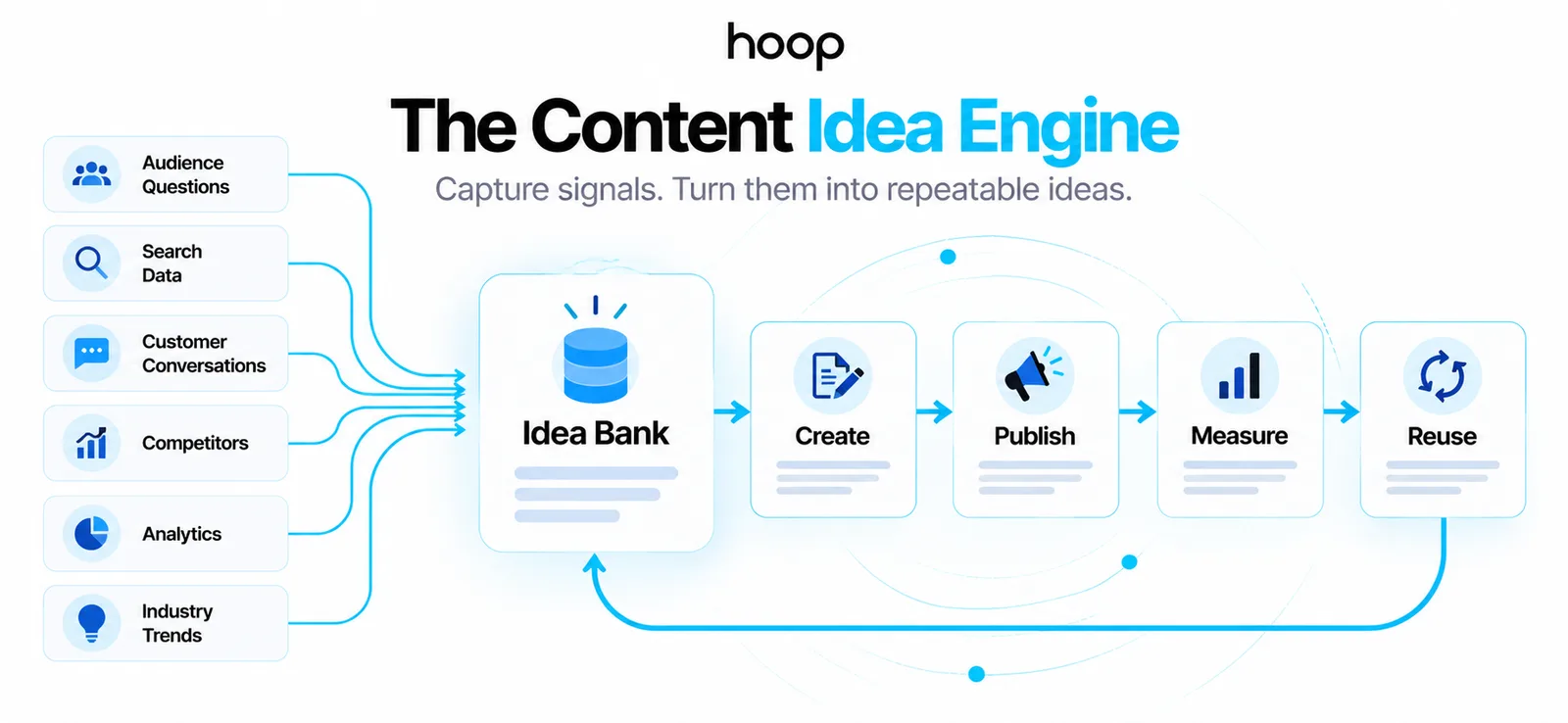
To build a content idea bank, capture ideas continuously and review them on a fixed schedule. Do not wait until the day you need to publish.
Your idea bank can live in Notion, Airtable, Google Sheets, a project tool, or a simple notes file. The software matters less than the fields and habits.
Track at least 6 details for each idea: topic, audience, problem, format, source, and priority. Add a status field when production starts.
Use a repeatable workflow:
| Task | Timing | Method | Difficulty |
|---|---|---|---|
| Capture audience questions | Weekly | Comments, calls, support, reviews | Easy |
| Research search demand | Monthly | Search Console, Trends, keyword tools | Medium |
| Review competitor gaps | Monthly | Topics, formats, missing angles | Medium |
| Check top performers | Monthly | Saves, clicks, leads, watch time | Easy |
| Refresh the idea bank | Monthly | Prioritize, merge, archive, reuse | Easy |
The strongest system follows 5 stages: Capture → Categorize → Prioritize → Create → Measure. Add a sixth stage, Reuse, so winners feed the next cycle.
How to Research Competitors Without Copying Them
To research competitors without copying them, study the problem, format, hook, and gap behind successful content. Never treat a competitor post as a script to rewrite.
Start with the topic. Ask why the topic attracted attention. Then identify the format, such as a list, case study, opinion, tutorial, or comparison. Study the hook and the evidence used. Finally, look for missing examples, outdated advice, weak explanations, or an audience the piece ignores.
A competitor article called “How to Plan 30 Days of Content” can inspire a different angle: “Why 30-Day Content Calendars Fail Small Teams.” The subject overlaps, but the argument changes.
This process produces original content while still learning from proven demand.
How to Know Whether a Content Idea Is Worth Creating
A strong content idea should solve a real problem, fit your audience, support a clear goal, and offer a useful angle. Score ideas before spending production time.
Use 5 questions:
- Does the audience care? Look for questions, searches, comments, or engagement signals.
- Can we add something useful? Add evidence, experience, a clearer explanation, or a stronger example.
- Does the idea support a goal? Connect the idea to awareness, leads, sales, retention, trust, or search visibility.
- Does the format fit? A visual process might suit a carousel, while a nuanced explanation suits a blog or video.
- Can the idea produce more value later? Strong themes can become follow-ups, updates, clips, and related posts.
If an idea scores poorly on audience relevance, drop it. A clever idea with no audience need still wastes production time.
How to Turn 1 Idea Into 7 Pieces of Content
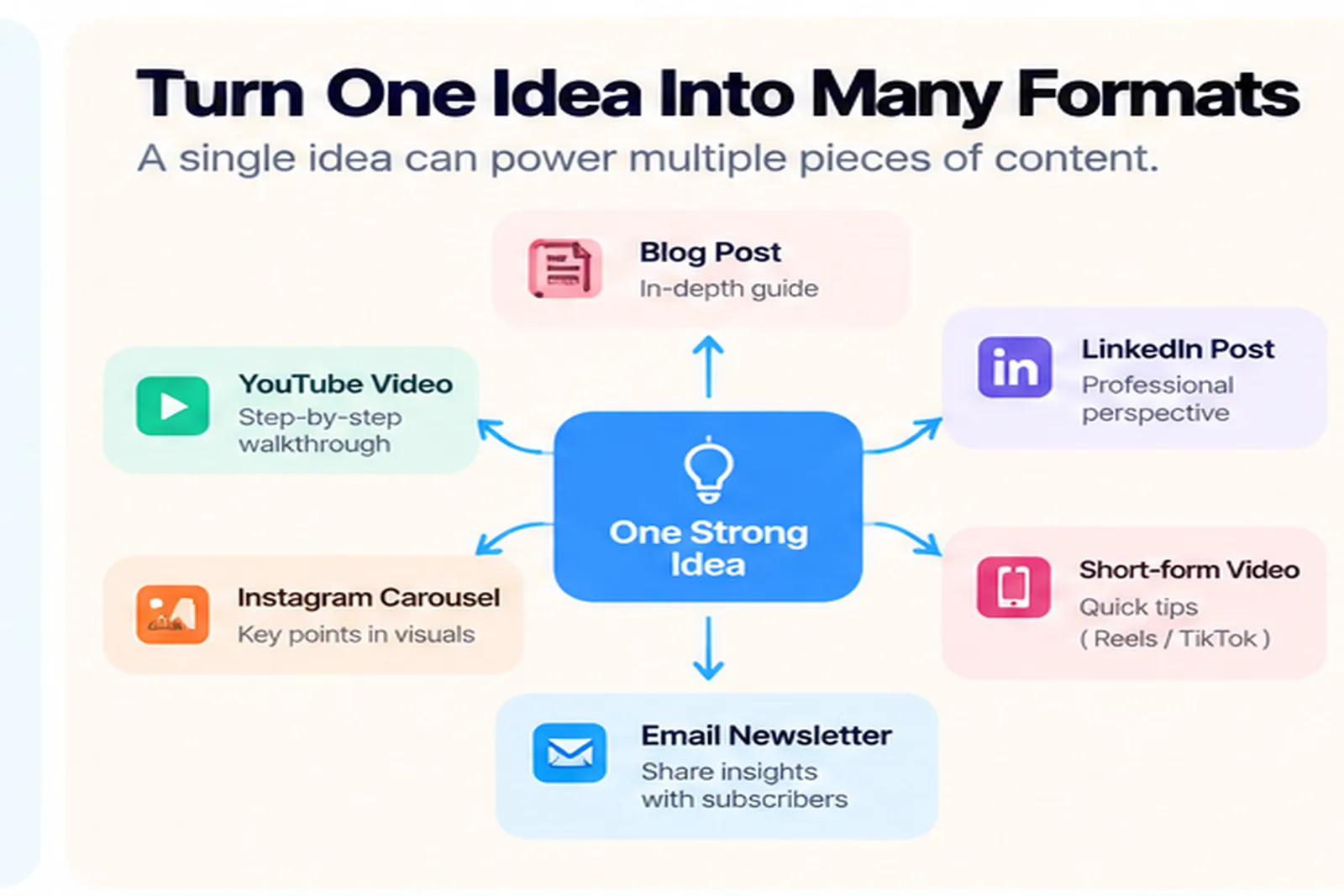
To turn 1 idea into several pieces of content, preserve the core insight and adapt the execution for each channel. Repurposing should change the format, depth, hook, and context.
Suppose the core idea is “5 signs your website needs a redesign.” The idea can become a long-form blog, a LinkedIn post, an Instagram carousel, a 60-second video, 2 short clips, and an email newsletter.
The blog can explain each sign in depth. The carousel can show the signs visually. The video can focus on the strongest 3. LinkedIn can add a business perspective. The email can connect the issue to a practical audit.
Repurposing works because one researched idea produces several useful touchpoints. Copy-pasting the same caption across every platform does not create the same effect.
How to Adapt Content Ideas Across Platforms
Adapt the idea to the behavior people expect on each platform. The core message can stay consistent while the structure changes.
LinkedIn works well for professional lessons, contrarian viewpoints, case studies, and founder expertise. Instagram suits visual education, carousels, Reels, before-and-after examples, and behind-the-scenes content. TikTok rewards clear hooks, fast explanations, demonstrations, and native storytelling.
YouTube supports deeper tutorials, reviews, comparisons, and searchable education. Email works well for focused insights, curated lessons, offers, and follow-up sequences. Blogs support search intent, depth, internal linking, and evergreen discovery.
Do not force every idea onto every platform. Choose the channels where the audience and format match.
How to Use AI for Content Ideas Without Generic Results
Use AI after supplying real audience context, not before. Generic prompts produce generic content creation ideas because the model receives almost no useful constraints.
Avoid prompts such as “Give me 20 content ideas for a marketing agency.” The prompt leaves out the audience, problem, offer, positioning, previous winners, and desired format.
Give AI better inputs:
- Audience: B2B SaaS founders with small marketing teams.
- Problem: inconsistent organic lead flow.
- Offer: technical SEO and content strategy.
- Evidence: 5 customer objections from recent calls.
- Format: LinkedIn posts and 60-second videos.
- Goal: generate qualified demo interest.
Then ask AI to create different angles, objections, examples, or formats. Human review still matters because your team knows the customer context and brand voice.
What to Do When You Run Out of Content Ideas
When your content pipeline feels empty, review evidence before starting a new brainstorming session. Most brands already have unused ideas hiding inside existing activity.
Check comments, search queries, customer emails, sales notes, and top-performing posts. Revisit older content that performed well. Look for topics that deserve an update, a narrower angle, or a different format.
Change the question if the niche feels exhausted. Instead of asking “What can we post about our product?” ask “What problems happen before someone needs our product?” Then ask what happens during evaluation, implementation, and long-term use.
A specialist accounting firm can create content about deadlines, mistakes, documents, tax questions, cash-flow decisions, software workflows, and client preparation. A manufacturing company can explain maintenance, selection criteria, safety, comparisons, procurement questions, and operating mistakes.
Boring niches rarely lack ideas. They usually lack a structured way to find the audience’s real questions.
How to Build a Content System That Does Not Burn You Out
Separate ideation, production, and publishing so your team does not restart the entire process for every post. Batch similar work and keep a visible backlog.
Use one session to collect and rank ideas. Use another session for research and outlines. Batch writing, recording, or design when the formats allow it. Schedule publishing separately.
Set content pillars to organize the backlog, not to limit creativity. A business might use 5 pillars: education, proof, product, opinion, and community. Every pillar can contain dozens of angles.
Review performance monthly. Feed winning themes back into the idea bank. Retire ideas that no longer match audience needs. Refresh evergreen winners when facts, examples, or search behavior changes.
The goal is not endless output. The goal is a sustainable system that creates useful content without constant creative panic.
Turn Content Ideas Into a Repeatable Growth System
A full content pipeline starts with better inputs, not more pressure to be creative. Capture real audience signals, organize them, prioritize the strongest angles, publish consistently, and reuse proven themes.
If your team needs research, strategy, production, and distribution working together, explore Hoop’s content marketing services and build a content system around measurable business goals.
“Boring niches rarely lack ideas. They usually lack a structured way to find the audience’s real questions.”
Key takeaways
- 01Separate idea collection from production — that is what kills the blank page.
- 02Capture the customer question in their exact words, then add audience, problem, format.
- 03Score an idea before producing it: audience, added value, goal, format, reuse potential.
- 04Give AI the audience, problem, offer, evidence, format, and goal — or expect generic output.
Written by
Sahar
Content Writer
Frequently Asked
Questions
Everything you need to know before booking a strategy call. Can't find your answer? Contact us directly.
Start with audience questions, search behavior, customer conversations, competitor gaps, and past performance. Capture the signals in one idea bank before production starts.
Review comments, FAQs, sales objections, top-performing posts, and older content first. Those sources usually contain topics you can update, expand, or reformat.
Yes. Update the evidence, angle, examples, hook, or format. Reusing a proven theme is different from publishing the same piece repeatedly.
Build a backlog and separate ideation from production. Batch research, writing, design, and publishing instead of starting every post from zero.
Yes, when you provide strong context. Give AI the audience, pain point, offer, format, goal, and real customer inputs before requesting angles.