
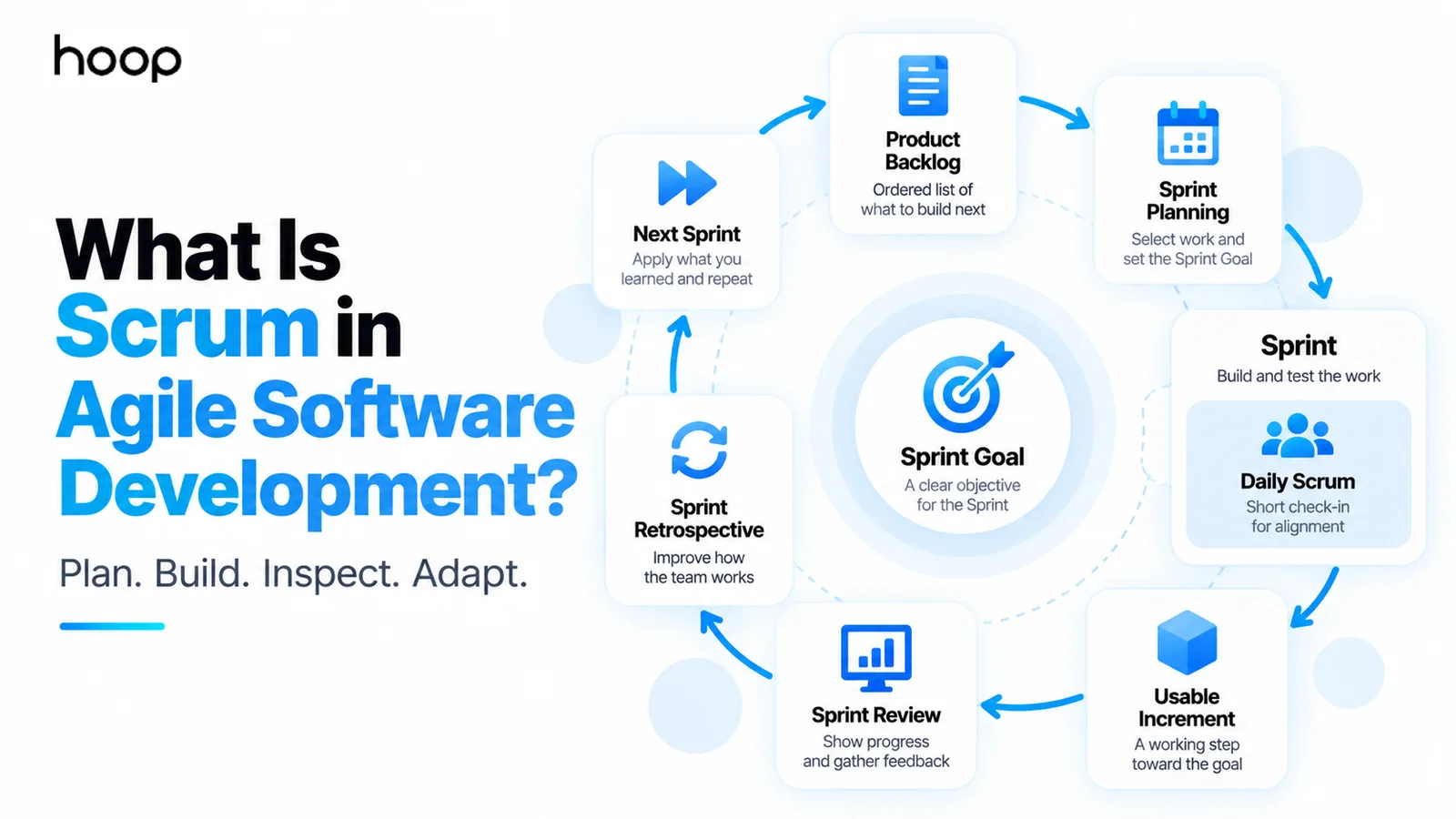
What Is Scrum in Agile Software Development?
Scrum is a lightweight Agile framework built around Sprints, a small self-managing team, clear goals, usable Increments, and regular inspection. Learn how Scrum works, who does what, and why Scrum is not the same as Agile.
Sahar
Content Writer
Scrum is a lightweight framework that helps teams solve complex product problems through short Sprints, clear goals, regular inspection, and adaptation. Agile provides the broader values and principles, while Scrum gives teams a defined structure for applying those ideas.
Scrum does not mean “daily stand-up,” and Scrum does not simply mean “work faster.” A Scrum Team uses a Product Backlog, a Sprint Goal, a usable Increment, and regular feedback to decide what to build next. The framework gives teams enough structure to coordinate work without prescribing every engineering practice.
Is Scrum the Same as Agile?
No. Agile and Scrum are related, but they are not the same thing. Agile describes a broader approach to software development that values working software, collaboration, frequent feedback, and the ability to respond to change.
Scrum is one framework that teams can use within that broader Agile approach. Kanban, Extreme Programming, and Lean software development provide other ways to organize work around similar principles.
A team can work in an Agile way without using Scrum. A team cannot claim to use Scrum while removing its core accountabilities, events, and artifacts.
How Does Scrum Work?
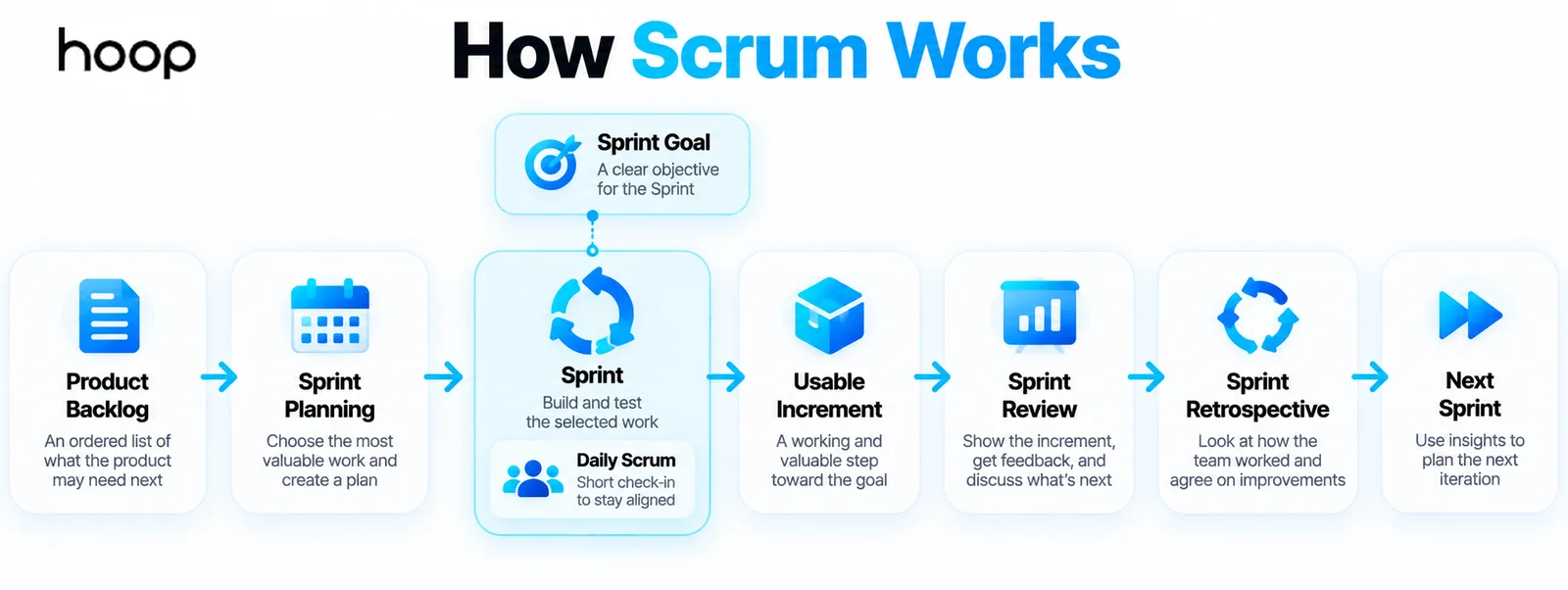
Scrum works by turning a large product problem into a repeated cycle of prioritization, focused delivery, review, and improvement. The Product Owner orders the Product Backlog. The Scrum Team selects work during Sprint Planning and turns that work into a usable Increment during the Sprint.
The Scrum Team and stakeholders inspect the outcome during the Sprint Review. The Scrum Team then inspects its own way of working during the Sprint Retrospective. The next Sprint starts immediately after the previous Sprint ends.
That sequence creates a short feedback loop:
- Prioritize the most valuable work.
- Set a clear Sprint Goal.
- Build and test a usable Increment.
- Inspect the result with stakeholders.
- Improve the team’s process.
- Adjust priorities for the next Sprint.
The official Scrum Guide describes Scrum as a framework built on empiricism and lean thinking. Teams make decisions from observed results instead of relying only on long-range predictions.
What Are the 3 Pillars of Scrum?
Scrum uses 3 empirical pillars: transparency, inspection, and adaptation. The pillars explain why the framework exposes goals, work, outcomes, and quality standards so clearly.
Transparency
Transparency makes important information visible to the people doing and receiving the work. A visible Product Backlog, Sprint Goal, Increment, and Definition of Done reduce hidden assumptions.
Teams cannot inspect work accurately when different people use different definitions of progress or quality. Clear artifacts create a shared basis for decisions.
Inspection
Inspection means checking progress and outcomes frequently enough to detect problems early. Scrum creates formal inspection points through Sprint Planning, Daily Scrum, Sprint Review, and Sprint Retrospective.
Inspection should lead to useful decisions. Measuring activity without changing anything does not create much value.
Adaptation
Adaptation means changing the plan, process, or product direction when evidence shows that a change is needed. Developers can adapt their Sprint plan daily. The team can adjust future backlog priorities after stakeholder feedback.
Scrum therefore treats learning as part of product development rather than as something saved for the end of a project.
What Are the 5 Scrum Values?
Scrum identifies 5 values: commitment, focus, openness, respect, and courage. These values shape how the Scrum Team makes decisions and works together.
Commitment keeps the team focused on agreed goals. Focus directs attention toward the Sprint and Product Goals. Openness makes problems and uncertainty visible. Respect supports professional independence. Courage helps team members raise difficult issues and make necessary changes.
The values matter because Scrum depends on honest inspection. A team cannot adapt effectively when people hide risks, avoid disagreement, or treat mistakes as failures to conceal.
Who Is on a Scrum Team?
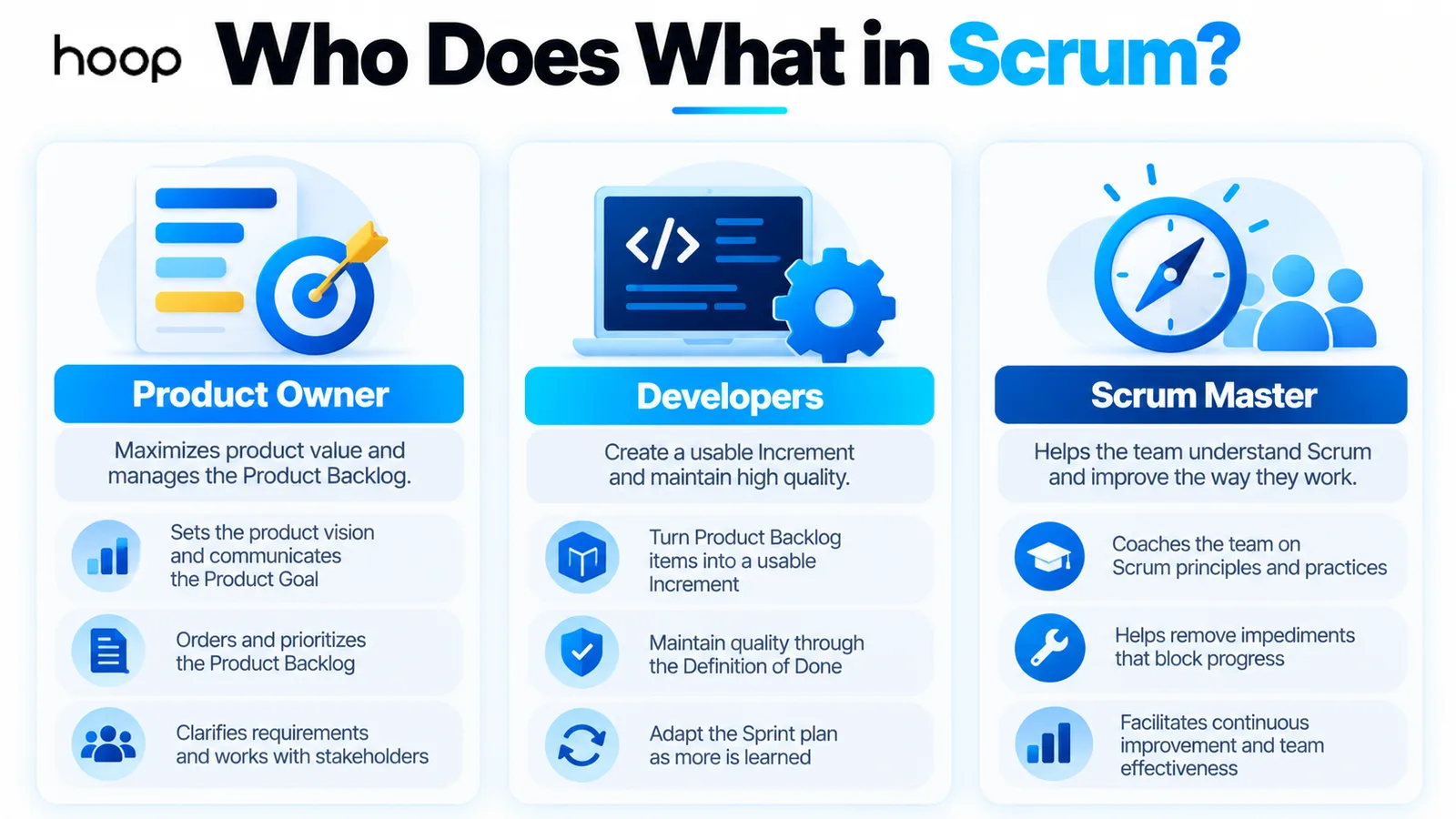
A Scrum Team contains 3 accountabilities: Product Owner, Scrum Master, and Developers. The current Scrum Guide describes the team as small, cross-functional, and self-managing.
Product Owner
The Product Owner is accountable for maximizing product value and managing the Product Backlog. The Product Owner communicates the Product Goal, creates or clarifies backlog items, and orders those items by value and priority.
The Product Owner decides what deserves attention first. The Developers decide how selected work becomes a usable product Increment.
Developers
Developers create the usable Increment and own the plan for achieving the Sprint Goal. The title includes anyone who contributes directly to the Increment, not only programmers.
Developers can include software engineers, testers, designers, data specialists, or other contributors. The required skills depend on the product.
Developers also maintain quality through the Definition of Done. Developers update the Sprint plan as new information appears.
Scrum Master
The Scrum Master helps the team understand Scrum and improve its effectiveness. The Scrum Master coaches self-management, helps remove impediments, and keeps Scrum events useful and within their timeboxes.
A Scrum Master is not simply a meeting coordinator. A Scrum Master also does not assign tasks like a traditional project manager.
What Is a Sprint in Scrum?
A Sprint is the fixed-length container for the work and all other Scrum events. The Scrum Guide sets a maximum Sprint length of 1 month, although many software teams use shorter cycles.
Every Sprint starts with a Sprint Goal and ends with a review of the product outcome and the team’s process. The team can create and release value before the Sprint ends, so the Sprint Review does not act as a release gate.
During a Sprint, the team protects the Sprint Goal. The Product Backlog can continue evolving, while Developers can clarify or renegotiate Sprint scope with the Product Owner when new information appears.
What Happens During Sprint Planning?
Sprint Planning creates the Sprint Goal, selects the work, and establishes a practical delivery plan. The entire Scrum Team collaborates during the event.
Sprint Planning answers 3 questions:
- Why is the Sprint valuable?
- What can the team complete during the Sprint?
- How will the selected work become a usable Increment?
The result becomes the Sprint Backlog. The Sprint Backlog combines the Sprint Goal, selected Product Backlog items, and the Developers’ delivery plan.
What Is the Daily Scrum?
The Daily Scrum is a 15-minute event for Developers to inspect progress toward the Sprint Goal and adapt the plan. The Daily Scrum is not the entire Scrum framework.
The event should help Developers coordinate work and identify problems early. The Scrum Guide does not require the classic “yesterday, today, blockers” script.
Developers can use any format that produces an actionable plan for the next working day. A Daily Scrum also should not become a manager-led status meeting.
What Happens During the Sprint Review?
The Sprint Review inspects the product outcome and helps the team decide what to do next. The Scrum Team presents results to relevant stakeholders and discusses progress toward the Product Goal.
The Review should create a conversation, not only a demonstration. Stakeholders can provide feedback, market conditions can change, and the Product Backlog can be adjusted after the discussion.
A productive Sprint Review helps the team answer a practical question: Did the latest Increment create the value we expected?
What Is the Sprint Retrospective?
The Sprint Retrospective focuses on improving quality and team effectiveness. The Scrum Team reviews how people, processes, tools, interactions, and the Definition of Done affected the Sprint.
The team identifies useful improvements and can add important improvement work to the next Sprint Backlog.
The difference between Review and Retrospective is simple:
- The Sprint Review inspects the product outcome.
- The Sprint Retrospective inspects how the team worked.
What Are the 3 Scrum Artifacts?
Scrum uses 3 artifacts: Product Backlog, Sprint Backlog, and Increment. Each artifact also has a commitment that gives the team a clear target.
Product Backlog and Product Goal
The Product Backlog is an ordered, evolving list of work needed to improve the product. The Product Goal describes the longer-term product state the team wants to reach.
Backlog refinement adds detail, order, and size to future work. Refinement happens continuously rather than through one fixed requirements phase.
Sprint Backlog and Sprint Goal
The Sprint Backlog contains the Sprint Goal, selected Product Backlog items, and the Developers’ actionable plan.
The Sprint Goal creates one shared objective. Developers can adapt the exact work while protecting that objective.
Increment and Definition of Done
An Increment is a usable step toward the Product Goal. The Increment must work with previous Increments and meet the Definition of Done.
The Definition of Done gives everyone a shared quality standard. Work that fails that standard does not count as part of the Increment.
What Is the Definition of Done?
The Definition of Done describes the quality state required before work counts as complete. The exact standard depends on the product and organization.
A software Definition of Done can include requirements such as:
- Code has passed review.
- Automated tests pass.
- Security checks are complete.
- Documentation is updated.
- The feature works in the target environment.
- No critical known defects remain.
The Definition of Done prevents “finished coding” from becoming the same thing as “usable product.”
Why Does Scrum Use Timeboxes?
Timeboxes create regular opportunities to inspect work, make decisions, and adapt. A fixed Sprint length gives teams a predictable rhythm without fixing the product scope forever.
Scrum also timeboxes its formal events. Short events force teams to focus on the purpose of each conversation instead of turning every discussion into an open-ended meeting.
The timebox does not mean the team should rush. Scrum supports a sustainable pace and regular learning.
Does Scrum Make Software Development Faster?
Scrum can shorten feedback cycles, but Scrum does not automatically make developers code faster. The framework helps teams discover problems, misunderstandings, and changing priorities earlier.
That difference matters. A team can move quickly in the wrong direction and still waste time.
Scrum aims to reduce that risk through frequent delivery and inspection. Teams working on custom software development can use short feedback cycles to validate workflows, integrations, and user needs before investing in larger changes.
Why Do Some Developers Dislike Scrum?
Developers often dislike poor Scrum implementations more than Scrum’s core design. Problems appear when companies keep the ceremonies but remove the purpose behind them.
Common failures include stand-ups that become management reporting, overloaded Sprints, story points used as individual performance targets, and Product Owners who change priorities constantly.
Meeting overload also creates frustration when teams add Scrum events without removing unnecessary status meetings.
Another problem appears when leaders call a team self-managing but continue assigning every task and approving every technical decision. That behavior conflicts with Scrum’s intended team structure.
Scrum works better when the organization respects clear goals, professional autonomy, quality standards, and genuine inspection.
Scrum vs Kanban: What Is the Difference?
Scrum uses fixed Sprints and defined accountabilities, events, and artifacts. Kanban focuses on continuous flow and limiting Work in Progress. Both approaches can support Agile software development.
Scrum fits teams that benefit from a shared Sprint Goal and regular review cadence. Kanban can fit teams that receive work continuously, such as support, maintenance, or operations teams.
Neither method automatically produces better software. The team should match the operating model to the type of work.
Scrum vs Waterfall: What Is the Difference?
Scrum uses short feedback loops, while Waterfall-style delivery moves through larger sequential stages. A traditional sequence can move from requirements to design, development, testing, and release.
Scrum repeatedly moves through planning, building, review, and adaptation. The team can change future priorities after each Sprint because the Product Backlog remains dynamic.
Waterfall-style planning can work well when requirements are genuinely stable and changes are expensive. Scrum is useful when teams expect to learn while building.
When Does Scrum Work Well?
Scrum works well for complex products where teams can deliver usable increments and learn from regular stakeholder feedback. The framework often fits software products with changing requirements, multiple user needs, and uncertain technical decisions.
Scrum also benefits from a cross-functional team that can create value without waiting for many external handoffs.
For example, a web application development team can use Sprints to combine frontend, backend, QA, and product decisions around one shared goal.
When Might Scrum Be a Poor Fit?
Scrum can be a poor fit when work arrives unpredictably and cannot be organized around a meaningful Sprint Goal. A highly interrupt-driven support team may prefer continuous flow.
Scrum also struggles when stakeholders cannot provide feedback, the team lacks the skills to create a usable Increment, or leaders refuse to let the team manage its own work.
The framework should solve a coordination problem. Teams should not adopt Scrum only because a company wants Agile terminology.
Scrum Quick Reference
| Scrum Element | Main Purpose | Timing | Primary Participants |
|---|---|---|---|
| Sprint | Create value toward the Product Goal | 1 month or less | Entire Scrum Team |
| Sprint Planning | Set the Sprint Goal and plan the work | Start of Sprint | Entire Scrum Team |
| Daily Scrum | Inspect progress and adapt the plan | 15 minutes each working day | Developers |
| Sprint Review | Inspect the outcome and discuss next steps | Near end of Sprint | Scrum Team + stakeholders |
| Sprint Retrospective | Improve quality and effectiveness | End of Sprint | Scrum Team |
| Product Backlog | Order future product work | Continuous | Product Owner + team input |
| Sprint Backlog | Make the Sprint plan visible | Updated throughout Sprint | Developers |
| Increment | Provide a usable step toward the Product Goal | One or more each Sprint | Scrum Team |
Scrum Gives Agile Teams a Practical Operating Framework
Scrum gives Agile product teams a clear structure for turning complex work into short learning cycles. The framework combines a small self-managing team, explicit goals, usable product Increments, and regular inspection.
Teams get the most value when every event and artifact supports product value rather than ceremony. If your business needs a structured product team to scope, build, test, and iterate software, explore Hoop’s software development services for an end-to-end delivery model.
“A team can move quickly in the wrong direction and still waste time.”
Key takeaways
- 01Agile is the set of values; Scrum is one framework for applying them.
- 02The three pillars — transparency, inspection, adaptation — explain every event.
- 03The Definition of Done stops “finished coding” from meaning “usable product”.
- 04Scrum shortens feedback loops; it does not make anyone type faster.
Written by
Sahar
Content Writer
Frequently Asked
Questions
Everything you need to know before booking a strategy call. Can't find your answer? Contact us directly.
Scrum is a framework that helps a small team deliver product value in short Sprints, inspect results, and adapt what happens next.
No. Agile describes broader values and principles. Scrum provides one specific framework for organizing complex product work.
Scrum now describes 3 accountabilities: Product Owner, Scrum Master, and Developers. The Scrum Team does not contain formal sub-teams or hierarchies.
The team sets a Sprint Goal, builds and tests selected work, coordinates daily, creates a usable Increment, reviews the outcome, and improves its process.
No. The Daily Scrum is a 15-minute event for Developers to inspect progress toward the Sprint Goal and adapt their plan.
Keep reading
All articles →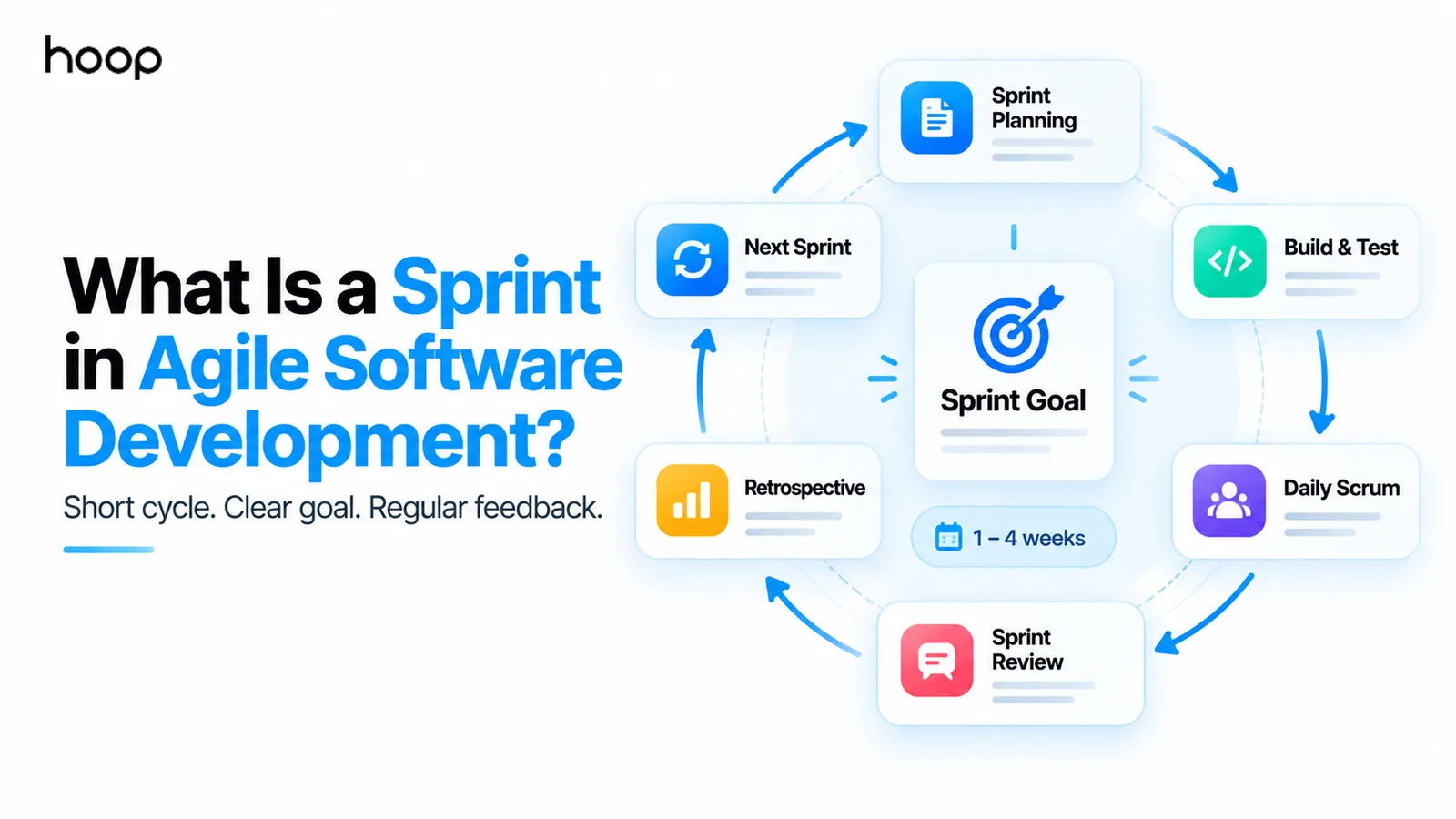
What Is a Sprint in Agile Software Development? A Clear Guide
Sep 23, 2026 · 10 min read
Agile Methodology in Software Development: How It Actually Works
Sep 17, 2026 · 10 min read