Agile Methodology in Software Development: How It Actually Works
Agile software development helps teams deliver working software in smaller increments, gather feedback earlier, and adapt as requirements change. It does not mean skipping planning or documentation — it means keeping both flexible.
Sahar
Content Writer
Agile methodology in software development is an approach that delivers software in small increments, gathers feedback often, and adjusts plans as teams learn. Agile does not mean skipping planning or documentation. It means keeping both flexible enough to respond when customers, priorities, or technical realities change.
The word “Agile” often gets mixed with Scrum, sprints, stand-ups, and Kanban boards. Those practices can support Agile, but they do not define Agile by themselves. The Agile Manifesto describes the core values. Teams then choose frameworks and practices that help them apply those values.
What Is Agile Methodology in Software Development?
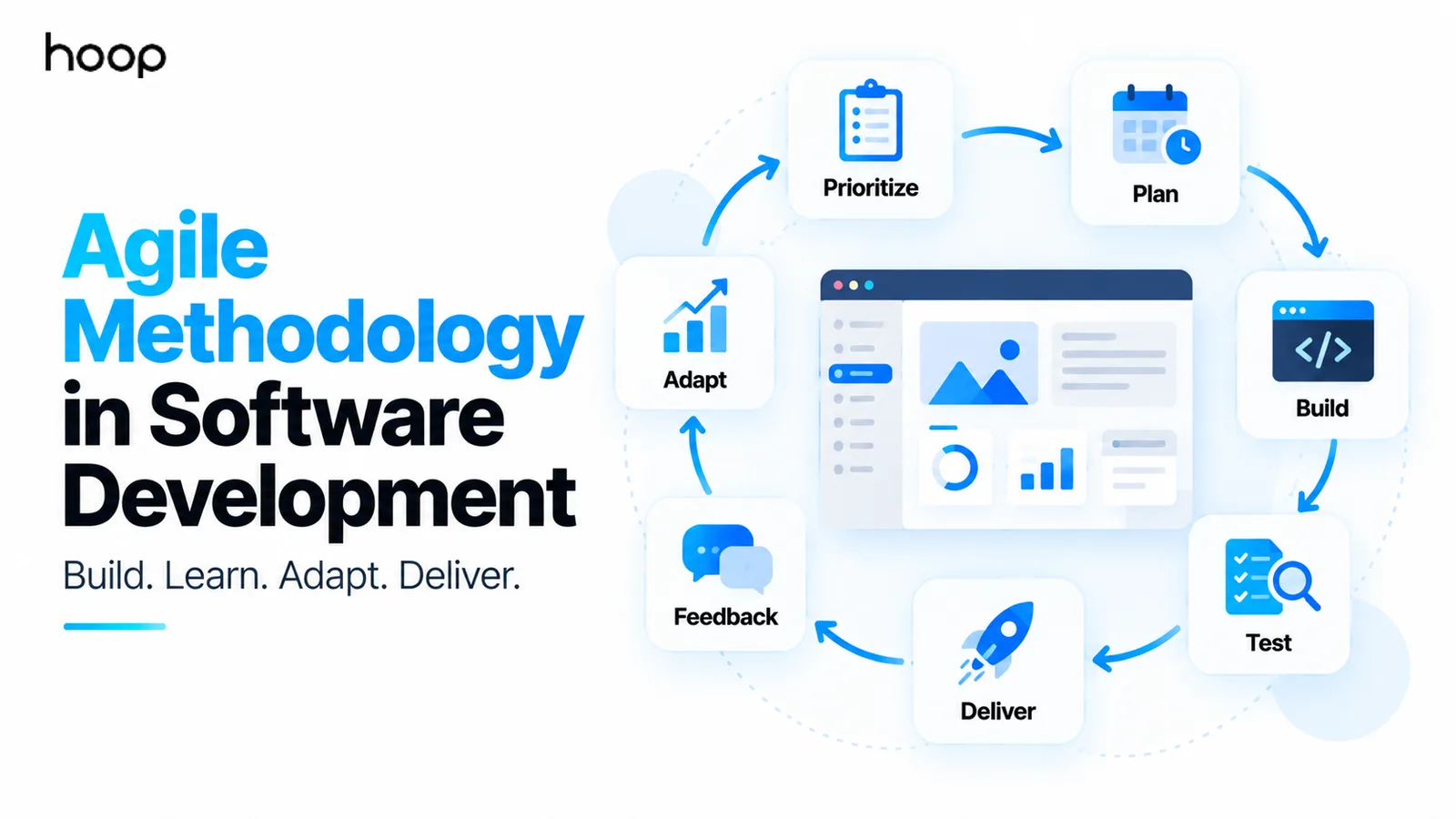
Agile methodology in software development organizes work around short feedback loops instead of one large delivery at the end. Teams choose a small, valuable piece of work, build it, test it, show it, learn from the result, and adjust the next step.
The approach works well when teams cannot know every requirement at the start. Software products often change because users behave differently than expected. Markets move. Competitors launch features. Technical constraints appear. Agile gives teams a structured way to learn before too much time goes into the wrong direction.
Agile also changes how people work together. Developers, designers, testers, product managers, and stakeholders communicate throughout development. A developer does not simply receive a final specification and disappear for months.
What Are the 4 Agile Values?
The manifesto introduced 4 values that guide Agile software development. The values do not reject processes, documentation, contracts, or plans. They place greater emphasis on the items that help teams learn and deliver useful software.
Individuals and interactions over processes and tools
Teams still need tools and processes. Agile gives more weight to clear communication and capable people than to following a workflow mechanically.
A perfect project board cannot fix unclear ownership or poor collaboration. Teams need direct conversations when requirements, risks, or dependencies become uncertain.
Working software over comprehensive documentation
Documentation still matters. Agile asks teams to avoid treating documents as the final proof of progress.
Working software provides stronger evidence because users can interact with it. Teams should document decisions, APIs, architecture, operations, and requirements where those records help future work.
Customer collaboration over contract negotiation
Software requirements often change after customers see a working product. Agile keeps customers and stakeholders involved throughout the project instead of limiting them to the beginning and end.
Frequent collaboration lets teams confirm whether features solve the intended problem before further investment.
Responding to change over following a plan
Agile teams plan continuously. They simply avoid treating an early plan as permanently correct.
A plan should guide the next decisions. New evidence should be allowed to change the plan when the change creates better product outcomes.
Why Was Agile Software Development Created?
Agile grew from frustration with heavyweight development processes that delayed feedback. In a highly sequential project, teams could spend months defining requirements before users saw working software.
That delay creates risk. A requirement can become outdated. A stakeholder can describe the wrong need. A technical assumption can fail. The team can discover these problems only after major work has already happened.
Agile shortens that gap. Teams expose assumptions sooner by delivering smaller increments. When the result misses the mark, the team changes direction while the cost of change remains manageable.
The goal is not simply speed. The goal is faster learning about whether the team is building the right product correctly.
How Does Agile Methodology in Software Development Work?
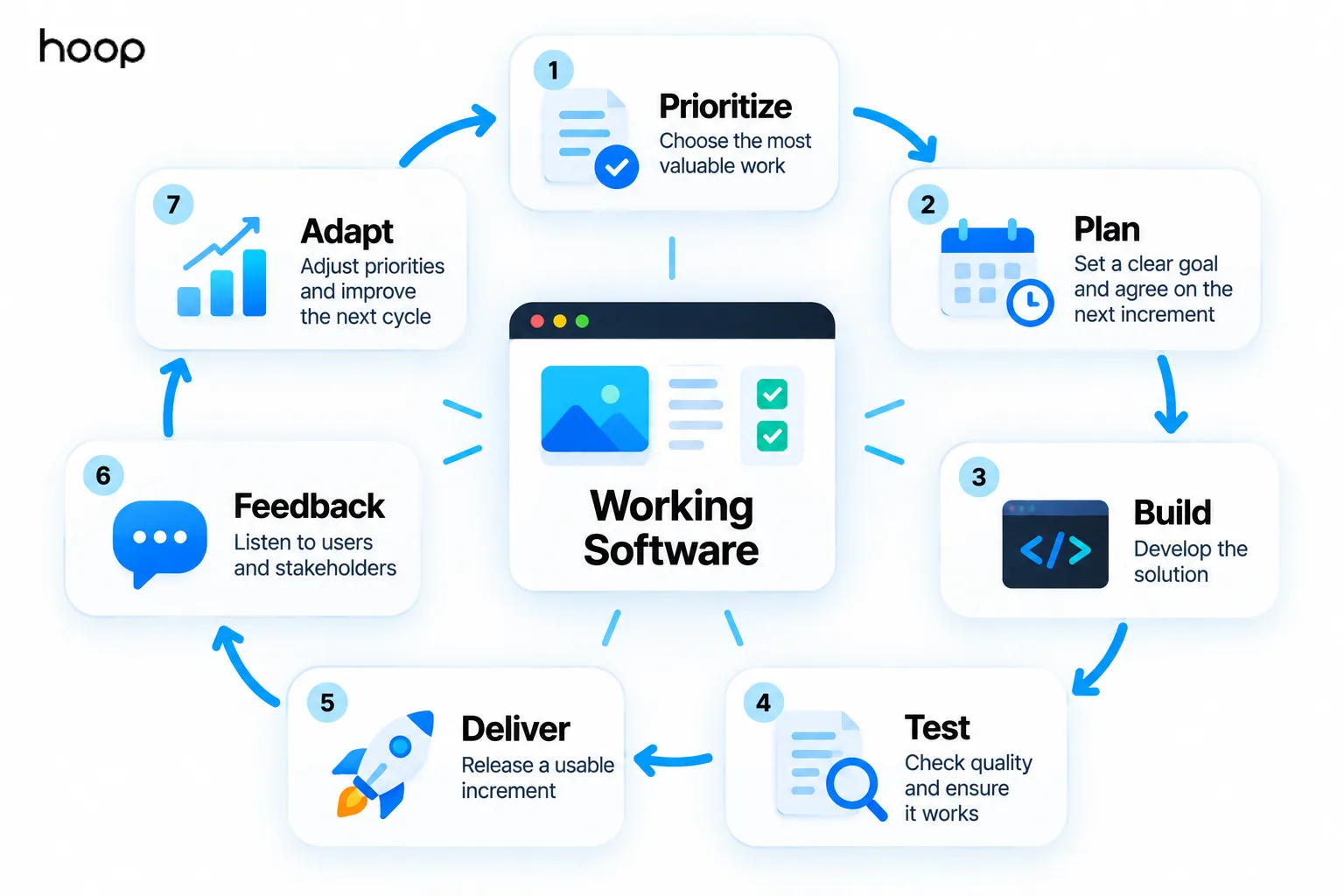
Agile methodology in software development does not require one universal lifecycle. Different teams use different frameworks. A practical Agile loop usually follows 7 connected activities.
Prioritize and plan a small increment
To plan a small increment, choose the highest-value problem the team can address next. Define the outcome, constraints, acceptance criteria, and dependencies clearly enough to begin.
The team should avoid planning months of detailed tasks when later feedback will change those tasks.
Build, test, and deliver working software
Developers build the selected increment while testers, designers, and product contributors stay involved. Teams test throughout development instead of saving all quality work for the end.
The team then delivers a usable increment. Delivery can mean production release, stakeholder demo, beta build, or another testable product state.
Gather feedback and adapt
Users and stakeholders react to the working result. Product data can also reveal whether people use the feature as expected.
The team then updates priorities. Feedback changes the next cycle instead of becoming a report that nobody acts on.
Is Agile the Same as Scrum?
No. Agile and Scrum are not the same thing. Agile describes values and principles. Scrum is a specific framework teams can use to organize complex work.
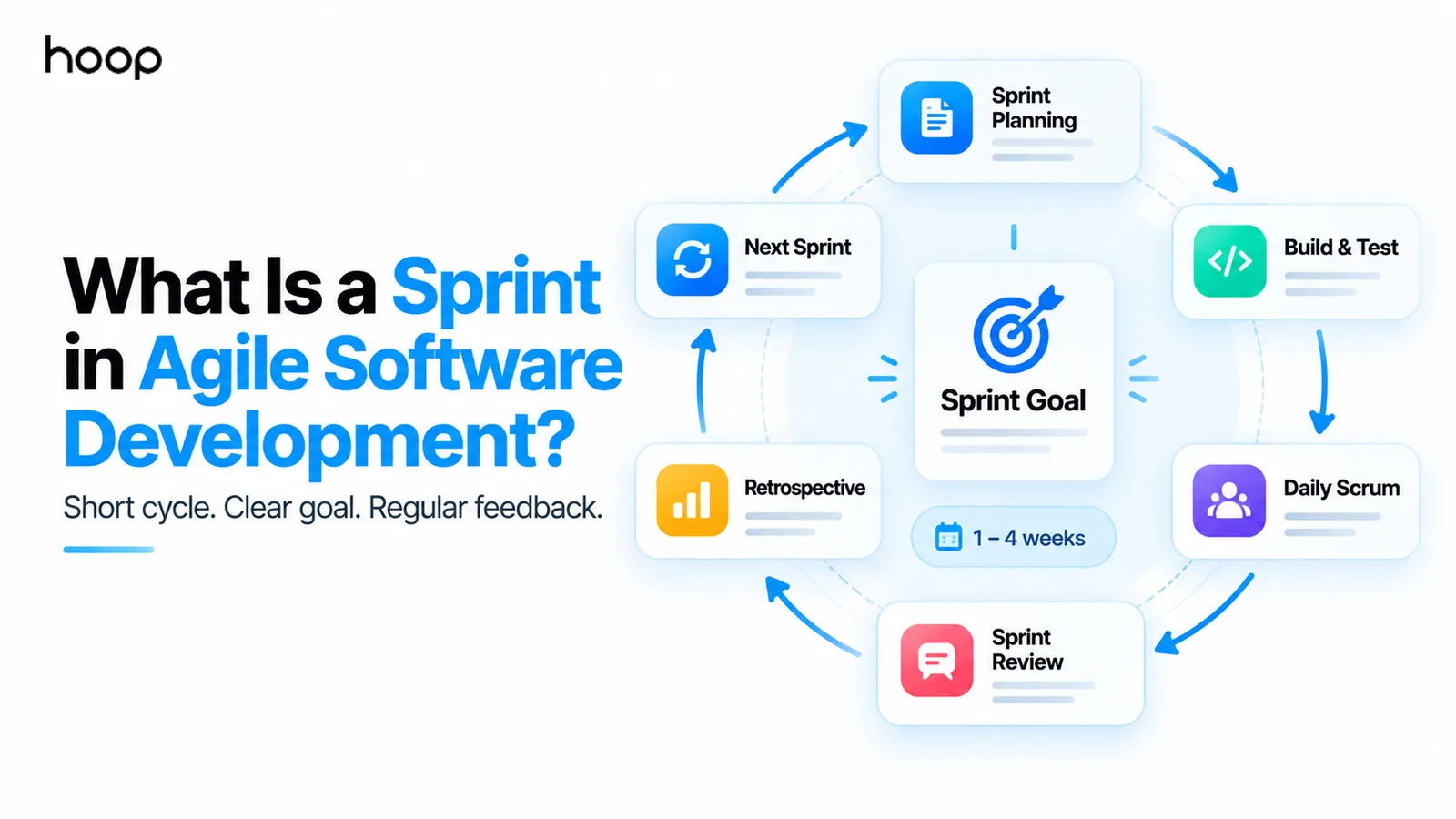
Scrum adds defined accountabilities, events, and artifacts. Teams work through Sprints and use practices such as Sprint Planning, the Daily Scrum, Sprint Review, and Sprint Retrospective.
A company can use Agile principles without Scrum. A Scrum team can also follow the events mechanically while ignoring Agile values. That distinction explains why two companies can both say “we are Agile” yet operate very differently.
Teams that want a deeper explanation of sprint-based development can connect Agile planning to a practical delivery process built around incremental builds, QA, and regular demonstrations.
What Are the Main Agile Frameworks and Methods?
Agile is an umbrella. Teams choose frameworks based on the type of work, level of uncertainty, and delivery model.
Scrum
Scrum organizes work around fixed-length Sprints, a Product Backlog, a Sprint Goal, and regular inspection points. Scrum fits product teams that benefit from a shared short-term objective and a predictable review cadence.
Kanban
Kanban focuses on continuous flow and Work in Progress limits. Teams pull new work when capacity becomes available rather than waiting for a new Sprint.
Kanban can fit support teams, maintenance work, operations, or environments where incoming priorities change frequently.
Extreme Programming and Lean
Extreme Programming (XP) places strong emphasis on engineering practices. Examples include automated testing, continuous integration, pair programming, and frequent releases.
Lean software development focuses on reducing waste, shortening delays, improving flow, and delivering value with fewer unnecessary steps.
Teams often combine useful practices instead of following one framework in isolation.
What Does Agile Mean for a Software Developer Day to Day?
Agile changes more than project scheduling. Developers usually participate more directly in planning and feedback.
A developer may help clarify a user story, estimate complexity, identify dependencies, implement code, write tests, review pull requests, attend a short coordination meeting, and demonstrate completed work.
The developer also raises problems early. A blocked API, unclear requirement, or risky technical assumption should not wait until a final project review.
Agile works best when the team shares responsibility for outcomes. Developers contribute technical judgment instead of acting only as task executors.
What Are User Stories, Backlogs, and Sprints?
These terms appear frequently in Agile teams, especially Scrum teams.
A user story describes a need from a user’s perspective. A product backlog stores prioritized work that may be needed. A Sprint is a fixed Scrum timebox in which the team works toward a Sprint Goal.
These concepts are not mandatory for every Agile team. Kanban teams, for example, can manage work continuously without Sprints.
A startup testing uncertain demand can use the same feedback mindset through MVP development services, where a small working product tests assumptions before a larger build.
Does Agile Mean No Planning?
No. Agile requires planning, but planning happens at multiple levels. Teams can still define product vision, budgets, release goals, architecture, risks, and milestones.
The difference lies in detail and timing. Teams avoid pretending they can accurately specify every feature months before users interact with the product.
Agile plans become more detailed as work gets closer. That approach preserves direction while leaving room to respond to evidence.
Does Agile Mean Less Documentation?
No. Agile means useful documentation, not zero documentation. Teams still need records that support development, maintenance, security, onboarding, and compliance.
Useful documentation can include API specifications, architecture decisions, data models, setup instructions, acceptance criteria, and operational runbooks.
The problem appears when documentation becomes a substitute for collaboration or working software. A 100-page document has little value if the implemented product solves the wrong problem.
What Are the Benefits of Agile Software Development?
Agile can create strong benefits when the product and organization support iterative delivery.
First, teams receive earlier feedback. Stakeholders can react to working software before the entire budget is spent.
Second, teams can adapt priorities when requirements change. A lower-value feature can move down while a new customer problem moves up.
Third, smaller increments make quality problems easier to isolate. Teams can test and review changes before they become part of a large release.
Fourth, Agile encourages cross-functional collaboration. Product, design, engineering, and QA solve problems together rather than handing work between isolated departments.
Fifth, incremental delivery can reduce product risk. A team can validate important assumptions before expanding the scope.
What Are the Limitations of Agile Software Development?
Agile is not automatically efficient. Poor implementation can create constant meetings, unstable priorities, weak ownership, and uncontrolled scope.
Teams can also confuse flexibility with indecision. Changing priorities every day prevents focused execution. Agile still needs a clear product goal and someone who can make priority decisions.
Frequent collaboration also demands stakeholder availability. Feedback loops fail when users, product owners, or decision-makers disappear for weeks.
Some projects also need stronger upfront constraints. Regulated systems, hardware dependencies, fixed contractual milestones, or safety-critical work can require more formal planning and documentation.
Agile should solve delivery problems. The process should never become the product.
Why Do Some Developers Dislike Agile?
Many complaints about Agile actually describe poorly managed Scrum or excessive ceremony. Developers often object when stand-ups become status meetings, planning sessions consume hours, or managers use story points as performance scores.
Those practices can create surveillance instead of collaboration. They also shift attention from software outcomes toward ticket movement.
Another problem appears when organizations copy ceremonies without changing decision-making. A team can hold every Scrum event while still waiting weeks for approvals.
Good Agile practice keeps communication purposeful. Teams should remove meetings that do not improve decisions, coordination, quality, or learning.
Agile vs Waterfall: What Is the Difference?
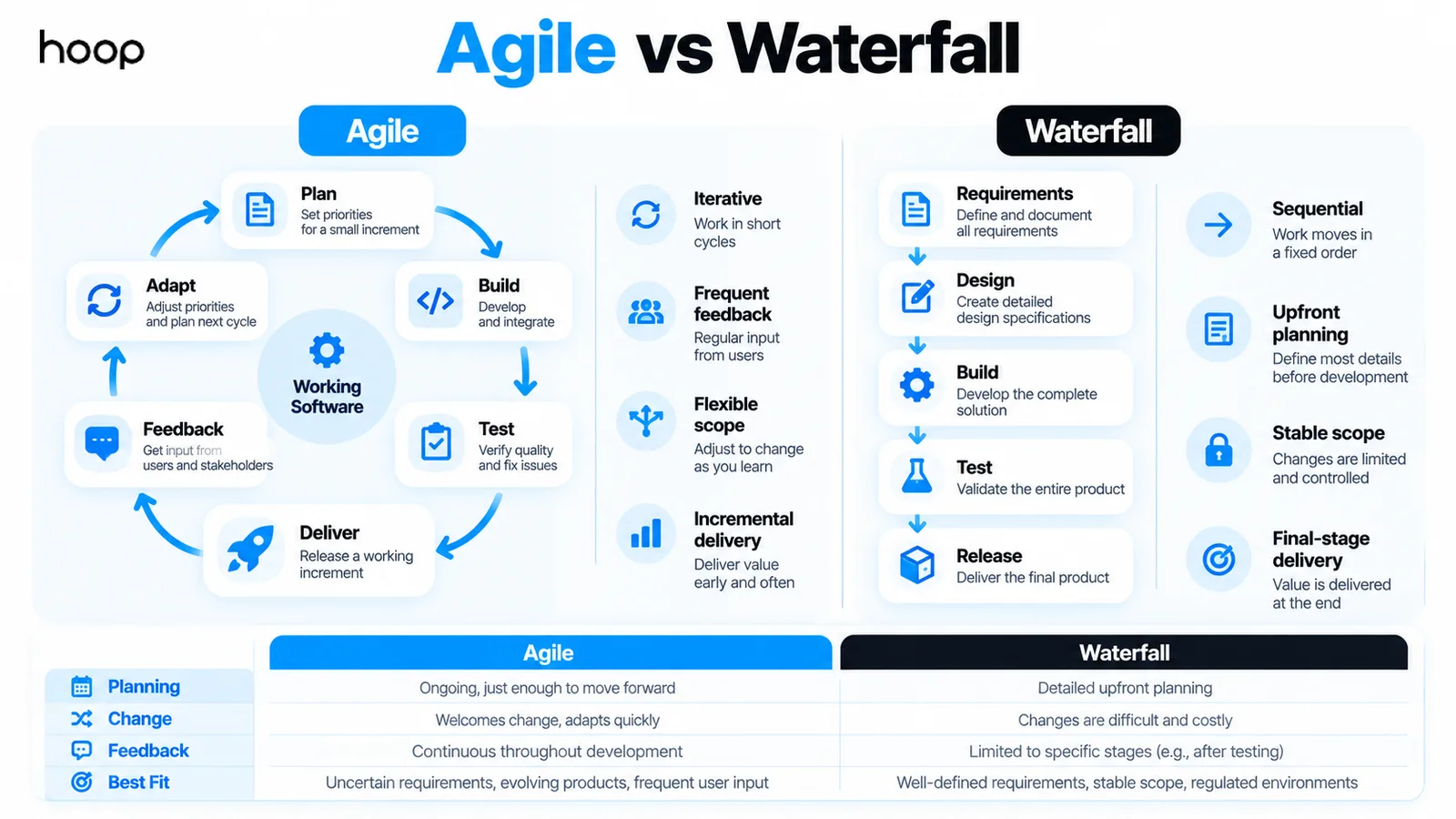
Agile and Waterfall organize uncertainty differently. Agile assumes teams will learn during development. Waterfall-style delivery places greater emphasis on defining requirements and sequence before implementation begins.
| Factor | Agile | Waterfall |
|---|---|---|
| Planning | Ongoing planning with increasing detail | Detailed planning happens earlier |
| Delivery | Small increments can ship throughout the project | Delivery often happens after major phases finish |
| Feedback | Frequent feedback can shape upcoming work | Feedback usually occurs at defined review stages |
| Change | Teams expect and manage change | Change can require formal rework or approval |
| Best Fit | Evolving products and uncertain requirements | Stable requirements and strongly sequential work |
Neither approach wins every project. A team should choose a delivery model that matches the cost of change, feedback availability, dependencies, and regulatory constraints.
When Should You Use Agile Software Development?
Agile fits projects where teams expect to learn while building. New SaaS platforms, mobile applications, digital products, internal tools, and evolving customer experiences often benefit from iterative delivery.
Agile also works well when stakeholders can review progress frequently and make timely decisions.
Projects with significant uncertainty can benefit from custom software development because the product architecture and delivery plan can evolve around real business needs instead of a generic package.
When Might a Traditional Approach Fit Better?
A more sequential model can fit when requirements are genuinely stable and the cost of later change is unusually high.
Examples include tightly regulated deliverables, projects with fixed physical dependencies, migrations with hard cutover constraints, or contracts that require formal stage approvals.
Even those projects can still borrow Agile practices. Teams can review prototypes early, test components incrementally, or hold regular feedback sessions without adopting Scrum.
How Can Teams Make Agile Work Better?
Strong Agile teams protect 6 operating habits.
They keep a clear product goal. They work in small enough increments to receive useful feedback. They keep priorities stable long enough to finish meaningful work. They include engineering quality in every cycle. They use real stakeholder feedback instead of assumptions. They improve the process when evidence shows friction.
Teams should also measure outcomes, not ceremony completion. Shipping 40 tickets means little if users receive no meaningful improvement.
Agile works when the team can answer 3 questions clearly: What problem are we solving? What did we learn? What should change next?
Agile Works Best When Feedback Changes Decisions
Agile methodology in software development gives teams a way to deliver useful software while requirements and knowledge evolve. The strongest teams do not worship Sprints, boards, or meetings. They use short feedback loops to make better product decisions, protect engineering quality, and adjust before mistakes become expensive. Explore Hoop’s software development services to see how discovery, iterative builds, QA, deployment, and long-term support can work as one connected delivery process.
“Agile should solve delivery problems. The process should never become the product.”
Key takeaways
- 01Agile is a set of values; Scrum, Kanban, and XP are frameworks that apply them.
- 02The 4 values favour people, working software, collaboration, and responding to change.
- 03Most complaints about “Agile” are really complaints about excessive ceremony.
- 04Measure outcomes, not tickets — 40 closed items can still ship nothing useful.
Written by
Sahar
Content Writer
Frequently Asked
Questions
Everything you need to know before booking a strategy call. Can't find your answer? Contact us directly.
Agile is a flexible way to build software in small increments, gather feedback frequently, and adjust the next steps based on learning.
No. Agile describes values and principles. Scrum is one framework that teams can use to apply those ideas.
The 4 values prioritize people and interaction, working software, customer collaboration, and responding to change. The original wording appears in the official manifesto.
Agile expects iterative delivery and frequent feedback. Waterfall emphasizes a more sequential process with more requirements defined before implementation.
Agile can create scope creep, meeting overhead, unclear priorities, and constant reprioritization when teams apply it without discipline.
Keep reading
All articles →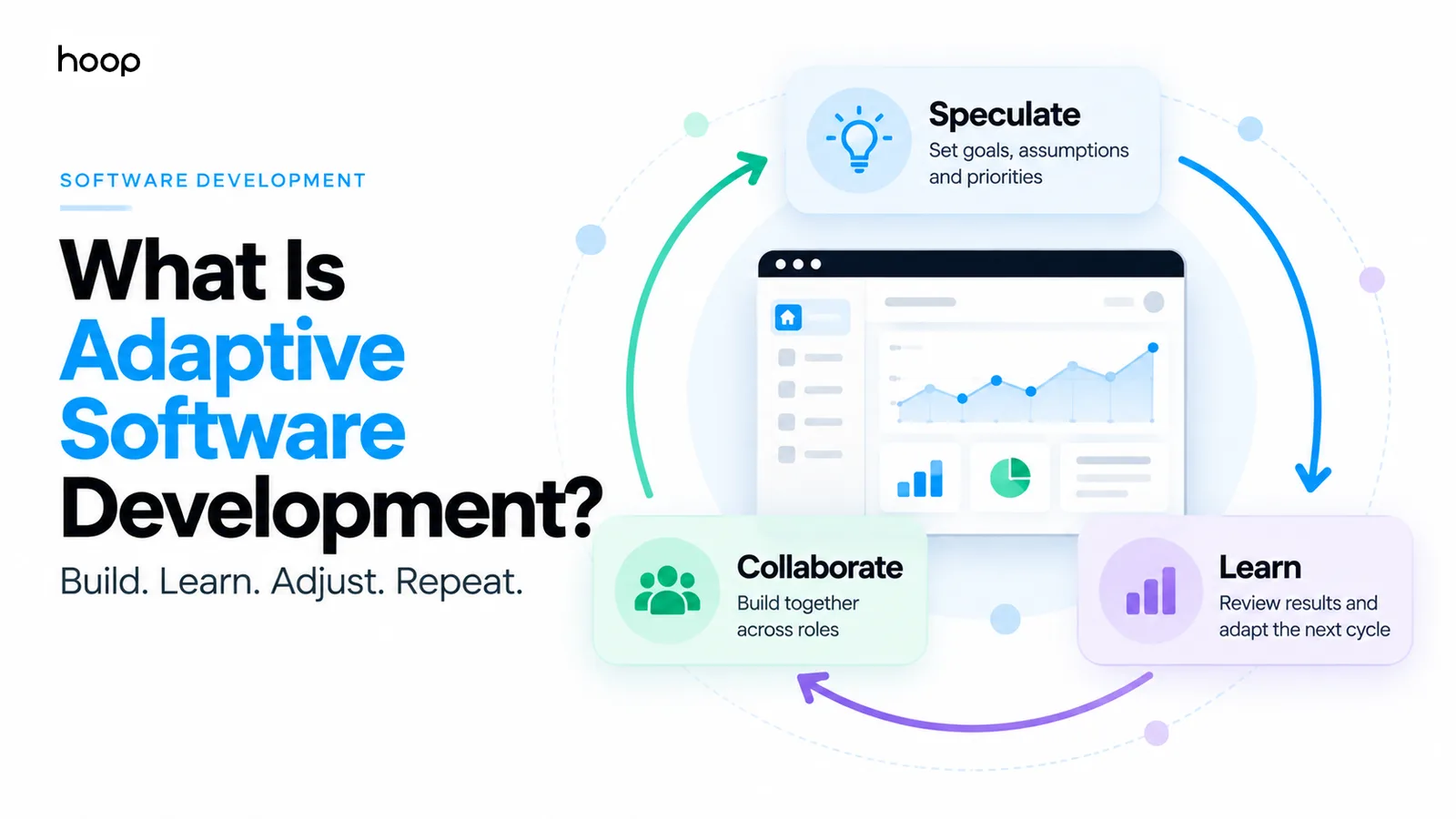
What Is Adaptive Software Development? A Practical ASD Guide
Sep 21, 2026 · 10 min read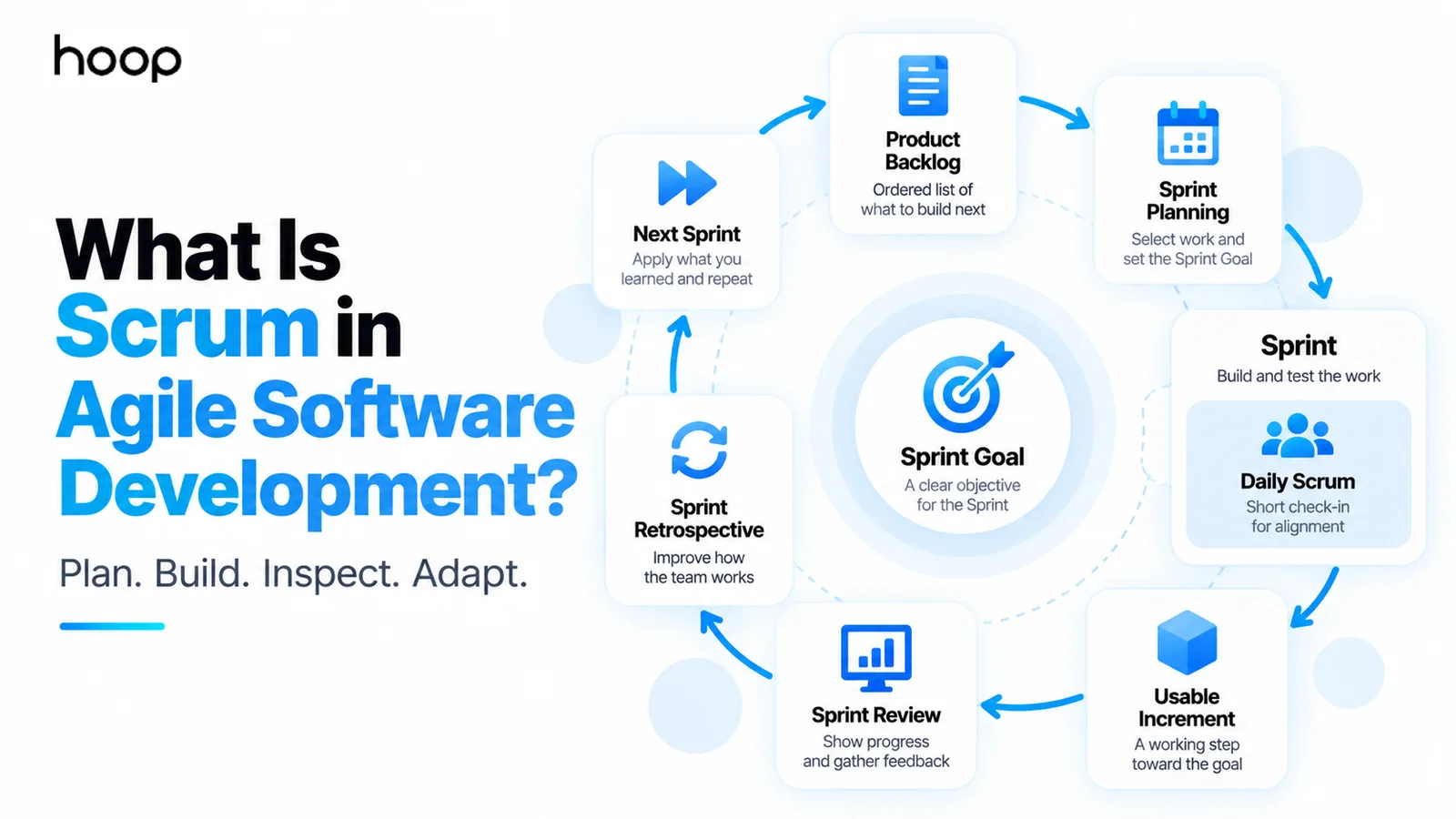
What Is Scrum in Agile Software Development?
Sep 22, 2026 · 10 min read