What Is Adaptive Software Development? A Practical ASD Guide
Adaptive Software Development (ASD) helps teams build under uncertainty through a repeating Speculate, Collaborate, and Learn cycle. This guide explains how the method works, how it compares with Scrum, Kanban, Agile, and Waterfall, and when an adaptive approach fits a software project.
Sahar
Content Writer
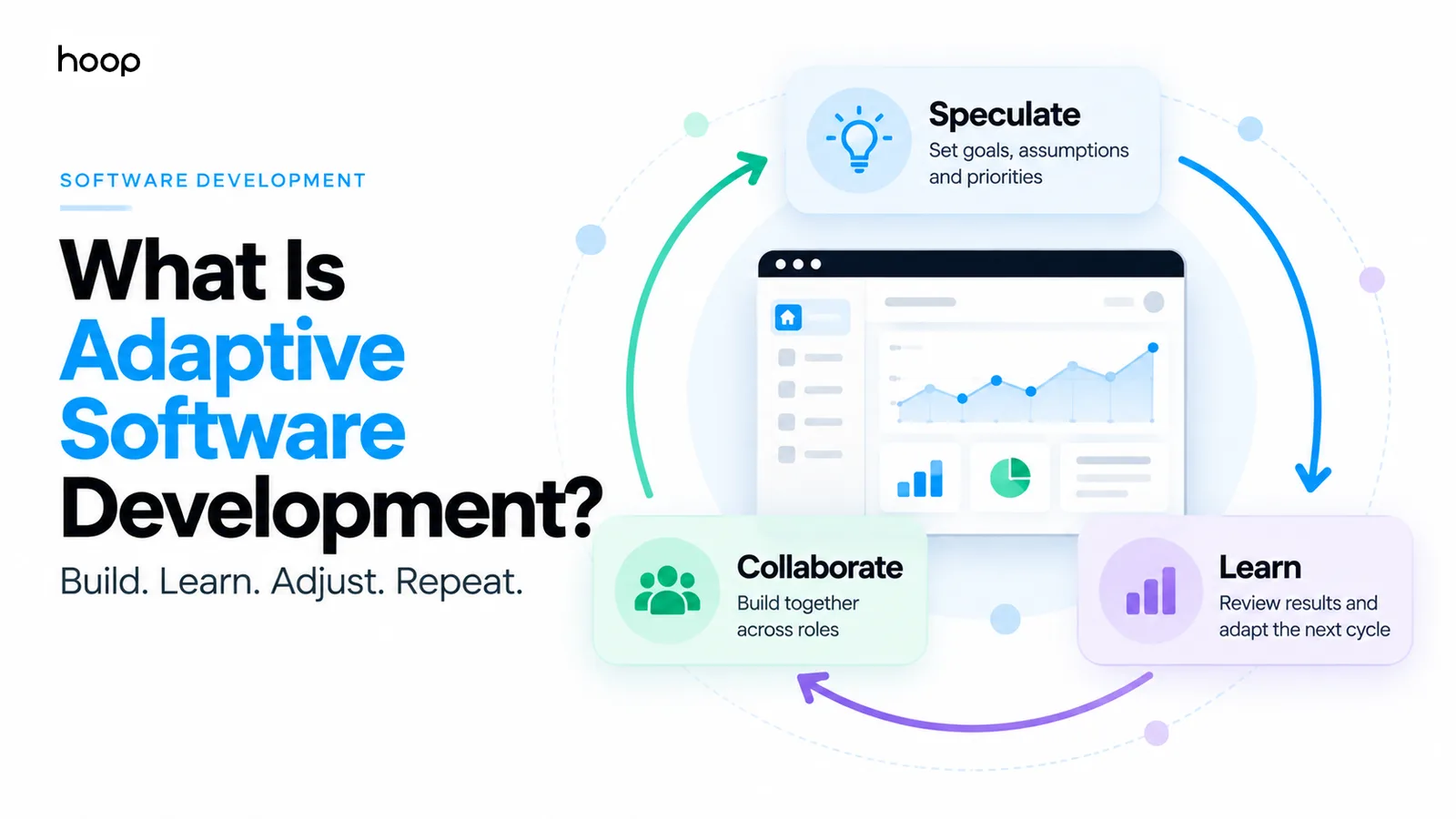
Adaptive Software Development (ASD) is an Agile software development approach built for projects where requirements, priorities, and technical understanding can change during delivery. ASD uses a repeating Speculate, Collaborate, and Learn cycle so teams can build working software, test assumptions, and adjust the next cycle with evidence.
ASD does not remove planning. ASD changes how teams treat a plan. Instead of treating the original roadmap as a fixed promise, the team treats the roadmap as a current hypothesis that can improve when new information appears.
What Is Adaptive Software Development and Why Does It Exist?
Adaptive Software Development is an iterative methodology for complex software projects that expect uncertainty. Jim Highsmith and Sam Bayer developed the approach from Rapid Application Development (RAD) work during the 1990s. The method later became one of the approaches represented in the early Agile movement.
Traditional project models work best when a team can define the destination, requirements, and implementation path early. Software products often behave differently. A customer can reject a feature after seeing the first usable version. A technical limitation can appear after integration begins. A competitor can change the market before release.
ASD gives teams a disciplined response to those conditions. The team sets a mission, builds a useful increment, gathers evidence, and changes direction when the evidence demands it.
Jim Highsmith also joined the group that created the Agile Manifesto. The Agile Manifesto history lists Adaptive Software Development among the methods represented at the Snowbird meeting.
What Are the 3 Phases of Adaptive Software Development?
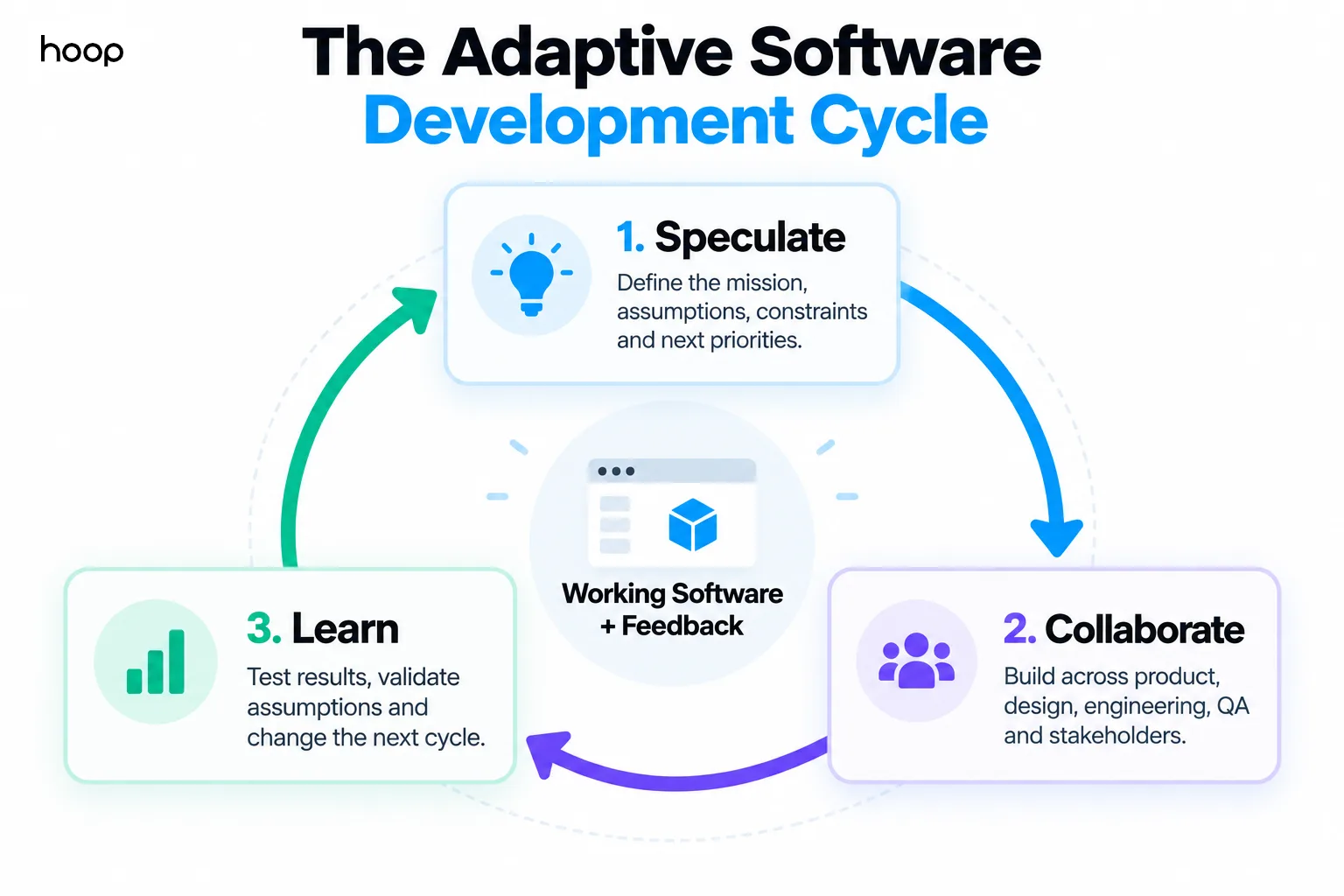
The 3 phases are Speculate, Collaborate, and Learn. The phases repeat throughout the project rather than appearing once in a fixed sequence.
1. Speculate: set direction without pretending you know everything
The Speculate phase defines the mission, current assumptions, constraints, risks, priorities, and next delivery goal. The team still creates a plan, but the plan remains flexible.
A product team can define a goal such as reducing onboarding abandonment. The team can then choose the smallest feature set that tests the assumption behind that goal. The cycle should produce something users or stakeholders can review.
Speculation works best when teams record assumptions clearly. A written assumption such as “new users leave because setup takes too long” creates a testable decision. A vague statement such as “improve onboarding” does not.
2. Collaborate: build across roles instead of working in silos
The Collaborate phase turns the current plan into working software. Developers, designers, product managers, quality assurance specialists, customers, and stakeholders share information throughout the cycle.
Collaboration matters because complex software problems rarely belong to one discipline. A payment-flow problem can involve interface design, backend logic, security, compliance, and analytics at the same time.
Strong collaboration also shortens decision loops. The developer does not need to wait until the end of a long phase to discover that the product owner expected a different behavior.
3. Learn: use results to change the next cycle
The Learn phase compares actual outcomes with the assumptions made during Speculate. Teams review working software, user feedback, test results, product analytics, defects, technical discoveries, and delivery performance.
The team then changes priorities for the next cycle. A feature can move forward, change shape, lose priority, or disappear completely.
Learning is not a closing ceremony. Learning is an input to the next plan. That feedback loop gives ASD its adaptive character.
Why Does ASD Use “Speculate” Instead of “Plan”?
ASD uses the word “speculate” because complex software plans contain assumptions that teams cannot prove at the start. The term reminds teams to separate direction from certainty.
A conventional plan can encourage false precision. A roadmap can show 8 months of detailed features even when the team has not tested the first major assumption. ASD asks the team to plan only as far as current knowledge supports.
That approach does not justify weak project management. Teams still need deadlines, budgets, responsibilities, dependencies, and release goals. ASD simply asks teams to revise those decisions when stronger evidence appears.
How Does Adaptive Software Development Work in Practice?
ASD works by turning each delivery cycle into a small product experiment. Consider a company building a new analytics platform for independent retailers.
During Speculate, the team decides that store owners need a simple weekly performance dashboard. The first cycle focuses on revenue, orders, returning customers, and top products. The team intentionally delays advanced forecasting.
During Collaborate, designers create the dashboard flow, engineers connect sales data, QA tests calculations, and product managers review the experience with pilot customers. The team ships a limited version to a small user group.
During Learn, analytics show that users open the dashboard but repeatedly export data into spreadsheets. Customer interviews reveal that users need category-level comparisons before forecasting. The team changes the next cycle and prioritizes category analysis.
A company using MVP development services can apply the same logic. The MVP tests the riskiest assumptions first, then real usage shapes the next release.
Adaptive Software Development vs Agile: What Is the Difference?
Agile is a broad set of values and principles, while Adaptive Software Development is one specific methodology within that wider family. ASD predates the Agile Manifesto but shares many of the same ideas.
Both approaches value working software, customer collaboration, iterative delivery, and responsiveness to change. ASD places special emphasis on uncertainty, continuous learning, and flexible planning.
A team can follow Agile values without using ASD terminology. A team can also use ASD principles while managing day-to-day work with Scrum ceremonies or a Kanban board.
Adaptive Software Development vs Scrum: How Do They Differ?
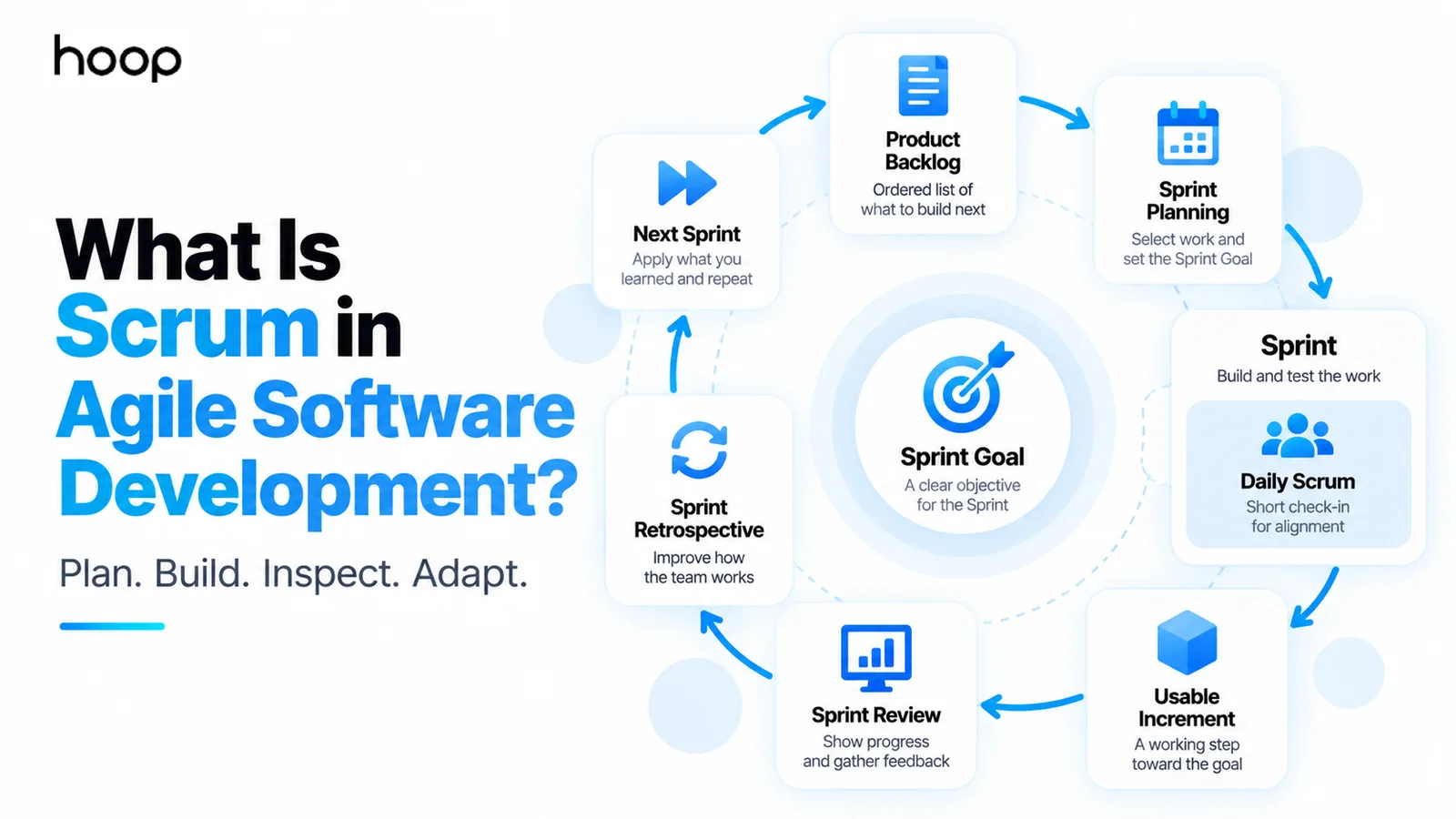
Scrum provides a more defined operating framework, while ASD provides a looser adaptive cycle centered on learning. Scrum defines roles, events, and artifacts such as the Product Owner, Sprint Planning, Sprint Review, and Product Backlog.
ASD does not prescribe an equivalent set of roles or ceremonies. The method asks teams to speculate, collaborate, and learn, then lets the team choose practices that support those goals.
Scrum can therefore provide useful structure for a team that also thinks adaptively. A Sprint Review can support the Learn phase. Sprint Planning can support Speculate. Daily collaboration can support the Collaborate phase.
Adaptive Software Development vs Kanban: What Changes?
Kanban focuses on managing flow, while ASD focuses on adapting through evidence and learning. Kanban helps teams visualize work, limit Work in Progress (WIP), identify bottlenecks, and improve delivery flow.
ASD focuses more directly on uncertain requirements and product direction. A Kanban board can show how work moves through development, but the board does not define how the product team should revise assumptions after customer feedback.
Teams can combine both approaches. Kanban can manage execution while ASD principles shape planning and learning.
Adaptive Software Development vs Waterfall: The Core Difference
Waterfall assumes teams can define major requirements before implementation, while ASD assumes important knowledge will emerge during development. Waterfall moves through defined stages such as requirements, design, development, testing, and release.
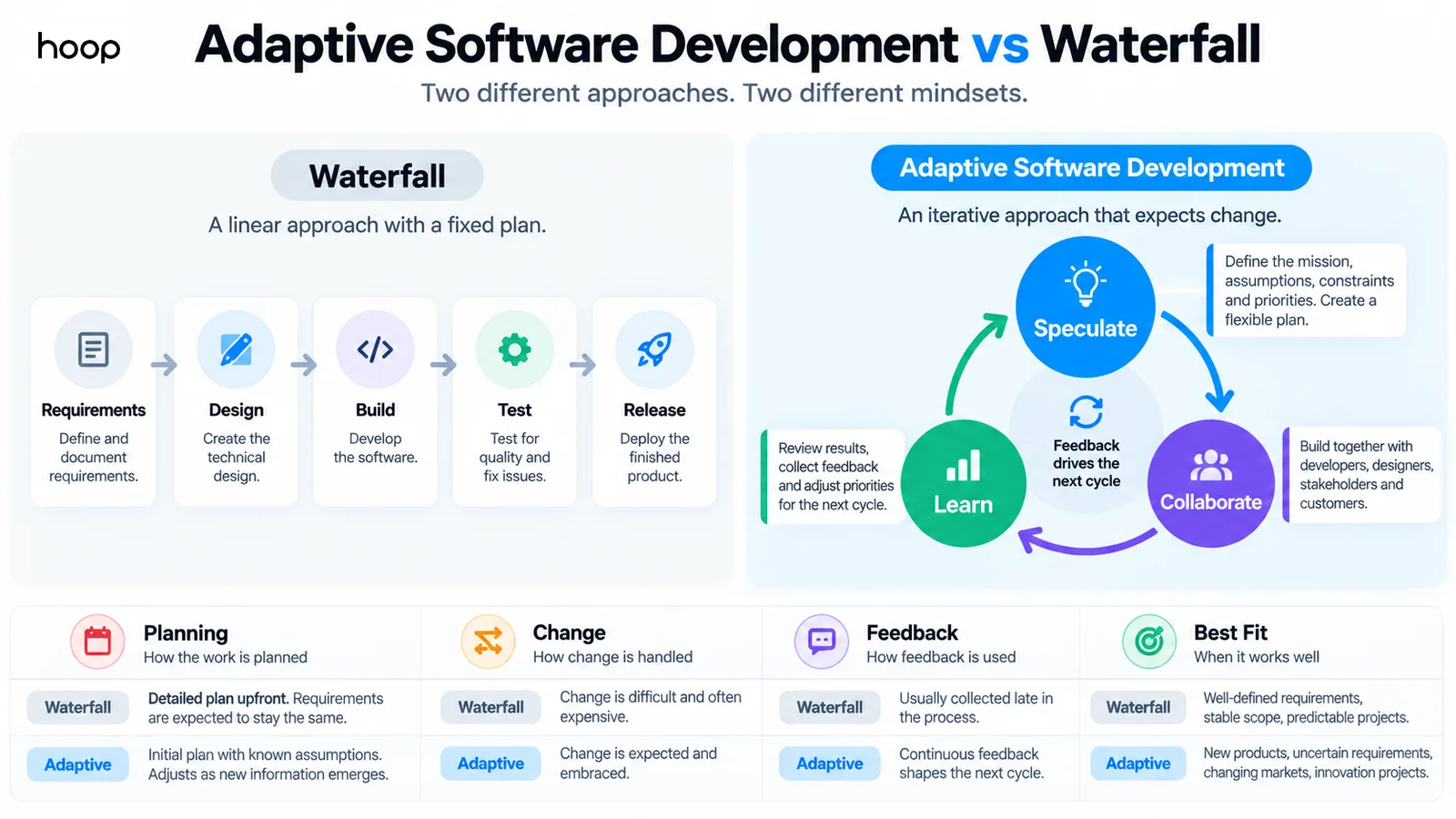
ASD repeats a shorter cycle. The team speculates about the next useful increment, collaborates to build it, learns from the result, and then repeats.
The comparison does not make Waterfall universally wrong. A predictable project with tightly controlled requirements can benefit from a more sequential model. A new product with uncertain demand usually needs more room for learning.
| Approach | Planning Style | Response to Change | Feedback Pattern | Best Fit |
|---|---|---|---|---|
| Adaptive Software Development | Flexible assumptions and mission | Change expected during delivery | Continuous learning shapes the next cycle | New products, uncertain requirements, complex problems |
| Scrum | Sprint-based planning | Change managed around sprint boundaries | Reviews and retrospectives | Teams that want a defined Agile operating framework |
| Kanban | Continuous prioritization | Change flows through the system | Flow metrics and ongoing review | Operations, maintenance, continuous delivery |
| Waterfall | Detailed upfront plan | Change usually costs more later | Feedback often arrives after major stages | Stable requirements and predictable scope |
What Are the Main Benefits of ASD?
ASD helps teams learn faster when the product, market, or technical solution is still uncertain. The value comes from making adaptation part of the operating model rather than treating every change as a failure.
Faster feedback on risky assumptions
Teams can test the riskiest product or technical assumption before investing in a large feature set. A failed assumption then costs less to correct.
Stronger cross-functional decisions
ASD encourages people from product, design, engineering, QA, and business roles to solve problems together. Shared decisions reduce handoff errors and hidden assumptions.
Better response to changing requirements
The team expects priorities to move as evidence improves. A change in customer demand becomes a planning input rather than an emergency exception.
More useful progress measures
Teams can judge progress through working software, validated learning, user behavior, and solved problems. Completed tickets still matter, but completed tickets do not prove customer value.
What Are the Challenges of ASD?
ASD can create confusion when a team treats flexibility as permission to change everything at any time. Adaptive work still needs discipline.
Scope creep becomes a risk when stakeholders add ideas without removing lower-priority work. Teams need a clear mission and explicit priority decisions.
Long-range estimates also become harder when product direction remains uncertain. Leaders should separate committed near-term work from lower-confidence future assumptions.
ASD also depends on collaboration. A team cannot learn quickly when customers, product owners, or subject experts disappear for weeks. The method needs timely feedback and clear decision ownership.
Technical quality can suffer when teams chase visible features without protecting architecture, testing, and maintainability. Teams building larger web application development projects should include architecture, security, performance, and QA work inside each learning cycle.
When Should You Use Adaptive Software Development?
Use ASD when uncertainty is high and learning can materially change what the team should build next. The method fits projects where teams know the mission but cannot confidently define every requirement upfront.
Good candidates include new SaaS products, AI-enabled applications, experimental internal platforms, new mobile products, and software entering an unfamiliar market.
ASD also fits projects with active stakeholders who can review working increments. Regular access to users or decision-makers makes each Learn phase more useful.
The methodology becomes especially valuable when technical discovery matters. An integration, data model, performance constraint, or third-party platform can reveal limits that change the original design.
When Is ASD a Poor Fit?
ASD adds less value when requirements are stable, the solution is well understood, and feedback will not change the delivery path. A routine implementation based on a proven pattern can need execution more than discovery.
ASD also struggles when stakeholders cannot participate. A team cannot adapt intelligently without evidence or decisions.
Highly regulated work can still use iterative delivery, but teams must respect fixed compliance controls, required documentation, validation rules, and approval gates. Adaptation should happen inside those boundaries rather than replacing them.
A fixed-price engagement can also use adaptive practices, but the team needs clear rules for scope trade-offs. Adding a new priority should usually remove or delay another priority.
Is Adaptive Software Development Still Used Today?
ASD is less visible as a standalone label than Scrum or Kanban, but its core ideas remain common in modern product development. Teams routinely use iterative delivery, hypothesis-driven planning, customer feedback, cross-functional work, and continuous learning even when nobody calls the process ASD.
That influence matters more than the label. A team can follow Scrum and still apply ASD thinking by treating the backlog as revisable evidence rather than a permanent contract.
Modern product teams also use experiments, feature flags, analytics, user interviews, prototypes, and staged releases to shorten learning cycles. Those practices fit the same adaptive mindset.
ASD vs Self-Adaptive Software: What Is the Difference?
Adaptive Software Development describes how people manage and build software. Self-adaptive software describes software that changes its own behavior during operation. The terms sound similar, but they describe different subjects.
ASD concerns planning, collaboration, delivery, feedback, and project learning. A self-adaptive system can monitor conditions and alter configuration, resource use, routing, or behavior at runtime.
A development team can use ASD to build a self-adaptive system, but one concept does not require the other.
How to Start Using Adaptive Software Development
To start using Adaptive Software Development, replace long-range certainty with short, evidence-based cycles while keeping a clear mission. A practical rollout can follow 7 steps.
- Define the mission. State the user or business outcome the team needs to improve.
- List the assumptions. Record the beliefs that must be true for the current plan to work.
- Choose the next increment. Select a small piece of working software that can test important assumptions.
- Build across roles. Keep product, design, engineering, QA, and stakeholders connected during delivery.
- Release something reviewable. Give users or stakeholders a real artifact to test whenever possible.
- Collect evidence. Review behavior, feedback, defects, performance, and technical discoveries.
- Change the next cycle. Keep, revise, delay, or remove work based on what the team learned.
Teams do not need to replace every current process on day 1. Start with one product area and compare decisions before and after a few learning cycles.
Build Software That Can Change With What You Learn
Adaptive Software Development gives teams a structured way to work when the original plan cannot answer every question. The Speculate, Collaborate, and Learn cycle keeps the mission visible while allowing evidence to change the route.
If your product needs room for discovery, iteration, and changing priorities, Hoop Interactive’s custom software development team can help you plan, build, test, and refine the product around real user and business feedback.
“Completed tickets still matter, but completed tickets do not prove customer value.”
Key takeaways
- 01“Speculate” is deliberate — a plan built on untested assumptions is a hypothesis, not a promise.
- 02Learning is an input to the next plan, not a closing ceremony.
- 03ASD and Scrum coexist: Sprint Planning can serve Speculate, Sprint Review can serve Learn.
- 04Flexibility without a clear mission and priority calls becomes scope creep.
Written by
Sahar
Content Writer
Frequently Asked
Questions
Everything you need to know before booking a strategy call. Can't find your answer? Contact us directly.
Adaptive Software Development is a way to build software in short learning cycles instead of following one fixed plan from start to finish. Teams plan, build, gather feedback, and adjust repeatedly.
The 3 phases are Speculate, Collaborate, and Learn. Speculate sets the current direction, Collaborate builds the software, and Learn changes the next cycle using evidence.
Yes. ASD is an Agile methodology and one of the approaches that influenced the wider Agile movement.
No. Scrum defines specific roles, events, and artifacts. ASD defines a broader adaptive cycle and gives teams more freedom to choose supporting practices.
Use ASD when requirements, customer needs, or technical understanding can change during development. New products and complex software projects often fit that condition.
Keep reading
All articles →
Agile Methodology in Software Development: How It Actually Works
Sep 17, 2026 · 10 min read
What Is a Sprint in Agile Software Development? A Clear Guide
Sep 23, 2026 · 10 min read