Link Building Campaign: How to Plan and Run One
A link building campaign turns backlink acquisition into a measurable process. Choose target pages, create link-worthy assets, qualify prospects, write better outreach, verify placements, and measure whether links actually improve search visibility.
Sahar
Content Writer
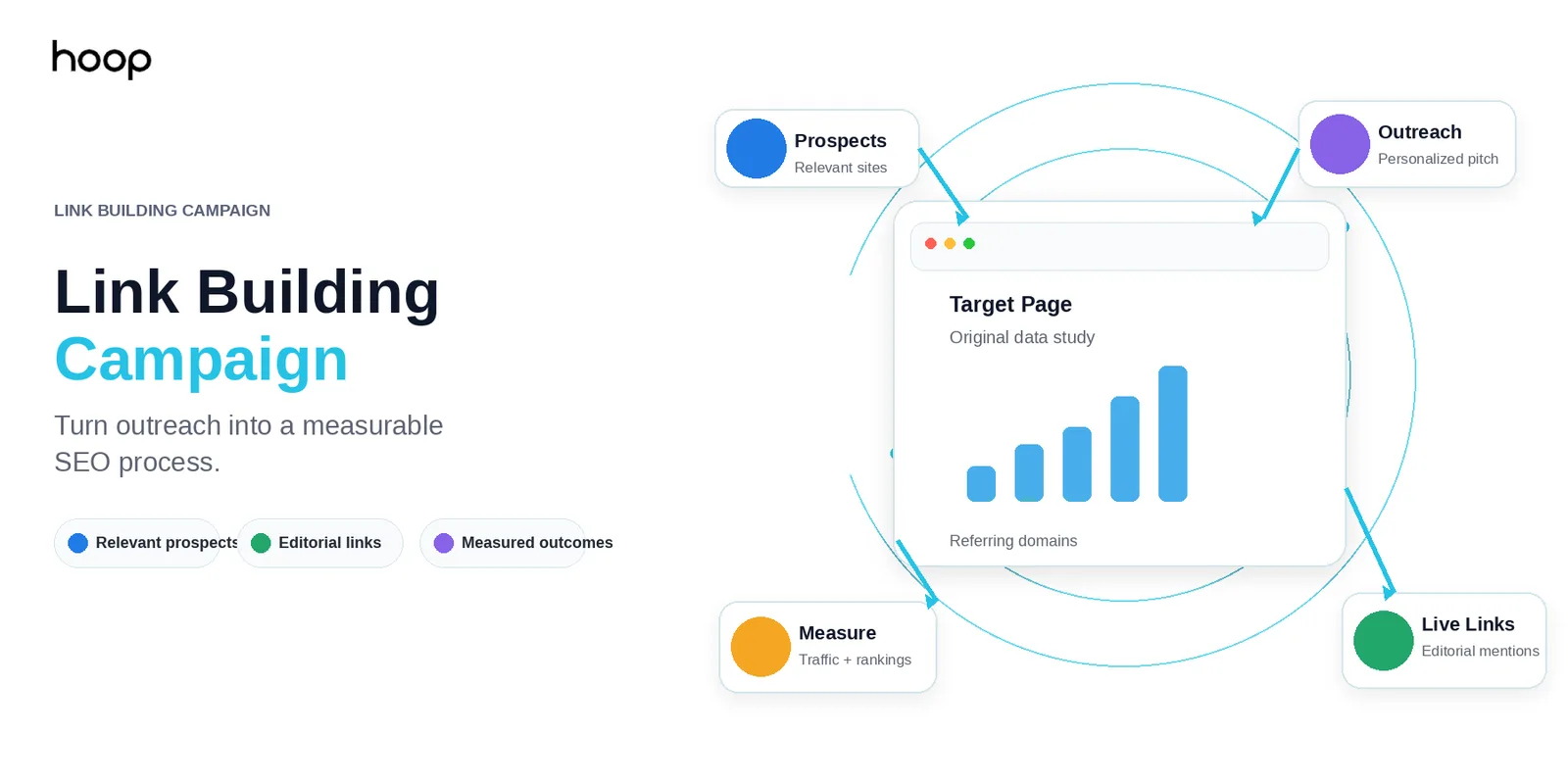
A link building campaign is a structured effort to earn relevant backlinks to specific pages for a defined SEO goal. A real campaign combines target-page selection, a link-worthy reason to care, prospect research, outreach, placement checks, and measurement.
Randomly collecting backlinks is not the same process. A campaign gives you a target, a workflow, an owner, and a way to judge whether the work improved the pages that matter.
What Is a Link Building Campaign?
A link building campaign organizes backlink acquisition around a specific objective. You choose the pages that need authority, identify websites that could reasonably reference them, create a strong reason for those sites to link, and then measure the outcome.
The campaign can support goals such as improving a competitive service page, strengthening an important category, promoting original research, or increasing the number of relevant referring domains around a topic.
The important word is campaign. A campaign has boundaries. You know what you are promoting, who you want to reach, what quality standard a prospect must meet, and which metrics define progress.
That structure also makes bad tactics easier to spot. If a provider reports only a raw link count without showing relevance, target pages, referring domains, or business impact, you are seeing link delivery rather than a complete link building strategy.
Do Link Building Campaigns Still Work?
Yes, link building campaigns still work when they earn legitimate, relevant references from useful websites. Links can help search engines understand authority and relationships between pages, while also sending referral traffic and brand exposure.
A link building campaign fails when the team treats outreach volume as the goal. Sending hundreds of emails does not fix weak content, irrelevant prospecting, or a page nobody wants to cite.
Links also work alongside other SEO foundations. A technically broken page, poor search intent match, or thin commercial page will not become strong simply because more websites point to it. Use links to support a page that already deserves to rank.
For broader planning, Hoop’s SEO strategy services combine content, technical SEO, authority building, and measurement instead of treating backlinks as a separate scoreboard.
What Should You Do Before Starting a Campaign?
Prepare the page and the campaign objective before you build a prospect list. This step saves more time than any email tool because it determines whether your outreach has a credible reason to exist.
Set the campaign objective
Choose one primary outcome. Examples include increasing relevant referring domains to a product category, improving visibility for a priority keyword cluster, promoting a research asset, or recovering authority lost after a migration.
Avoid goals such as “build 50 links.” A quantity target can help with capacity planning, but a link count does not explain whether the linked pages improved.
Choose the target pages
Select pages where additional authority can support a real business objective. Priority pages can include service pages, product categories, commercial guides, original research, free tools, or high-value informational resources.
Do not force outreach directly to a sales page when the page gives publishers no editorial reason to reference it. Sometimes the better move is to create a useful supporting asset, earn links to that asset, and connect the authority internally.
Make the page worth linking to
Ask one question: Why would another website cite this page for its own readers?
Useful reasons include original data, expert insight, a strong visual, a practical calculator, a definitive guide, a unique example, or a resource that saves the publisher research time.
If your campaign needs a stronger informational asset, professional blog writing services can turn real search demand and subject expertise into content that is easier to reference naturally.
Compare competing backlink profiles
Review pages already ranking for the queries you care about. Look for patterns in referring domains, publication types, link context, and the assets competitors use to earn coverage.
Do not copy a backlink list mechanically. Study why each site linked. That reason often reveals the better campaign idea.
How to Run a Link Building Campaign Step by Step
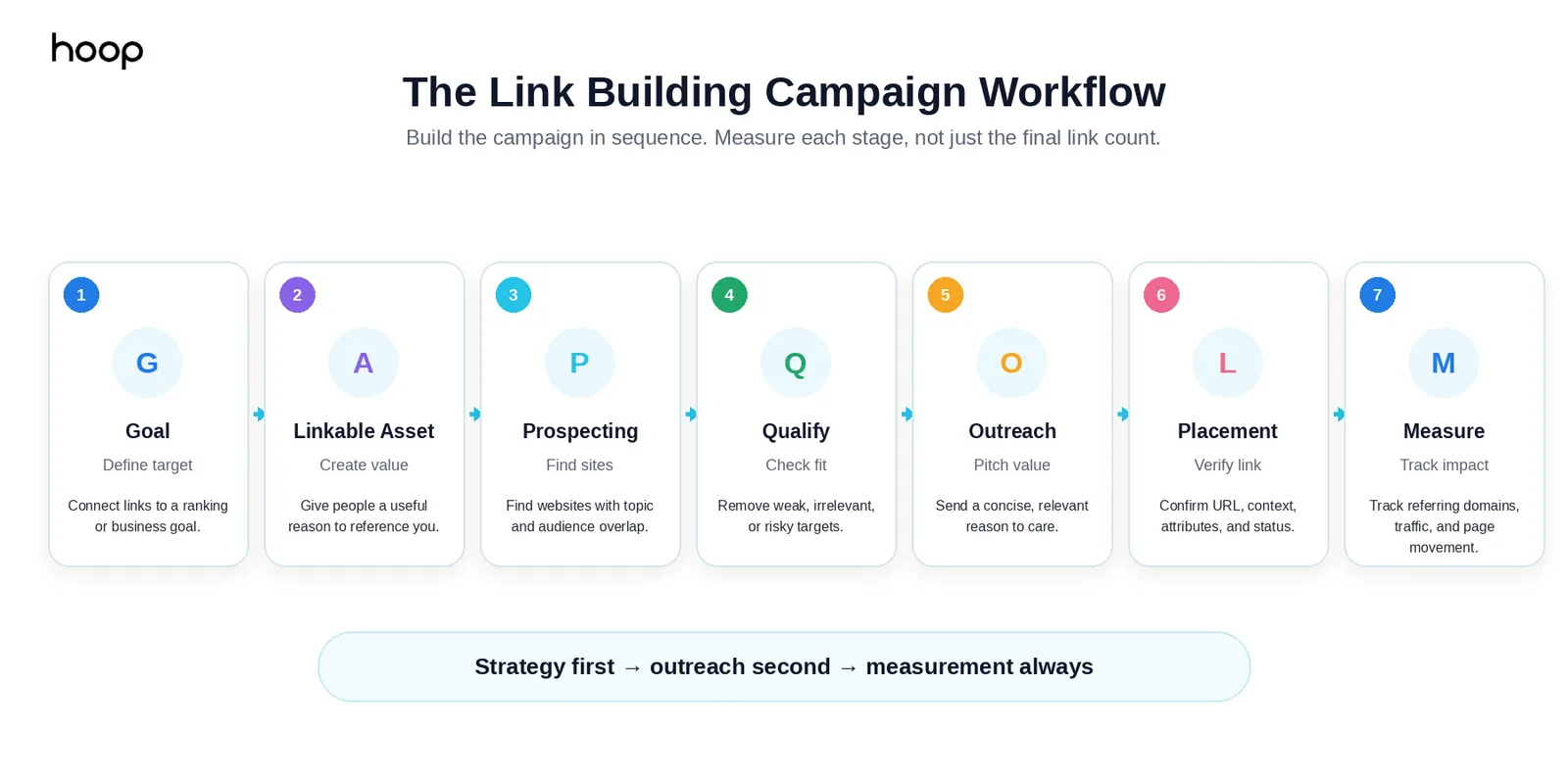
To run a link building campaign, move through 7 stages: goal, asset, prospecting, qualification, outreach, placement, and measurement. Skipping a stage usually shifts the problem downstream instead of removing it.
| Stage | Main Task | Method | Difficulty |
|---|---|---|---|
| Goal | Define the outcome | Target page, keyword gap, referring-domain gap | Easy |
| Asset | Create a reason to link | Research, guide, tool, case study, expert resource | Medium |
| Prospecting | Find relevant sites | Competitor links, search, publications, relationships | Medium |
| Qualification | Remove weak targets | Relevance, traffic, editorial quality, site history | Medium |
| Outreach | Start a useful conversation | Personalized email, introductions, journalist pitching | High |
| Placement | Verify the live result | URL, context, link attributes, anchor, status | Easy |
| Measurement | Judge campaign impact | Referring domains, traffic, rankings, conversions | Medium |
1. Define the goal
Start with the page and outcome. Write down the campaign objective before opening an outreach tool.
A useful campaign brief names the target page, the audience, the topic, the reason the page is linkable, and the metrics you will review later.
2. Choose or create a linkable asset
The asset gives the recipient a reason to care. Strong examples include original research, statistics pages, calculators, templates, expert guides, visual resources, and case studies.
The asset does not need to be huge. The asset needs to be useful enough that another editor can justify referencing it.
3. Find relevant prospects
Build your prospect list from places where a link would make editorial sense. Sources can include competitor referring domains, trade publications, resource pages, association sites, journalists, partner websites, and relevant blogs.
Start narrow. A smaller list of realistic prospects is more valuable than thousands of scraped domains with no audience overlap.
4. Qualify each opportunity
Remove weak prospects before outreach. Check topical relevance, real organic visibility, editorial quality, site history, audience fit, and outbound-link patterns.
Authority metrics can help you sort a list, but a high score does not prove quality. A website with impressive metrics and no genuine readers can still be a poor target.
5. Build the outreach angle
Your outreach angle explains why the recipient should care. The angle might offer fresh data, a useful replacement for a broken resource, an expert contribution, a new visual, or a genuinely relevant article.
Avoid opening with your need for a backlink. The recipient needs a reason that benefits the page, publication, or audience they manage.
6. Send, follow up, and manage conversations
Keep outreach short, specific, and human. Reference the exact page or topic that makes the opportunity relevant.
Follow up when the first message receives no reply, but do not turn the sequence into pressure. A useful campaign protects sender reputation and relationships as carefully as it protects link quality.
7. Verify the placement and measure impact
When a link goes live, check the linking URL, destination, anchor text, placement context, and link attributes. Track whether the page remains live over time.
Then measure what happened. New referring domains matter, but rankings, referral traffic, organic traffic, qualified leads, and assisted conversions provide better context.
How Do You Find Link Building Prospects?
Find prospects where topic relevance and a realistic editorial reason already overlap. Competitor backlink research works well because it shows websites that have already referenced similar subjects.
You can also use search operators to find resource pages, industry publications, guides, statistics pages, and contributor opportunities. Existing relationships can produce strong opportunities too. Suppliers, associations, customers, partners, and experts already understand your business.
Broken-link research can uncover pages that reference a dead resource. Your outreach becomes more credible when you offer a genuinely useful replacement instead of simply asking for space.
Unlinked brand mentions provide another path. A publisher that already mentions your company has already crossed the awareness barrier. A polite request can sometimes turn that mention into a useful reference.
What Makes a Website Worth Contacting?
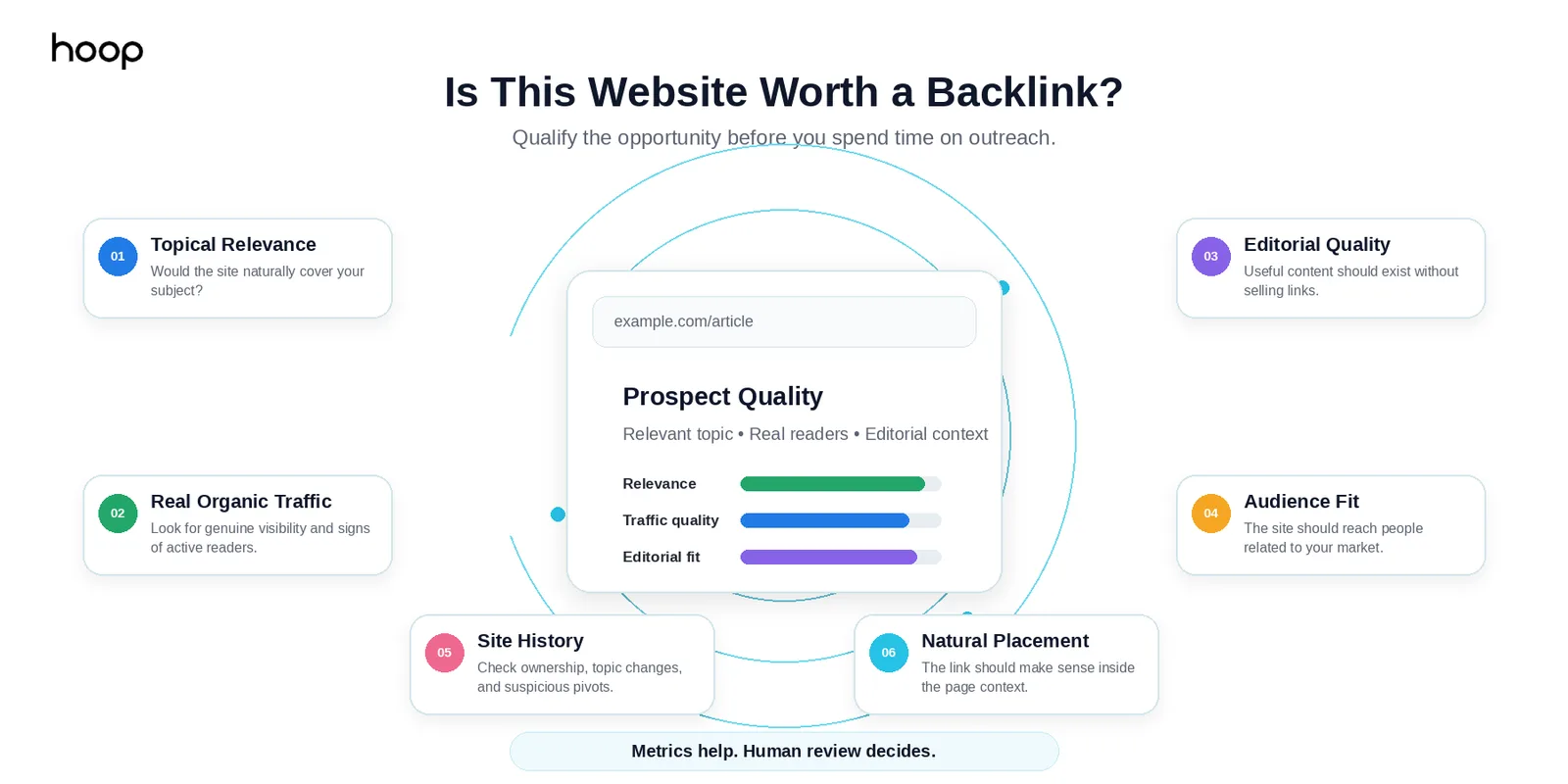
A good prospect is relevant, active, editorially credible, and connected to a real audience. Evaluate the complete website instead of chasing one metric.
Topical relevance
The site should naturally cover your subject, market, or audience. A relevant mid-sized publication can make more sense than a larger unrelated site.
Real organic visibility
Look for signs that search engines and users actually find the website. Traffic estimates are imperfect, but consistent visibility across relevant pages gives you useful context.
Editorial quality
Read the content. Check whether articles demonstrate care, expertise, useful information, and a consistent subject focus.
Audience fit
A backlink can provide value beyond rankings. The strongest placements can also put your brand in front of readers who could become customers, partners, journalists, or future linkers.
Site history and outbound links
Check whether the site has changed topics repeatedly, publishes unrelated sponsored content at scale, or links to questionable destinations. A clean editorial history matters more than a single attractive metric.
How Do You Write Outreach That Gets Replies?
Write outreach around relevance and value, not around your need for a backlink. A useful email explains why you chose that specific person and why the proposed resource helps their audience.
A strong message usually contains 4 parts: a relevant opening, a clear reason for contact, the useful asset or idea, and a simple next step.
Avoid fake personalization such as inserting a first name and article title into a mass template. Real personalization shows that you understand the page and can explain exactly why your suggestion belongs there.
Keep the email short. Editors, marketers, and journalists do not need your company history before deciding whether the idea deserves attention.
Which Tactics Belong in a Campaign?
Choose tactics that match the asset and the audience. A campaign does not need every available technique.
Digital PR works well when you have original research, expert commentary, or a newsworthy angle. Guest contributions can work when you can add genuine expertise to a relevant publication. Broken-link building fits useful replacement assets. Resource outreach works when a page genuinely improves an existing curated list.
Other options include original statistics, free tools, case studies, expert roundups, partnerships, unlinked mention reclamation, and relationship-led outreach.
The common requirement is editorial logic. A link should make sense for the reader even if search engines did not exist.
How Many Backlinks Does a Campaign Need?
There is no universal backlink quota. Set a target from competitive gaps, opportunity quality, campaign capacity, and the authority needs of the specific page.
Compare the relevant referring domains supporting pages that already rank well. Then assess whether those links come from publications you can realistically earn coverage from.
A campaign that earns 5 strong relevant referring domains can be more useful than one that produces 50 weak placements. Measure quality and diversity alongside volume.
How Long Does a Link Building Campaign Take?
Link building usually requires weeks or months because several stages happen before a live placement appears. Research, prospecting, email conversations, editorial review, content creation, and publication all take time.
Some opportunities move quickly because an editor already needs your resource. Other placements require multiple conversations or a content contribution.
Search impact also takes time to evaluate. Do not judge a campaign the day a link goes live. Track the target page across a meaningful period and compare rankings, impressions, traffic, and conversions against the starting baseline.
Should You Buy Links During a Campaign?
Do not buy links that pass ranking credit primarily to manipulate Google Search. Google’s spam policies for link spam identify buying or selling links for ranking purposes as a violation.
Paid advertising, sponsorships, and commercial placements can exist legitimately. Google says paid links should use appropriate qualification such as rel="sponsored" or rel="nofollow" when needed.
The safest campaign model focuses on editorial reasons to earn references rather than disguising payments as organic endorsements.
What Metrics Should You Track?
Track campaign operations, link quality, search movement, and business outcomes together. No single metric tells the whole story.
Operational metrics include qualified prospects, outreach sent, reply rate, conversations started, placements secured, and lost links. Quality metrics include relevant referring domains, traffic quality, topical fit, and placement context.
SEO metrics include target-page impressions, clicks, keyword movement, and organic traffic. Business metrics can include enquiries, sales, demo requests, assisted conversions, or other outcomes tied to the linked pages.
Raw backlink totals belong in the report, but they should not dominate it.
Why Do Link Building Campaigns Fail?
Most campaigns fail because the team starts outreach before creating a strong reason to earn the link. Weak targeting then makes the problem worse.
Common failure points include pitching irrelevant websites, relying on mass templates, choosing target pages nobody wants to cite, chasing authority metrics, over-optimizing anchor text, skipping follow-up, and measuring only the number of links delivered.
Automation can also damage a campaign when teams automate judgment. Use tools for contact discovery, list management, email sequencing, and status tracking. Keep prospect validation, positioning, and relationship decisions human.
Should You Run Link Building In-House or Outsource It?
Run link building in-house when you have the specialist time, relationships, content support, and process discipline to sustain it. Outsource when capacity or expertise limits execution.
An internal team gives you direct control over positioning and relationships. The tradeoff is hiring, training, software, content production, and management time.
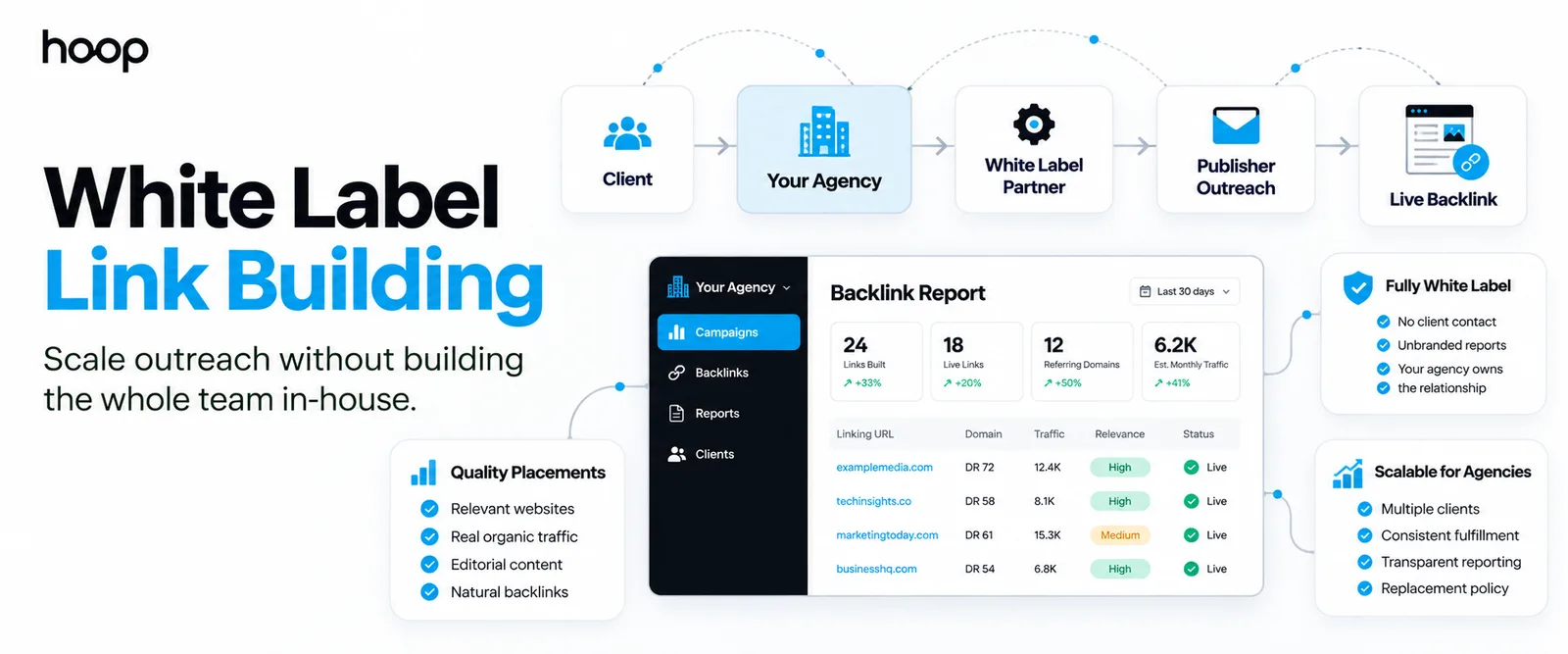
A specialist partner can provide campaign research, outreach, content support, quality control, and reporting without building that infrastructure internally. White label link building is one version of that model for agencies.
Build Links Around a Real SEO Goal
A strong link building campaign starts before the first outreach email. Choose the pages that matter, create something worth referencing, qualify prospects carefully, make a useful pitch, and measure what changes after links go live.
If you want a structured campaign without building the full outreach operation internally, explore Hoop Interactive’s link building services to plan prospecting, digital PR, editorial outreach, quality control, and reporting around your SEO goals.
“A link should make sense for the reader even if search engines did not exist.”
Key takeaways
- 01“Build 50 links” is not a goal — it says nothing about whether the page improved.
- 02The asset comes before the prospect list; outreach without a reason is just volume.
- 03Authority metrics sort a list; they do not prove a site has real readers.
- 04Five relevant referring domains can beat fifty weak placements.
Written by
Sahar
Content Writer
Frequently Asked
Questions
Everything you need to know before booking a strategy call. Can't find your answer? Contact us directly.
A link building campaign is a planned process for earning relevant backlinks to selected pages. The process includes strategy, prospecting, outreach, placement checks, and measurement.
Yes. Relevant editorial backlinks can support authority, rankings, referral traffic, and brand visibility when the underlying page deserves to rank.
There is no fixed monthly number. Base the target on competitive gaps, page importance, realistic prospect quality, and your campaign capacity.
Most campaigns require weeks or months. Prospecting, outreach, editorial review, publication, and search impact happen on different timelines.
Earn links because publishers genuinely want to reference useful content, expertise, research, or resources. Avoid schemes created primarily to manipulate ranking signals.