White Label Link Building: How It Works for SEO Agencies
White label link building lets an agency offer backlink outreach under its own brand while a specialist partner handles prospecting, publisher communication, content coordination, placement, quality checks, and reporting — but the agency still owns quality, compliance, client relationships, and reporting standards.
Sahar
Content Writer
White label link building lets your agency sell backlink outreach under your own brand while a specialist partner handles fulfillment. You keep the client relationship, strategy, approvals, pricing, and reporting while the partner manages research, outreach, content coordination, placement, and quality checks.
The model solves a capacity problem for agencies. Link acquisition needs research, publisher communication, negotiation, content, monitoring, and repeated follow-up. Building that operation internally takes people, systems, tools, and management time.
A white label partner can supply that execution without becoming visible to your client. The model only works when your agency keeps control over quality, transparency, and client ownership.
What Is White Label Link Building?
White label link building is outsourced backlink fulfillment delivered under your agency’s brand. A specialist provider performs the execution while your agency remains responsible for the client-facing service.
The arrangement usually involves 3 parties: your client, your agency, and your fulfillment partner. Publishers sit outside that relationship and provide the final media or editorial opportunity.
Your client should continue working with your account team. The fulfillment provider should not pitch additional services, contact the client directly, or place its branding inside client reports.
White labeling differs from simple referral work. A referral sends the client to another company. White label fulfillment keeps the client inside your agency’s service delivery.
Your agency can combine outsourced outreach with broader professional SEO services such as technical SEO, on-page optimization, content planning, and reporting.
How Does White Label Link Building Work?
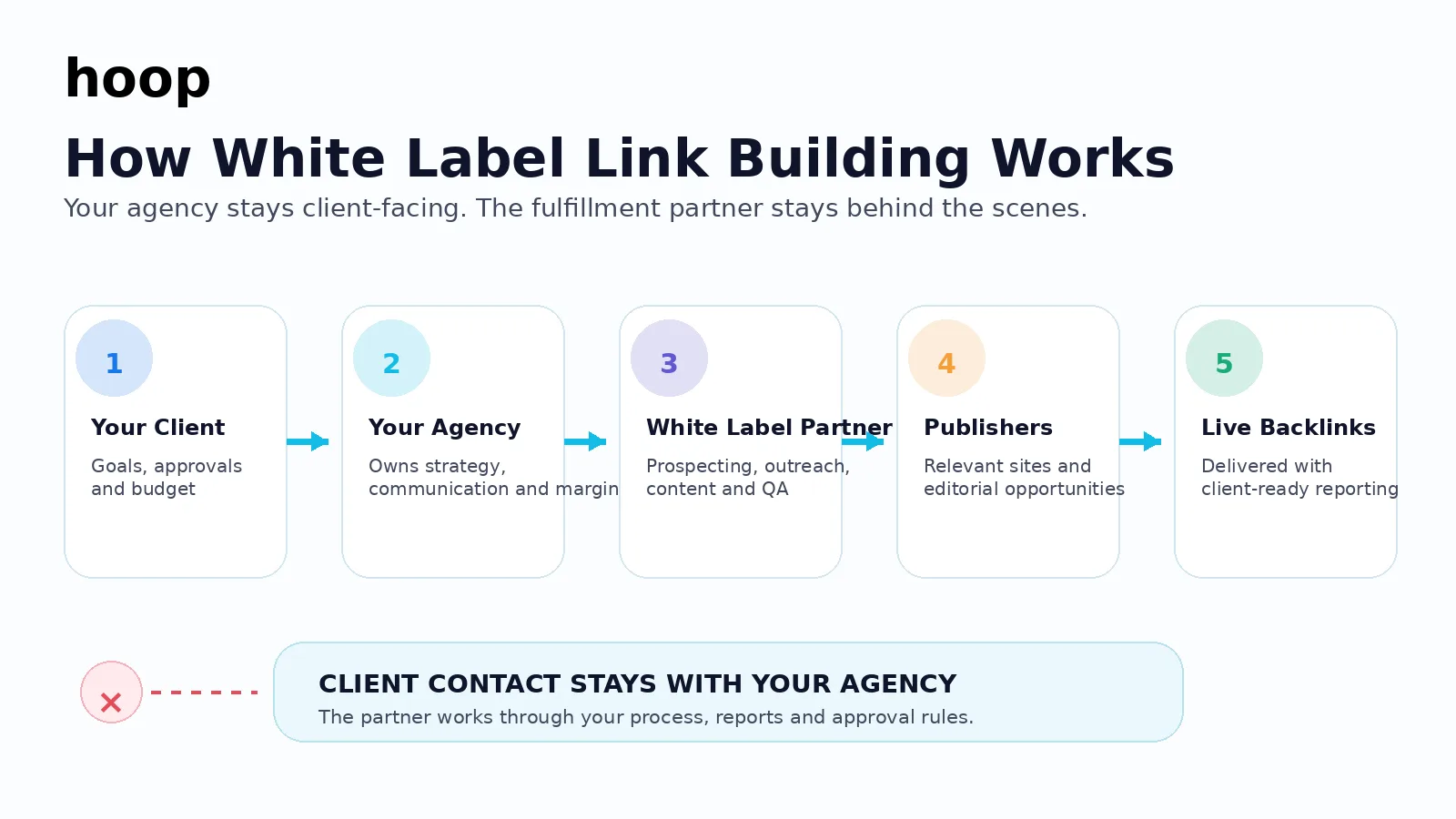
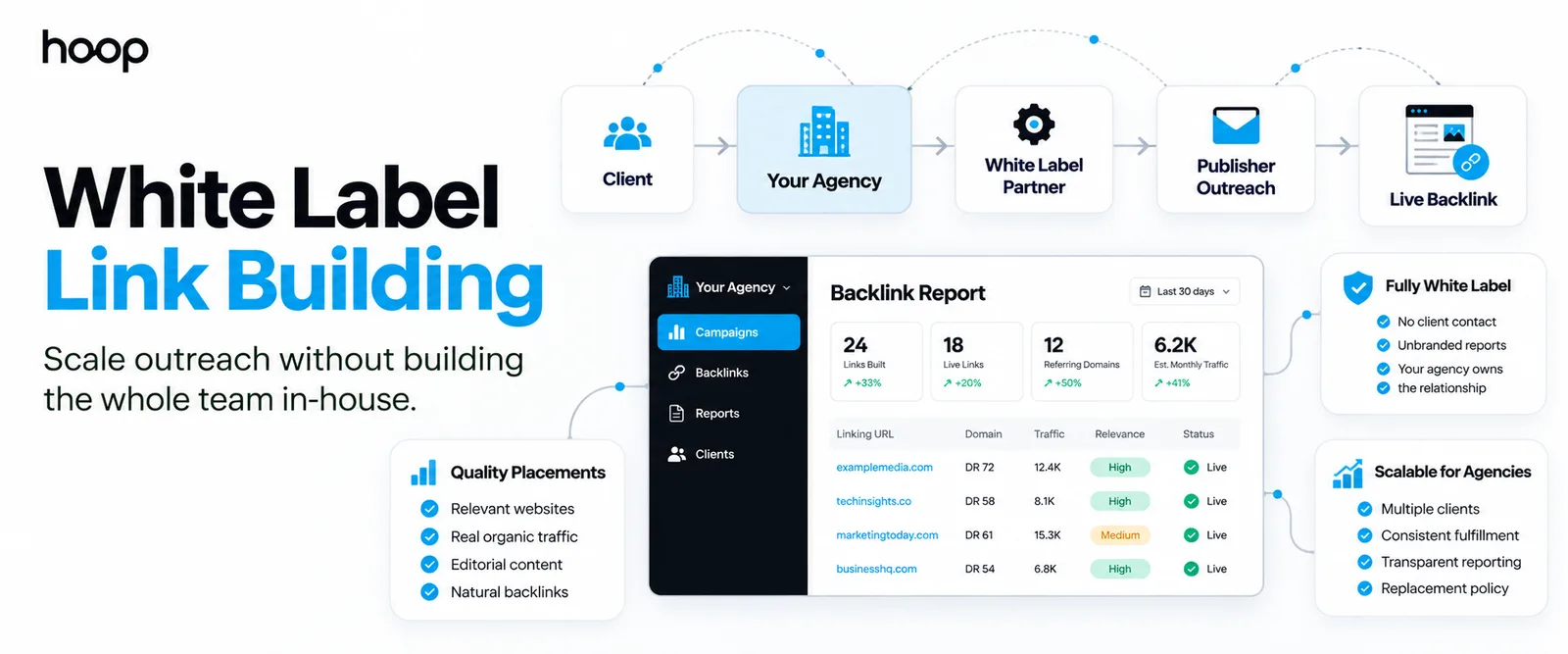
A white label campaign moves from agency strategy to partner execution, publisher outreach, placement, quality review, and client-ready reporting. Your agency should control the goals before outreach starts.
1. Your agency defines the campaign strategy
You choose the client pages that need authority, the topics that matter, acceptable anchor types, market restrictions, and publisher standards.
A useful brief can include target URLs, excluded websites, preferred industries, competitor backlinks, geographic rules, and minimum traffic requirements.
The fulfillment partner should not invent strategy after receiving a vague order for “10 links.” Clear campaign inputs reduce irrelevant placements.
2. The partner researches publishers and starts outreach
The partner builds a prospect list, reviews websites, finds contact routes, and approaches publishers or editors.
Good prospecting looks beyond a single authority score. The partner should inspect relevance, real search visibility, content quality, site history, and outbound link patterns.
3. Content and placement get coordinated
A publisher may request a contributed article, expert input, data, a resource addition, or another editorial format.
The provider coordinates the content and proposed link. Your agency should retain approval rules for sensitive clients, regulated industries, and high-value landing pages.
4. The provider completes quality assurance
Quality assurance should check the live URL, destination URL, anchor text, surrounding context, link attributes, indexability, topic relevance, and agreed publisher criteria.
A backlink spreadsheet without manual review can hide problems. Your process should reject placements that miss the agreed standard.
5. Your agency receives client-ready reporting
A white label report should show what was delivered without exposing the fulfillment provider. The agency can then add strategy notes and client commentary.
Replacement monitoring can continue after delivery when the commercial agreement includes a defined guarantee period.
Why Do Agencies Use White Label Link Building?
Agencies use white label link building to increase fulfillment capacity without building a complete outreach department internally. The model converts a specialist operational function into a scalable partner service.
White label fulfillment reduces hiring pressure
A reliable outreach operation can require prospecting, relationship management, copywriting, quality control, and reporting. One SEO generalist cannot always handle that workload across many clients.
Outsourcing lets an agency increase or reduce volume without carrying the same permanent staffing commitment.
Specialist partners bring focused processes
A provider that works on link acquisition daily can maintain publisher research systems, outreach workflows, negotiation experience, and quality-control procedures.
Your agency still needs to review those processes. Specialist focus does not remove the need for oversight.
Agencies can expand their SEO service mix
Some agencies deliver technical SEO and content well but lack outreach infrastructure. White label support lets those agencies add authority-building work without creating a new department first.
Hoop’s link building team combines outreach with editorial and authority-focused campaigns for businesses that need off-page SEO support.
What Makes a White Label Backlink High Quality?
A strong backlink comes from a real, relevant website and appears inside useful content where the link makes contextual sense. Domain metrics can support evaluation, but no single metric proves quality.
Topical relevance connects the link to the client
A cybersecurity company benefits more from relevant technology, security, business, or industry coverage than an unrelated lifestyle article.
Relevance should exist at 2 levels: the website should have a credible topical connection, and the specific page should support the link context.
Real organic visibility shows the site has an audience
Traffic estimates from tools such as Ahrefs or Semrush can help identify whether a domain receives search visibility.
Traffic estimates are not exact analytics data. Use them as one signal alongside indexed pages, ranking keywords, content quality, and publishing history.
Editorial quality matters around the backlink
The article should exist for readers, not only to hold outbound links. Review the writing, author information, topic depth, navigation, and other content on the domain.
A site filled with unrelated sponsored articles creates a different risk profile from a focused publication with consistent editorial standards.
Natural placement matters more than an aggressive anchor
A backlink should fit the sentence and destination. Repeating exact-match commercial anchors across many websites can create an unnatural profile.
Use branded, descriptive, partial-match, URL, and other natural anchors based on the context of each placement.
Domain Rating vs Real Quality: What Should You Check?
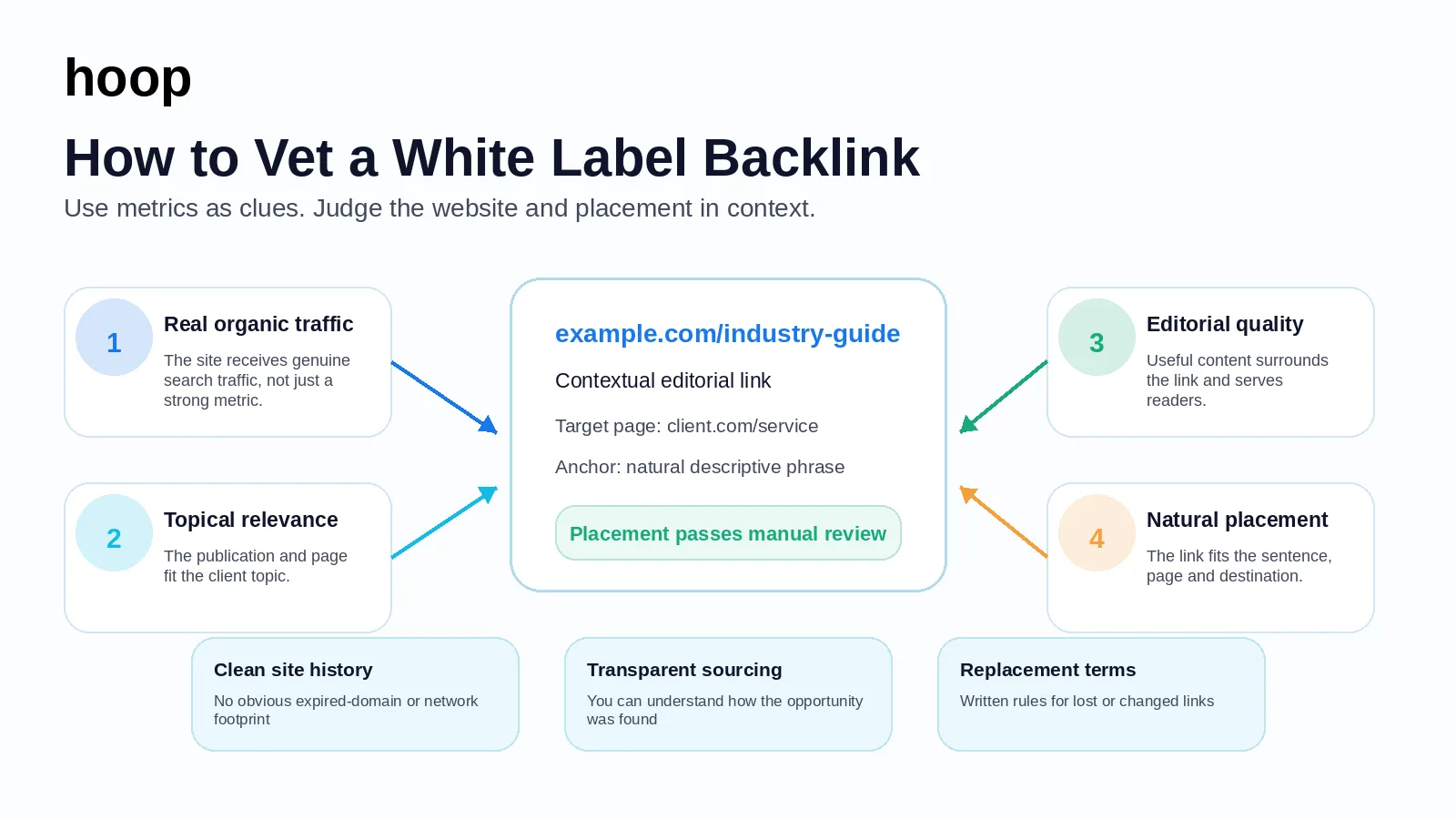
Domain Rating and Domain Authority are third-party metrics, not Google quality scores. Use metrics to filter opportunities, then inspect the website manually.
A high score can coexist with weak traffic, unrelated content, aggressive link selling, or an unusual site history. A lower-scoring specialist publication can still offer stronger topical value.
Review at least 6 factors before approving a placement: organic traffic, topical relevance, editorial quality, outbound link behavior, site history, and placement context.
The best white label process lets your agency reject sites that fail your quality rules before or after outreach.
How Are White Label Links Actually Built?
White label providers can earn or arrange links through outreach, digital PR, contributed content, resource pitching, and publisher relationships. The method changes the level of editorial control and compliance risk.
Manual outreach targets relevant opportunities
Manual outreach starts with websites that fit the campaign. The provider identifies contacts and pitches an idea, asset, expert contribution, or relevant resource.
This model takes time because publishers can ignore or reject pitches. The slower process can give your agency more control over relevance.
Digital PR earns coverage through newsworthy material
Digital PR uses research, data, expert commentary, stories, or creative assets to earn media attention and citations.
Campaigns often create brand mentions as well as links. Agencies that need earned-media support can combine link acquisition with digital PR services.
Paid placements require careful policy handling
Google’s spam policies classify buying or selling links for ranking purposes as link spam. Google allows paid advertising links when publishers qualify them appropriately with rel="sponsored" or rel="nofollow".
A white label partner should explain how placements are obtained and which link attributes apply. Your agency should not treat a paid dofollow placement as automatically compliant because the website has strong metrics.
How to Choose a White Label Partner
Choose a partner by testing transparency, placement quality, client protection, communication, and delivery controls before increasing volume. A polished sales page cannot replace a campaign test.
Request real sample placements
Ask for live examples that represent the service you would actually buy. Review the complete website, not only the linking page.
Check whether the examples match the niches, countries, and quality levels your clients need.
Ask how publishers are sourced
A provider should explain whether opportunities come from fresh outreach, existing relationships, marketplaces, digital PR, or a fixed inventory.
The answer helps you understand how much control the provider has over relevance and scale.
Confirm client-contact rules in writing
Your agreement should state that the partner will not contact, solicit, or market directly to your clients.
White label fulfillment depends on clear ownership boundaries. The partner supports the agency rather than competing with the agency.
Review reporting before signing
Ask for a sample report. The report should give your account team enough information to answer client questions confidently.
Start with a controlled test
Use 1 campaign or a small number of placements to test communication, quality, turnaround, and reporting. Increase volume only after the process passes your standards.
Partner Review Checklist
| Task | Timing | Method | Difficulty |
|---|---|---|---|
| Review sample sites | Before signing | Check traffic, relevance, content, history, outbound links | Medium |
| Confirm client ownership | Before signing | Contract clause and communication rules | Easy |
| Test a small campaign | First engagement | Limited targets and strict approval criteria | Medium |
| Audit delivered links | Every delivery | Manual URL, anchor, attribute, context, indexability check | Medium |
| Review retention | Monthly or quarterly | Confirm placements remain live and unchanged | Easy |
| Review performance | Quarterly | Compare referring domains, visibility, rankings, leads | High |
What Is a Link Replacement Policy?
A replacement policy defines what happens when an approved backlink disappears or changes during a stated period. The policy should specify time limits and eligible situations.
Ask whether the provider replaces a link when the article disappears, the domain goes offline, the link becomes nofollow, or the destination changes.
Also ask what the policy excludes. A publisher can remove content for reasons outside the provider’s control, so replacement terms need precise wording.
A written policy protects both sides from assumptions after delivery.
What Should Reports Include?
A useful report should let your agency verify every delivered placement and explain the campaign to the client. Reports should prioritize transparency over decorative metrics.
Include the linking URL, target URL, anchor text, placement date, publisher domain, topic, link attribute, status, and agreed quality signals.
Your agency can add strategy commentary before presenting the report. That layer keeps the service connected to broader SEO goals instead of presenting backlinks as isolated units.
White Label Service vs Software: What Is the Difference?
A white label service performs the fulfillment, while white label software helps your agency order, manage, track, or report campaigns. Some providers combine both models.
A service can handle research, outreach, negotiation, content, placement, and QA. A platform can provide ordering, publisher databases, workflow management, dashboards, or branded reports.
Choose based on the work your team wants to keep internally. Software does not remove outreach work unless the platform also includes managed fulfillment.
How Much Does White Label Link Building Cost?
Pricing changes with outreach method, publisher quality, niche difficulty, market, content needs, and approval rules. Compare scope before comparing price.
Common models include per-link pricing, monthly campaigns, credit packages, and custom outreach retainers.
A low unit price can hide limited vetting, fixed inventories, weak content, or narrow replacement terms. A higher price can also be poor value when the provider cannot explain sourcing.
Evaluate cost against the complete delivery process rather than the backlink count alone.
How Can Agencies Protect Their Profit Margins?
Protect margin by selling strategy and account ownership, not by acting as a simple backlink reseller. Your client pays for the campaign system, not only the provider’s unit cost.
Your agency adds value through competitor analysis, target-page selection, anchor planning, client communication, reporting, prioritization, and integration with the rest of SEO.
Track fulfillment cost, account-management time, revision time, reporting time, and replacement work. Those costs determine the real gross margin.
Standardized briefs and approval rules also reduce expensive rework as client volume grows.
Can the Model Scale Across Multiple Clients?
Yes, but scale requires campaign separation, clear quality rules, capacity planning, and consistent reporting. More volume should not weaken publisher relevance or approval standards.
Create separate briefs for each client. Record excluded domains, previous placements, target pages, anchor history, niche rules, and country requirements.
Ask the provider how capacity affects turnaround. A partner that performs well for 2 clients may struggle when the agency sends 20 campaigns at once.
Review quality at every volume increase instead of assuming the first campaign standard will continue automatically.
What Are the Main Risks?
The main risks are poor-quality placements, opaque sourcing, client-contact conflicts, weak reporting, lost links, and policy violations. Most risks come from weak controls rather than outsourcing itself.
Avoid providers that refuse to show examples, promise guaranteed rankings, sell every niche from the same small website inventory, or cannot explain how publishers enter the network.
Your agency should also avoid outsourcing judgment. The fulfillment partner can perform research, but your account team still owns the client’s risk tolerance and strategy.
In-House vs White Label: Which Model Fits Your Agency?
In-house teams offer maximum process control, while white label fulfillment reduces fixed staffing and infrastructure requirements. The right model depends on volume, expertise, margins, and management capacity.
An in-house team can make sense when link acquisition represents a major share of revenue and the agency has enough volume to support specialist roles.
White label link building can fit agencies with changing demand, limited outreach capacity, or a broader SEO service mix.
Hybrid models also work. An agency can keep strategy and digital PR internally while outsourcing specific outreach campaigns or overflow work.
Scale Link Building Without Losing Control
White label link building can give your agency more delivery capacity without forcing you to build every outreach function internally. The strongest partnerships keep strategy, client ownership, quality thresholds, reporting, and approvals clear from the first campaign.
If your agency needs a structured backlink campaign built around relevance, editorial quality, and transparent reporting, explore Hoop Interactive’s link building services to plan the next campaign.
“Your agency should also avoid outsourcing judgment.”
Key takeaways
- 01Your agency owns the brief; a vague “10 links” order produces irrelevant placements.
- 02Domain Rating is a third-party metric, not a Google quality score — inspect the site manually.
- 03Put non-solicitation and client-contact rules in writing before the first campaign.
- 04Sell strategy and account ownership; reselling links alone erodes the margin.
Written by
Sahar
Content Writer
Frequently Asked
Questions
Everything you need to know before booking a strategy call. Can't find your answer? Contact us directly.
Yes, when the process uses transparent sourcing, relevant websites, natural placements, clear policy standards, and manual quality control. Outsourcing does not make a link safe or unsafe by itself.
Not from properly white-labeled delivery. Your agency controls communication and reporting while the provider remains behind the scenes.
No. Third-party authority metrics do not guarantee relevance, traffic, editorial quality, rankings, or business results.
No, not when your agreement prohibits direct contact. Put client ownership and non-solicitation rules in writing before work starts.
No. White label describes who fulfills the work, while link acquisition describes how the link is obtained. Paid ranking links also carry specific Google policy requirements.