

How to Start a Social Media Marketing Agency From Scratch
Start with one service, one niche, and one measurable client problem. Proof comes from a real measured project, pricing starts from your delivery cost, and the agency label only earns its place once demand exceeds one person.
Sahar
Content Writer
If you want to know how to start a social media marketing agency, begin with one marketable skill and one focused niche. Choose one measurable client problem next. A real agency grows from reliable delivery and profitable client relationships, not from branding alone.
The fastest route is usually smaller than beginners expect. Start with one service you can deliver well, one type of client you understand, and one clear business outcome. Then turn early results into proof, referrals, and a process that another person can eventually follow.
What Does a Social Media Marketing Agency Actually Do?
A social media marketing agency helps businesses plan, create, publish, manage, and measure social activity tied to commercial goals. Some agencies handle only organic content. Others add community management, paid social, creator campaigns, reporting, or strategy.
Professional social media marketing usually combines research, content planning, creative production, publishing, community work, and measurement. Your agency does not need every service on day 1.
Clients pay for judgment and execution. Clients rarely care how many tools you own. Clients care whether the agency understands the audience, communicates clearly, meets deadlines, and produces useful business results.
How to Start a Social Media Marketing Agency With No Experience
You can start the business with limited experience, but you should only sell work you can competently deliver. Personal posting experience does not automatically prepare you for client strategy, reporting, approvals, revisions, or commercial accountability.
Build capability before promising outcomes. Manage a real account, complete a measurable project, or work under an experienced marketer. Practice audience research, content planning, analytics, copywriting, creative briefing, and client communication.
A beginner can also start with a narrow service. For example, you might offer short-form video editing for local gyms instead of full social media management. A narrow offer reduces delivery risk while you build broader skills.
Should You Start as a Freelancer or an Agency?
Starting as a freelancer usually gives you the simpler path. You can validate demand, improve delivery, and learn client management without carrying unnecessary payroll or operational costs.
The agency model becomes useful when demand exceeds your personal capacity and the work follows a repeatable process. At that stage, contractors or employees can handle parts of delivery without changing the client promise.
Do not force the agency label before the business model exists. Build a service that works with one person. Then document the process and add capacity when revenue supports the decision.
How to Choose a Profitable Social Media Agency Niche
To choose a profitable niche, assess market demand, client budgets, and access to prospects. Then choose a problem you can solve repeatedly. A niche should make your sales message more specific, not simply make your audience smaller.
Choose an Industry You Can Understand
Start with an industry where you can learn customer behavior quickly. Examples include dental clinics, boutique fitness studios, ecommerce beauty brands, B2B software companies, or restaurants. Familiarity reduces research time and improves sales conversations.
Choose a Problem Worth Paying to Solve
Clients buy solutions to business problems. A restaurant may need local awareness and bookings. A SaaS company may need demo demand. An ecommerce brand may need stronger product discovery and social proof.
Choose a Platform Strength
Platform specialization can sharpen your positioning further. You might focus on LinkedIn for B2B founders, Instagram for beauty brands, or TikTok for consumer products. Platform expertise becomes stronger when paired with an industry problem.
Validate Demand Before Committing
Speak with real prospects before rebuilding your entire brand around a niche. Ask how the business handles social media, what results matter, what has failed, and what budgets already exist. Five useful conversations can expose weak assumptions quickly.
Which Social Media Services Should You Sell First?
Start with the smallest service set that solves the client problem. A new agency often performs better with one clear offer than with ten loosely connected services.
- Offer content strategy and monthly planning when clients lack direction.
- Offer content creation when clients know the strategy but lack production capacity.
- Offer community management when comments, messages, and audience relationships need daily attention.
- Offer reporting and optimization when clients already publish but cannot connect activity to results.
Avoid adding paid advertising, influencer management, email marketing, SEO, and web design only to look bigger. Every added service creates new workflows, expertise requirements, and client expectations.
How to Build an Offer Around a Result
To build an offer around a result, describe the client, problem, service, and expected outcome. Avoid selling only a fixed number of posts because post counts do not explain why the client should care.
For example, “12 posts and 4 Reels” describes production. “Organic Instagram management for boutique fitness studios seeking local discovery and inquiries” describes a business problem and direction.
Keep promises realistic. Social media performance depends on brand strength, offer quality, competition, budget, audience demand, and execution. Sell a credible process and measurable targets rather than guaranteed viral growth.
How to Build a Portfolio Without Paying Clients
To build a portfolio without paying clients, complete a real project with a defined baseline and objective. Set the scope and measurement period before work starts. A genuine case study carries more weight than a collection of mock graphics.
Choose one business where you can access data and decision-makers. The business can belong to a friend, a local owner, a nonprofit, or your own project. Agree on the exact work before you begin.
Document the starting position, actions, and outcome. Show numbers such as engagement rate, qualified inquiries, profile visits, website traffic, saves, shares, or conversions. Explain what changed and why the result matters.
Free work should have boundaries. Set a fixed timeline and fixed deliverables. The goal is proof, not an open-ended arrangement where the client keeps adding work.
How to Price Social Media Marketing Services
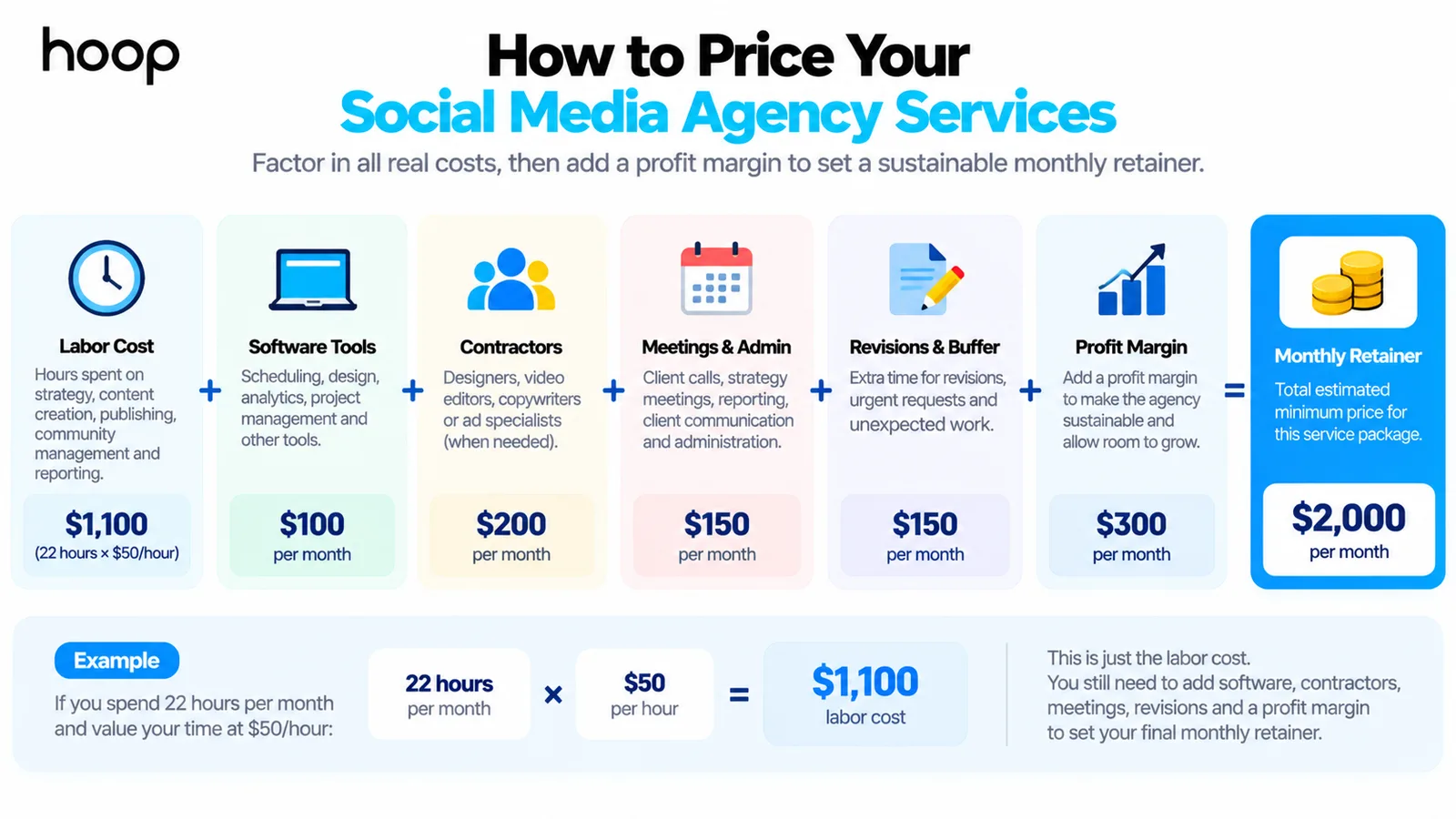
To price social media marketing services, calculate delivery cost first. Then compare the price with market value. Your price must cover labor, software, contractors, meetings, revisions, reporting, administration, taxes, and profit.
Monthly retainers fit ongoing account management because the work repeats every month. Project pricing fits audits, launches, strategy documents, and campaign builds. Hourly pricing fits consulting or work with uncertain scope.
Calculate a pricing floor before discussing packages. If an account takes 22 hours monthly at $50 per hour, labor already costs $1,100. Software, meetings, revisions, and profit must sit above that amount.
Do not copy another agency’s rates without understanding the delivery model. A low price can create growth problems when every new client adds more work than cash.
What Should Your Contract and Scope Cover?
A contract should define the relationship before work starts. Clear scope protects both sides and reduces misunderstandings when clients request work outside the agreement.
- Define deliverables, platforms, publishing frequency, and reporting responsibilities.
- Define revision limits, approval deadlines, meeting frequency, and response expectations.
- Define payment terms, cancellation terms, content ownership, and access responsibilities.
- Define how extra work gets quoted when requests fall outside the agreed scope.
Local laws differ, so use qualified legal and accounting support for your jurisdiction. Do not rely on a copied online contract for high-value client work.
How to Set Up Client Onboarding and Delivery
To set up client onboarding and delivery, create one repeatable path from agreement to monthly reporting. A defined workflow reduces missed information, late approvals, and inconsistent results.
Strong social media management depends on consistent access, planning, approvals, publishing, community work, and reporting. Your onboarding should collect brand guidelines, audience information, account access, past performance, offers, and approval contacts before production starts.
Then create a monthly operating rhythm. Research and strategy come first. Content planning follows. Creation, review, approval, publishing, community work, and reporting should each have an owner and deadline.
Document every recurring task as a standard operating procedure. Written processes make training easier and expose steps that waste time.
How to Get Your First Client
To get your first social media marketing client, start where trust already exists. Then add targeted outreach and visible expertise. Random mass messaging usually creates weak conversations because the pitch lacks relevance.
Start With Warm Relationships
Contact former colleagues, business owners, friends, suppliers, and professional contacts. Do not ask everyone for work. Explain the specific client you help and the problem you solve, then ask for an introduction when the fit exists.
Use Targeted Outbound
Build a small prospect list inside your niche. Review each account before contacting the business. Reference one real issue, explain the likely impact, and suggest a clear next step. Personalization should come from research, not automated first-name fields.
Publish Your Expertise
Use your own channels to prove how you think. Break down campaigns, explain mistakes, share tests, show client results, and publish useful observations from your niche. A small account can still create trust when the thinking is strong.
A repeatable client acquisition strategy becomes more important once referrals stop covering your pipeline. Track outreach volume, meetings, proposals, close rate, and average deal value so growth stops depending on luck.
What Do Clients Look for When Hiring a New Agency?
Clients usually look for relevance, proof, communication, clear scope, and realistic expectations. A polished website helps, but buyers still want evidence that the agency understands their market and can deliver reliably.
Relevant proof beats generic volume. One strong case study from a similar business can carry more weight than 20 unrelated graphics. Clients also notice how quickly you reply, how clearly you explain decisions, and how well you manage approvals.
Avoid pretending your agency has capabilities that do not exist. Buyers can usually detect vague case studies, recycled frameworks, and inflated team claims during discovery calls.
Which Tools Does a New Social Media Agency Actually Need?
A new agency needs tools that remove operational friction, not a large software stack. Start with reliable tools for planning, design, scheduling, analytics, communication, file storage, and invoicing.
Examples include Notion or ClickUp for projects and Canva or Adobe tools for creative work. Buffer or Sprout Social can handle publishing. Google Drive can store files, while accounting software manages invoices. Choose tools after identifying a workflow problem.
Artificial intelligence can reduce research, ideation, repurposing, reporting, and administrative work. AI access alone does not create a defensible agency advantage. Clients can access the same general-purpose tools.
How to Keep Your First Clients
To keep your first clients, deliver consistently and communicate before problems grow. Connect reporting to the client’s business goals. Retention starts during sales because unrealistic promises create future dissatisfaction.
Set expectations for response times, approvals, reporting dates, and testing periods. Show what changed during the month, what the numbers mean, what you learned, and what the next action will be.
Ask for feedback before renewal time. A short monthly conversation can reveal frustration early, while the relationship remains fixable.
When Should You Hire Your First Contractor or Employee?
Hire when repeatable work exceeds your capacity and client revenue can support the role without damaging cash flow. Do not hire only because the word agency sounds larger with a team.
Contractors can help with specialized or variable workloads such as video editing, design, copywriting, or paid media. Employees make more sense when consistent demand justifies stable capacity and closer operational control.
Document the task before delegating the task. A new hire cannot fix a delivery process that only exists inside the founder’s head.
Common Mistakes New Social Media Agency Owners Make
New agency owners often spread attention across too many services and underprice retainers. Many also chase every prospect or promise results too early. Those choices create delivery problems long before revenue looks impressive.
Another common mistake is treating followers as the main proof of value. Clients can care about reach and engagement, but commercial accounts usually need stronger measures. Examples include inquiries, qualified leads, bookings, sales, retention, and branded demand.
Founders also underestimate administration. Sales, invoicing, client calls, contracts, hiring, quality control, and cash flow compete with the marketing work itself. Agency ownership requires business management as well as social media skill.
How Long Does It Take to Build a Social Media Marketing Agency?
No fixed timeline applies to every founder. Existing skills, network strength, niche demand, pricing, proof, sales ability, and available time all change the pace.
An experienced founder can reach stable revenue faster than a beginner learning delivery and sales together. Judge progress through proof, recurring revenue, margins, retention, and pipeline quality instead of arbitrary 30-day promises.
The useful milestone is not the first logo, website, or client. The useful milestone is a repeatable system that attracts suitable prospects and closes profitable work. The system must also support reliable delivery and retention.
Quick Reference: Agency Build Sequence
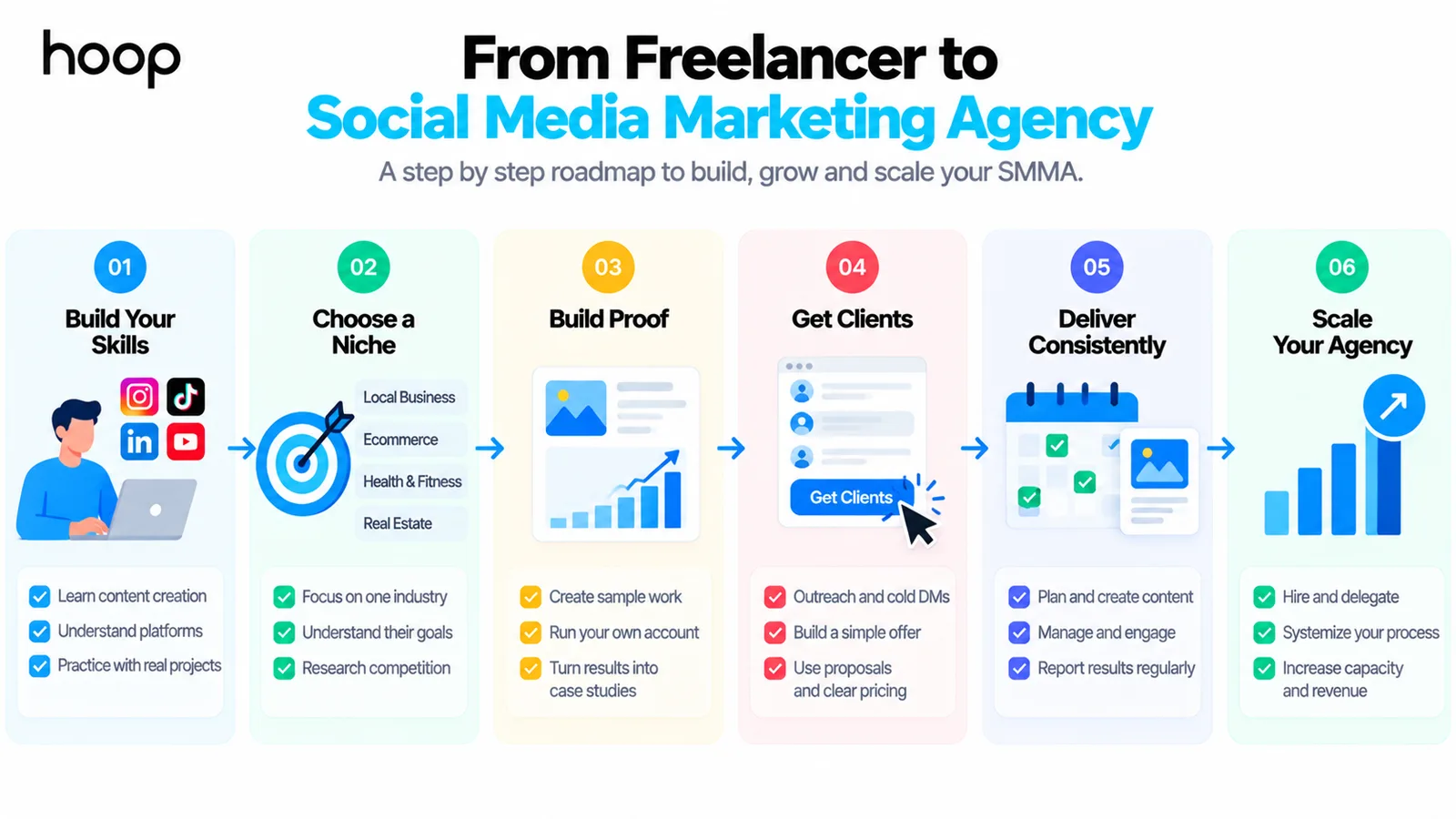
| Stage | Main Task | Evidence to Collect | Next Move |
|---|---|---|---|
| Skill | Deliver one service well | Completed work and analytics | Choose a niche |
| Niche | Validate one market problem | Prospect interviews and demand | Build the offer |
| Proof | Run a measured project | Case study and testimonial | Start outreach |
| Sales | Win suitable clients | Meetings, proposals, close rate | Refine pricing |
| Delivery | Create repeatable workflows | SOPs and retention data | Add capacity |
| Scale | Delegate documented work | Margins and utilization | Hire selectively |
Build the Agency Around Proof and Process
A social media marketing agency becomes sustainable when skill creates proof and proof creates trust. Trust then supports repeatable client work.
Start narrow, protect your scope, price for delivery, and document the process before you scale. For support with strategy, content, community, and growth systems, explore Hoop Interactive’s social media marketing services.
“The useful milestone is not the first logo, website, or client. The useful milestone is a repeatable system that attracts suitable prospects and closes profitable work.”
Key takeaways
- 01Freelance first. Add the agency structure when repeatable demand exceeds your own capacity, not before.
- 02Price from a floor: 22 hours at $50 is $1,100 of labour before software, meetings, revisions, and profit.
- 03One relevant case study with a real baseline beats twenty unrelated mock graphics.
- 04Document each recurring task as an SOP before delegating — a hire cannot fix a process that lives in your head.
Written by
Sahar
Content Writer
Frequently Asked
Questions
Everything you need to know before booking a strategy call. Can't find your answer? Contact us directly.
No. Clients usually care more about relevant skills, proof, communication, and reliable delivery than a specific degree. Formal education can still help with business and marketing fundamentals.
Yes. Many founders start alone and add contractors after client demand exceeds personal capacity. A solo start also helps you learn the delivery process before delegating work.
Startup costs can stay low if you already own a computer and work remotely. Your larger costs often come from software, legal setup, insurance, contractors, and the time required to acquire clients.
Yes, but only with a fixed scope and fixed timeline when the project gives you useful proof. A discounted paid pilot often creates stronger commitment from both sides.
The number depends on service depth, content volume, meetings, approval speed, and community workload. Track actual hours per account before deciding how many clients your capacity supports.