

What Is Behavior Driven Development? BDD Explained Simply
BDD is a collaboration approach, not a test framework. Teams agree on concrete examples of behavior before coding, and some of those examples later become executable specifications.
Sahar
Content Writer
Behavior driven development is a software-development approach built around shared examples of how a system should behave. Teams clarify those examples before implementation begins.
Developers, testers, and product stakeholders use the examples to remove ambiguity and agree on expected outcomes. Useful examples can later become executable specifications.
BDD is not the same as Cucumber, Gherkin, or automated testing. Those tools and techniques can support the approach without defining it.
Need this done right?
Hoop builds the strategy, design and development behind sites like this one — talk to us about yours.
What Does Behavior Driven Development Mean?
Behavior driven development helps teams describe software through observable behavior rather than internal implementation details. The discussion begins with what users or businesses need.
The team then explores concrete examples that prove everyone understands the requirement the same way. Those examples guide development and testing.
The main goal is shared understanding. Automated scenarios, readable specifications, and regression checks are useful results of that understanding.
Why Was Behavior Driven Development Created?
Software projects often fail because people interpret the same requirement differently. Product, engineering, and testing roles can each make reasonable but conflicting assumptions.
Behavior driven development tries to expose those assumptions before they become code. Teams discuss examples while changing the requirement is still inexpensive.
A sentence like “premium customers receive a discount” sounds clear until someone asks about eligibility, sale items, and expired memberships.
Concrete examples force those hidden rules into the conversation. The team can resolve uncertainty before development starts.
How Does Behavior Driven Development Work?
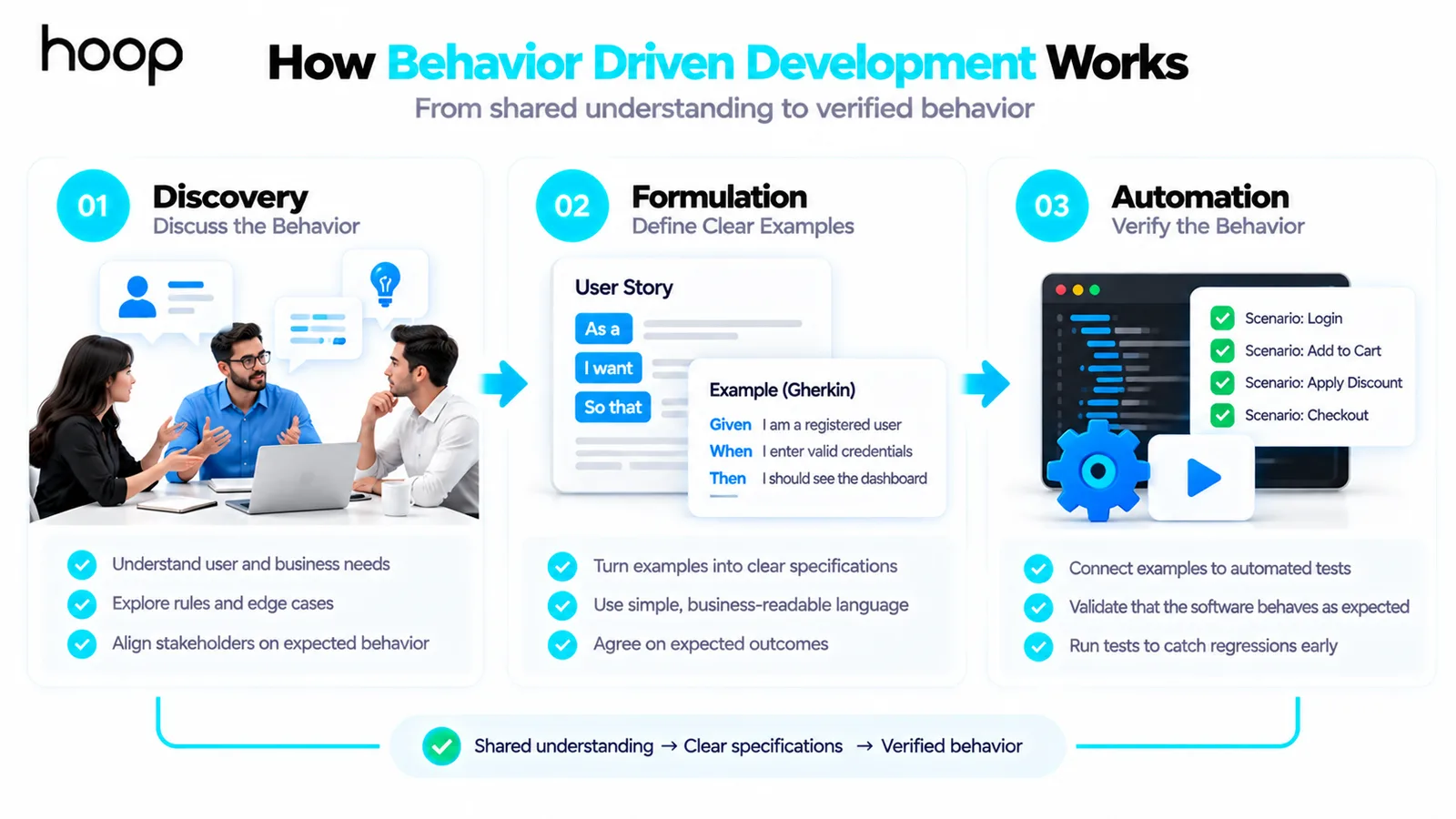
A practical BDD workflow has three connected activities: discovery, formulation, and automation. Each activity answers a different question about behavior.
Discovery
Discovery asks what the product should do and which examples reveal important rules. Product, engineering, and testing perspectives challenge assumptions together.
Formulation
Formulation turns useful examples into clear, readable specifications. The language should express domain behavior without exposing unnecessary technical details.
Automation
Automation connects selected specifications to executable checks. Behavior driven development then verifies that implementation continues matching the agreed behavior.
Not every example needs automation. Some examples are valuable because they clarify a requirement, even when another test level covers the final behavior.
What Is BDD Discovery?
BDD discovery is the conversation where a team explores a story before building it. The goal is to uncover rules and unanswered questions.
A useful discovery session asks what success looks like, what could go wrong, and which conditions change the expected outcome.
This discussion can happen during backlog refinement, story planning, or a focused workshop. The meeting format matters less than the quality of the questions.
What Is Example Mapping?
Example Mapping is a lightweight way to organize a BDD discovery conversation. Teams separate the story, business rules, concrete examples, and unresolved questions.
Suppose a story says customers can use promotional codes. The team may identify rules for expiry dates, minimum spend, usage limits, and eligible products.
Each rule gets concrete examples. Questions that remain unclear return to the appropriate product or domain expert before implementation.
This process turns vague acceptance criteria into shared decisions. It can provide value even when no Gherkin file is created.
What Is Given-When-Then?
Given-When-Then is a common structure for expressing one example of system behavior. It separates context, action, and expected outcome.
Given describes the starting conditions. When describes the event or action. Then describes the observable result that should follow.
For example, given a premium customer has an eligible order, when checkout begins, then a 10 percent discount appears.
The structure keeps examples focused on cause and outcome. It also gives business and technical roles a consistent language for discussing behavior.
What Is Gherkin?
Gherkin is a structured language commonly used to write readable BDD scenarios. It includes keywords such as Feature, Scenario, Given, When, Then, And, and But.
Gherkin makes examples easy for tools such as Cucumber to parse. Its syntax can also make scenarios easier for humans to review.
The syntax does not create shared understanding by itself. A poorly discussed requirement remains unclear even when it is formatted perfectly.
Is Gherkin the Same as Behavior Driven Development?
No. Gherkin is a specification syntax, while behavior driven development is a broader collaboration and development approach.
A team can write hundreds of Gherkin scenarios without practicing meaningful BDD. That happens when scenarios are created after decisions are already made.
A team can also use BDD principles without Gherkin. Concrete examples and shared discovery can guide development through other formats.
Is Cucumber the Same as BDD?
No. Cucumber is a tool that can execute behavior specifications. BDD is the process used to discover, clarify, and formulate the behavior.
Cucumber connects readable scenarios to automation code through step definitions. That connection lets selected examples become executable checks.
Installing Cucumber does not make a team behavior driven. The value depends on whether examples came from useful collaboration and remain meaningful.
What Does a Good BDD Scenario Look Like?
A good scenario describes business behavior at the level users or domain experts care about. It avoids unnecessary browser clicks and implementation details.
For example, “When the customer logs in” is usually better than describing every field, button, selector, and page transition.
The implementation may later move from passwords to single sign-on. The business behavior can remain stable while technical steps change underneath.
Good scenarios are specific enough to remove ambiguity but broad enough to survive harmless implementation changes.
How Do BDD Examples Become Executable Specifications?
Behavior driven development can turn selected examples into executable specifications after the team agrees on the intended outcome.
Automation code connects each readable scenario to application actions and assertions. The check then confirms whether working software matches the example.
Behavior driven development does not require every example to become an end-to-end test. Faster unit or API tests may cover some rules better.
The team should automate examples that provide repeatable confidence. Discovery examples can remain conversational when automation would add little value.
Who Writes BDD Scenarios?
BDD scenarios should reflect shared understanding rather than one role working alone. Product, development, and testing perspectives all contribute.
Business stakeholders do not need to type feature files themselves. They do need to influence the examples and confirm important business rules.
Developers often help determine feasible boundaries. Testers often challenge edge cases, alternative paths, and assumptions that others may overlook.
What Are the Three Amigos in BDD?
The Three Amigos describes collaboration across business, development, and testing perspectives. The phrase does not require exactly three people or fixed job titles.
A product manager may represent business intent. A developer may represent implementation concerns. A QA engineer may challenge risks and failure paths.
Other roles can join when needed. Designers, analysts, security specialists, or domain experts may add important context for specific stories.
What Makes BDD Scenarios Maintainable?
Maintainable scenarios focus on stable business outcomes. They avoid selectors, internal method names, and temporary implementation details.
Scenario wording should use domain language consistently. Step definitions can hide technical changes while the business meaning stays readable.
Behavior driven development suites also need regular cleanup. Teams should remove obsolete scenarios, merge duplication, and investigate slow or unreliable checks.
A small trusted suite provides more value than hundreds of scenarios nobody understands. Maintenance protects both feedback speed and documentation quality.
BDD vs TDD: What Is the Difference?
Test-Driven Development usually focuses on a tight developer feedback loop around code. A developer writes a failing test, implements behavior, and then refactors.
Behavior driven development puts stronger emphasis on shared examples of desired behavior. Those examples often begin at the user or business level.
The approaches can work together. A BDD example may define an outcome, while TDD helps developers implement the smaller components supporting that outcome.
BDD should not be reduced to “TDD in plain English.” Collaborative discovery is a major part of its value.
BDD vs ATDD: What Is the Difference?
Acceptance Test-Driven Development uses acceptance tests to guide implementation toward agreed requirements. BDD shares much of that goal and adds behavioral language.
The practices overlap heavily in real teams. Both encourage agreement about acceptance before implementation is considered complete.
BDD often emphasizes examples, domain language, and collaborative conversations more explicitly. The exact labels matter less than the working practice.
Does BDD Replace Unit Testing?
No. BDD does not remove the need for fast, focused unit tests. The two approaches usually operate at different levels of feedback.
A BDD scenario might state that an eligible premium customer receives a 10 percent discount. Several small components may implement that rule.
Unit tests can verify those components quickly. The behavior example checks that the intended outcome appears at the appropriate system boundary.
Does BDD Replace QA Testing?
No. Automated BDD scenarios only verify behaviors the team already described. They cannot discover every usability problem, integration failure, or unexpected risk.
A broader QA testing strategy still needs exploratory, regression, API, performance, accessibility, and other relevant coverage.
BDD can reduce repetitive acceptance checking when scenarios are automated. That can leave more human attention available for investigation and exploratory work.
What Is Living Documentation in BDD?
Living documentation describes specifications that stay connected to executable behavior. Passing scenarios show that the implementation still matches the documented examples.
This can make important business rules easier for future developers, testers, and product owners to understand. The documentation remains close to working software.
The idea only works when teams maintain the scenarios. Outdated examples become misleading documentation and can reduce trust in the entire suite.
How Does Behavior Driven Development Fit Into Agile?
Behavior driven development complements Agile by improving the conversation around upcoming work. It does not replace planning, prioritization, iteration, or product feedback.
During custom software development, BDD-style discovery can clarify stories before implementation and expose expensive misunderstandings early.
A story becomes easier to estimate and test when the team understands its rules and examples. Unanswered questions can return to refinement before coding begins.
How Does BDD Fit Into CI/CD?
Automated behavior specifications can run inside continuous integration and delivery pipelines. They may sit alongside unit, API, integration, security, and regression checks.
A mature Cloud and DevOps workflow can run selected BDD scenarios before deployment and stop releases when important behavior fails.
However, CI/CD is not the main purpose of BDD. Its primary value begins earlier, when teams decide what behavior the product should have.
What Are the Benefits of Behavior Driven Development?
Behavior driven development can be valuable when requirements contain ambiguity or complex business rules. Its strongest benefits come from improving shared decisions.
- Clearer requirements through concrete examples instead of vague acceptance statements.
- Earlier discovery of edge cases, conflicting assumptions, and unanswered business questions.
- Shared language between product, development, testing, and relevant domain experts.
- Readable acceptance criteria that stay connected to observable product behavior.
- Executable examples that can provide repeatable regression protection where automation is useful.
- Better traceability between business rules, implementation choices, and acceptance outcomes.
What Are the Disadvantages of BDD?
BDD adds collaboration and specification work, so it has a real cost. That cost becomes wasteful when the team applies the method mechanically.
Feature files can become another maintenance layer. Large suites may accumulate duplicate steps, unclear abstractions, slow scenarios, and outdated examples.
Business-readable files can also stop serving business readers. Technical teams may become the only people maintaining supposedly shared specifications.
BDD creates the most value when conversations solve genuine ambiguity. It creates less value when syntax and ceremony become the objective.
Common BDD Mistakes
- Treating Cucumber installation as proof that the team practices BDD.
- Writing scenarios after development, without using examples to clarify requirements first.
- Describing browser clicks and selectors instead of meaningful domain behavior.
- Turning every example into a slow end-to-end automated scenario.
- Creating vague reusable steps that hide the business meaning of each scenario.
- Leaving outdated scenarios in place after rules or product behavior change.
- Forcing BDD onto trivial technical work where shared behavioral discovery adds little value.
When Should a Team Use Behavior Driven Development?
BDD is most useful when people can reasonably interpret a requirement in several ways. Complex rules make concrete examples especially valuable.
Good candidates include pricing, eligibility, permissions, claims, subscriptions, booking rules, approval flows, financial calculations, and regulated workflows.
Behavior driven development can also help teams with recurring product-to-engineering misunderstandings. A short discovery conversation may save far more time than later rework.
The team should still choose automation selectively. The discussion may provide value even when lower-level tests verify the final implementation.
When Might BDD Be Unnecessary?
BDD may add little value when the change is small, technical, and already well understood. Not every refactor or dependency upgrade needs a behavior workshop.
Simple utility functions may be better served by focused unit tests. Infrastructure maintenance may need technical acceptance criteria instead of business-readable scenarios.
The decision should depend on uncertainty and communication risk. Teams should use enough structure to clarify behavior without adding empty ceremony.
Does AI Change the Value of BDD?
AI can accelerate code generation, test drafting, and implementation. Faster coding does not automatically clarify what the software should do.
Behavior driven development still addresses requirement ambiguity and shared understanding. Those problems remain separate from the speed of producing code.
AI can help draft candidate examples, but teams still need domain judgment. Product behavior must reflect real rules, risks, and customer outcomes.
Build Shared Understanding Before Code
Behavior driven development works best as a way to remove ambiguity before implementation. The examples matter because they make assumptions visible and testable.
Given-When-Then, Gherkin, and Cucumber can support that process. None of them replaces the conversation that defines meaningful behavior.
Teams get the strongest value when BDD improves decisions and guides development. It also keeps important product behavior understandable as software evolves.
“A sentence like "premium customers receive a discount" sounds clear until someone asks about eligibility, sale items, and expired memberships.”
Key takeaways
- 01Three activities: discovery (the conversation), formulation (readable examples), automation (selected checks).
- 02Gherkin and Cucumber support BDD but do not constitute it — scenarios written after the fact miss the point.
- 03Scenarios should describe business outcomes, not selectors and clicks, so they survive implementation changes.
- 04Use it where a requirement can be read several ways: pricing, eligibility, permissions, approvals, regulated flows.
Written by
Sahar
Content Writer
Frequently Asked
Questions
Everything you need to know before booking a strategy call. Can't find your answer? Contact us directly.
No. BDD is a development and collaboration approach that can produce automated tests. Testing supports the approach but does not define it.
No. Cucumber is one tool for executing readable behavior specifications. Teams can practice BDD using other tools or no dedicated BDD framework.
No. Given-When-Then is a useful structure for examples, not a mandatory rule. Clear shared examples matter more than one syntax.
Yes, but missing domain input can reduce the value. Someone with accurate product knowledge should shape important rules and examples.
No. Automate scenarios when repeated execution provides useful confidence. Some examples are primarily valuable for discovery, discussion, or documentation.
Keep reading
All articles →
What Is Software Quality Assurance? QA Explained
Oct 12, 2026 · 11 min read
What Is Software Testing? Types, Methods and How It Works
Oct 12, 2026 · 9 min read