
How to Choose a Web Design Company: Hire Smarter
Choose a web design company by examining strategic fit, relevant results, technical quality, ownership terms, communication, cost, and post-launch support — not by portfolio screenshots and the headline price.
Sahar
Content Writer
To choose a web design company, look beyond attractive portfolio images and low headline prices. The right partner should understand your customers, connect design decisions to business goals, explain its process clearly, demonstrate relevant results, protect your ownership, and support the website after launch. Your decision should be based on evidence, fit, transparency, and long-term value.
A website can influence how prospects understand your offer, whether they trust your business, and how easily they can enquire or buy. Choosing the wrong company may lead to missed deadlines, unexpected charges, poor performance, limited access, or an expensive rebuild. A structured selection process helps you avoid those problems before a contract is signed.
Need this done right?
Hoop builds the strategy, design and development behind sites like this one — talk to us about yours.
Start With Your Business Needs
Before comparing agencies, define what the website must accomplish. A company cannot recommend the right structure, platform, or scope if the goal is simply “we need a better website.” Decide whether success means generating qualified leads, selling products, supporting customers, presenting a portfolio, improving recruitment, or replacing a manual process.
Clarify the audience, priority pages, essential features, current problems, desired launch window, budget range, and the people who will approve the work. Separate requirements from preferences. Secure payments and appointment booking may be requirements; a particular animation style may only be a preference.
This preparation allows a web design company to discuss the project in useful terms. It also makes proposals easier to compare because each company responds to the same problem rather than inventing a different version of the brief.
Decide What Kind of Partner You Need
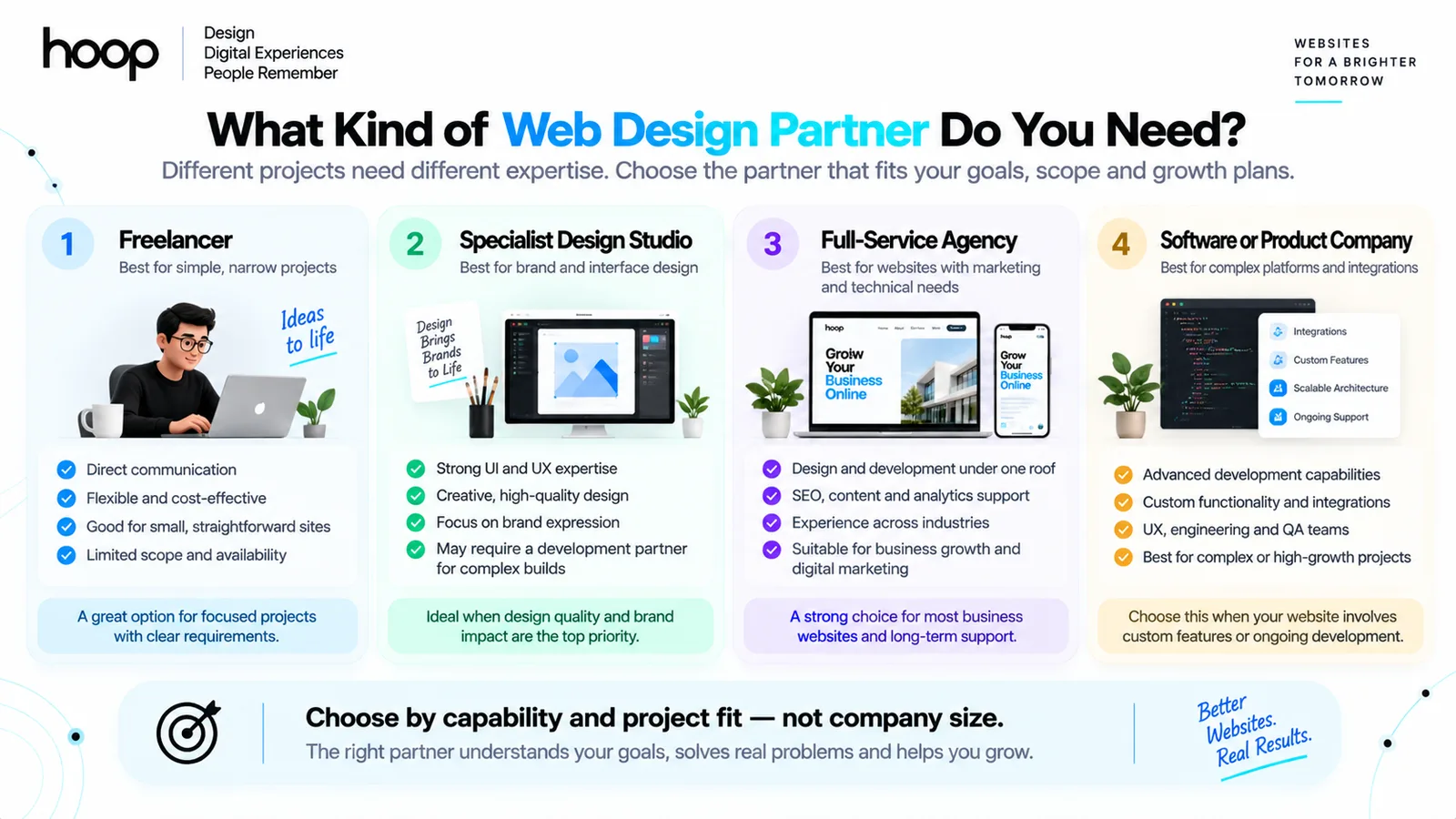
A freelance designer, specialist studio, full-service agency, and software company offer different advantages. A freelancer may suit a small project with a narrow scope. A specialist design studio may be ideal when brand expression and interface design are the main priorities. A multidisciplinary company is often a stronger fit when the website also needs development, integrations, analytics, SEO, performance optimisation, or ongoing growth support.
Do not choose by company size alone. Ask whether the available skills match the work. A small senior team can outperform a large agency on some projects, while a complex platform may require dedicated UX, development, quality assurance, security, and project-management specialists. The important issue is whether the actual delivery team can cover your requirements.
Evaluate Relevant Experience Rather Than Surface Style
A portfolio is useful, but screenshots show only part of the story. Look for projects with similar users, commercial goals, functionality, or operational complexity. The visual style does not need to resemble your preferred design; in fact, varied work may show that the company adapts to each client rather than applying the same template repeatedly.
Open the live websites where possible. Test navigation on a phone, try forms, review page speed, enlarge text, use the keyboard, and look for broken pages. Remember that a live site may have changed after handover, so ask the company which parts it designed and developed. The goal is not to assign blame for every current issue but to understand the work it actually controlled.
Ask for a case study that explains the starting problem, constraints, design decisions, delivery process, and outcome. A polished homepage proves visual ability. A clear explanation of why the work succeeded reveals strategic and technical thinking.
Look for Evidence of Business Results
The best web design company should be able to discuss outcomes that match the project. Those outcomes might include increased enquiries, a stronger checkout completion rate, fewer support requests, improved task success, faster page loading, greater accessibility, or easier content management. Not every client permits agencies to disclose revenue data, but the company should still explain what it measured and how it evaluated success.
Be cautious when every case study uses vague language such as “improved engagement” without a timeframe, baseline, method, or result. Equally, do not assume one impressive percentage guarantees your outcome. Evidence should demonstrate disciplined thinking, not promise identical performance for every business.
Assess Their Discovery and Strategy Process
A capable company should ask about your customers, positioning, competitors, content, sales process, internal workflows, technical constraints, and definition of success. If the conversation jumps directly to colours or templates, the team may be treating design as decoration rather than problem-solving.
Ask what happens before visual design begins. Strong answers may include stakeholder interviews, analytics review, user research, content inventory, sitemap planning, customer journeys, wireframes, and measurable project goals. For interaction-heavy products, dedicated UI and UX design may include prototypes and usability testing before development begins.
The company should also explain why it recommends a particular platform or architecture. “We always use this tool” is weaker than an answer tied to your editing needs, integrations, security, budget, internal skills, and plans for growth.
Meet the Actual Delivery Team
The senior person leading the sales conversation may not design or build your website. Ask who will act as project lead, who will perform the design and development, and which work will be subcontracted. Request clarity about experience levels, availability, time zones, and how directly you can communicate with the people making key decisions.
Subcontracting is not automatically a problem. Hidden subcontracting is. A transparent company remains accountable for quality, communication, security, and delivery regardless of who performs a task. The proposal should identify responsibilities clearly enough that you know who owns each decision.
Examine Communication and Project Management
Website projects involve decisions, dependencies, and feedback. Even talented designers can create a difficult engagement if communication is irregular or responsibilities are unclear. During the sales process, notice whether the company listens, answers questions directly, documents decisions, and follows through when promised.
Ask how often you will receive updates, which project tool will be used, who records approvals, and how risks or delays are raised. Confirm the feedback process and the number of revision rounds. Your organisation also needs an internal decision-maker; conflicting feedback from several stakeholders can delay even a well-managed project.
Review Technical Quality
A business website must work well after the mock-ups are approved. Ask how the team handles responsive behaviour, browser testing, accessibility, performance, forms, security, analytics, search fundamentals, backups, and quality assurance. If these topics are outside the agency’s scope, establish who will cover them.
Request specific testing information instead of accepting “fully optimised” as an answer. Which devices and browsers are tested? Are forms checked for helpful labels and error messages? Can the whole site be used by keyboard? How are large images, scripts, and fonts controlled? Will analytics events be verified? The W3C guidance on selecting web tools and services recommends stating accessibility requirements in procurement and evaluating suppliers’ knowledge and previous work.
If your project is more than an informational site, check whether the company has genuine web application development capability. Login systems, dashboards, payment flows, APIs, permissions, and complex data should not be treated like ordinary page components.
Check Their Approach to Content, SEO, and Measurement
Design and content depend on one another. Ask who writes, edits, migrates, and approves the copy. Confirm whether image selection, photography, illustrations, legal text, product data, and translations are included. A project often stalls because the proposal assumes the client will provide finished content without defining dates or responsibilities.
SEO should influence the sitemap, page purpose, internal linking, headings, metadata, redirects, indexation, and technical implementation. Be wary of guaranteed rankings or claims that a few keywords in meta tags will provide lasting visibility. Ask how existing rankings will be protected, especially during a website redesign.
Measurement must also be planned before launch. The team should know which actions matter, how consent will be handled, which analytics events are needed, and how performance will be reviewed after release.
Compare Scope and Price Carefully
The lowest quote may omit discovery, content, testing, migration, integrations, training, or post-launch support. The highest quote is not automatically the best. Compare what each proposal includes, excludes, assumes, and delivers. Ask what can change the price and how additional work is approved.
A professional proposal should define deliverables, milestones, responsibilities, revision limits, payment schedule, target dates, acceptance criteria, and ongoing costs. Platform subscriptions, plugins, hosting, stock assets, third-party services, and maintenance may continue after launch, so calculate total cost rather than the build fee alone.
| Compare | Questions to answer | Why it matters |
|---|---|---|
| Scope | Which pages, features, integrations, content tasks, and tests are included? | Prevents apparently similar quotes from hiding major differences. |
| Timeline | What dependencies, review periods, and milestones shape the launch date? | Shows whether the schedule is realistic and shared responsibilities are clear. |
| Price | What is fixed, estimated, recurring, or charged separately? | Reduces unexpected costs and supports fair comparison. |
| Quality | Which accessibility, performance, browser, security, and acceptance checks apply? | Turns broad quality promises into verifiable work. |
| Handover | Which accounts, files, documentation, and training will you receive? | Protects operational control after launch. |
| Support | What is covered after launch, for how long, and at what rate? | Clarifies how defects, updates, and future requests will be handled. |
Confirm Ownership and Access in Writing
Ownership is one of the most important checks. Your business should understand who owns or controls the domain, hosting account, website platform, source code, design files, written content, photography, analytics, search tools, advertising accounts, and third-party licences. Do not rely on a verbal promise that “everything is yours.”
Some tools and reusable code may remain the supplier’s intellectual property while your company receives a licence to use them. That arrangement can be reasonable when it is explained clearly. The contract should state what transfers to you, what is licensed, what remains proprietary, and what happens if the relationship ends.
Ask whether you will receive administrator access and whether another qualified provider could maintain or move the website. A managed service may restrict changes for legitimate security or support reasons, but those limitations and exit procedures should be transparent before purchase.
Understand Post-Launch Support
Launch is the beginning of the website’s operational life. Software updates, backups, monitoring, content changes, performance issues, broken integrations, security concerns, and new campaigns may require attention. Ask what support is included during the warranty period and what happens afterwards.
Clarify response times, support channels, maintenance fees, emergency procedures, and responsibility for third-party failures. Ask whether the company provides training and documentation so your team can handle routine updates. A partner that offers broader software development services may also help when the website grows into a more complex digital system.
Contact References and Verify Claims
Speak to at least two relevant clients if the investment is significant. Instead of asking only whether they were satisfied, ask how the company handled delays, scope changes, feedback, budget pressure, and post-launch issues. Find out whether the client worked with the people you are about to hire.
Reviews can help identify patterns, but they need context. A handful of perfect ratings does not replace direct evidence. Compare testimonials with live work, company explanations, references, and the detail contained in the proposal.
Red Flags When Choosing a Web Design Company
- The company recommends a solution before asking about users, goals, or constraints.
- Its portfolio contains only screenshots, with no clear role or project explanation.
- It guarantees rankings, conversions, or business results it cannot control.
- The proposal uses broad promises but leaves deliverables, testing, and responsibilities undefined.
- Pricing is unusually low because important work is postponed or excluded.
- You cannot meet the delivery team or learn which work will be subcontracted.
- Communication is slow, evasive, or inconsistent before the contract is signed.
- Ownership, administrator access, licensing, and exit terms remain unclear.
- The company dismisses accessibility, performance, security, or mobile testing.
- There is no defined plan for launch, handover, training, maintenance, or support.
Questions to Ask Before You Sign
| Question | What a strong answer should reveal |
|---|---|
| How will you learn about our users and goals? | A defined discovery process linked to design decisions and success measures. |
| Which projects are most relevant to ours? | Comparable challenges, an honest description of the team’s role, and useful outcomes. |
| Who will work on the project? | Named responsibilities, appropriate experience, availability, and transparent subcontracting. |
| How will quality be tested? | Specific responsive, accessibility, performance, browser, form, security, and QA checks. |
| What does the price exclude? | Clear assumptions, recurring charges, change control, and third-party costs. |
| What will we own and control? | Written terms for the domain, hosting, accounts, code, content, files, licences, and credentials. |
| What happens after launch? | Warranty terms, training, documentation, maintenance options, support rates, and response times. |
| How will success be measured? | Relevant metrics, an analytics plan, review points, and a process for improvement. |
How to Compare Your Final Shortlist
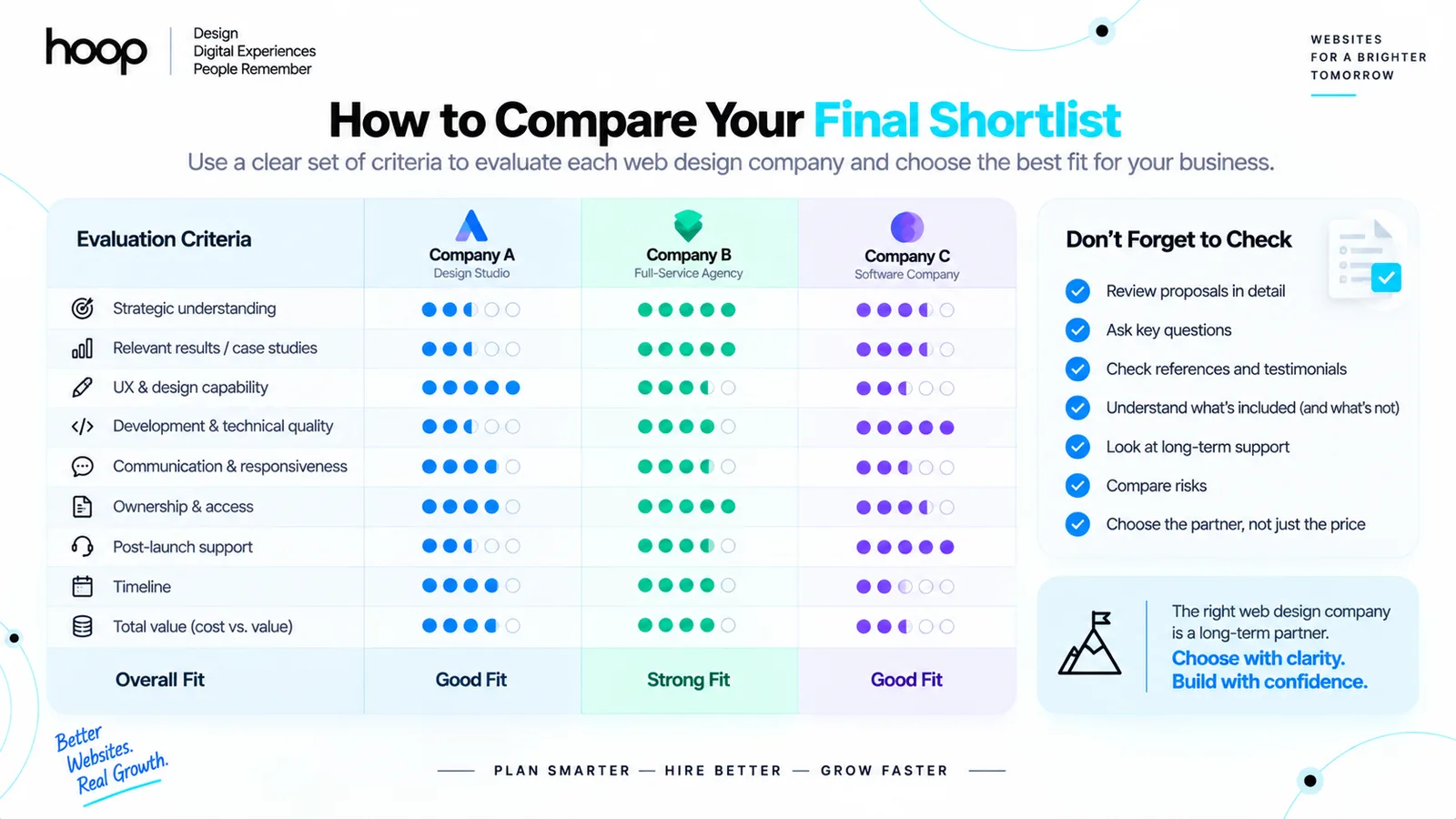
Create a shortlist of two or three companies and score them against criteria that reflect your project. Weight strategic understanding, relevant evidence, delivery capability, communication, technical quality, ownership, support, timeline, and total cost. Do not let one attractive presentation outweigh several weak contract terms.
After scoring, revisit the risks. Which proposal contains the most assumptions? Which company depends on one unavailable specialist? Which option leaves important content or integration work unowned? Which partner explained trade-offs honestly? The safest choice is often the team that makes complexity visible and manageable, not the team that makes the easiest promises.
Choose a Partner, Not Just a Portfolio
Learning how to choose a web design company means evaluating what happens behind the finished screens. The right company will investigate your goals, challenge weak assumptions, explain its decisions, protect your control, and build a website that can be measured and improved.
Hoop Interactive combines research-led design, UX, development, performance, and digital growth expertise within one team. If you need a website built around clear business outcomes rather than surface appearance alone, explore our complete digital services and start a conversation about your project.
“The safest choice is often the team that makes complexity visible and manageable, not the team that makes the easiest promises.”
Key takeaways
- 01Define what the website must accomplish before you brief anyone.
- 02Capability and project fit matter more than company size or location.
- 03Get ownership of the domain, hosting, code, content, and accounts in writing.
- 04The cheapest quote is often the one that postponed testing, content, or support.
Written by
Sahar
Content Writer
Frequently Asked
Questions
Everything you need to know before booking a strategy call. Can't find your answer? Contact us directly.
Look for relevant experience, a user-focused process, measurable evidence, clear communication, technical capability, transparent pricing, written ownership terms, and reliable post-launch support.
A shortlist of two or three well-matched companies is usually enough for a meaningful comparison. Too many proposals can consume time without improving the decision, especially when the brief is not consistent.
Local access can help when in-person workshops or regional knowledge matters, but capability, communication, process, and fit are more important than distance. Remote teams can work effectively when responsibilities and communication routines are clear.
Verify its business details, speak with relevant clients, inspect live work, meet the delivery team, review a detailed proposal, and confirm ownership and payment terms in a written contract. No single review or portfolio item is sufficient proof.
Choose the proposal that offers the best fit and value for the required outcome. A cheap quote can become expensive when strategy, content, testing, migration, or support is missing. Compare the full scope and ongoing cost.
Your contract should state which website assets and rights transfer to your business and which third-party or reusable components are licensed. Your business should also understand and control essential accounts, credentials, and exit procedures.