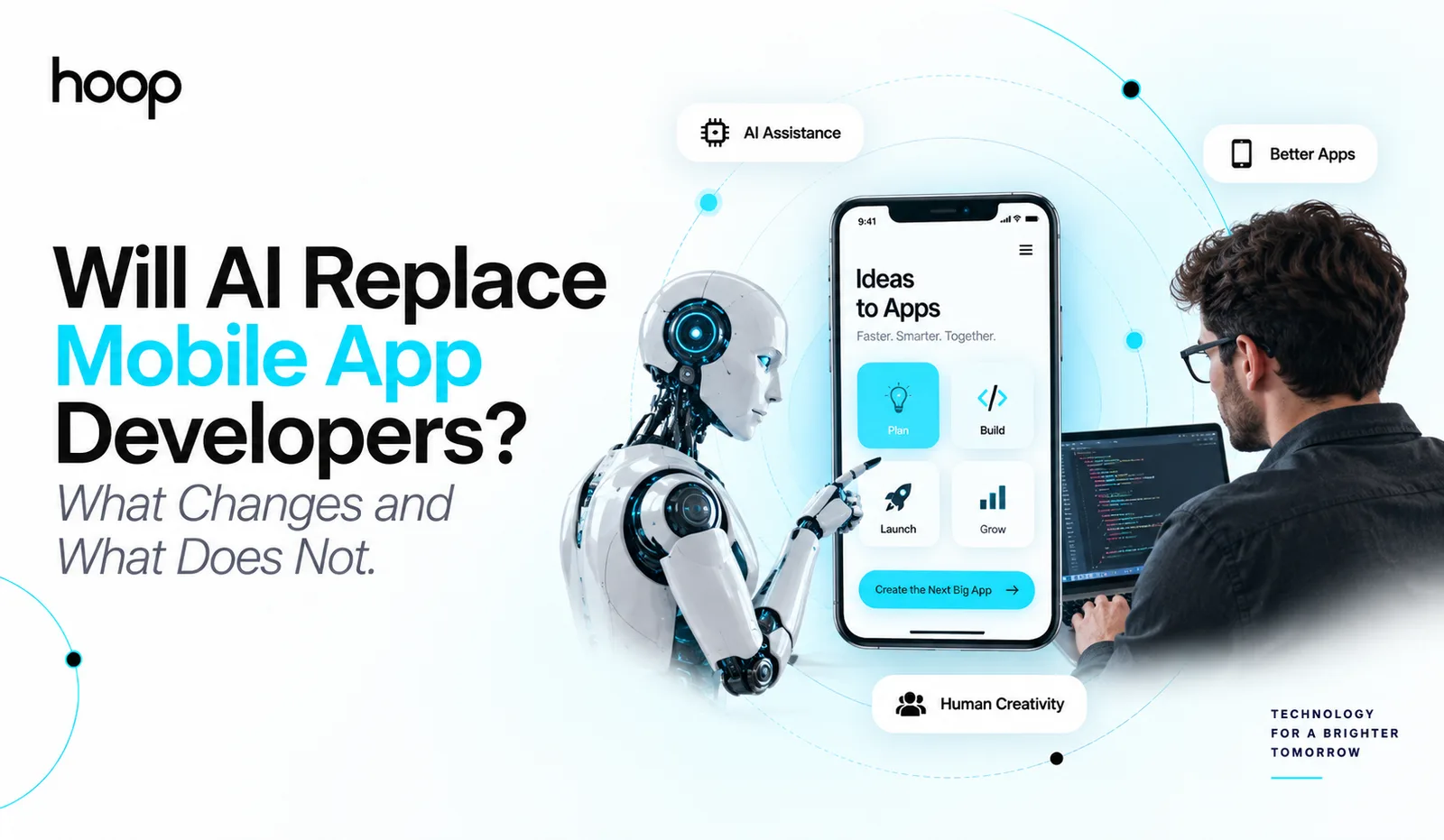
Will AI Replace Mobile App Developers? What Changes and What Does Not
AI can automate more mobile coding, testing, debugging, and documentation. Production apps still need human architecture, security, platform knowledge, releases, and maintenance. Developers who combine mobile engineering with AI-assisted workflows hold the strongest position.
Sahar
Content Writer
No, AI will not replace mobile app developers as a complete profession. AI will replace more coding tasks and change how developers build apps.
People asking will AI replace mobile app developers should separate code generation from mobile engineering. Coding agents now produce screens, functions, tests, and documentation quickly.
The better question is whether AI will replace mobile app developers who only perform repeatable implementation. Those roles face stronger pressure.
Need this done right?
Hoop builds the strategy, design and development behind sites like this one — talk to us about yours.
Will AI Replace Mobile App Developers or Automate Their Tasks?
AI will automate more tasks before AI replaces complete mobile engineering roles. The answer depends on which responsibilities a developer owns.
Repeatable implementation faces the most pressure
AI handles patterned work fastest. Coding agents can scaffold forms, navigation, data models, networking clients, localization files, and standard state logic.
Developers still decide whether generated components fit the product architecture. Generated code can compile while creating weak boundaries or maintenance debt.
AI-assisted testing moves faster
AI can draft unit tests, explain stack traces, suggest fixes, and identify common build errors.
Android Studio can also help troubleshoot Compose interfaces, Gradle failures, crashes, and Logcat output.
A developer still decides whether a failure comes from code, requirements, backend behavior, or a device condition.
Production responsibility does not disappear
Mobile engineering includes architecture, security, device behavior, backend integration, release management, monitoring, and maintenance.
AI can propose changes across those areas. Human engineers still approve production decisions and own the outcome.
That distinction makes will AI replace mobile app developers more complex than a code-generation benchmark.
What Mobile Development Work Can AI Already Automate?
AI already speeds up well-scoped mobile work. Replacement becomes less likely when projects require context beyond familiar code patterns.
AI can generate user interface code
Coding agents can create SwiftUI views, Jetpack Compose screens, React Native components, and Flutter widgets.
Engineers still verify accessibility, empty states, errors, localization, platform conventions, and user flows.
AI can scaffold APIs and data layers
AI can generate REST clients, GraphQL queries, request models, response models, serialization logic, and caching drafts.
Engineers still control token storage, refresh logic, retries, offline behavior, data consistency, and backend contracts.
What Mobile App Development Still Requires Human Engineers?
Production mobile apps still require human judgment across architecture, security, device behavior, and release quality. Replacement remains unlikely across those responsibilities.
Architecture requires product context
A mobile architecture connects user flows, state management, backend services, local storage, background work, and failure handling.
Engineers choose boundaries based on product scale, data rules, security needs, and team structure.
A banking app, fitness tracker, marketplace, and field-service app need different system decisions.
Device behavior creates real engineering work
Mobile apps run across operating systems, hardware states, network conditions, permissions, and battery constraints.
Engineers test cameras, GPS, Bluetooth, biometrics, notifications, background sync, deep links, and offline storage.
Security needs accountable review
Mobile apps can store tokens, personal data, payment details, health information, and business records.
Engineers protect secrets, validate input, encrypt sensitive data, and control API access.
AI-generated code can expose keys, store data weakly, log secrets, or skip authorization checks.
Store releases require platform ownership
Shipping code requires signing, certificates, store metadata, privacy declarations, testing tracks, and rollback plans.
Will AI Replace Mobile App Developers on iOS?
No, Apple platform expertise still matters. The answer on iOS depends on whether AI can own platform decisions, not Swift syntax.
Swift and SwiftUI knowledge still matters
iOS developers use Swift, SwiftUI, UIKit, concurrency, networking, persistence, testing, and Apple frameworks.
AI can write syntax, but engineers still decide how those APIs fit together.
Products needing deep Apple integration still benefit from native iOS app development.
Xcode now includes coding agents
Apple has integrated coding intelligence directly into Xcode.
Developers can use agents to explore code, add features, refine interfaces, and modify project files.
Apple still presents changes for developer review. See Apple coding intelligence documentation for the current workflow.
Apple release knowledge remains valuable
iOS engineers manage entitlements, code signing, TestFlight, privacy manifests, background modes, push notifications, and StoreKit.
Those tasks connect code with Apple infrastructure and production policy.
Will AI replace mobile app developers who own these release decisions remains doubtful without reliable human review.
Will AI Replace Mobile App Developers on Android?
No, Android engineering extends far beyond generated Kotlin code. The answer on Android depends on lifecycle, devices, builds, and release ownership.
Kotlin and Jetpack Compose remain core skills
Android developers use Kotlin, Jetpack Compose, coroutines, Gradle, Android SDK APIs, storage, networking, and test frameworks.
AI can draft each layer, but engineers still control lifecycle and state behavior.
Strong developers understand process death, rotation, background restrictions, and unreliable connections.
Device fragmentation increases validation work
Android runs across many manufacturers, hardware profiles, screen sizes, and operating-system versions.
Engineers test permissions, notifications, battery restrictions, deep links, background tasks, and hardware integrations.
Android Studio adds AI without removing engineers
Gemini in Android Studio can generate code, answer questions, diagnose Gradle errors, and analyze crashes.
The developer still owns architecture, build configuration, signing, Play Console releases, monitoring, and compatibility.
That division of work explains why the replacement framing remains the wrong one for Android.
Will AI Replace React Native and Flutter Developers?
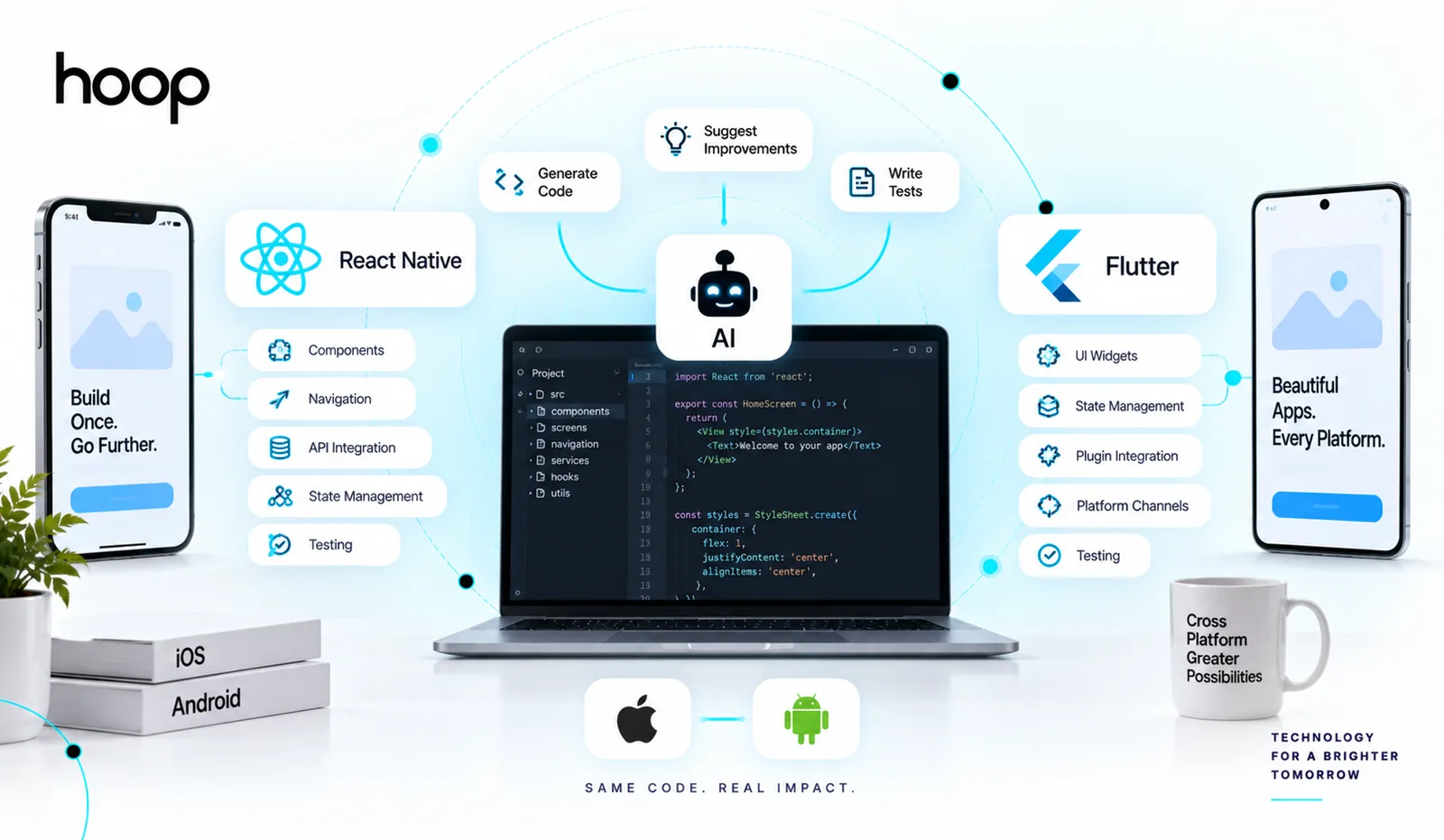
AI will make cross-platform development faster, but shared code does not remove platform engineering. The same limits apply to cross-platform frameworks.
React Native coding becomes faster
AI can generate TypeScript components, hooks, navigation flows, API clients, tests, and state logic quickly.
Modern React Native also depends on Fabric, TurboModules, native modules, Xcode, and Gradle.
Teams using React Native development services still need engineers who can diagnose native failures.
Flutter generation still needs platform channels
AI can generate Dart widgets, Riverpod or Bloc state logic, networking layers, tests, and package integrations.
Complex apps still need platform channels for unsupported native features.
Teams using Flutter app development services still need developers who understand both stores and platforms.
One codebase still needs 2 platform perspectives
Cross-platform frameworks reduce duplicated implementation, not platform responsibility.
Engineers still test Apple and Android conventions, hardware APIs, push notifications, payments, accessibility, and release behavior.
Any answer here cannot ignore the native systems underneath shared code.
Are Junior Mobile Developers at Greater Risk From AI?
Junior roles face more pressure because AI automates many tasks that once trained entry-level developers. This level requires a more careful answer.
Entry-level ticket work shrinks first
Junior developers often start with small screens, bug fixes, test writing, documentation, and basic API integrations.
AI now handles many first drafts for those tasks.
A junior developer who only converts tickets into code faces stronger competition from AI-assisted engineers.
Fundamentals create a stronger career path
You should learn state management, networking, concurrency, databases, debugging, testing, version control, and software design.
Framework syntax alone provides less protection.
Strong fundamentals help you evaluate generated code instead of accepting output that only looks correct.
Code review becomes a core junior skill
Junior developers should practice reading unfamiliar code, tracing data flow, reproducing bugs, and writing tests.
Junior developers should also explain architectural tradeoffs clearly.
A developer who can verify generated work offers more value than a developer who only requests another draft.
Will AI Make Mobile Development Teams Smaller?
AI can reduce implementation hours for the same roadmap. This is partly a headcount question, not only a profession question.
One engineer can produce more code
AI coding assistants reduce time spent on boilerplate, test drafts, documentation, migrations, and repetitive refactors.
Experienced engineers can therefore cover more product surface.
Higher output does not always mean lower headcount because cheaper development can increase product demand.
Senior ownership becomes more concentrated
Smaller teams place more architecture, security, release, and mentoring responsibility on experienced engineers.
Companies cannot remove technical ownership without increasing production risk.
Will AI replace mobile app developers who own those decisions remains less likely than role compression.
Specialists remain useful on difficult products
Complex products still need specialists for performance, accessibility, payments, security, backend systems, and hardware integration.
AI can reduce manual work inside each specialty.
AI does not remove the domain knowledge required to approve production decisions.
Can AI Build a Complete Production Mobile App Alone?
AI can build impressive prototypes, but AI cannot reliably own a complete production app without human engineering. The answer depends on the definition of complete.
A prototype is easier than a production system
AI can generate onboarding, authentication screens, dashboards, forms, lists, and simple API calls quickly.
A production app also needs error recovery, observability, security, performance budgets, migrations, analytics, and support tooling.
Connected apps need backend engineering
Most serious mobile apps depend on APIs, databases, authentication, storage, push services, payments, search, or messaging.
Engineers design those systems together with the mobile client.
Hoop’s mobile app development services include backend APIs, device testing, store submission, and post-launch support.
Long-term maintenance exposes hidden weaknesses
Production apps must survive dependency updates, operating-system changes, database migrations, API changes, and security patches.
A human team still decides what changed, what broke, and which release path protects existing users.
How AI Changes the Mobile Development Workflow
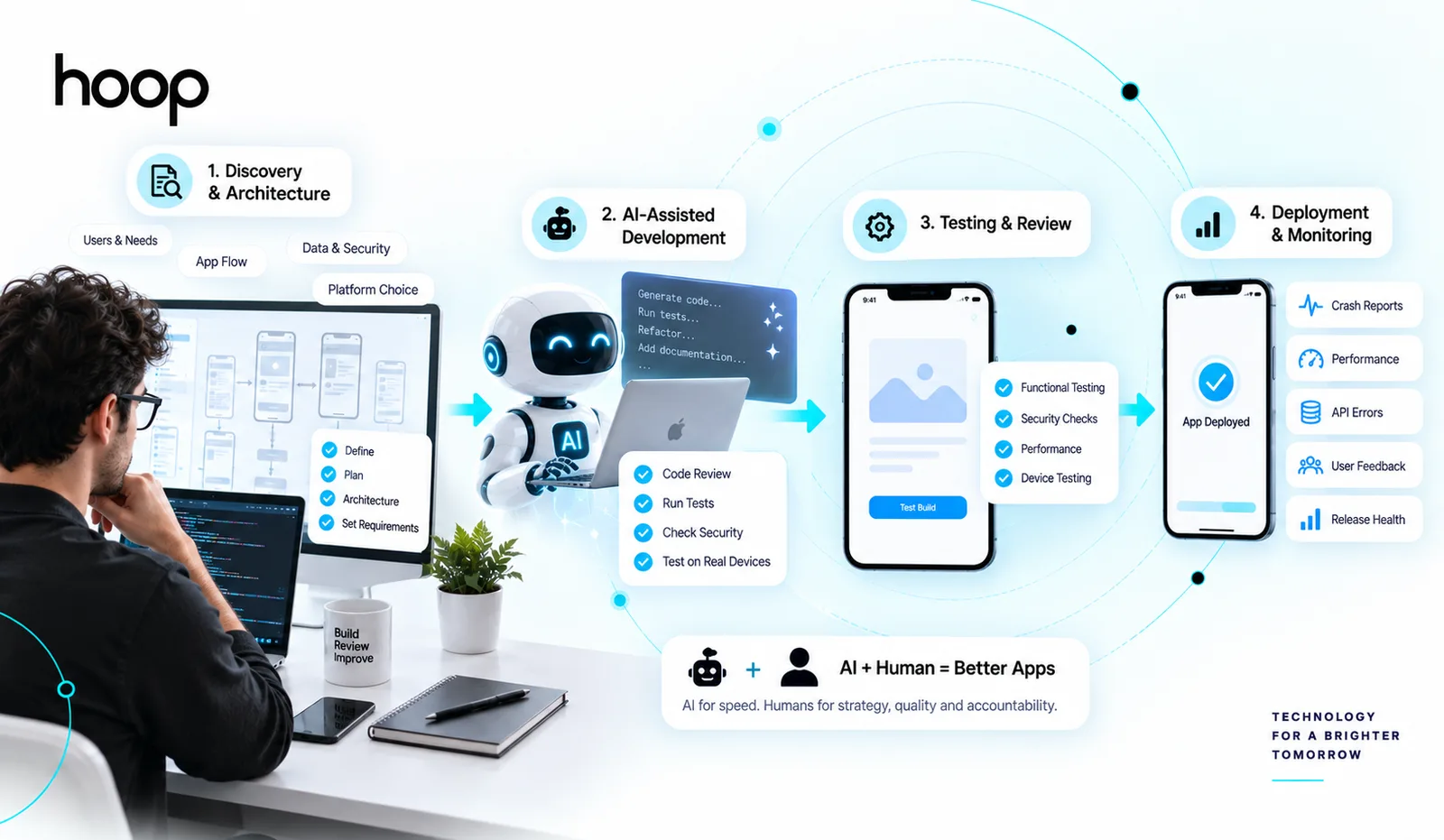
AI shifts mobile development toward faster iteration with stronger review. The replacement question matters less when teams redesign the workflow around human verification.
Discovery and architecture come before prompting
Teams should define users, core flows, data ownership, backend boundaries, privacy requirements, and platform choices first.
Weak architecture produces inconsistent output across screens, services, and releases.
AI-assisted coding needs review gates
Developers can assign agents feature work, tests, refactors, and documentation.
Engineers should then review diffs, run tests, inspect security-sensitive changes, and test real devices.
A disciplined flow protects quality while preserving AI speed.
Monitoring closes the production loop
Teams should track crashes, startup time, network failures, API errors, and release regressions after launch.
Crashlytics, Sentry, App Store Connect, and Play Console reveal production behavior.
Quick Reference: AI and Human Roles Across Mobile Development
The strongest workflow gives AI repeatable work and gives humans architecture, verification, and accountability. The question matters less once responsibilities are mapped clearly.
| Task | AI contribution | Human method | Timing | Difficulty |
|---|---|---|---|---|
| Architecture | Draft options and diagrams | Define boundaries and risks | Before coding | High |
| UI scaffolding | Generate SwiftUI, Compose, React Native, or Flutter drafts | Review states and platform behavior | Each feature | Medium |
| API integration | Draft clients, models, and error wrappers | Verify auth, retries, and caching | Development | Medium |
| Testing | Draft tests and explain failures | Reproduce defects and validate causes | Each sprint | High |
| Security | Flag patterns and suggest controls | Approve storage, authorization, and secrets | Before release | High |
What Skills Keep Mobile Developers Valuable?
Mobile developers stay valuable by owning systems, not just syntax. The question becomes less threatening when your skills cover production responsibility.
Learn system architecture and backend integration
You should understand APIs, authentication, databases, caching, queues, file storage, observability, and cloud services.
Mobile clients depend on those systems for most connected features.
Architecture knowledge helps you catch generated code that creates unstable dependencies.
Learn AI-assisted engineering
You should practice writing precise implementation prompts, reviewing diffs, constraining agents, and testing generated code.
Teams building AI features can use AI development services for models, agents, APIs, evaluation, and monitoring.
Learn security, testing, and release engineering
You should know secure storage, authentication, authorization, secrets handling, testing, CI/CD, signing, and store release procedures.
Those skills protect the product after AI produces code quickly.
Production confidence becomes more valuable as generation speed rises.
Should Students Still Learn Mobile App Development?
Yes. Students should still learn mobile app development with engineering fundamentals. The AI question should not push students toward shallow tool switching.
Choose one stack and learn it deeply
You can start with Swift and SwiftUI, Kotlin and Compose, React Native and TypeScript, or Flutter and Dart.
Depth teaches lifecycle, state, networking, storage, testing, and release work.
Use AI as a tutor and reviewer
Ask AI to explain code, generate test cases, compare architectures, and review your implementation.
Do not submit a portfolio app that you cannot explain under technical questioning.
The Future Belongs to AI-Assisted Mobile Engineers
AI will replace parts of mobile app development before AI replaces mobile app developers.
Coding agents already generate interfaces, tests, refactors, and integration code faster than manual workflows.
Human engineers still own architecture, security, iOS and Android behavior, backend integration, device quality, store release, and maintenance.
Will AI replace mobile app developers who only perform routine implementation? Some roles will shrink or change.
Will AI replace mobile app developers who own systems and production outcomes? The evidence points toward augmentation instead.
The strongest path is to direct AI, review AI output, and ship reliable mobile software.
“A developer who can verify generated work offers more value than a developer who only requests another draft.”
Key takeaways
- 01Repeatable implementation faces the most pressure; system ownership faces the least.
- 02Generated code can compile and still create weak boundaries or maintenance debt.
- 03Junior roles change most — code review and fundamentals become the entry-level skill.
- 04Cross-platform frameworks reduce duplicated implementation, not platform responsibility.
Written by
Sahar
Content Writer
Frequently Asked
Questions
Everything you need to know before booking a strategy call. Can't find your answer? Contact us directly.
Yes, AI can generate a simple iPhone prototype without a professional developer. A production iPhone app still needs platform review, security, testing, signing, store release work, and maintenance.
No, AI will automate parts of Android development rather than remove Android engineering. Kotlin, Compose, Gradle, device compatibility, testing, and Play Store delivery still require technical ownership.
Yes. Learn one mobile stack deeply and add AI-assisted development skills. Framework knowledge gives you the context required to judge generated code and solve production problems.
No, mobile developer jobs are changing rather than disappearing completely. Routine implementation faces pressure, while architecture, security, product engineering, AI integration, and production ownership gain importance.
Architecture, security, debugging, product judgment, platform expertise, and production accountability remain hardest to automate. Those skills depend on context, tradeoffs, and responsibility across the system.
Keep reading
All articles →
What Do Mobile App Developers Do? Roles and Process
Sep 20, 2026 · 10 min read
How to Become a Software Developer: A Practical Career Roadmap
Sep 19, 2026 · 10 min read