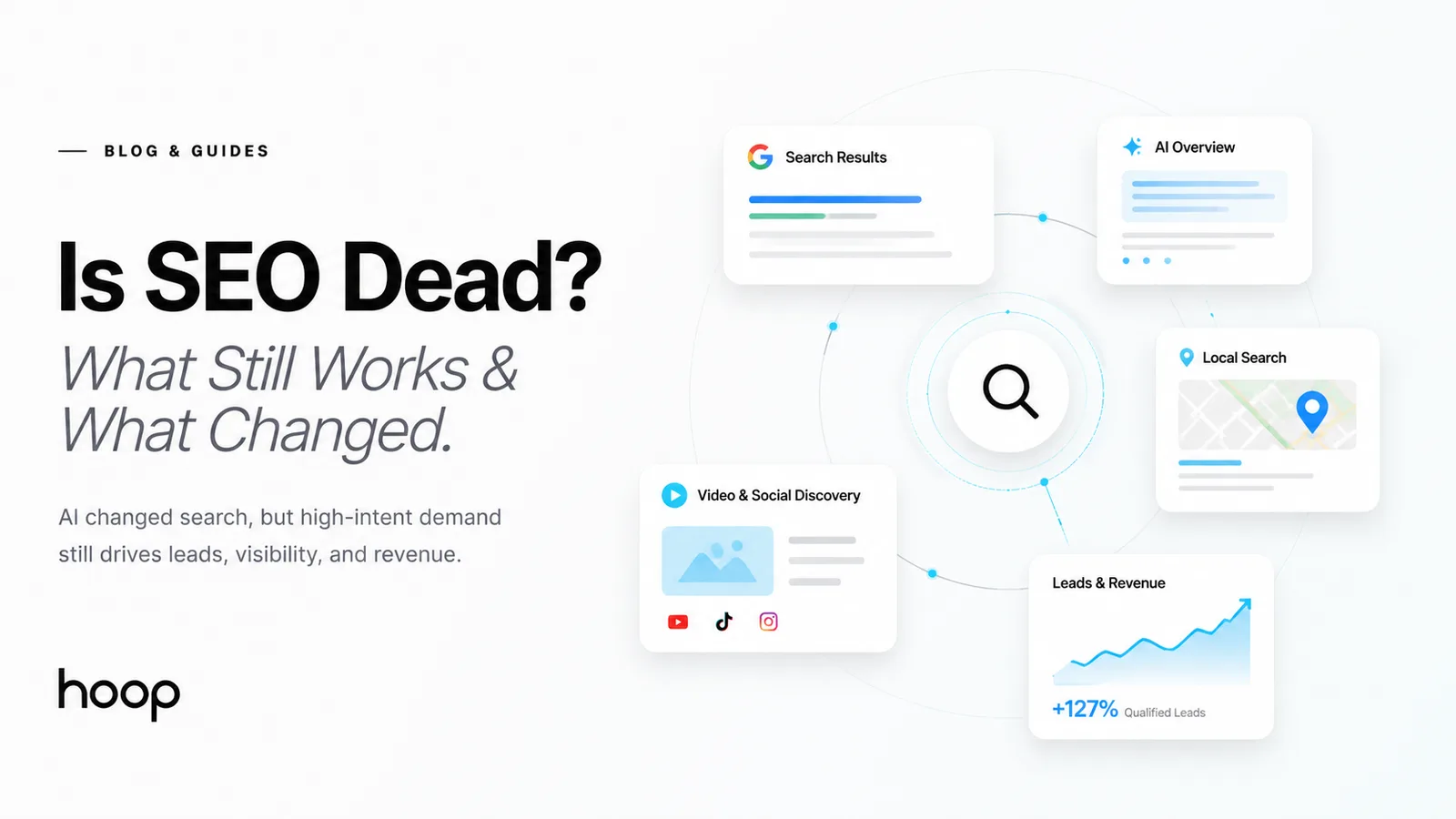
Is SEO Dead? What Still Works and What Changed
SEO is not dead — traffic-first tactics are. Informational clicks fell, AI answers took result-page space, and discovery spread across more platforms, but high-intent demand still converts. Judge organic performance on pipeline and revenue rather than sessions.
Sahar
Content Writer
The question “is SEO dead” reflects a real shift in how people discover information, compare options, and choose businesses.
Search now includes classic results, AI summaries, maps, videos, marketplaces, and conversational tools. You still need discoverable, credible pages that answer demand and convert qualified visitors.
SEO still works when you connect visibility with intent and business outcomes. Old traffic-first tactics deserve less budget.
Is SEO Dead in 2026?
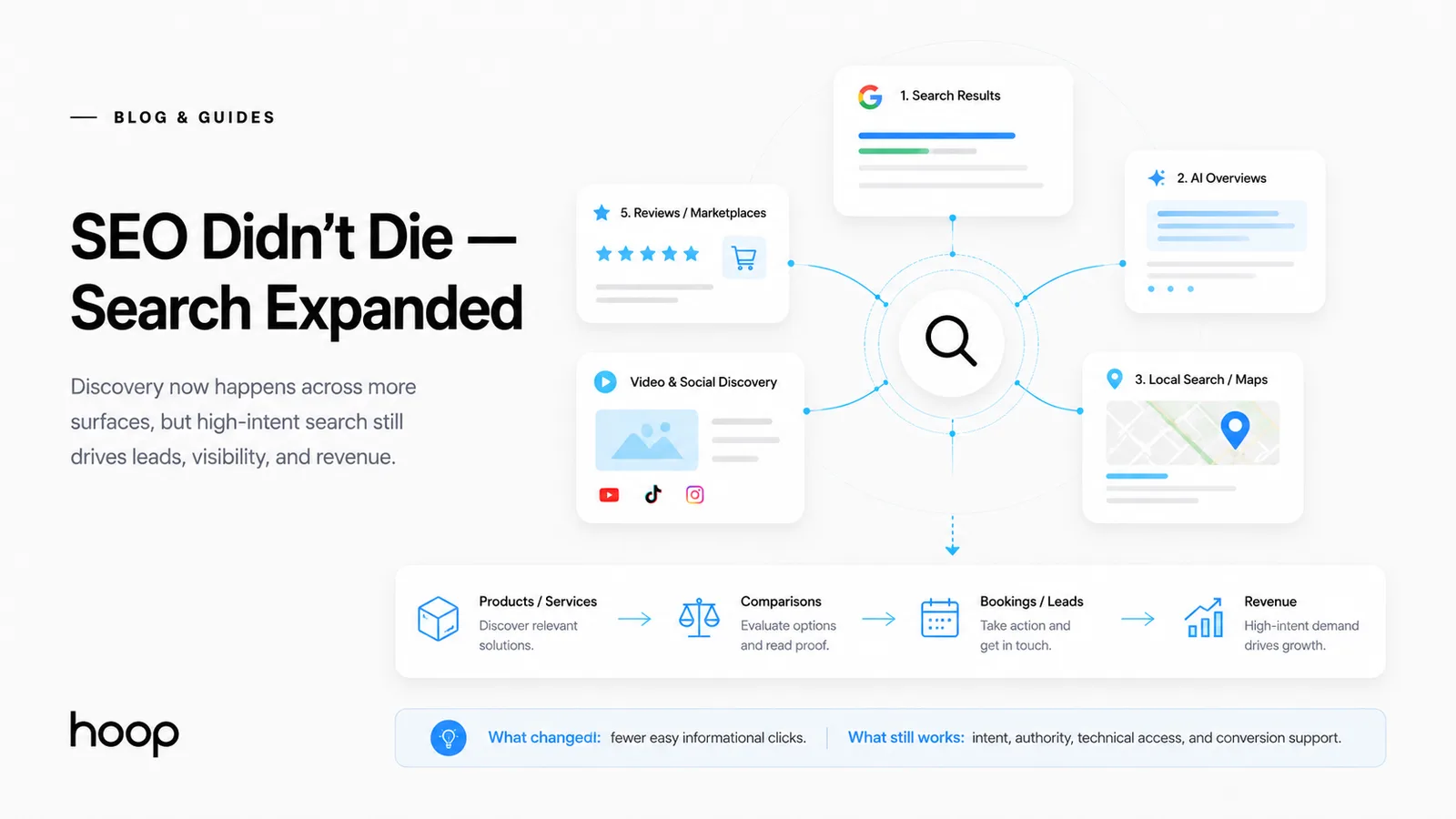
No. SEO still helps businesses earn discovery, qualified traffic, leads, and revenue from active searchers.
The debate usually mixes 3 different changes. Informational clicks declined for many queries, AI answers occupy more search space, and discovery now happens across more platforms.
Those changes affect tactics, not search demand. People still look for products, services, comparisons, local providers, pricing, and reviews.
A buyer searching “best payroll software for 50 employees” still needs evidence before purchasing. A homeowner searching “emergency plumber near me” still needs a provider.
SEO still serves high-intent demand
High-intent searches connect a clear need with a next action. Examples include “dentist open Saturday” and “best CRM for startups.”
Those searches can produce fewer visits than broad informational topics. However, qualified visits can carry greater commercial value.
Judge organic performance by pipeline quality, revenue, bookings, and customer acquisition cost. Traffic volume cannot show business value alone.
AI search changed the result page
AI summaries can answer simple questions before a website visit. Google also combines links, videos, local results, products, and forums.
Google states that its generative search features still rely on core Search ranking and quality systems, and that foundational SEO practices remain relevant. You can review Google’s generative AI guidance for the current official position.
Search discovery now happens across more surfaces
Customers can discover businesses through Google, YouTube, TikTok, marketplaces, AI assistants, review platforms, and social communities.
The question therefore needs a broader answer. Search optimization now supports discovery across more surfaces.
Why Do People Ask “Is SEO Dead?”
People ask because clicks, result layouts, and content economics changed faster than many reporting systems changed.
Businesses can see stable rankings with weaker click-through rates when answer features satisfy basic questions directly.
Zero-click results reduce some informational visits
Zero-click behavior matters most for short factual answers. Definitions, dates, and basic instructions can finish inside a result page.
A page built only to answer one commodity question carries more risk in 2026. You need deeper usefulness, original evidence, or a stronger commercial role.
Generic content faces more competition
AI tools can produce surface-level summaries quickly. Search engines also have large indexes filled with near-identical explanations.
Create material that adds evidence or experience. Examples include original data, expert analysis, case studies, calculators, and comparison criteria. Hoop’s expert content marketing approach can support that shift through research-led pages and commercial topic coverage.
Rankings no longer tell the whole story
A number 1 ranking can produce fewer clicks when search features answer part of the query first. A lower-traffic page can also produce stronger conversion rates.
The debate becomes misleading when teams compare only sessions year over year. You need a wider measurement model.
Track organic conversions, qualified leads, assisted revenue, branded demand, non-branded visibility, and conversion rate alongside traffic.
What SEO Tactics Still Work in 2026?
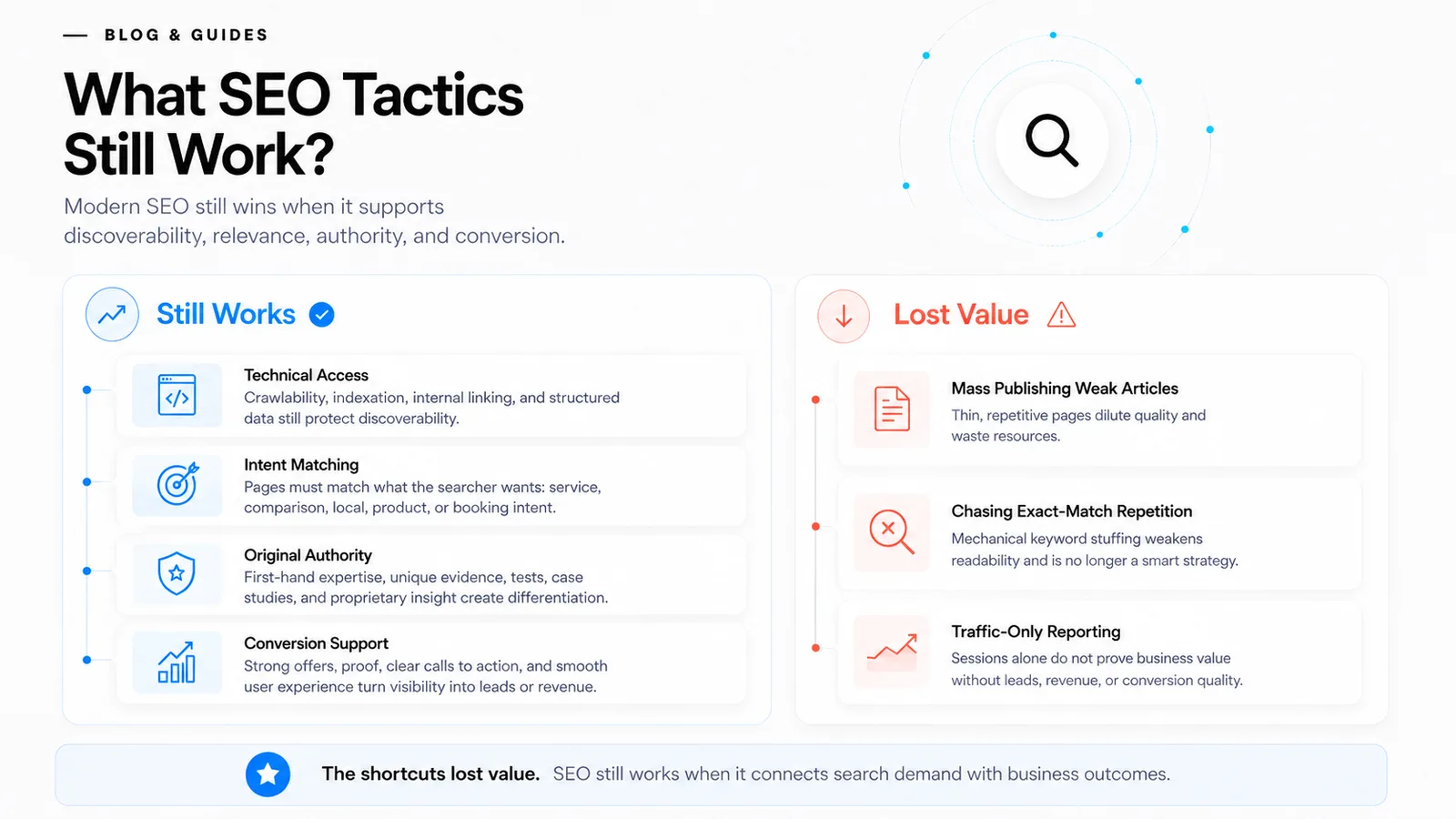
Strong SEO still solves 4 jobs: technical access, intent matching, authority building, and conversion support.
Technical SEO still protects discoverability
Technical work helps search systems crawl, process, and index your pages. Core tasks include crawl controls, canonicalization, internal linking, structured data, and mobile usability.
Technical SEO cannot create demand. Technical SEO can prevent strong content from disappearing behind indexing or architecture problems. A modern full-funnel digital marketing plan should connect technical search work with content, conversion, and demand generation.
Search intent still decides relevance
You need a page format that matches what the searcher wants. A service query needs a service page, while a comparison query needs evaluation criteria.
Intent mismatches waste strong copy. A detailed guide will struggle when searchers want prices, locations, products, or immediate booking options.
Original authority still creates differentiation
Original authority means publishing information competitors cannot easily reproduce. Examples include proprietary data, expert observations, tests, and first-hand experience.
The question often appears after low-value content stops performing. Strong original material gives search systems and readers a reason to prefer your source.
What SEO Tactics Lost Value?
Some tactics lost value as search systems improved their understanding of quality, manipulation, and user intent.
The narrative often describes declining shortcuts, not disappearing organic search.
Mass publishing weak articles
Publishing hundreds of thin pages does not create authority by volume alone. Weak pages can dilute editorial quality and waste crawl attention.
You should publish fewer pages when each page lacks a clear audience need. Add original value before adding another keyword variation.
Chasing exact-match repetition
Mechanical keyword repetition creates awkward copy and weakens readability. Search systems understand related language, entities, and context far better than older systems.
Use the primary phrase where relevance requires the phrase. Use natural supporting terms everywhere else.
Measuring success only through traffic
Traffic provides context, not a final verdict. A page with 5,000 visits and 2 leads can underperform 500 visits with 20 leads.
The debate becomes more useful when you compare revenue efficiency. Qualified outcomes show whether organic visibility still deserves investment.
Is Informational SEO Dead?
No. Informational SEO still works, but generic information needs a stronger business purpose.
Basic answers need more depth
A basic definition often competes directly with AI summaries and featured answers. You need a reason for the reader to continue.
Useful additions include decision tables, templates, diagnostic steps, calculators, screenshots, or expert commentary.
Commercial research remains valuable
Comparison and evaluation content supports buyers who need choices, tradeoffs, prices, features, or implementation details.
Examples include “HubSpot vs Salesforce” and “SEO agency pricing.” These searches sit closer to a decision.
Content should build a journey
A useful article should route readers toward the next relevant action. Internal links can move readers from education into services, case studies, tools, or consultations.
You can connect organic education with qualified lead generation when content captures clear purchase intent and routes prospects correctly.
Does SEO Still Generate Leads and Revenue?
Yes. SEO generates business value when target customers search before buying and your pages support conversion.
The question matters less than your own search economics. You need to know whether organic discovery produces profitable customers for your business.
High-intent pages can outperform high-traffic pages
A commercial service page can receive fewer sessions than a broad guide. The service page can still create more revenue.
Evaluate pages by qualified conversions, not audience size alone. Revenue per organic visit gives stronger context than raw sessions.
Conversion quality changes the SEO equation
Organic traffic needs a clear action path. Slow pages, vague offers, weak proof, and complicated forms can waste visibility.
A focused conversion rate optimization program can improve the value of existing organic traffic without requiring more rankings.
Attribution needs more than last click
Buyers often research across several sessions before converting. A user can discover your guide, return through branded search, then submit a form later.
Track assisted conversions and branded demand where your analytics setup supports those measurements. Last-click reporting can understate organic influence.
How Should You Measure SEO in 2026?
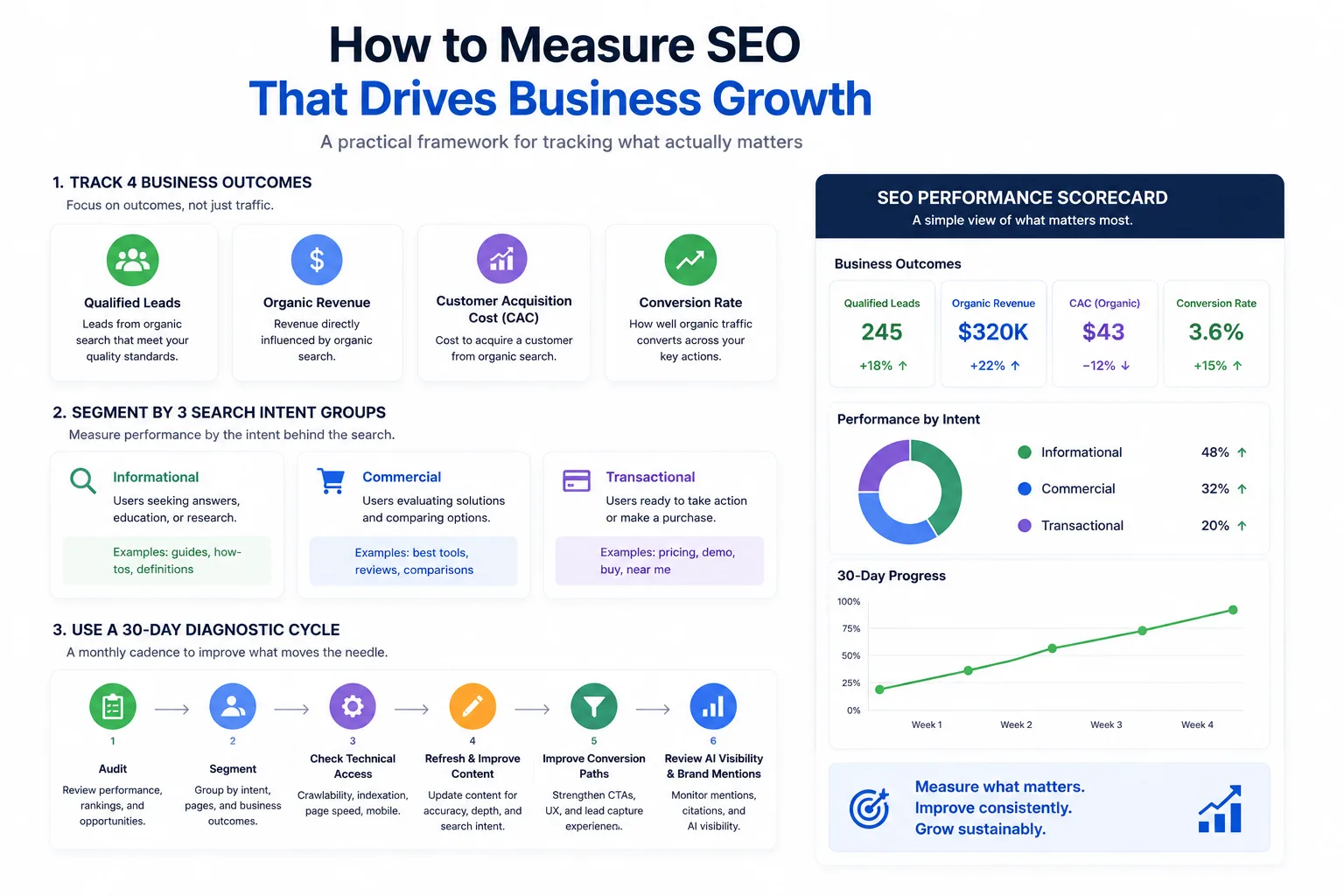
To measure SEO in 2026, track business outcomes first. Then diagnose visibility, traffic, and content signals behind those outcomes.
Track 4 business outcomes
Track qualified leads, organic revenue, customer acquisition cost, and conversion rate. Ecommerce teams can also track repeat purchase revenue from organic customers.
Service businesses can track booked calls, qualified opportunities, and closed revenue. Local businesses can add directions and appointments.
Segment 3 search intent groups
Separate informational, commercial, and transactional queries. Local businesses can add a geographic segment when location changes the buying decision.
Informational pages can build awareness. Transactional pages should produce clearer conversion signals.
Use a 30-day diagnostic cycle
Review Search Console, analytics, ranking visibility, conversions, and landing-page performance every 30 days. Compare changes by page type and intent.
Do not react to one isolated traffic drop. Diagnose demand shifts, result changes, technical problems, seasonality, and conversion behavior.
| Task | Timing | Method | Difficulty |
|---|---|---|---|
| Audit organic conversions | Day 1 | Analytics and CRM review | Medium |
| Segment query intent | Days 2–4 | Search Console and keyword mapping | Medium |
| Check technical access | Days 5–7 | Crawl, index, and template review | Medium |
| Refresh priority pages | Days 8–18 | Update evidence, intent, and structure | Medium |
| Improve conversion paths | Days 19–24 | Forms, proof, calls to action | Medium |
| Review AI visibility | Days 25–30 | Search features and referral review | Advanced |
How Does AI Search Change SEO?
AI search changes where answers appear, while web content still supplies facts, products, services, and source material.
The debate often assumes AI systems operate without the open web. Search-based AI features still retrieve and reference indexed web content.
Foundational SEO still supports AI discovery
Google’s current guidance says existing SEO practices remain relevant for generative search features. Google does not require a separate special markup system for inclusion.
You still need crawlable pages, clear information, useful content, and strong user experience. Those foundations support traditional results and newer search experiences.
AI visibility rewards clear source value
AI systems need reliable information that answers a user’s question. Unique facts, original research, concrete examples, and precise explanations improve source usefulness.
Do not rewrite every page for machines. Write for readers, then make the page easy to access, understand, verify, and navigate.
New metrics need context
Track AI referrals where available, but do not replace revenue metrics with citation counts. Business outcomes still decide investment value.
Is Local SEO Dead?
No. Local SEO remains useful because nearby customers still need providers, reviews, directions, and booking options.
The argument fits local search poorly because local intent often requires action beyond an answer box.
Local searches often carry immediate intent
Queries such as “emergency electrician near me” and “dentist open now” express an immediate service need. A user still needs a business selection.
Local visibility should support accurate business details, useful location pages, reviews, and clear conversion paths.
Maps and organic results work together
A strong local presence can include map listings, organic pages, service pages, and review signals.
Local success needs revenue tracking
Measure calls, bookings, direction requests, qualified leads, and closed revenue. Ranking reports alone cannot show whether local visibility pays back.
Should Your Business Reduce SEO Investment?
Reduce SEO investment when data shows weak demand, poor economics, or a stronger channel for the same buyers.
Do not cut SEO because a headline asks whether it is dead. Protect SEO only when performance supports the investment.
Keep investing when search captures demand
Keep investing when customers actively research your category through search. Strong examples include local services, software comparisons, ecommerce products, professional services, and complex purchases.
Organic search can capture existing demand and keep generating discovery after publication.
Rebalance when another channel owns discovery
Some audiences discover products primarily through social media, marketplaces, communities, referrals, or direct sales. Your channel mix should reflect real customer behavior.
SEO can support validation after discovery through branded searches, reviews, pricing, alternatives, and product details.
Stop funding work without a business case
Stop paying for content volume without intent. Stop paying for reports that show rankings without qualified outcomes.
The debate should push teams toward stronger accountability. Every recurring activity needs a reason, owner, metric, and review date.
What Should You Stop Doing in SEO?
Stop treating SEO as a production quota. Treat SEO as a demand, authority, and conversion system.
Stop publishing commodity pages
Do not publish another generic guide because a tool found search volume. Publish when your page can answer a real need better.
Add evidence, experience, comparisons, or decision support. Remove pages that only occupy another keyword variation.
Stop reporting vanity metrics alone
Rankings, impressions, and traffic can support diagnosis. None of those metrics proves profit alone.
Build reports around qualified leads, sales, revenue, conversion rate, and acquisition cost. Then use search metrics to explain movement.
Stop separating SEO from the funnel
SEO teams need product knowledge, sales feedback, customer objections, and conversion data. Content teams also need search intent and performance evidence.
Marketing teams should share one commercial goal instead of defending isolated channel metrics.
What Should You Do Next?
Treat SEO as an evolving discovery channel, not a fixed checklist from 5 years ago. Profitable search demand answers the question.
Start by identifying the queries that influence revenue. Fix technical barriers, improve high-intent pages, strengthen original evidence, and measure qualified outcomes.
Then expand visibility through content, brand mentions, video, local results, and AI search where your audience actually discovers options. For a revenue-focused plan, contact Hoop Interactive’s SEO services team to review your next growth priorities.
“The shortcuts lost value, not the channel. SEO still works when it connects search demand with business outcomes.”
Key takeaways
- 01Four jobs still pay: technical access, intent matching, original authority, and conversion support.
- 02A page with 5,000 visits and 2 leads underperforms 500 visits with 20 leads.
- 03Google says foundational SEO still applies to its generative search features.
- 04Cut SEO spend on evidence of weak economics — never because of a headline.
Written by
Sahar
Content Writer
Frequently Asked
Questions
Everything you need to know before booking a strategy call. Can't find your answer? Contact us directly.
No. The claim overstates AI’s impact. AI changes result formats, while search systems still rely on accessible web content.
No. Technical access, intent matching, useful content, internal links, and authority all still matter.
Yes. Small businesses can benefit when customers search for their services, products, locations, prices, reviews, or alternatives.
Yes, when search supports profitable customer acquisition. Review demand, conversion quality, competition, and channel economics before setting budget.
No. That assumes discovery will stop using web sources. Current search AI still depends heavily on indexed web information.